
Direct Answer: Brushing removes soft plaque, but hardened tartar can only be removed with professional tools. Skipping cleanings lets tartar build up silently, leading to gum disease and costly repairs.
It’s one of the most common things we hear from patients: “I brush twice a day, sometimes three times. Do I really still need to come in for a cleaning?” It’s a fair question, and the honest answer is yes — but not for the reasons most people assume.
Your toothbrush is genuinely good at what it does. But there’s a whole category of buildup it physically cannot remove, no matter how long you brush or how good your technique is. And that buildup is exactly what causes the problems that turn into expensive dental work down the road.
This article breaks down what’s actually happening in your mouth between visits, what a professional cleaning does that brushing can’t, and what the real cost of skipping looks like — not in scare tactics, but in plain numbers.
What Your Toothbrush Actually Can’t Do
Brushing removes soft plaque — that thin, sticky film of bacteria that forms on your teeth throughout the day. Done consistently, it’s genuinely effective at keeping that film from causing damage.
But plaque that stays on your teeth for 48 to 72 hours starts to mineralize. It absorbs calcium from your saliva and hardens into a substance called tartar, also called calculus. Once that happens, no toothbrush — electric or manual — can remove it. It’s essentially bonded to the tooth surface.
Tartar loves to hide in the spots your brush already struggles to reach:
- Along the gumline, especially on lower front teeth
- Between teeth where floss might not reach consistently
- On the back surfaces of rear molars
- In shallow pockets just below the gumline
This isn’t a reflection of how hard you’re trying. It’s just biology. Tartar is a physical problem that requires a physical tool — specifically, a scaler used by a trained hygienist — to remove safely without damaging the tooth.
If you’ve ever noticed your gums bleeding during a cleaning and wondered why, the answer is usually tartar-related inflammation — not the cleaning itself causing harm.
What a Professional Cleaning Actually Does (Step by Step)
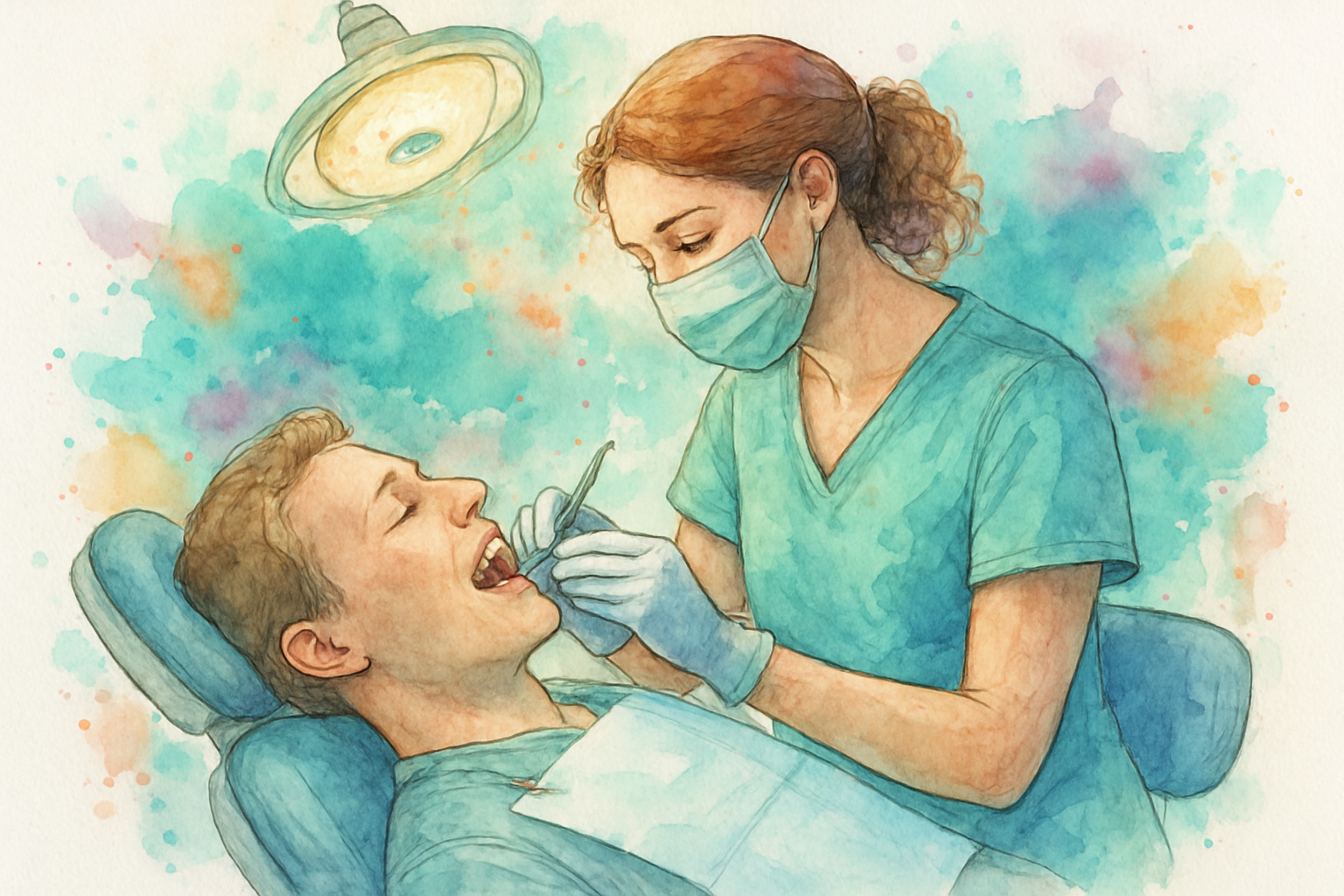
A lot of patients think a cleaning is just someone poking around and polishing their teeth. The actual process is more deliberate than that — and each step has a specific job.
Scaling is the first and most important part. Your hygienist uses a hand scaler or an ultrasonic tool to break up and remove tartar deposits from every surface of the tooth, including just below the gumline. This is what brushing cannot replicate.
Polishing comes next. A slightly gritty paste removes surface stains and smooths the enamel, which makes it harder for new plaque to stick. This is the part most people remember because of the gritty texture and mint taste.
Flossing at the end of a professional cleaning isn’t just a reminder to floss at home. The hygienist is clearing debris from between teeth and checking for areas where buildup tends to return.
And then there’s the exam — the part patients sometimes forget is connected. Dr. Kalvin reviews your X-rays, checks for early signs of cavities, evaluates gum pocket depth, and flags anything that needs attention before it becomes a bigger issue. You can read more about what that process looks like in our dental exams explained guide.
The whole appointment typically takes 45 to 60 minutes for a routine cleaning. Patients who haven’t been in for a year or more may need additional time.
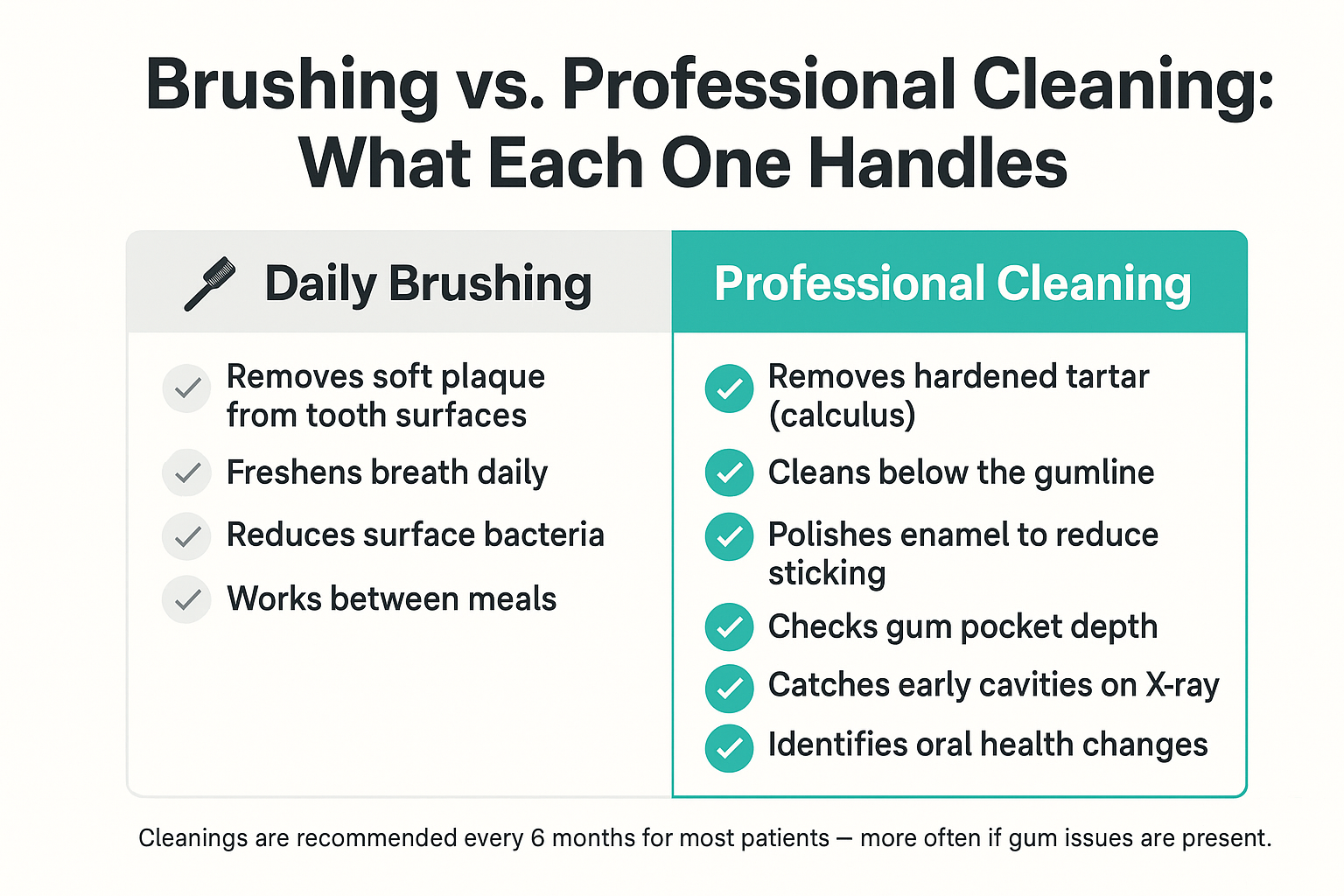
Brushing vs. Professional Cleaning: What Each One Actually Handles
This side-by-side breakdown shows exactly where brushing stops and professional cleaning picks up — so you can see why both matter.
The Real Cost of Skipping Cleanings
We understand why people put off dental appointments — cost, time, anxiety, or just the feeling that everything seems fine. But the math on skipping cleanings rarely works out in the patient’s favor.
A routine cleaning and exam in the Huntington Beach area typically runs $100 to $200 out of pocket, depending on whether you have insurance. With insurance, most plans cover two cleanings per year at 100% — meaning the visit costs you nothing.
Compare that to what tartar buildup eventually leads to:
- Gingivitis — early gum inflammation that’s reversible with a cleaning, but requires more work the longer it sits
- Periodontitis — advanced gum disease that may need a deep cleaning (scaling and root planing), which runs $200 to $400 per quadrant without insurance
- Cavities that were missed early — fillings start around $150 to $300 per tooth; if the decay reaches the nerve, you’re looking at a root canal and crown, which can run $1,500 to $2,500
None of this is meant to alarm anyone. But the pattern is consistent: patients who come in twice a year spend far less over five or ten years than patients who only come in when something hurts.
For patients without insurance, we offer an in-house savings plan that covers cleanings and exams at a reduced rate — so cost alone doesn’t have to be the reason to wait.
What Skipping Cleanings Can Lead To — and What It Costs
This is a realistic look at how dental costs escalate when routine cleanings are skipped. These are typical out-of-pocket ranges for the Huntington Beach and Orange County area.
| Issue | How It Develops | Typical Cost to Treat |
|---|---|---|
| Tartar buildup | Forms within 72 hours if plaque isn’t removed | $0 — removed at routine cleaning |
| Gingivitis | Tartar irritates gums over weeks to months | $100–$200 (cleaning + exam) |
| Early cavity | Missed on X-ray if no recent exam | $150–$300 per filling |
| Periodontitis (gum disease) | Untreated gingivitis over 1–2+ years | $800–$1,600+ (deep cleaning, all quadrants) |
| Root canal + crown | Decay reaches the tooth nerve | $1,500–$2,500 per tooth |
| Tooth extraction | Tooth becomes unsalvageable | $150–$350+ (simple); more for surgical |
How Often Do You Actually Need to Come In?
The standard recommendation is every 6 months, and for most healthy adults with no active gum issues, that holds true. Two visits a year gives your hygienist enough touch points to catch changes early and keep tartar from accumulating.
But not everyone fits the same schedule. Some patients genuinely benefit from coming in every 3 to 4 months — particularly those who:
- Have a history of gum disease or deep cleanings
- Smoke or use tobacco products
- Have diabetes or other conditions that affect gum health
- Are undergoing orthodontic treatment, including clear aligners
- Tend to build tartar faster than average (this is genetic for some people)
On the other side, patients with consistently healthy gums and low cavity risk may eventually move to a longer interval — but that’s a conversation to have with Dr. Kalvin based on your actual chart, not a self-diagnosis.
For families in Huntington Beach managing multiple schedules — school, sports, work — it can help to book your whole family’s cleanings on the same day. We see patients of all ages, from young kids to grandparents, and a single family dental practice makes that coordination a lot easier.
Frequently Asked Questions About Dental Cleanings
Does a cleaning hurt?
For most patients, a routine cleaning is uncomfortable at most — not painful. If your gums are inflamed from tartar buildup, you may feel some sensitivity during scaling, especially near the gumline. But we go at your pace. If something is bothering you, say so. We adjust.
My teeth feel fine. Can I skip this year’s cleaning?
Tooth decay and gum disease are almost always painless in their early stages. By the time something hurts, the problem is usually well past the easy fix. A cleaning isn’t just a polish — it’s also the exam that catches things before they become expensive.
I haven’t been to the dentist in a few years. Will I be judged?
No. We see this regularly and we don’t make it awkward. People skip dental care for all kinds of reasons — cost, anxiety, life getting in the way. Our job is to get your mouth healthy from wherever it is right now, not to lecture you about where it’s been.
Does my insurance really cover two cleanings a year at 100%?
Most PPO dental plans do cover two preventive cleanings per year at 100%, meaning no copay. But every plan is different. Call your insurance company directly and ask: ‘What is my coverage for a routine prophylaxis and exam?’ We can also help verify your benefits when you schedule.
What if I don’t have insurance?
We offer an in-house membership plan that includes two cleanings and exams per year at a significantly reduced rate, plus discounts on other treatments. It’s designed specifically for patients without insurance who want consistent care without the sticker shock. Ask us about it when you call.
My child brushes well — do they still need cleanings?
Yes — and kids actually tend to accumulate tartar in different spots than adults, especially around back molars. Cleanings also give us the chance to apply fluoride treatments and sealants that protect those molars from decay during the cavity-prone years. Starting early builds the habit too.
Ready to Get Back on Track with Your Dental Health?
Whether you came in six months ago or six years ago, we’re here to help you move forward without judgment. Our team at Kali Dental in Huntington Beach — serving families across Oak View, Goldenwest, Bolsa Chica-Heil, and surrounding communities — is ready to get you scheduled for a cleaning and exam that’s comfortable, thorough, and straightforward. Call us at (657) 800-5254 or book your appointment online at kalidental.com — we’d love to see you.