
Direct Answer: Brushing removes soft plaque, but tartar hardens within 48 hours and can only be removed with professional tools. That buildup causes gum disease and cavities that brushing alone cannot prevent.
You brush in the morning, you brush at night, maybe you even floss most nights. And then you sit down at a cleaning and somehow there’s still buildup, still a lecture about your gum line, still something that needs attention. It feels like the rules aren’t adding up.
For families in Huntington Beach — from Huntington Harbour to Oak View — this is one of the most common questions we hear. If daily brushing is doing its job, why does a professional cleaning uncover problems that weren’t there six months ago?
The honest answer has nothing to do with how hard you’re trying. It comes down to what a toothbrush is actually capable of — and what it simply isn’t built to do.
What Your Toothbrush Actually Does (and Doesn’t Do)
A toothbrush is good at one thing: removing soft plaque from the surfaces it can reach. Plaque is a sticky film of bacteria that forms constantly on your teeth, and yes — brushing removes it.
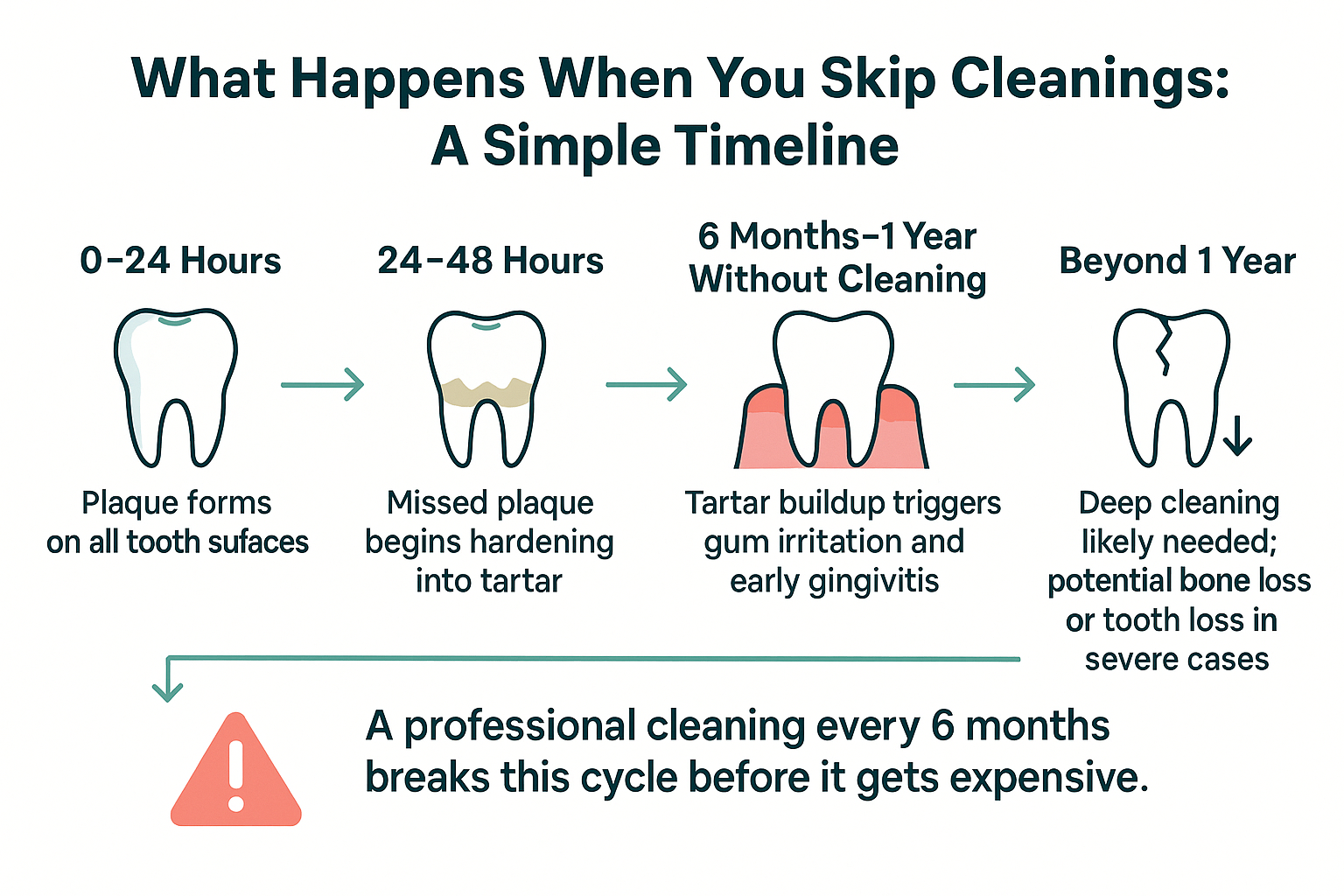
But here’s what most people don’t know. Within 24 to 48 hours, any plaque that your brush misses starts to mineralize. It bonds with calcium in your saliva and hardens into tartar — also called calculus — and once that happens, no toothbrush on earth can break it loose.
The places your brush misses most often are not random. They tend to be the same spots every time:
- The gumline, especially on the back of lower front teeth
- Between teeth where bristles can’t fully reach
- Around the edges of older fillings or crowns
- The back surfaces of your upper and lower molars
Over time, tartar accumulates in these exact spots. It creates a rough surface that attracts even more bacteria, which is why gum inflammation — the kind that leads to bleeding gums during a cleaning — tends to cluster in predictable places rather than spreading evenly.
Why Tartar Is the Real Problem — Not Your Brushing Habits
Tartar is not just cosmetically unpleasant. It actively drives two of the most common dental problems we treat: gum disease and cavities.
The bacteria living inside tartar produce acids that eat into enamel and irritate the gum tissue right where it meets the tooth. Left alone, that irritation becomes gingivitis. Left longer, gingivitis becomes periodontitis — a deeper infection that affects the bone holding your teeth in place. At that stage, a standard cleaning isn’t enough anymore. Patients end up needing a deep dental cleaning to clear the infection from below the gumline — and that’s a longer, more involved procedure than a regular visit.
For a lot of Huntington Beach patients — especially working adults who put off appointments for a year or two — this is exactly how routine situations become expensive ones. A cleaning that would have cost $100–$150 under a basic plan becomes a deep cleaning at $300–$500 per quadrant.
The math strongly favors showing up twice a year.
What Happens When You Skip Cleanings: A Timeline
This infographic shows how quickly plaque and tartar progression can move from a minor nuisance to a serious dental problem — and what stage each phase typically requires in terms of treatment.
What a Professional Cleaning Actually Does That Brushing Can’t
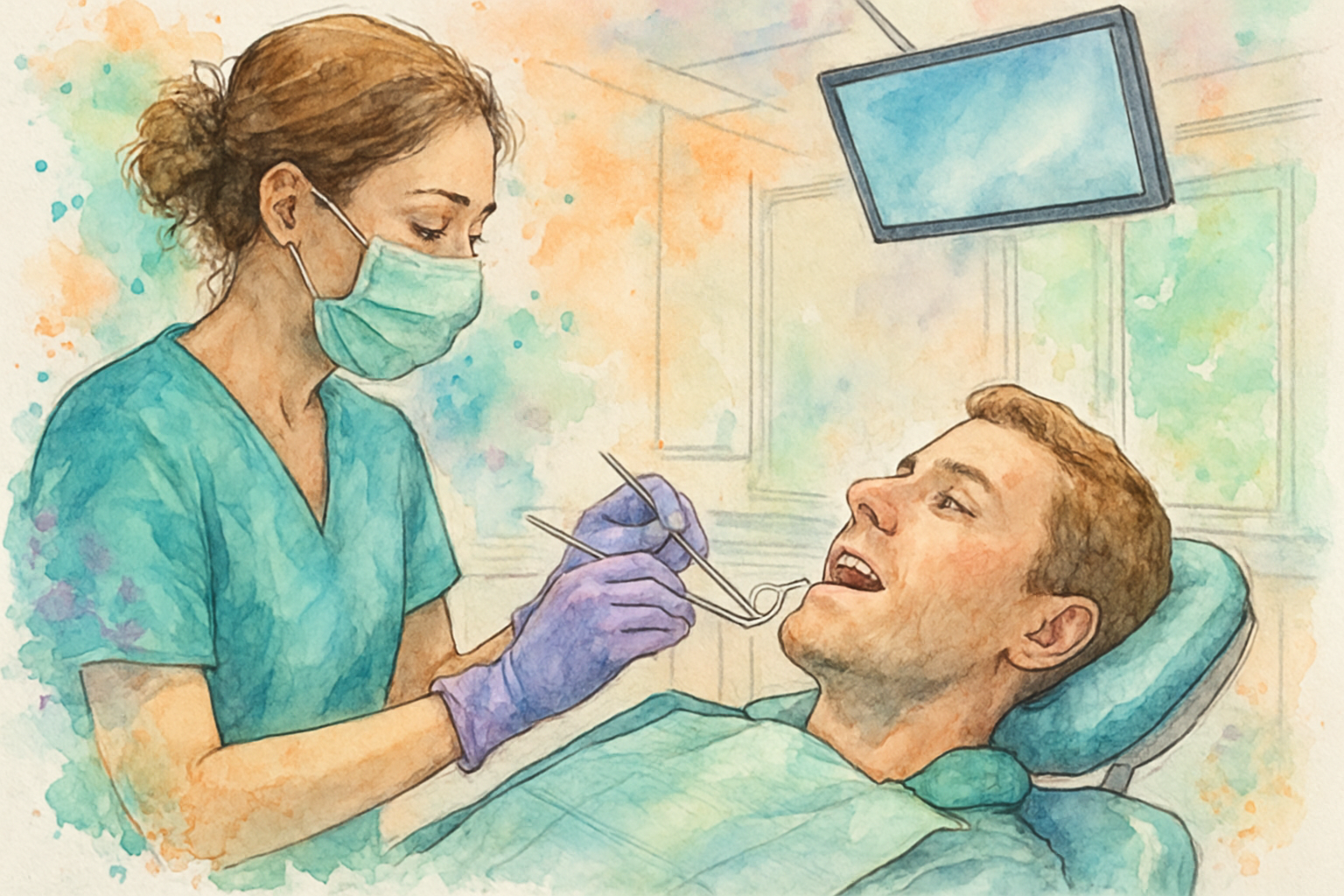
A professional cleaning isn’t just a more aggressive version of what you do at home. It’s a completely different process using instruments that can physically break tartar off the tooth surface without damaging the enamel underneath.
Here’s what actually happens during a standard cleaning appointment:
- A hygienist uses a scaler — a curved metal tool — to carefully chip away hardened tartar from the tooth surface and just below the gumline
- Ultrasonic scaling tools vibrate at frequencies that loosen tartar without scraping, which is more comfortable and faster on heavy buildup
- Polishing paste removes surface stains and smooths the tooth surface so plaque has fewer rough edges to cling to
- A thorough exam with Dr. Kalvin follows to look for early-stage cavities, gum pocket depth, and anything that warrants a closer look
The exam portion matters more than most patients realize. Many problems — a small cavity forming between two teeth, a hairline crack in a molar, early gum recession — have no symptoms at the early stage. By the time they hurt, the repair is almost always more involved. Our dental exams are specifically designed to catch problems while they’re still small and manageable.
Brushing vs. Professional Cleanings: What Each One Actually Handles
Both brushing and professional cleanings are necessary — they just do different jobs. Here’s a clear look at what each one is actually built to handle.
| Task | Daily Brushing | Professional Cleaning |
|---|---|---|
| Removing soft plaque from tooth surfaces | Yes | Yes |
| Removing hardened tartar | No | Yes |
| Cleaning between teeth | Partial (with floss) | Yes |
| Cleaning below the gumline | No | Yes |
| Polishing and stain removal | Mild | Deep |
| Checking for cavities and cracks | No | Yes — with Dr. Kalvin |
| Measuring gum pocket depth | No | Yes |
| Recommended frequency | Twice daily | Every 6 months |
The Uninsured Patient Question: Is a Cleaning Worth It Without Insurance?
A lot of families in Goldenwest and Central Huntington Beach skip cleanings because they don’t have dental insurance and assume it’s too expensive to justify. We hear this all the time, and it’s worth addressing directly.
In Orange County, a routine cleaning and exam without insurance typically runs $150–$250 at most private practices. That’s real money, and we understand why people weigh it against other expenses.
But consider what the alternative usually leads to. A cavity caught early costs $150–$250 to fill. A cavity left until it reaches the nerve needs a root canal — easily $900–$1,500 — and often a crown on top of that. A tooth lost to untreated gum disease runs $3,000–$5,000 to replace with an implant. The cleaning was never the expensive option.
For patients without insurance, we offer an in-house savings plan that makes regular preventive care genuinely affordable — no waiting periods, no claim denials, no annual maximums to decipher. If you’ve been avoiding coming in because of cost, it’s worth learning what affordable dental care actually looks like in Huntington Beach before assuming it’s out of reach.
Frequently Asked Questions About Dental Cleanings
How often do I actually need a professional cleaning?
For most adults and children, every 6 months is the standard recommendation. But if you’ve had gum disease in the past, or if your gum pockets are deeper than normal, Dr. Kalvin may recommend every 3 to 4 months to stay ahead of bacteria building back up below the gumline. Your cleaning schedule should be based on your actual mouth, not just a calendar.
My teeth don’t hurt and my gums don’t bleed — do I still need to come in?
Yes — and that’s actually the best time to come in. Most early-stage problems don’t cause pain. Cavities between teeth, early gum recession, and small cracks are often completely silent until they get big enough to cause real damage. No pain doesn’t mean no problem.
Why do my gums bleed during a cleaning if I brush every day?
Bleeding usually means the gum tissue is inflamed, which is almost always caused by bacteria living in tartar that brushing can’t reach. The bleeding isn’t from the cleaning itself damaging tissue — it’s from inflamed gums reacting to contact. Most patients who come in regularly see their gum bleeding improve significantly between visits as the irritant is removed.
Can I just get a cleaning without the exam?
We always do both together. A cleaning without an exam means no one is checking for new cavities, gum problems, or early signs of anything more serious. Skipping the exam to save time would actually cost you more in the long run.
I haven’t been to the dentist in a few years. Will I need a deep cleaning instead of a regular one?
Maybe — but not automatically. Dr. Kalvin will measure your gum pocket depth at your first visit to determine what kind of cleaning you actually need. If pockets are shallow and tartar is above the gumline, a standard cleaning may still be appropriate. If pockets are deeper than 4 millimeters and there’s buildup below the gumline, a deep cleaning may be the right first step. We’ll explain exactly what we find and why before anything happens.
Do kids need professional cleanings too?
Absolutely. Kids are actually more prone to cavities than adults because their enamel is thinner and their brushing technique is less precise. Baby teeth matter — they hold space for adult teeth and affect how kids eat and speak. We see pediatric patients right alongside adults, and we make the visits easy for kids who are nervous about the chair.
Ready to Get Back on Track?
If it’s been more than six months — or a few years — since your last cleaning, our team at Kali Dental in Huntington Beach is ready to meet you where you are, no judgment. We serve families across Orange County, from Bolsa Chica-Heil to Fountain Valley, and we make it easy to get started whether you have insurance or not. Call us at (657) 800-5254 or book an appointment anytime at kalidental.com.