
Quick Answer
Nighttime teeth grinding, also called sleep bruxism, is often linked to stress and anxiety, but it can also be connected to sleep apnea, certain medications, family history, and lifestyle habits that disrupt sleep. It’s common, often treatable, and worth evaluating early so you protect both your teeth and your sleep.
You may be reading this because you wake up with a tight jaw, a dull morning headache, or a partner has told you that you grind in your sleep. If so, you’re not overreacting. What causes teeth grinding at night is not always simple, and that’s exactly why it helps to break it down clearly.
I’m Dr. Kalvin, and I want to make this easier to understand. Nighttime grinding can come from stress, sleep issues, medications, and sometimes factors that run in families. The good news is that once you identify the pattern, the next steps usually feel much more manageable.
The Most Common Signs You Might Be Grinding Your Teeth
Before talking about causes, it helps to know what grinding looks and feels like in real life. Some people hear it from a spouse first. Others only notice the aftereffects when they wake up.

What you might notice in the morning
A lot of patients describe a pattern like this:
- Jaw soreness: Your cheeks or jaw muscles feel tired, tight, or tender when you first get up.
- Morning headaches: The pain is often around the temples or sides of the head.
- Tooth sensitivity: Teeth may feel irritated with cold drinks or cold air. If that sounds familiar, this guide on what causes tooth sensitivity to cold can help connect the dots.
- Neck tension: Clenching doesn’t always stay in the jaw. It can spill into the muscles around the neck and shoulders.
What a dentist may see
Sometimes people don’t feel much at all, but their teeth tell the story. Common findings include flattened chewing surfaces, small chips, worn edges, or enamel that looks polished down from repeated contact.
You might also see faint ridges or scalloped marks along the sides of your tongue, or notice that your teeth seem more fragile than they used to.
Practical rule: If you wake up with jaw tension more than once in a while, or your teeth are getting more sensitive without an obvious reason, it’s worth checking for grinding.
Why symptoms can be confusing
People often misunderstand. They assume grinding is always just a dental issue, so they buy a generic mouthguard and move on. Sometimes that protects the teeth. Sometimes it misses the bigger reason the grinding is happening.
That matters because nighttime grinding can be a clue, not just a habit. In some patients, it points to sleep disruption that deserves a closer look, especially if the person also snores, wakes often, or never feels rested.
Main Causes of Teeth Grinding at Night (Nocturnal Bruxism)
Nighttime grinding usually has more than one driver. In my Huntington Beach office, I often explain it like a smoke alarm going off at 2 a.m. The sound is the problem you notice, but the reason behind it might be stress, lighter sleep, medication effects, airway trouble, or the way the teeth and jaw are working together.
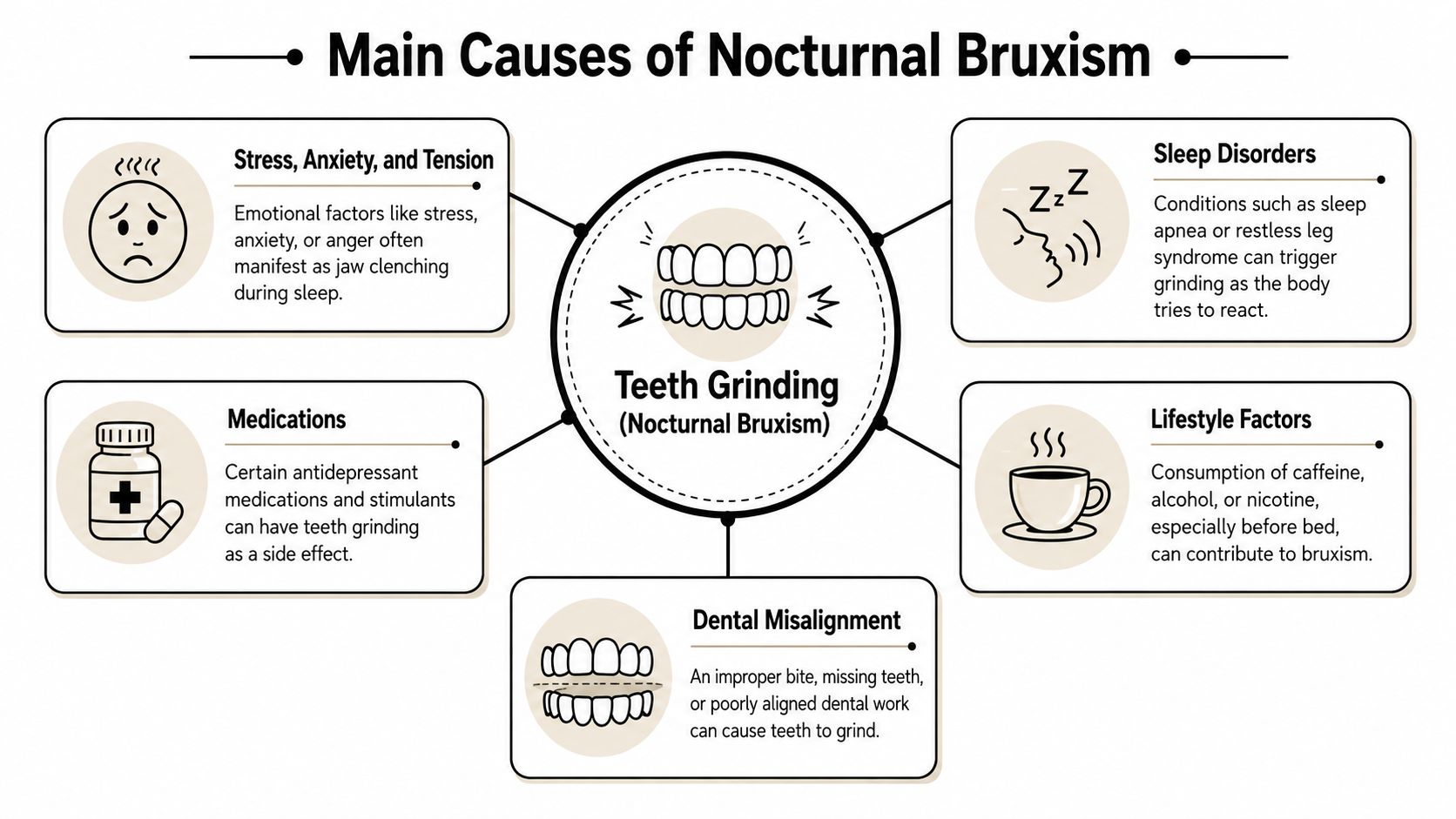
Stress, anxiety, and a keyed-up nervous system
Stress is one of the most common pieces of the puzzle. If your body stays on high alert during the day, that tension can show up in the jaw at night too. Some people clench while answering emails, driving, or concentrating. Sleep becomes another time when the same muscle pattern keeps going.
This part can confuse patients. They assume that if they are asleep, they should be fully relaxed. Sleep does not always work that way. A restless nervous system can keep firing in the background, and the jaw muscles may stay more active than they should.
Lifestyle habits that make sleep lighter
Grinding becomes more likely when sleep is broken up or less restorative. Caffeine later in the day, alcohol close to bedtime, and smoking can all make sleep more fragmented, which gives the jaw more chances to clench or grind.
One habit alone usually does not explain everything. More often, I see a stack of smaller factors. A stressful week, extra coffee, a couple of drinks at night, and poor sleep can create the right conditions for bruxism to flare up.
Medications, especially SSRIs
This is one of the most missed causes, and it deserves careful attention. Some medications can increase jaw clenching or grinding, especially certain antidepressants such as SSRIs. Patients are often surprised by this because the medicine may be helping their mood while subtly irritating the jaw muscles or changing sleep patterns.
If that sounds familiar, please do not stop a prescription on your own. The better next step is to tell both your dentist and prescribing physician when the grinding started and whether it changed after a medication was added or adjusted. That timing can be very helpful.
This is also where a bigger-picture approach matters. A mouthguard can protect enamel, but it does not explain why the grinding began. Your dentist should be asking about your medication list, not just your molars.
Family history and inherited tendency
Some people are more prone to bruxism. If you ground your teeth as a child and now your son or daughter does the same, that family pattern is useful information. Genetics do not guarantee that someone will grind, but they can lower the threshold, especially when stress or poor sleep gets added to the mix.
I describe it to families as a loaded backpack. Inherited tendency may put a few books inside. Stress, sleep disruption, and medication effects add more weight.
Bite changes and jaw mechanics
Bite problems are usually not the whole story, but they can still matter. A shifting tooth, missing teeth, uneven contacts, or a jaw that has to slide into position can make the chewing muscles work harder than they should. Over time, that extra strain can feed into clenching.
If you have noticed changes in how your teeth meet, or you are dealing with alignment issues such as an open bite that affects function and tooth contact, it is worth mentioning during an exam. The goal is not to blame the bite for everything. The goal is to see whether it is one contributor among several.
Why the cause is often missed
Patients sometimes hope for one simple answer. Bruxism rarely works that way. It is often a combination of nervous system tension, sleep disturbance, medication side effects, airway factors, and tooth or jaw mechanics.
That is why a careful dental evaluation matters. In my office, I want to know when the symptoms started, what your sleep is like, whether you snore, whether any medications changed recently, and what I see on the teeth and jaw muscles. That process helps us choose a treatment plan that fits the actual cause, instead of guessing.
The Critical Link Between Sleep Apnea and Teeth Grinding
This is one of the most important parts of the discussion because it changes how you think about treatment. Sometimes grinding isn’t just a problem to cushion. It’s a clue that the body is reacting to disrupted breathing during sleep.
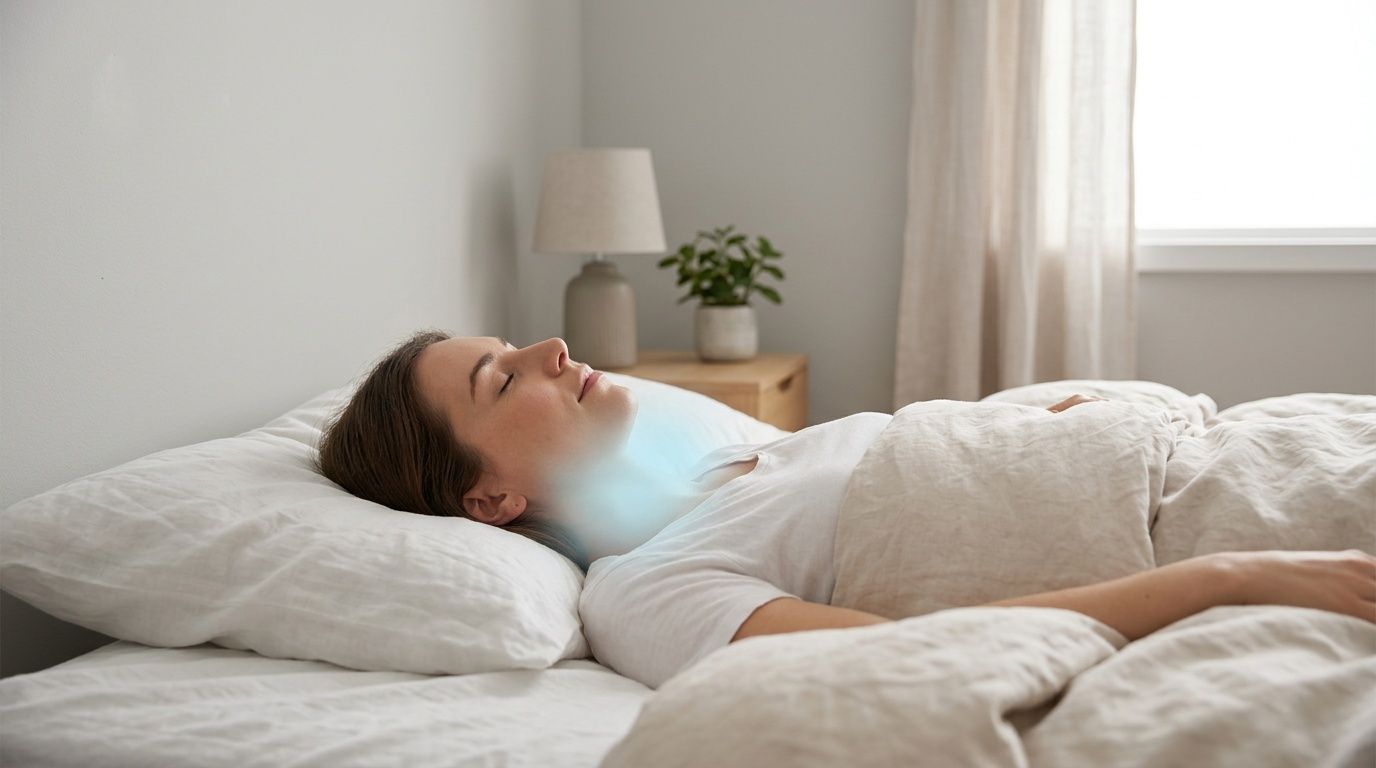
According to the Cleveland Clinic’s bruxism overview, grinding episodes are often preceded by increased brain and heart activity, which suggests they’re part of an arousal response. That’s one reason bruxism is strongly correlated with obstructive sleep apnea, and grinding may be the body’s attempt to restart breathing.
Why this confuses people
Patients often hear two messages that seem to clash. One is that sleep apnea and grinding are related. The other is that it’s still unclear exactly whether one directly causes the other in every case. Both can be true.
What matters for you as a patient is practical. If you grind, snore, wake with a dry mouth, feel unusually tired, or your sleep feels broken, it makes sense to consider whether an airway issue could be part of the picture.
Treating the symptom versus looking deeper
A mouthguard can protect the teeth from wear. That’s valuable. But a mouthguard does not diagnose why the grinding is happening.
Here’s a simple comparison:
| Approach | What it helps with | What it does not do |
|---|---|---|
| Store-bought guard | Adds a basic layer between upper and lower teeth | Doesn’t evaluate fit, bite balance, or root cause |
| Custom-fitted guard | Better comfort and more precise protection | Still may not address sleep apnea or stress by itself |
| Sleep evaluation | Looks for disrupted breathing or sleep fragmentation | Doesn’t replace dental protection if teeth are already wearing down |
If grinding is your body’s alarm bell, protecting the teeth is smart, but ignoring the alarm can leave the real problem untouched.
If sleep position is part of your nighttime struggle, this Golden Dreams Mattress sleep wellness guide offers practical ideas that may help support better rest while you seek professional guidance.
How Dr. Kalvin Diagnoses Nighttime Grinding in Huntington Beach
Individuals often anticipate a complicated workup. In reality, the process is usually calm, conversational, and noninvasive. The goal is to understand both the damage on the teeth and the pattern behind it.
The first part is a close exam
I start by looking for physical signs of grinding. That includes wear on the enamel, tiny fractures, flattened edges, irritated jaw muscles, and any signs that certain teeth are taking more force than they should.
If needed, digital X-rays or CBCT imaging can help us look more closely at the teeth, bone, and jaw structures. Those tools are useful when symptoms suggest the bite or jaw joint needs a deeper look.
The second part is the questions
The conversation matters just as much as the exam. I’ll ask about:
- Morning symptoms: Jaw pain, headaches, neck tension, or tooth sensitivity
- Sleep patterns: Snoring, frequent waking, poor sleep quality, or dry mouth
- Stress levels: Work pressure, family stress, or daytime clenching
- Medication changes: Especially antidepressants or other drugs that may affect muscle activity
- Dental history: Missing teeth, shifting teeth, or recent bite changes
Why that discussion helps
Two people can have the same worn teeth and need very different next steps. One patient may need a protective appliance and stress-management support. Another may need a conversation with their physician because the pattern points toward sleep-disordered breathing.
For families in Huntington Beach, this is especially helpful with children because kids may not explain jaw discomfort clearly. Parents often notice the sounds first, or they mention that the child sleeps restlessly.
A good diagnosis shouldn’t feel mysterious. You should leave understanding what we found, what we’re watching, and what your options are.
Evidence-Based Treatments to Protect Your Smile
The right treatment depends on why your teeth are grinding in the first place. I explain it to patients this way: a night guard can act like a helmet for your teeth, but a helmet does not explain why the crash is happening. Sometimes we need to protect the teeth. Sometimes we also need to calm overworked jaw muscles, improve sleep breathing, or coordinate with your physician if a medication may be part of the pattern.
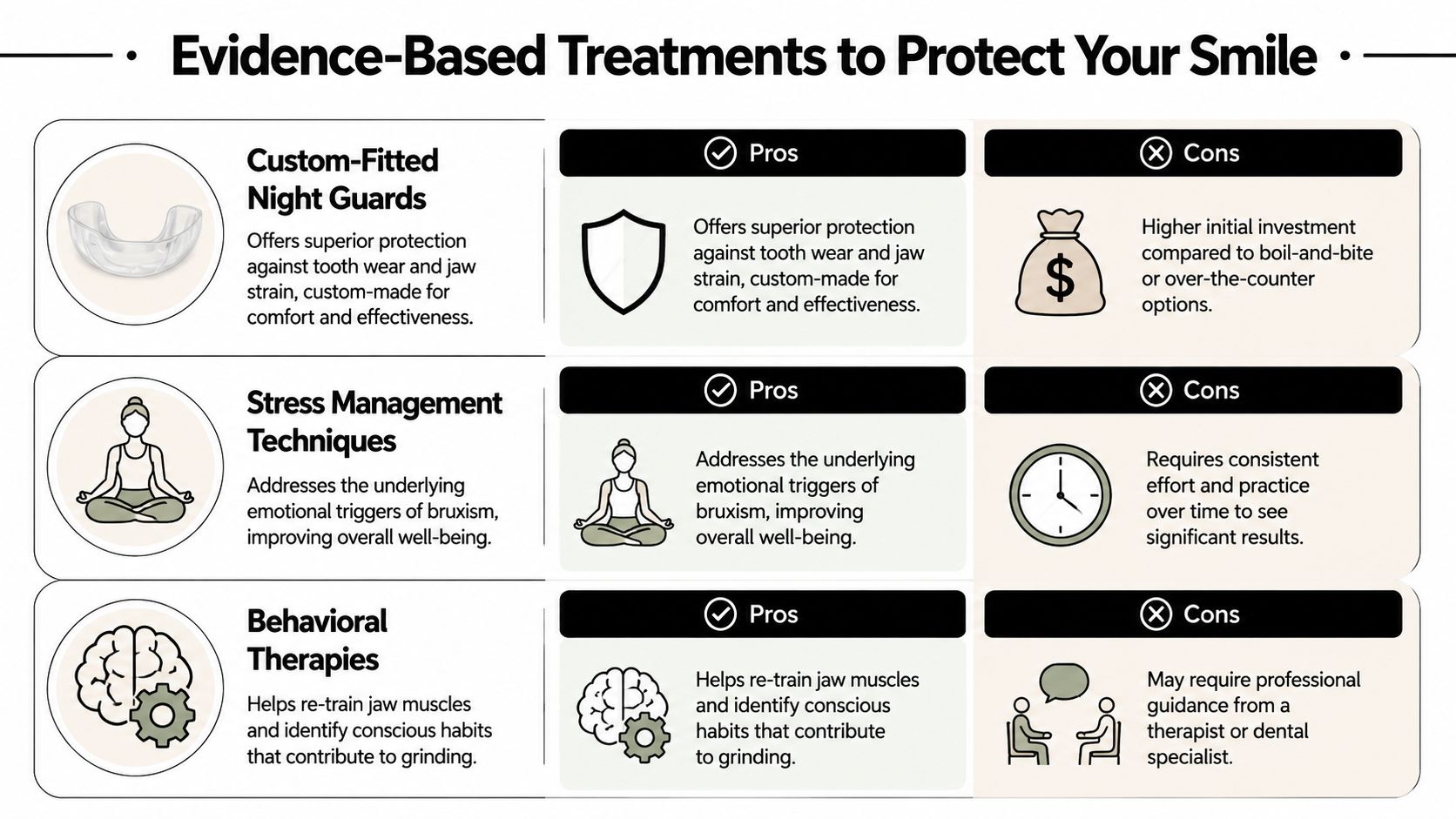
Custom-fitted night guards
A custom night guard is often the fastest way to reduce further wear. Because it is made for your bite, it usually feels more stable and less bulky than a store-bought version.
That fit matters more than many patients expect. If a guard shifts, feels thick, or makes it hard to close comfortably, people often stop using it after a few nights. A custom appliance gives you a better chance of wearing it consistently, which is what protects enamel, fillings, and cracked edges over time.
Stress reduction and daytime awareness
If tension is feeding the habit, treatment has to address the muscles and the nervous system too. That can include a more regular sleep routine, less caffeine or alcohol late in the day, and simple check-ins during work or traffic when you notice your teeth touching.
A relaxed jaw should have a little space between the upper and lower teeth. I often tell patients to let the lips close, keep the teeth apart, and rest the tongue lightly on the roof of the mouth. Small daytime changes can lower the load your jaw carries into the night.
Some patients also benefit from stretching, breathing exercises, or counseling support when anxiety is a major driver. For broader sleep habit ideas, this New Zealand Bed Company's sleep advice is a useful non-dental resource.
Medical review when the pattern points beyond the teeth
Bruxism is not always just a dental problem. If the history suggests poor sleep quality, snoring, frequent waking, or pauses in breathing, treatment may need to include a sleep evaluation. In those cases, grinding can be part of the body’s response to disrupted breathing, and protecting the teeth alone may leave the underlying trigger untouched.
As noted earlier, if grinding began after a prescription change, especially with an SSRI, collaboration is important. Do not stop a medication on your own. Bring your dentist and prescribing physician into the same conversation so changes can be considered safely and in context.
When damaged teeth need repair
Sometimes the first sign of heavy grinding is a broken filling, a chipped cusp, or a cracked tooth. Once a tooth has been damaged, we may need to restore it so you can chew comfortably and avoid more breakdown.
If you’ve already had a tooth break from heavy pressure, this explanation of what’s the difference between a crown and a bridge for broken teeth can help you understand common restorative options.
A simple way to compare the main options
| Treatment option | Best use | Limitation |
|---|---|---|
| Custom night guard | Protects teeth from wear and reduces direct grinding damage | Does not remove the underlying trigger |
| Stress-focused strategies | Helps when tension and daytime clenching are major drivers | Works best with steady practice |
| Medical evaluation for sleep or medication issues | Helps identify root causes such as sleep-disordered breathing or prescription-related grinding | May involve care from another provider |
| Dental repair | Restores chipped, worn, or broken teeth | Protects function, but future damage can continue if grinding is not addressed |
The strongest plan usually has two layers or more. We protect your teeth while we work on the reason the grinding is happening. That approach is how I help Huntington Beach patients protect their smiles without turning the process into a mystery.
Frequently Asked Questions About Teeth Grinding
Do I really need a custom night guard or is a store-bought one okay?
A store-bought guard may give you temporary protection, but it won’t be specifically made for your bite. A custom guard is usually more comfortable, more stable, and better suited for long-term wear. If your grinding is strong or you already have worn teeth, custom protection is often the better choice.
Can teeth grinding go away on its own?
Sometimes it improves when the trigger settles down, especially if stress, sleep disruption, or a medication change is involved. But if you’re having pain, sensitivity, or visible wear, it’s risky to wait too long and hope it stops. The damage can continue without notice.
Is teeth grinding in children normal?
Grinding is more common in children than in adults, but that doesn’t mean it should always be ignored. If your child grinds loudly, complains of jaw pain, sleeps poorly, or seems tired during the day, it’s worth bringing up during a dental visit.
How do I know if my medication is causing the grinding?
The timing is often the clue. If clenching or jaw pain started after beginning or changing a medication, especially an antidepressant, mention that pattern to both your dentist and prescribing doctor. Don’t stop the medication on your own.
Will insurance cover treatment for nighttime grinding?
Coverage depends on your specific plan and on what treatment is needed. The best approach is to call the office and review your benefits and options before you start. That helps avoid surprises and gives you a clearer picture of what to expect.
What if I wake up with severe pain or a cracked tooth at night?
Grinding can sometimes lead to broken teeth or sudden pain. If that happens, follow the guidance in this page on what to do if you have a dental emergency at night and arrange prompt care.
Take the First Step Toward a More Restful Night
You wake up tired, your jaw feels tight, and you are left wondering whether this is just stress or something more. That uncertainty is often the hardest part.
Understanding what causes teeth grinding at night helps turn a vague worry into a clear plan. As Dr. Kalvin, I want patients to know that nighttime grinding is often connected to more than the teeth alone. In some people, the pattern points to stress or jaw tension. In others, it can be tied to airway problems during sleep, or even to medications such as SSRIs. That is why a careful evaluation matters. We are not just looking for worn enamel. We are looking for the reason your body is grinding in the first place.
A diagnosis usually begins. We talk through your symptoms, sleep habits, health history, and any recent medication changes, then examine your teeth, bite, and jaw muscles. That process often brings relief on its own because the problem starts to make sense. Preventive care also matters, and this overview of what preventive dentistry means for long-term smile health in Huntington Beach explains why early attention can save trouble later.
If you live in Huntington Beach or nearby Orange County, you do not have to sort this out alone.
If you’d like a clear, low-pressure evaluation, Kali Dental offers comfort-first care and a personalized dental experience for families and adults in Huntington Beach. Call (657) 800-5254, visit 19201 Brookhurst Street, Suite 103, Huntington Beach, CA, or learn more at kalidental.com. Office hours are Monday through Friday 9:00 AM to 6:00 PM and Saturday 8:00 AM to 2:00 PM.