
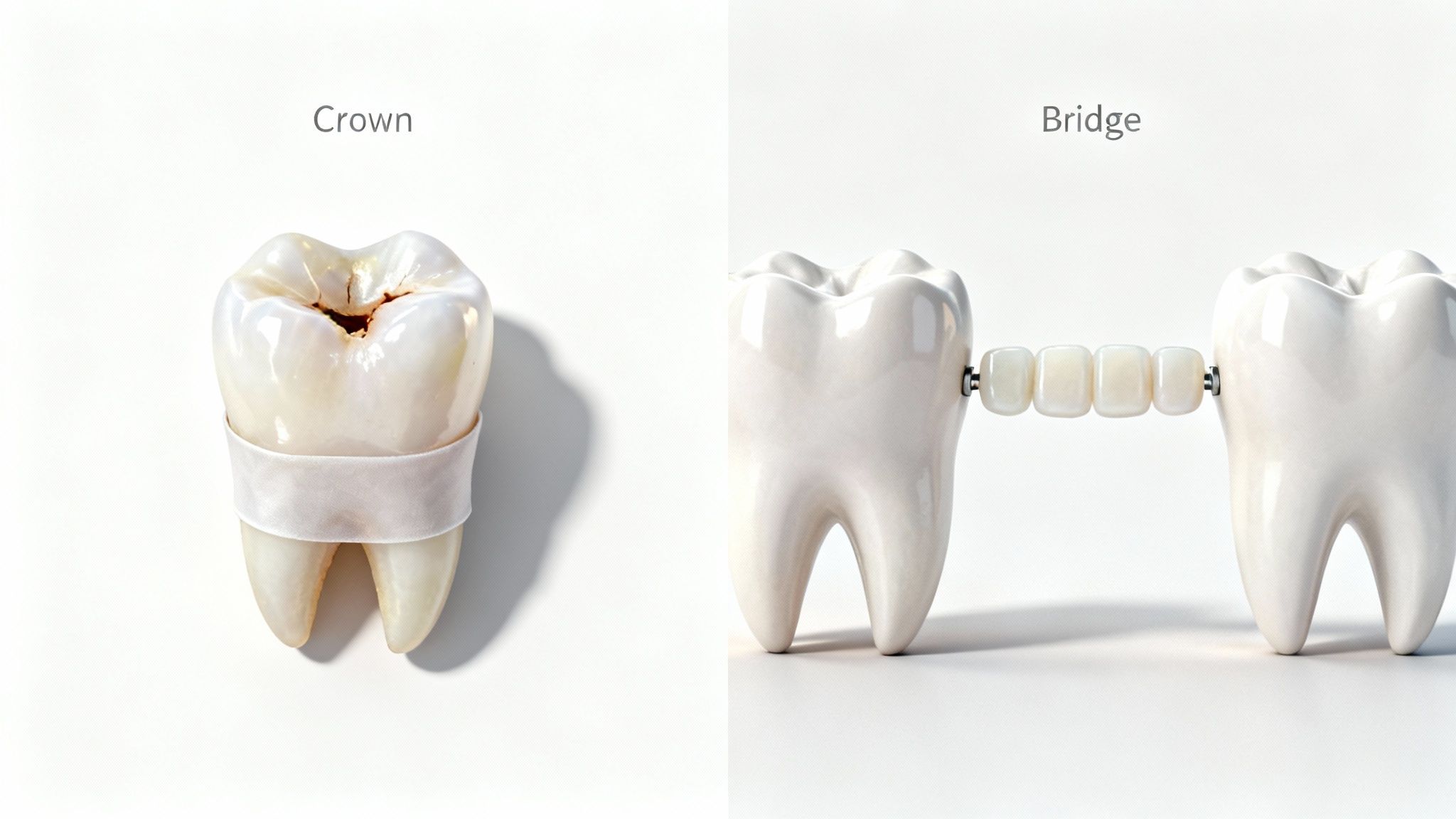
When you’ve got a broken tooth, the decision boils down to one simple question: can we save the tooth, or do we need to replace it? A dental crown is our go-to for saving a single, damaged tooth—think of it as a custom-fitted helmet that restores strength and function.
On the other hand, a dental bridge literally "bridges" a gap left by one or more completely missing teeth, using the neighboring teeth as anchors.
Crowns vs. Bridges: Answering the Real Question
When people ask, "crown or bridge?" they’re usually worried about more than just the treatment—they’re worried about cost. Many patients aren’t sure if they’re being upsold or if choosing the wrong option now will cost them more later, especially without insurance.
This cost anxiety is a major reason people delay dental care. Recent industry data shows that over 1 in 4 adults lack dental insurance, making cost a significant barrier to treatment.
When treatment is delayed, patients often end up needing more complex and expensive procedures, turning a manageable fix into a major bill.
Why Choosing the "Cheapest" Option Can Cost More
A common misstep is choosing a treatment based only on the lowest upfront price—or avoiding treatment altogether. For example, skipping a recommended crown to “save money” can lead to tooth loss.
This often results in higher long-term costs, not savings. The smarter approach is to choose the option that preserves as much of your natural tooth as possible and prevents future damage.
The Right Choice for Your Smile and Wallet
The best choice is the one that prevents shifting, bone loss, or further damage, reducing the chance of needing emergency or repeat treatment.
In many cases:
- Crowns are ideal for damaged but salvageable teeth.
- Bridges are used when a tooth is already missing.
The “cheapest” option depends on your current tooth condition, not a generic price list.
At Kali Dental, Dr. Kalvin Nguyen provides transparent treatment explanations, so you understand exactly why a crown or bridge is recommended—without pressure. We also offer affordability-first planning with flexible financing and in-house savings options, designed for patients without insurance.
If you’re in Huntington Beach and trying to decide between a dental crown or bridge—especially on a budget—we can walk you through both options clearly. For urgent situations, learn more about our emergency dental care services.
Understanding the Role of a Dental Crown
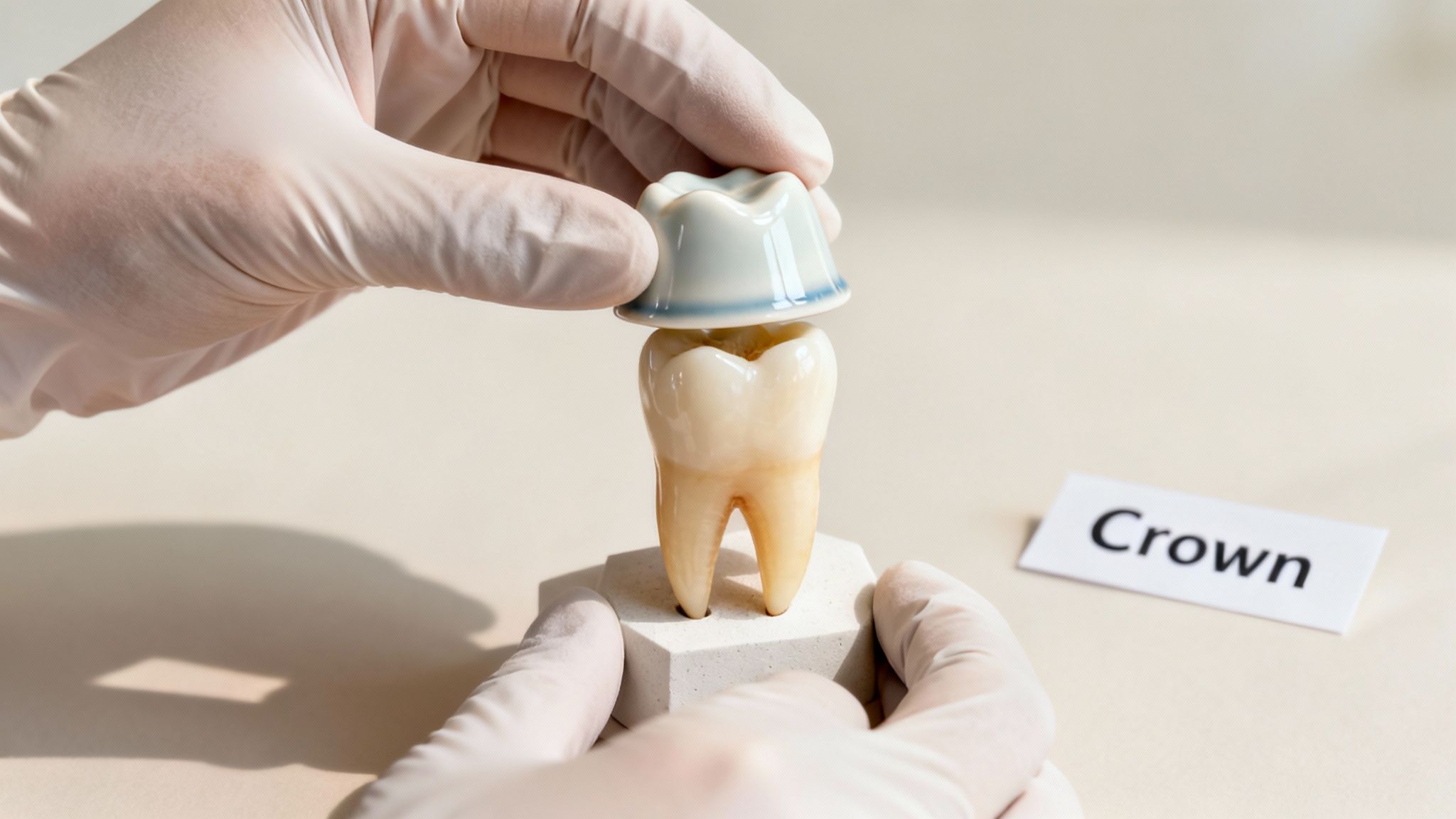
When a tooth is damaged but the root system is still solid, our first instinct is always to save it. That's where a dental crown comes in. Think of it as a custom-made helmet that fits snugly over the entire visible part of a tooth.
This "cap" restores the tooth's original shape, strength, and appearance. It shields the tooth from chewing forces that could cause it to break further. You can learn more about dental crowns and their specific applications.
When Is a Dental Crown the Right Choice?
A crown is often the hero of restorative dentistry, saving natural teeth for our Huntington Beach patients every day.
Dr. Kalvin Nguyen will likely suggest a crown to:
- Repair a Severely Cracked or Fractured Tooth: A crown holds fractured pieces together and stops a crack from spreading.
- Protect a Tooth After a Root Canal: A tooth that’s had a root canal can become brittle, and a crown provides needed reinforcement.
- Restore a Tooth with a Large, Failing Filling: When an old filling is too large, the tooth structure becomes weak. A crown provides a durable solution.
- Fix a Tooth Worn Down by Grinding: For patients with bruxism, crowns can rebuild worn-down teeth to their proper height.
The Crown Placement Process Explained
Getting a crown is a straightforward process that we typically complete over two visits to our Huntington Beach office.
Visit 1: Preparation and Temporary Crown
First, Dr. Nguyen will numb the area so you won't feel a thing. He then carefully reshapes the tooth to create a stable base for the crown.
We’ll then take a super-accurate digital impression of your tooth. This scan goes to a specialized lab where your permanent crown is crafted. You’ll leave with a temporary crown in place.
Visit 2: Placing Your Permanent Crown
A couple of weeks later, you’ll come in for your final appointment. We’ll remove the temporary and test the fit and color of your new permanent crown.
Dr. Nguyen will make any tiny adjustments needed before permanently bonding the crown into place. It’s a key part of our high-quality restorative dentistry in Huntington Beach.
When a Dental Bridge Is the Right Solution
While a crown is all about saving a damaged tooth, a dental bridge steps in when a tooth is already gone. Its purpose is entirely different: to fill the gap left by one or more missing teeth.
A traditional bridge uses the two healthy teeth on either side of the gap as anchors. These are called abutment teeth. We place crowns on these teeth, and they hold a false tooth—the pontic—in the middle, "bridging" the gap.
How a Dental Bridge Restores Your Smile
Leaving a gap in your mouth isn't just a cosmetic issue. When a tooth is missing, neighboring teeth can start to tilt and drift into the open space. This can throw your bite off and lead to jaw strain.
A professionally crafted bridge is essential for a few key reasons:
- Restores your bite and distributes chewing forces properly.
- Maintains alignment by stopping other teeth from shifting.
- Supports your facial structure by filling out your lips and cheeks.
- Completes your smile for renewed confidence.
The Multi-Visit Bridge Procedure
Getting a dental bridge is a precise process that usually takes two visits to our Huntington Beach office.
On your first visit, Dr. Nguyen will prepare the abutment teeth by carefully reshaping them. Then, we’ll take a highly accurate digital impression to send to a dental lab. You’ll go home with a temporary bridge.
About two weeks later, you’ll come back for the final step. Dr. Nguyen will meticulously check the fit, color, and bite of your new permanent bridge before bonding it in place.
Are There Different Types of Bridges?
Absolutely. The traditional bridge is the most common, but we have other designs for specific situations. The right type of bridge depends on where the gap is and the condition of the teeth next to it.
Here are a couple of other common types:
- Cantilever Bridge: This is an option when you only have a healthy tooth on one side of the gap.
- Maryland Bridge: A more conservative choice, this bridge uses a framework that is bonded to the back of the neighboring teeth.
Each design has its place. Here in Huntington Beach, Dr. Nguyen will always explain the best options for your unique situation.
Crowns vs. Bridges: A Head-to-Head Comparison
Choosing between a dental crown and a bridge will have a lasting impact on your oral health. Let's compare them on the factors that matter most to our Huntington Beach patients.
How They Affect Your Other Teeth
The biggest difference is how each option treats the teeth next to the problem area.
A dental crown is a solo act. It is designed to cover and protect a single damaged tooth without affecting its neighbors.
A dental bridge, on the other hand, requires us to reshape the two healthy teeth on either side of the gap. This means we must intentionally alter perfectly healthy tooth structure.
The Daily Grind: Oral Hygiene and Care
Keeping a crown clean is easy. You just brush and floss around it like you would any of your other teeth. No special instructions are needed.
A bridge is a different story. Because the replacement tooth is fused to the crowns next to it, you can't floss between them in the usual way.
To keep a bridge clean, you'll need a few extra tools:
- Floss Threaders: To help you thread floss underneath the bridge.
- Interproximal Brushes: For cleaning tight spaces.
- Water Flossers: To flush out anything that gets trapped.
This extra daily step is non-negotiable to prevent decay on the supporting teeth.
Durability, Bone Health, and the Long Game
When we talk about long-term success, crowns generally have an excellent track record, with studies showing high success rates over 10 years. A bridge's lifespan is tied to the health of two other teeth, which introduces more variables.
There's also the unseen factor: jawbone health. When you lose a tooth, the jawbone underneath can start to shrink. A bridge sits on top of the gums and does nothing to stop this. A crown, however, saves the natural tooth root, which continues to stimulate the jawbone.
This simple decision tree highlights the core question: is there a tooth there or not?
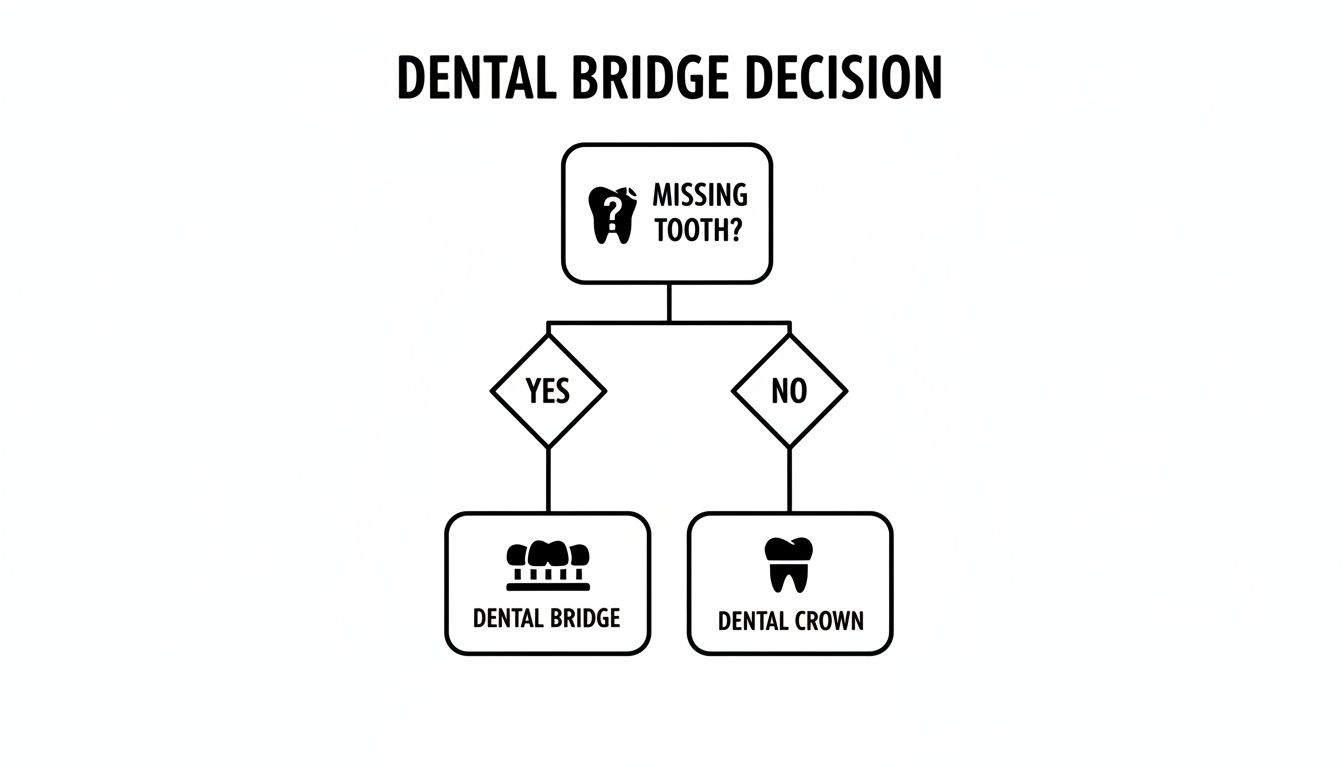
As you can see, if the tooth is still present but damaged, a crown is the go-to solution. If there's a gap, a bridge becomes one of the main options.
How Invasive Is the Procedure?
A crown procedure is less involved because we're only focused on preparing one tooth. You can learn more about the technologies that set Kali Dental apart, which can make the process even smoother.
A bridge procedure involves preparing at least two healthy teeth. It's a more extensive process that requires more time in the chair.
Navigating the Cost of Crowns vs Bridges
Sooner or later, the conversation about dental work always comes around to one thing: the cost. For our patients here in Huntington Beach, I know the price tag can be a source of anxiety, especially without dental insurance.
That hesitation is completely understandable. The biggest mistake, however, is when people compare the upfront cost of a crown to a bridge without looking at the bigger picture.
Why Upfront Price Is the Wrong Metric
Choosing a dental treatment based only on the lowest initial cost can lead to bigger problems. For instance, a patient might skip a crown on a cracked tooth, only to have that tooth fracture beyond repair a year later.
What could have been a simple fix now requires a more complex—and expensive—situation. Putting off a necessary procedure often leads to higher long-term costs, not savings.
Making a Smart Investment in Your Smile
A better approach is to think of this as an investment in your long-term health. The goal is to choose the treatment that preserves your natural teeth and prevents future damage.
Clinical studies show that for a single damaged tooth, a crown is a predictable and durable solution. They are also typically less expensive upfront and often have a lower total cost over a decade. You can read more about the success rates of different restorations to see the data.
Ultimately, the "cheapest" option depends entirely on your specific situation:
- Crowns are for when a tooth is damaged but savable.
- Bridges are for when a tooth is already gone.
Affordable Care Without Compromise
At Kali Dental, we get that figuring out treatment costs can be stressful. Dr. Kalvin Nguyen is committed to explaining why he recommends a certain treatment, without pressure.
That’s why we offer flexible financing and in-house savings plans designed to fit your budget, especially for our Huntington Beach neighbors without insurance. Check out our guide on how Kali Dental helps you save on quality dental care.
How to Choose the Right Option for Your Smile
Making the final call really boils down to your specific needs. The simplest way to think of it is: crowns save damaged teeth, while bridges replace missing ones.
Feeling confident about your choice starts with asking the right questions. A clear conversation with Dr. Nguyen will ensure the solution you pick protects your smile and fits your budget.
Your Decision-Making Checklist
When you come into our Huntington Beach office, bring these questions with you. They’ll help guide our conversation so you can feel good about the path you choose.
- Is my natural tooth strong enough to support a crown? If the root is healthy, a crown is almost always the best choice.
- How will a bridge affect the teeth next to the gap? It's important to understand that a bridge means permanently altering two healthy teeth.
- Which option is better for my long-term jawbone health? A bridge sits on top of the gums and doesn't stop the jawbone from shrinking.
- Are there any other alternatives I should consider? For a missing tooth, it's worth exploring all your options, like dental implants in Huntington Beach.
At Kali Dental, our job is to give you all the information you need, explained clearly and without pressure. If you’re in Huntington Beach and facing this decision, Dr. Kalvin Nguyen can walk you through every detail.
Frequently Asked Questions About Crowns and Bridges
We get it—you have questions. Here are clear, concise answers to some of the most common concerns we hear from our Huntington Beach patients.
Will getting a crown or bridge hurt?
No, the procedure itself is not painful. Dr. Nguyen will make sure the area is completely numb with local anesthetic before starting. You may feel some mild sensitivity for a few days afterward, but this is easily managed with over-the-counter pain relievers.
How long does the whole process take?
Getting a crown or bridge is typically a two-visit process. The first visit is for preparing the tooth and taking impressions. About two to three weeks later, you’ll return for your second visit to have your permanent, custom-made restoration placed.
Can a crowned tooth still get a cavity?
Yes, it can. While the crown material itself can't decay, the natural tooth underneath is still vulnerable, especially at the gumline where the crown meets the tooth. This is why excellent brushing and flossing are so important to maintain your restoration long-term.
What happens if I get a cavity under my bridge?
This is a more complex situation. If one of the anchor teeth holding the bridge gets a cavity, the entire bridge usually has to be removed to treat the decay. Depending on the damage, we may be able to place a new bridge after restoring the tooth.
Are dental implants a better option than a bridge?
For replacing a missing tooth, dental implants are often considered the gold standard. They don't require altering healthy adjacent teeth and they preserve jawbone health, which a bridge cannot do. We can discuss if an implant is the right choice for your specific needs and budget.
At Kali Dental, we believe that when you’re well-informed, you can make the best decisions for your health. If you still have questions about crowns, bridges, or anything else, we're here to provide clear, honest answers. Schedule a consultation with Dr. Kalvin Nguyen by visiting us at https://kalidental.com and let us help protect your smile.