
Direct Answer: A true dental emergency involves uncontrolled bleeding, severe trauma, or swelling that threatens your airway. A dental urgency is painful and needs prompt attention, but it can wait hours — not weeks.
It’s 9 p.m. on a Tuesday and your tooth is throbbing. You’re Googling whether you need to drive to an ER in Fountain Valley or if this is something that can wait until morning. Most people have no idea how to answer that question — and that uncertainty alone causes a lot of unnecessary stress.
There’s actually a meaningful distinction between what dentists call a dental urgency and a true dental emergency. One needs immediate medical attention, sometimes at a hospital. The other needs a dental appointment soon — but you’re not in danger tonight.
Understanding which category your situation falls into can save you a panic-driven ER bill that runs $500–$1,500 for something a dentist could have handled in the office the next day. This article breaks it down clearly so you know exactly what to do when something goes wrong with your teeth.
What Actually Counts as a True Dental Emergency
A true dental emergency is any situation where your life or long-term health is at immediate risk. These are situations where waiting until morning is genuinely dangerous — not just uncomfortable.
The clearest signs you’re dealing with a true emergency:
- Uncontrolled bleeding in the mouth that won’t stop after 10–15 minutes of firm pressure
- Severe facial swelling that is spreading toward your eye, throat, or neck — this can signal an abscess that has become a systemic infection
- Difficulty swallowing or breathing caused by swelling in the jaw or throat
- Significant facial trauma — a broken jaw, knocked-out teeth from an accident, or a deep laceration
- Signs of infection spreading systemically — fever above 101°F combined with swelling, difficulty opening your mouth, or feeling genuinely ill
In any of these cases, the right move is an emergency room or a call to 911. A dentist’s office, even one open late, is not equipped to manage a spreading infection that has moved into the neck or handle airway-related swelling.
For anything involving trauma to the face or jaw after a sports injury — something that happens a lot with the active beach lifestyle in Huntington Beach — the ER should be the first call to rule out fractures before any dental work begins.

What a Dental Urgency Actually Looks Like
A dental urgency is real pain that deserves real attention — just not necessarily tonight. These are the situations that feel alarming but are not immediately life-threatening, and that a dentist can address within 24–48 hours without putting you at risk.
Common dental urgencies include:
- A severe toothache with no visible swelling of the face or neck
- A cracked or broken tooth that isn’t bleeding heavily
- A lost filling or crown that is causing sensitivity or discomfort
- A tooth that was knocked loose but is still in the socket
- Mild to moderate swelling limited to the gum tissue around a tooth
- Sharp pain when biting down
If you’re wondering whether a toothache can wait until morning, the short answer is usually yes — as long as swelling isn’t spreading, you can breathe normally, and you don’t have a fever.
The goal is to manage the discomfort tonight and get into a dental office first thing the next morning. Over-the-counter options like ibuprofen (400–600mg every 6 hours with food) and clove oil applied directly to the area can take the edge off. Dental cement from a pharmacy can temporarily re-seat a lost crown. And home remedies for cavity pain can help bridge the gap when you’re waiting for an appointment.
Dental Urgency vs. True Emergency: A Quick Reference
Use this to figure out what kind of situation you’re dealing with — and what your next move should be.
| Symptom or Situation | Category | What to Do |
|---|---|---|
| Swelling spreading to neck or throat | True Emergency | Go to the ER now |
| Difficulty swallowing or breathing | True Emergency | Call 911 |
| Bleeding that won’t stop after 15 min | True Emergency | Go to the ER now |
| Fever above 101°F with jaw swelling | True Emergency | Go to the ER now |
| Severe toothache, no spreading swelling | Dental Urgency | Call dentist in the morning |
| Broken tooth, mild bleeding that stopped | Dental Urgency | Call dentist in the morning |
| Lost crown or filling, sensitivity | Dental Urgency | Call dentist next business day |
| Tooth knocked loose, still in socket | Dental Urgency | Call dentist first thing AM |
| Facial trauma, suspected jaw fracture | True Emergency | Go to the ER first |
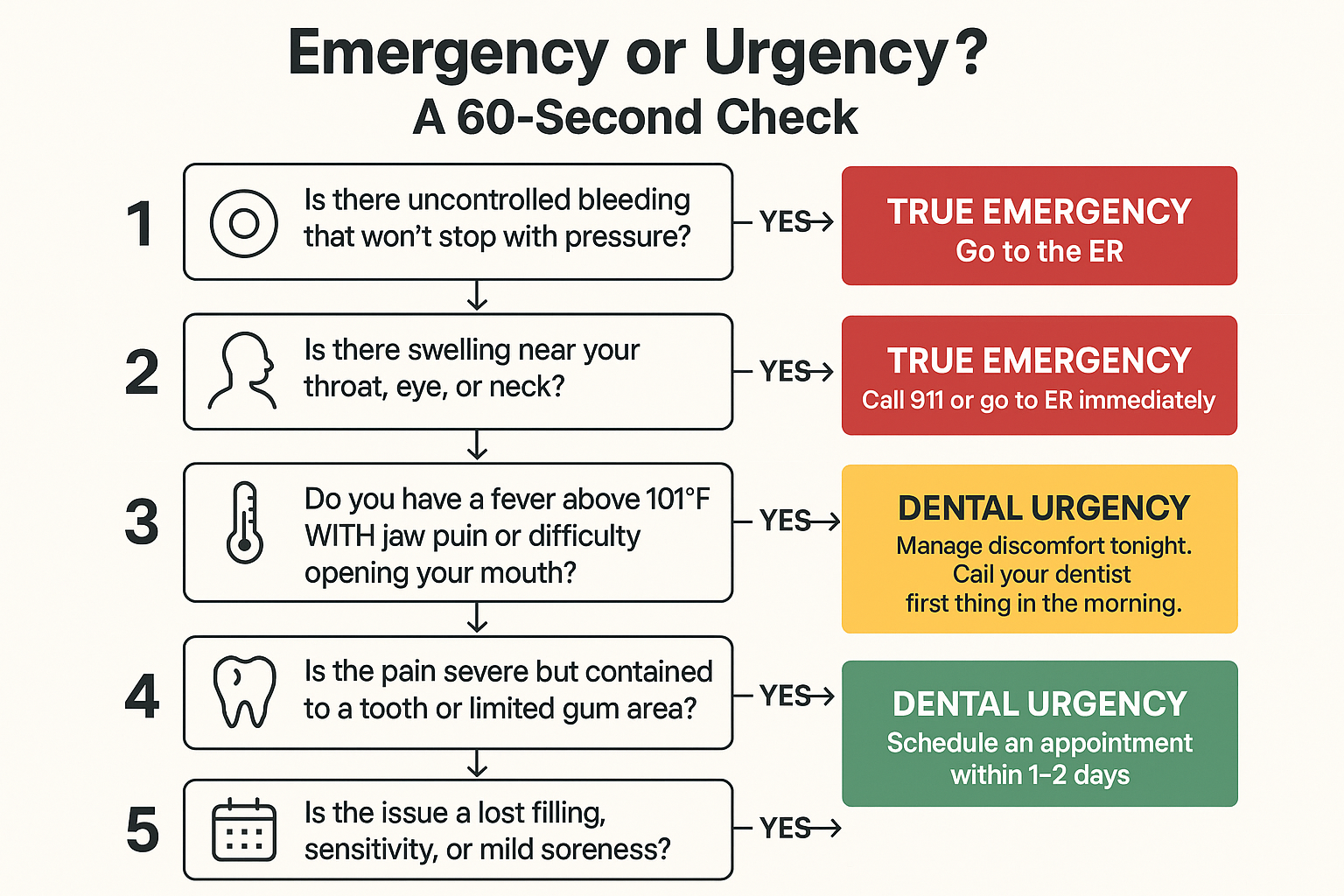
The 60-Second Test: Emergency or Urgency?
Run through these checkpoints when you’re not sure how serious your situation is. This decision path covers the most common scenarios patients face after hours.
The Abscess Question — Because This Is Where People Get It Wrong
A dental abscess is one of the most misunderstood situations in dentistry. Some abscesses are serious urgencies. Others are true emergencies. The difference matters a lot.
An abscess is a pocket of infection — usually at the root of a tooth or in the gum — caused by bacteria getting into the dental pulp or surrounding tissue. Left untreated, that infection can spread into the jawbone, neck, or bloodstream.
Here’s how to read the situation:
- Localized swelling on the gum that looks like a small pimple, with a toothache but no fever: This is a dental urgency. It needs treatment soon, but you’re not in immediate danger. A root canal or extraction can resolve this.
- Rapidly spreading swelling, especially if it’s pushing up toward your eye socket or down under your jaw, combined with fever, chills, and difficulty swallowing: This is a true emergency. Go to the ER.
In Huntington Beach and surrounding areas of Orange County, an untreated abscess that progresses to a deep space infection can become life-threatening within 24–48 hours. This is not a situation to sleep on for a week hoping it resolves.
If you know you have a history of dental infections and you’re feeling that familiar throbbing return, knowing what symptoms mean you need an emergency dentist right away can help you act before it escalates.
After the Immediate Crisis: What Comes Next
Whether you spent a night managing pain at home or made a trip to the ER, there’s always a next step that involves a dentist. Emergency rooms can prescribe antibiotics and pain medication, but they can’t perform root canals or extract teeth. The dental work still has to happen.
For a tooth that needed extraction after an infection or trauma, what recovery from a tooth extraction actually looks like gives you a clear picture of the healing timeline and what’s normal vs. what warrants a follow-up call.
And for patients who end up needing a root canal — which is often the right move for a tooth with a deep abscess that can still be saved — what to expect after a root canal with a temporary crown walks through the recovery so nothing catches you off guard.
The bigger picture is this: dental pain rarely comes from nowhere. Most urgent situations can be traced back to a problem that was developing quietly for months. Regular checkups exist exactly for that reason — not to find problems after they’ve become emergencies, but to catch them while they’re still small and easy to treat.
Frequently Asked Questions About Dental Urgencies and Emergencies
My tooth was knocked out in an accident. What do I do right now?
Pick the tooth up by the crown — never the root. Rinse it gently with clean water but don’t scrub it. If you can, place it back in the socket and bite down gently to hold it. If you can’t, keep it in a cup of milk or your own saliva. Call a dentist immediately — reimplantation has the best chance of success within 30–60 minutes of the tooth leaving the socket.
How do I know if a swollen jaw is an emergency or just from a sore tooth?
The location and direction of the swelling matters more than the size. Swelling that stays near the gumline of a single tooth is usually a localized abscess — painful, but not immediately dangerous. Swelling that is pushing upward toward your eye, spreading down your neck, or making it hard to open your mouth or swallow is a different story. That’s a true emergency — go to the ER or call 911.
Can I wait until Monday for a cracked tooth?
Usually, yes — if there’s no heavy bleeding, no spreading swelling, and the pain is manageable with ibuprofen. A cracked tooth that isn’t infected can wait a day or two without putting you at serious risk. But don’t wait a week. Cracks can deepen, infection can set in, and what was a simple fix on Monday can become a more involved treatment by Friday.
I went to the ER for tooth pain. Why did they just give me antibiotics and send me home?
Emergency rooms aren’t set up to do dental procedures. They can diagnose the source of infection, prescribe antibiotics to slow it down, and manage your pain — but the actual dental work (root canal, extraction, drainage) has to happen at a dental office. Think of the ER visit as stabilizing the situation. The dentist appointment is what actually fixes it.
What if I don’t have dental insurance and I’m nervous about the cost of an emergency visit?
Cost should never be the reason someone avoids care when they’re in real pain. Our in-house savings plan at Kali Dental is designed specifically for uninsured patients — it covers exams and X-rays and reduces costs significantly on restorative work. If you’re unsure what something will cost, call us first and we’ll give you an honest answer before you come in.
Have a Dental Concern That Needs Attention Soon?
If you’re dealing with tooth pain, a broken tooth, or anything that’s been bothering you and you’re not sure what it needs, we’re easy to reach. Our team at Kali Dental serves patients throughout Huntington Beach and the surrounding Orange County area with honest answers and same-day appointments when the situation calls for it. Call us at (657) 800-5254 or book online at kalidental.com — we’ll help you figure out exactly what you’re dealing with and what comes next.