
Direct Answer: Say your fear out loud before treatment starts. Tell your dentist what scared you before, what makes you tense, and ask for a hand signal to pause. That one conversation changes the whole visit.
Most people who tell me they are scared of the dentist apologize for it. They should not. Dental anxiety is one of the most common reasons adults in Huntington Beach go five, ten, even fifteen years without care.
I hear it from folks all over the area, from Oak View to Huntington Harbour. Someone had a rough appointment in their twenties, put off going back, and now they are more worried about the lecture than the drill.
So let’s talk about the single most useful thing you can do before your next visit: say the fear out loud. Below is exactly what to tell your dentist, why it matters, and what actually happens on a first visit when you have been away a long time.
Why saying it out loud changes the appointment
A dentist who does not know you are scared will treat you like an average patient. Average pace, average amount of explaining, average check-ins. That is fine for someone who has been coming in every six months since childhood, and it is the wrong speed for almost everyone else.
When you tell us up front, the plan shifts. We slow down, narrate each step before it happens, and stop when you ask us to stop.
Here is what is genuinely helpful to share, in your own words:
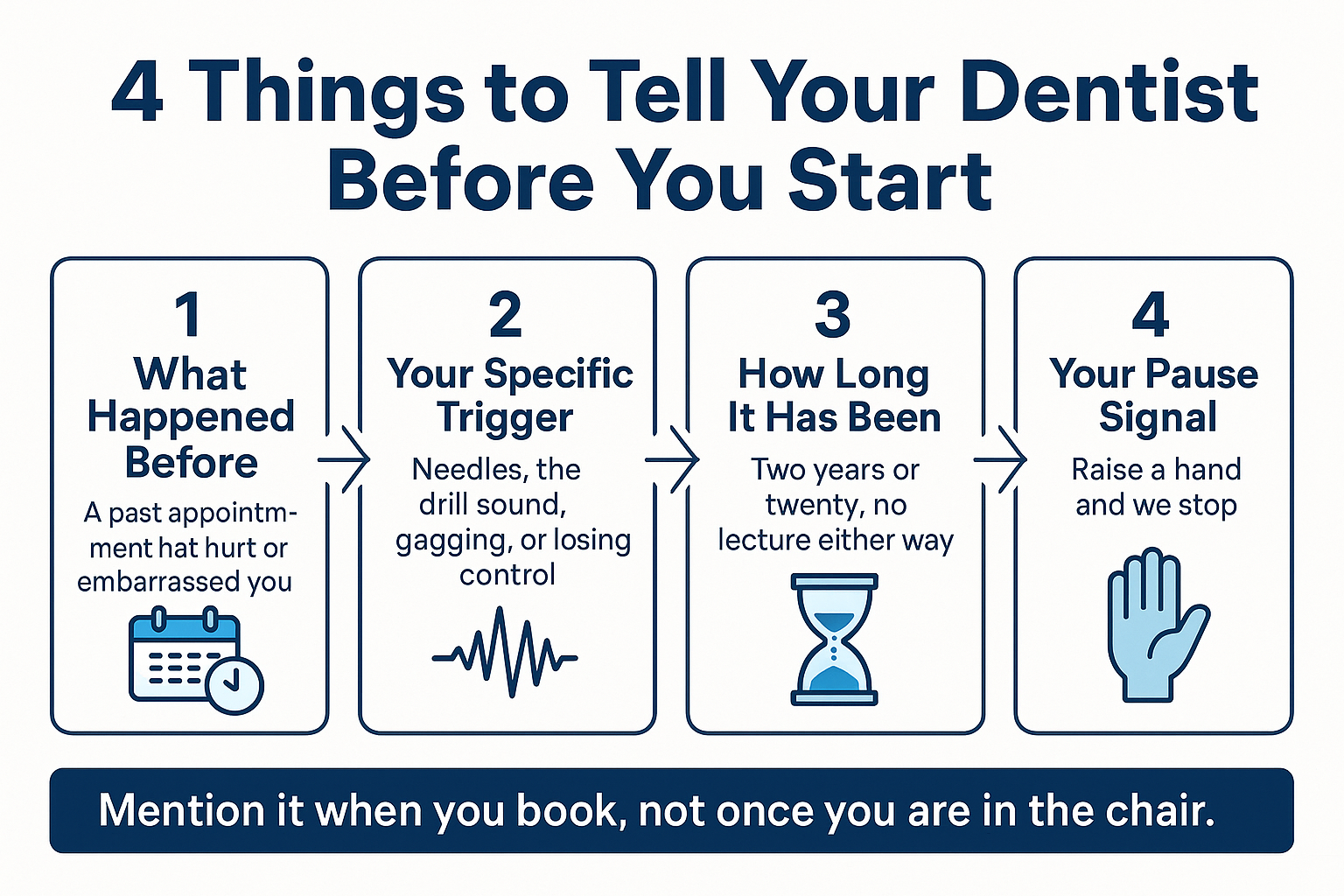
- What happened before. A dentist who did not numb you enough. A cleaning that hurt. Someone who made you feel small.
- What specifically scares you. Needles, the sound of the drill, the feeling of not being able to swallow, gagging, or the loss of control.
- How long it has been. Two years or twenty, it changes what we look for, not how we treat you.
- What helps you cope. Music, a blanket, a hand raised to signal a pause, or knowing the exact order of steps ahead of time.
None of this is extra work. In a comfort-first office it is just how the appointment gets planned.
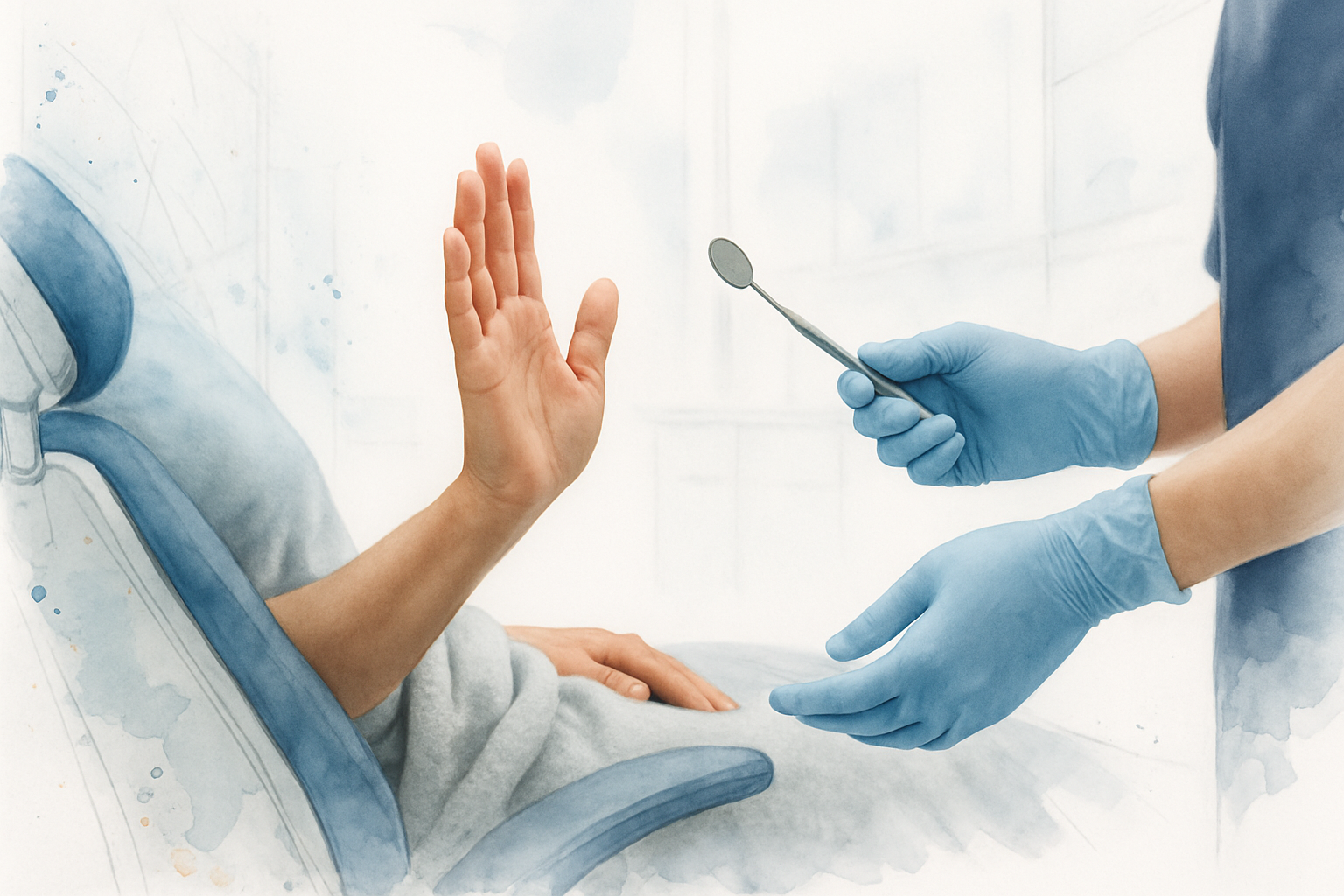
Say it when you book, not when you are already in the chair
This is the part people miss. Anxiety mentioned during scheduling is far more useful than anxiety mentioned once you are reclined with a bib clipped on.
When our front desk knows ahead of time, we can build the visit around it:
- A longer time block, so nobody is rushing you through questions.
- A quieter slot. Our Saturday hours run 8:00am to 2:00pm by appointment, and early Saturday tends to be calmer than a Tuesday at 5:00pm.
- A plan that stops at the exam if that is all you are ready for on day one.
- A heads-up to the assistant, so you are not repeating your story to three different people.
One thing worth knowing about our schedule: we are closed Thursdays, and Monday through Wednesday and Friday we run 9:00am to 6:00pm. If you want the last appointment of the day so you can go straight home afterward, ask. Working adults in Fountain Valley and Central Huntington Beach request that constantly.
What comfort-first actually looks like in the chair
People assume comfort measures are marketing. In practice they are the difference between keeping the appointment and canceling it that morning.
What that means at our office on Brookhurst Street:
- Neck pillows and blankets. Cold rooms make tense bodies tenser. A blanket sounds minor until you are the one shivering.
- In-room TVs. Something to look at that is not a light and a hand above your face.
- Check-ins during the procedure, not just before it. Dr. Kalvin will stop mid-step to ask how you are doing rather than push through.
- A no-pressure conversation about treatment. We tell you what we see, what is urgent, what can wait, and then you decide.
One patient wrote that she has “the worst anxiety and the doctor was so great and comforting especially during the procedure.” Another mentioned that the office decor and the Pokemon stickers genuinely lowered her nerves. I would not have guessed the stickers, but I believe her.
Our technology helps here too. Digital scans replace goopy impression trays, and CBCT 3D imaging means fewer guesses about what is happening under the gumline. Same-day crowns made in-office mean one visit instead of two, which matters a lot when every visit costs you a week of dread.
What to Say and What Changes Because of It
Here is how a specific sentence from you turns into a specific change in your appointment.
| What you tell us | Plain words you can use | What we do differently |
|---|---|---|
| Fear of needles | “The shot is the worst part for me.” | Numbing gel first, slower injection, and we tell you exactly when it is coming |
| Fear of pain | “Last time I could still feel everything.” | We test the numbness before starting and add more if it is not fully working |
| Fear of the drill sound | “The noise is what gets me.” | Headphones or the TV volume up, plus a rundown of the order of steps |
| Gagging or panic | “I gag easily and it makes me panic.” | Shorter working intervals, upright breaks, and a hand signal to pause anytime |
| Been away for years | “It has been about eight years.” | Exam and X-rays first, then a plan by priority instead of all at once |
| Worried about cost | “I need to know the number before we start.” | Written estimate before treatment, plus savings plan and financing options explained |
The Four Things to Mention Before Treatment Starts
If you remember nothing else from this article, remember these four sentences.
If you are bracing for a lecture, you can stop
I want to be direct about this part, because it is the fear people admit last. Plenty of new patients tell us they had not been in years “due to costs and time and some fears.” Not one of them got shamed for it.
Here is the honest clinical view: shame does not fix teeth. Information does. Untreated decay is extremely common, and the CDC reports that about 1 in 4 adults in the U.S. has untreated tooth decay. You are not the outlier you think you are.
What we do instead is look, explain, and rank. Some things need attention this month. Some things can be watched. And if you want a second opinion on treatment someone else recommended, that is a completely reasonable thing to ask for.
Cost fear and dental fear usually travel together. If insurance is the sticking point, there are more paths than people realize, including ways to stay ahead of problems without a dental plan and an in-house savings plan for uninsured patients.
What actually happens on visit one
This is the piece that gives most anxious patients permission to finally call. Nobody is going to recline you and start a root canal on your first appointment.
A first visit for someone who has been away is usually three things:
- X-rays, so we can see what is going on under the surface.
- An exam, where we check your teeth, gums, and bite.
- A conversation, where we tell you what we found and what your options are.
That is it. You leave with information and a plan, and you decide what happens next and when. Our new patient exam with X-rays is priced at $150 at the time of writing, and we will tell you what anything else would cost before we do it.
If you want more detail on the visit itself, we walk through it step by step in our guide to what to expect at a dental exam. And if your gums have been sore or bleeding, it is worth reading about how to tell if you actually need a deep cleaning before anyone recommends one to you.
Frequently Asked Questions About Dental Anxiety
Will my dentist judge me for how long it has been?
Not here. We see patients who have been away for a decade or more, and the conversation is about what to do next, not what you should have done. Bring the timeline, skip the guilt.
Can I stop in the middle of a procedure if I need a break?
Yes, and I recommend setting up the signal before we start. Raise your hand and we stop. Knowing you have that control is often what keeps the panic from building in the first place.
Do you offer sedation or nitrous oxide?
That is a question worth asking us directly by phone, since comfort options depend on the procedure and your health history. What I can tell you is that thorough local anesthesia, slower pacing, and clear narration handle the majority of anxiety we see, without anything extra.
Should I bring someone with me?
If having a friend or family member in the room helps, bring them. Plenty of our patients from Bolsa Chica-Heil and Goldenwest do exactly that for their first visit back.
What if I am scared and also in pain right now?
Pain moves you to the front of the line. Waiting almost always makes dental problems bigger and more expensive, so it is worth calling even if you are dreading it. If you are unsure how urgent it is, our guide on whether a toothache can wait until morning breaks down the warning signs.
Thinking about making the call after years away?
If dental anxiety has kept you out of the chair, the first step is smaller than you think: a phone call where you say the fear out loud and we plan around it. Our team at Kali Dental sees patients across Huntington Beach, Fountain Valley, and the rest of Orange County, and we are glad to answer questions before you commit to anything. You can reach us at (657) 800-5254 or book online at kalidental.com whenever you are ready.