
Direct Answer: A same-day crown is milled in-office from a ceramic block during a single two-to-three hour appointment — no temporary crown, no second visit, no lab wait.
A cracked crown doesn’t care about your schedule. It shows up on a Friday afternoon, or at a Saturday soccer game in Central Huntington Beach, or the night before something important you’ve had on the calendar for weeks. The old answer to that problem was a temporary crown, two appointments spread across two or three weeks, and a lab somewhere off-site doing the actual work. That timeline doesn’t fit most people’s lives.
Same-day crowns change that picture entirely — but a lot of patients arrive skeptical. They’ve heard the phrase and assumed it means a shortcut, or a compromise, or some version of care that’s fast because something’s been skipped. I want to walk through what actually happens during a same-day crown appointment, what drives the cost, and why the quality concern deserves a real answer instead of a dismissal.
If you’re already dealing with a broken crown right now, knowing what the process looks like — step by step, in plain language — makes the next call a lot easier to make.
What a Same-Day Crown Appointment Actually Looks Like
Most people’s mental model of a crown involves two trips and a lot of waiting. The first appointment numbs you, preps the tooth, takes an impression, and sends you home with a temporary that has a reputation for coming off at inconvenient moments. Then you wait two or three weeks for a lab to fabricate the permanent crown and mail it back. Then you come back for the second appointment to have it seated.
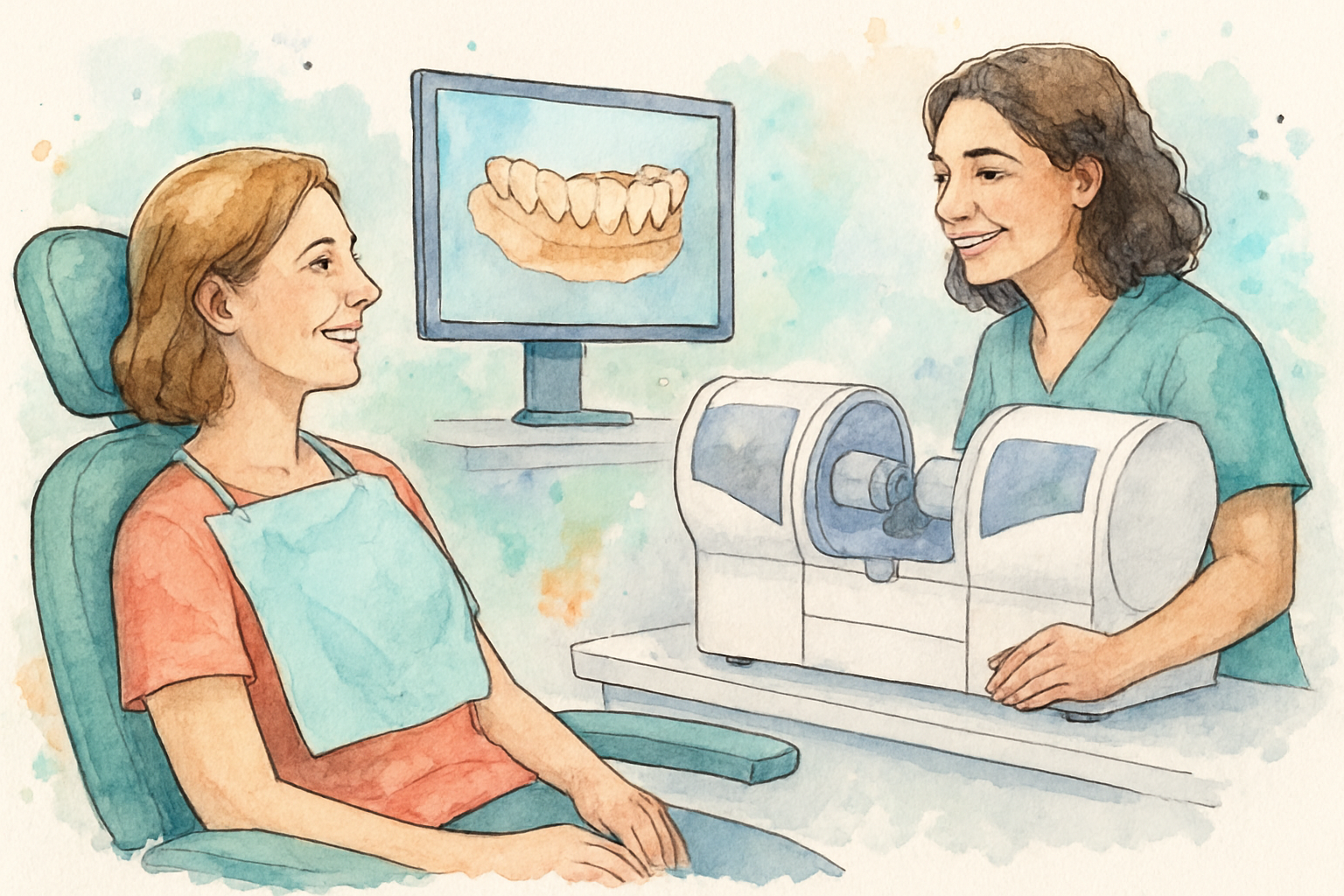
Same-day crowns collapse that entire sequence into a single visit, usually running two to three hours from start to finish. Here’s what that actually looks like:
- Digital scan: Instead of a putty impression, a small wand scans the prepared tooth and creates a precise 3D model. No gagging, no mess, and the fit is guided by digital measurements rather than the variability that comes with physical impressions.
- Crown design: The scan feeds into design software where the crown’s shape, size, and bite relationship are mapped out — all while you’re still in the chair.
- In-office milling: A ceramic block matched to your tooth’s shade goes into the milling machine. The crown is carved from that block in roughly 15 to 20 minutes.
- Fitting and adjustment: Dr. Kalvin checks the fit, adjusts the bite as needed, and makes sure the margin is tight and comfortable before anything is permanently cemented.
- Cementing: Once the fit is confirmed, the crown is bonded in place — permanently, not temporarily.
You leave with a finished crown, not a placeholder. That’s the whole visit.
Are Same-Day Crowns Actually as Strong as Lab Crowns?
This is the question I hear most often from patients who’ve done their research. The concern is reasonable: if the crown is made in the office in 20 minutes instead of a dental lab over two weeks, does that mean it’s a lesser product?
The short answer is no — and here’s why.
The ceramic blocks used for in-office milling are the same high-grade dental ceramic used in lab-fabricated restorations. The material itself isn’t a shortcut. What’s different is the manufacturing method: instead of a technician hand-crafting the crown from scratch, a computer-guided milling machine carves it from a pre-manufactured ceramic block to the exact specifications of your digital scan.
In some ways, the digital scan produces a more precise fit than a traditional putty impression. Physical impressions can shift slightly as they set. A digital scan captures the tooth geometry in real time with no distortion.
One of our patients, Sampson, described his experience in a review: he walked in on a Saturday afternoon with pain from a crown that had been in place for 20 years, and Dr. Kalvin identified the infection through X-rays, completed a root canal, and seated a permanent crown the same afternoon. That kind of outcome isn’t possible with a process that cuts corners — it requires technology that actually performs.
Christian Haupt, another patient, wrote that Dr. Kalvin replaced two crowns for him and the work was “excellent and pain free.” That tracks with what good restorative care actually feels like when the technology and the clinical skill are both present.
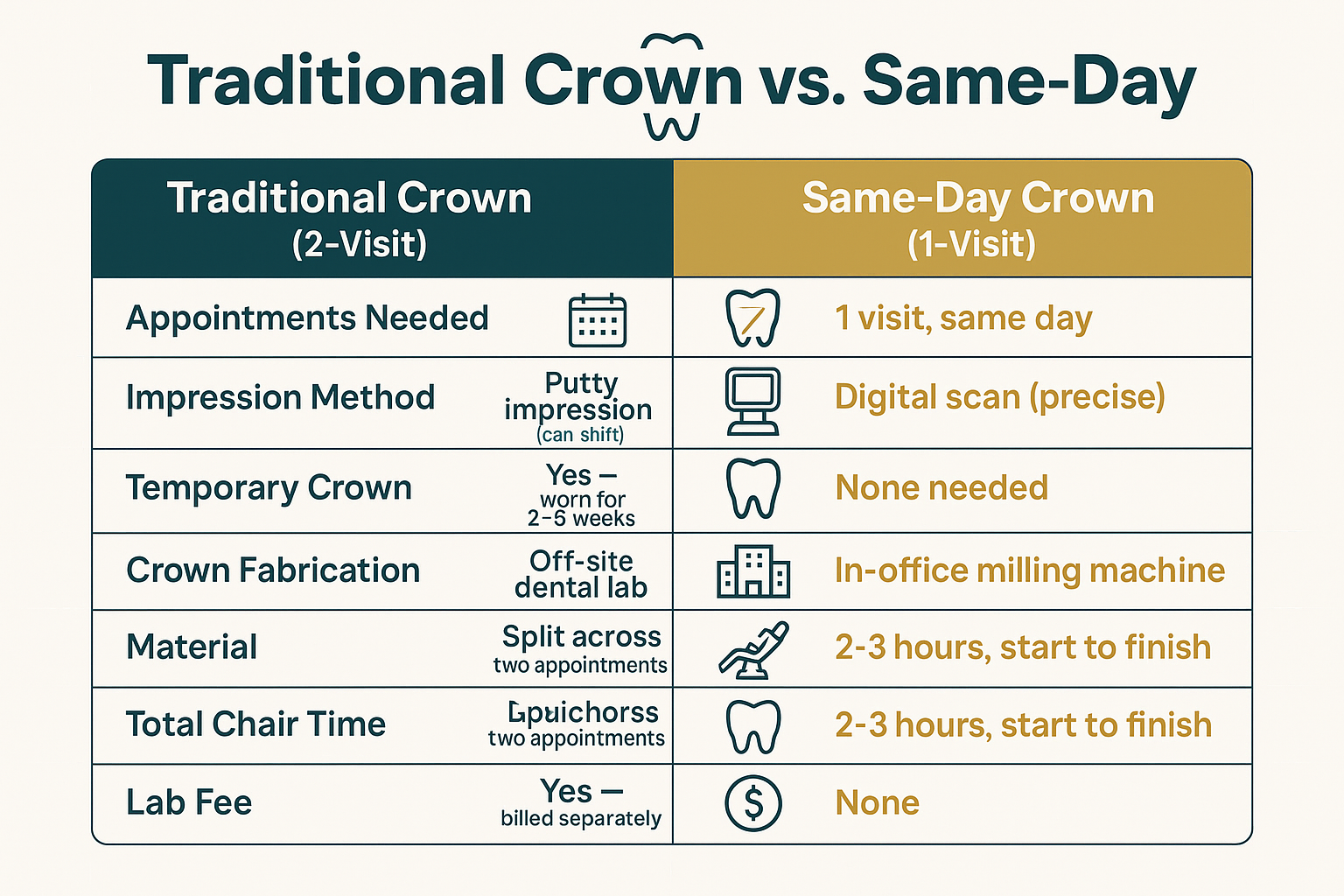
Traditional Crown vs. Same-Day Crown: Side by Side
This comparison lays out the key differences between the traditional two-appointment crown process and a same-day crown — so you can see exactly what changes and what doesn’t.
What Actually Drives the Cost of a Crown
Crown pricing is one of the most common questions that comes up before a first appointment — and it’s also one of the most misunderstood. People see a range online and assume the same-day version must cost more because the technology sounds premium. That’s not always how it works.
Same-day crowns eliminate three specific costs that exist in the traditional route:
- The lab fee, which is charged separately from the dentist’s fee in a conventional workflow
- The second appointment visit cost
- The temporary crown materials and placement time
When you add those up, the all-in cost of a same-day crown is often comparable to — and sometimes less than — the traditional two-visit path. The technology sounds more expensive, but the billing is often simpler.
That said, crown pricing across the board varies based on several factors:
- Location of the tooth in the mouth — back molars take more material and more time than front teeth
- Whether a buildup or post is needed — if the underlying tooth structure is compromised, additional work may be required before the crown can be placed
- Size and complexity of the restoration
- Your insurance plan — if you have coverage, the benefit applied will affect your out-of-pocket
For patients without insurance, there are still practical ways to manage the cost — including in-house savings plans and financing options that don’t require a third-party credit card. One caller who came in with a broken front tooth was approved for financing during the same phone call and was booked for 8am the next morning. That kind of same-day solution exists for a reason.
For an accurate number based on your specific tooth and situation, the only honest answer is a direct conversation with the office.
The Scenarios That Actually Come Through the Door
It helps to hear what same-day crown situations actually look like in practice — not the ideal-patient example, but the real ones.
Jeanne, who left a review after a Saturday evening visit, described a broken crown discovered at exactly the wrong time. Dr. Kalvin’s team completed a root canal and placed a new crown in about two and a half hours. She called it a five-star experience “especially given the timing.”
Hiro D., another patient, put it simply: “I went in for a cleaning and initial exam but ended up getting two new crowns, all completed in under three hours.”
And Frank Gonzales noted that the team stayed an hour after closing to finish his crown during a last-minute new patient appointment.
These aren’t edge cases — they’re the kind of situations that push people to search “same-day crown Huntington Beach” on a Friday night. If you’re someone who can’t afford to wait two weeks with a broken crown, or you have a job interview Monday and a cracked front tooth today, the question isn’t whether the technology works. The question is whether the office you’re calling actually has it and actually uses it.
If you’re unsure whether your situation qualifies as something that needs to be seen today versus something that can wait, this breakdown on dental urgency versus a true emergency can help you think it through before you call.
What Affects Your Crown Cost: A Quick Reference
Crown pricing isn’t one-size-fits-all. These are the factors that typically move the number up or down — knowing them before your appointment helps you ask the right questions.
| Factor | Lower Cost Scenario | Higher Cost Scenario |
|---|---|---|
| Tooth location | Front tooth (smaller, less material) | Back molar (larger, more complex) |
| Tooth condition | Healthy root structure underneath | Needs buildup or post before crown |
| Insurance coverage | In-network plan with crown benefit | No insurance or out-of-network plan |
| Additional treatment | Crown only | Root canal required first |
| Financing | Paid in full at time of service | Monthly payments through financing plan |
Frequently Asked Questions About Same-Day Crowns
Does a same-day crown hurt more than a traditional crown?
The prep process is the same either way — the tooth is numbed before any work begins. What changes is that you’re not making a second trip to have a permanent crown seated weeks later. Many patients report that having it done in one sitting is actually less stressful than splitting it across two appointments with a temporary in between.
How long does a same-day crown last?
Dental ceramic crowns — whether milled in-office or fabricated in a lab — generally last 10 to 15 years or longer with proper care. Longevity depends on factors like bite force, where the crown is located, and how well you maintain it at home. The material used for in-office milling is the same class of ceramic used in conventional restorations.
What if I also need a root canal — can that still be done the same day?
Yes, in many cases. Several patients have come in with an acutely painful or infected tooth and had both a root canal and a permanent crown completed in the same appointment. This depends on the complexity of the case, but it’s one of the main advantages of having the milling technology in-house. If you’re not sure whether your situation allows for same-day treatment, calling the office and describing your symptoms is the fastest way to find out. You can also read more about what to expect with a root canal and crown together before your visit.
I don’t have dental insurance — can I still afford a same-day crown?
Insurance helps, but it’s not the only path. Kali Dental has an in-house savings plan for uninsured patients, and financing through Cherry can be applied for quickly — sometimes during the same phone call as your booking. This article on managing dental costs without insurance covers your options in more detail.
Is the color match on a same-day crown going to look natural?
The ceramic blocks used in in-office milling come in a range of shades matched to your existing tooth color. Dr. Kalvin selects the block that fits your natural shade before milling begins. For front teeth especially, getting the color right matters — and the digital workflow allows for that precision before anything is cut.
Can a cracked crown be replaced the same day, or does it need multiple visits?
A cracked or broken crown is one of the most common same-day scenarios. If the underlying tooth is intact and no additional treatment like a root canal is needed, replacement can often happen in a single appointment. If there’s infection or significant damage underneath the old crown, the visit may involve more steps — but having in-office milling means you’re not waiting weeks for a lab to send back the replacement piece.
Need a Crown Replaced — Today?
If you’re in Huntington Beach or anywhere in Orange County with a cracked, broken, or loose crown, we’re set up to handle it in a single visit. Our team at Kali Dental can walk you through what your situation looks like and whether same-day treatment is the right fit — before you even come in. Call us at (657) 800-5254 or book directly at kalidental.com and we’ll find the earliest time that works.