
Direct Answer: Brushing removes soft plaque, but it can’t touch hardened tartar. Professional cleanings remove what builds up in spots your toothbrush simply can’t reach — and catch problems early before they get expensive.
A lot of people in Huntington Beach — Oak View families, working adults in Goldenwest, busy parents juggling school schedules near Bolsa Chica-Heil — brush twice a day without fail. So when a dentist recommends coming in every six months for a cleaning, the question makes total sense: if I’m already doing my part at home, what’s the point?
The short answer is that brushing and professional cleanings do completely different jobs. Your toothbrush is doing what it can, but there are things happening in your mouth that no amount of brushing will fix on its own. And skipping cleanings — even when your home routine is solid — is one of the most common reasons people end up needing expensive work down the road.
This article breaks down exactly what a professional cleaning does that your toothbrush can’t, what gets missed when you skip appointments, and what the real cost difference looks like between staying ahead of problems versus catching up to them.
What Your Toothbrush Actually Does — And Where It Stops
Your toothbrush is good at one thing: removing soft plaque from the surfaces of your teeth. Plaque is a sticky film of bacteria that forms every day, and if you brush consistently, you’re clearing most of it before it has a chance to cause damage.
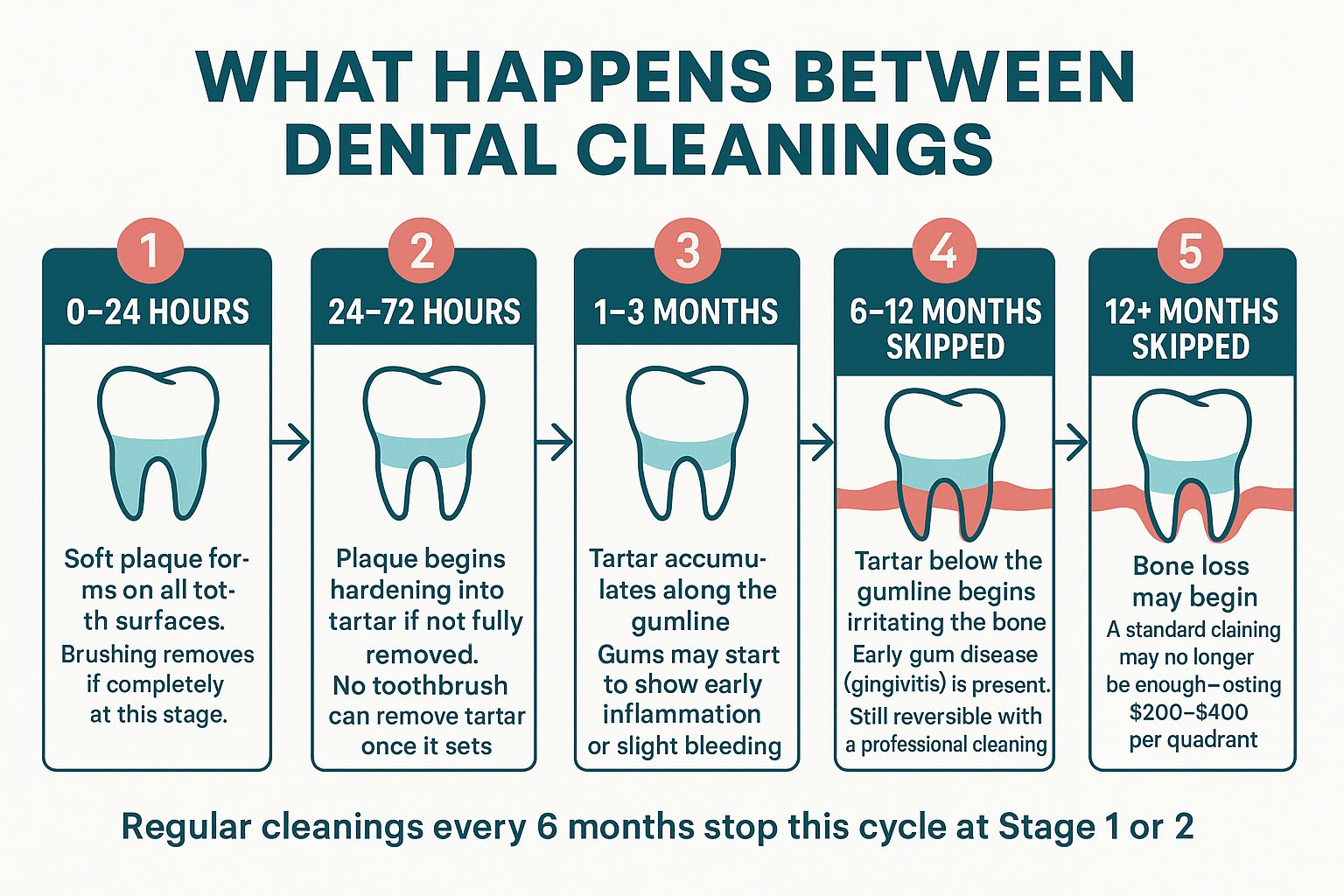
But here’s where the toothbrush runs out of road. Within 24 to 72 hours, any plaque that doesn’t get brushed away starts to harden into a substance called tartar (also called calculus). Once it hardens, no toothbrush — electric or manual, budget or premium — can remove it. It bonds to the tooth surface and stays there until a hygienist uses a special metal scaler to break it off.
Tartar doesn’t just sit there harmlessly. It creates a rough surface where more bacteria collect, and it often forms right at or just below the gumline — exactly where brushing is already hardest. This is the starting point for gum disease that causes bleeding during cleanings and early bone loss around teeth. The people who tend to have the worst tartar buildup aren’t always the ones who skip brushing — they’re often people who brush regularly but skip professional cleanings for a year or two.
The Spots Your Brush Misses Every Single Time
Even if your brushing technique is perfect, there are areas of your mouth that are structurally difficult to clean. These aren’t personal failures — they’re just the reality of human anatomy and how teeth sit next to each other.
The places where buildup consistently escapes home care include:
- Between teeth — Floss helps, but most people don’t floss thoroughly enough or consistently enough to clear everything
- Just below the gumline — Your brush can’t safely go below the gum margin; that’s where a hygienist’s instruments do their work
- The back sides of molars — The furthest teeth in your mouth are the hardest to reach, and they’re often where early decay shows up first
- Around dental work — Crowns, fillings, and old restorations create tiny ledges where plaque hides
During a professional cleaning, a hygienist works through each of these zones methodically. It typically takes 45 to 60 minutes for a thorough adult cleaning — not because your teeth are in bad shape, but because doing it right takes time that home brushing simply doesn’t replicate.
If you’re curious whether you might already need something beyond a standard cleaning, this breakdown on deep dental cleanings explains the difference and when it’s actually warranted.
What Happens to Your Teeth Between Cleanings
This timeline shows how plaque progresses into more serious problems when professional cleanings are skipped — and where each stage can still be reversed.
What the Exam Catches That Brushing Never Could
A professional cleaning isn’t just cleaning — it almost always includes a full exam, and that’s where the real preventive value lives.
Dr. Kalvin checks for things during an exam that have no visible symptoms in the early stages:
- Cavities between teeth — These are invisible to the naked eye and only show up on X-rays until they’ve grown large enough to cause pain
- Early gum disease — Probing depths around each tooth reveal whether the gum tissue is healthy or beginning to detach from the tooth root
- Cracked teeth — Small cracks don’t hurt at first, but they grow under chewing pressure and can eventually split a tooth that could have been saved with a crown
- Changes in existing fillings or crowns — Old dental work doesn’t last forever, and catching a failing filling early costs a fraction of what a root canal or replacement crown costs later
The math on this is pretty clear. A standard cleaning and exam in the Huntington Beach area typically runs $150 to $250 out of pocket for uninsured patients. A root canal with a crown — which is often what happens when a small cavity between teeth goes undetected for two or three years — runs $2,000 to $3,500 depending on which tooth it is.
For patients without insurance, our in-house savings plan makes cleanings and exams significantly more affordable — so cost doesn’t have to be the reason someone stays away.
Brushing vs. Professional Cleaning: What Each One Actually Does
This comparison breaks down exactly which dental health tasks belong to home care and which ones require a professional — because they genuinely don’t overlap as much as most people think.
| Task | Daily Brushing & Flossing | Professional Cleaning |
|---|---|---|
| Remove soft plaque from tooth surfaces | Yes | Yes |
| Remove hardened tartar | No | Yes |
| Clean below the gumline | No | Yes |
| Detect cavities between teeth | No | Yes — with X-rays |
| Measure gum pocket depth | No | Yes |
| Polish away surface stains | Partially | Yes |
| Identify cracked teeth or failing restorations | No | Yes |
| Frequency needed | Twice daily | Every 6 months (most adults) |
How Often You Actually Need to Come In
Most healthy adults need a cleaning and exam every six months. That’s not an arbitrary number — it’s based on how long it takes tartar to accumulate to the point where it starts causing real damage in most people.
But some people genuinely need to come in more often:
- Every 3 to 4 months for patients with a history of gum disease, since the bacteria that cause it recolonize quickly after treatment
- Every 3 to 4 months for people with diabetes, dry mouth, or certain medications that increase cavity risk
- Every 6 months or more frequently for kids, depending on how quickly their teeth develop buildup
And some people — particularly younger adults with great home care, no gum issues, and minimal history of cavities — might be fine at once a year. Dr. Kalvin makes that call based on what he actually sees, not on a generic schedule.
For Huntington Beach families trying to coordinate appointments around school schedules and summer activities, family dentistry that handles all ages in one visit can save a lot of back-and-forth. Getting the whole family seen in one trip is one of the things our patients in Huntington Harbour and Central Huntington Beach tell us they appreciate most.
Frequently Asked Questions About Dental Cleanings
My teeth look fine and don’t hurt. Do I still need a cleaning?
Yes — and this is exactly the trap most people fall into. Cavities between teeth, early gum disease, and small cracks don’t cause pain until they’ve reached a stage where the fix is much more involved. By the time something hurts, you’re often looking at a root canal or extraction rather than a simple filling. The whole point of a twice-yearly cleaning is to catch those things before you ever feel them.
My gums bleed when I brush. Should I still come in for a cleaning?
Absolutely — that bleeding is actually a reason to come in sooner, not a reason to wait. Healthy gums don’t bleed from brushing. Bleeding usually means inflammation from tartar buildup along the gumline, and a professional cleaning is what clears it out. Waiting tends to make the inflammation worse.
How much does a cleaning cost at Kali Dental if I don’t have insurance?
We offer an in-house savings plan that covers cleanings, exams, and X-rays at a significantly reduced rate — designed specifically for patients without dental insurance. The exact amount depends on your plan tier, but it’s structured so that the cost of the plan itself is offset by what you save on cleanings alone. You can ask about it when you call or book online.
Can I just get a cleaning without an exam?
We do the exam alongside the cleaning because that’s how we catch problems while they’re still small. Doing a cleaning without an exam would miss the whole diagnostic piece — and that’s where a lot of the real value is. It also means we’d be cleaning teeth without knowing their current condition, which isn’t safe practice.
I haven’t been to the dentist in a few years. Will I need a deep cleaning instead of a regular one?
Possibly, but not automatically. Dr. Kalvin will measure your gum pocket depths at the start of your visit — that’s the only way to know for sure. If the measurements are within a healthy range, a standard cleaning works fine. If there’s significant buildup below the gumline or early bone loss, a deep cleaning may be the right starting point. Either way, you’ll know exactly what’s needed and why before anything is done.
Do kids need cleanings too if they’re still losing baby teeth?
Yes. Baby teeth hold space for permanent teeth, and cavities in them can cause real problems — pain, infection, and shifting of permanent teeth that haven’t come in yet. Most kids should start dental visits by age one and come in every six months just like adults. The cleaning and exam process is gentler and shorter for younger patients.
Ready to Get Back on Track With Your Dental Health?
Whether your last cleaning was six months ago or six years ago, our team at Kali Dental is here without judgment — just a calm, thorough visit at our Huntington Beach office on Brookhurst Street. We see patients from across Orange County, including families from Oak View, Goldenwest, and Fountain Valley who want straightforward care at a price that makes sense. Call us at (657) 800-5254 or book your appointment online at kalidental.com.