
Some Huntington Beach families are doing dental care in pieces. One office for the kids. Another for mom or dad. A different place when a grandparent needs a bridge, denture help, or an urgent visit. It works, but it can feel like a second job.
You keep track of records, insurance details, school schedules, work meetings, and who is due for what. Then someone gets a toothache, a child needs sealants, or an adult finally wants to deal with an old filling, and the whole system gets harder to manage.
That's why family dentistry matters. It gives your household one dental home, one team that knows your history, and one place where care can grow with your family over time.
Your Guide to Family Dentistry in Huntington Beach
A lot of parents reach the same point. They realize the hardest part of dental care isn't always the cleaning or the exam. It's the coordination. One child does well with a gentle, familiar routine. A teenager needs monitoring as adult teeth settle in. A parent has gum concerns but keeps putting off care because there's no time. A grandparent may need dentures adjusted or a broken tooth checked quickly.
Family dentistry brings those needs under one roof. Instead of thinking in separate categories like “children's dentist” and “adult dentist,” it focuses on care across life stages. That means a toddler, a working parent, and a senior can all have age-appropriate treatment from the same practice.
What that looks like in real life
Here's a simple example. A family schedules a morning where one child gets a cleaning, fluoride treatment, and sealants. A parent has an exam and digital X-rays. Another adult asks about a same-day crown for a damaged tooth. Everyone leaves with a clearer plan, and nobody has to repeat the same health history at three different offices.
That kind of continuity can make dental care feel more manageable.
- Fewer moving parts: one office, one record system, one team to call
- Less repetition: your dentist already knows the family background and past treatment
- Easier routines: regular visits become part of family life instead of a scramble
- Better comfort: children often feel calmer when they go somewhere their parents already trust
A dental home should make life simpler, not more complicated.
If you're trying to sort out what to look for in one office that can care for everyone, this guide on how to choose the right family dentist in Huntington Beach is a useful next read.
Why local families often prefer one long-term dental home
When care is split between multiple offices, details can get lost. Advice may be consistent, but the full picture often isn't. In a family dentistry setting, the dentist sees patterns over time. Maybe a child tends to get cavities in certain grooves. Maybe a parent grinds their teeth during stressful periods. Maybe gum irritation keeps returning in the same area.
Those patterns matter. The longer a dental relationship lasts, the easier it becomes to catch small issues before they turn into bigger ones.
What Family Dentistry Really Means for Your Health
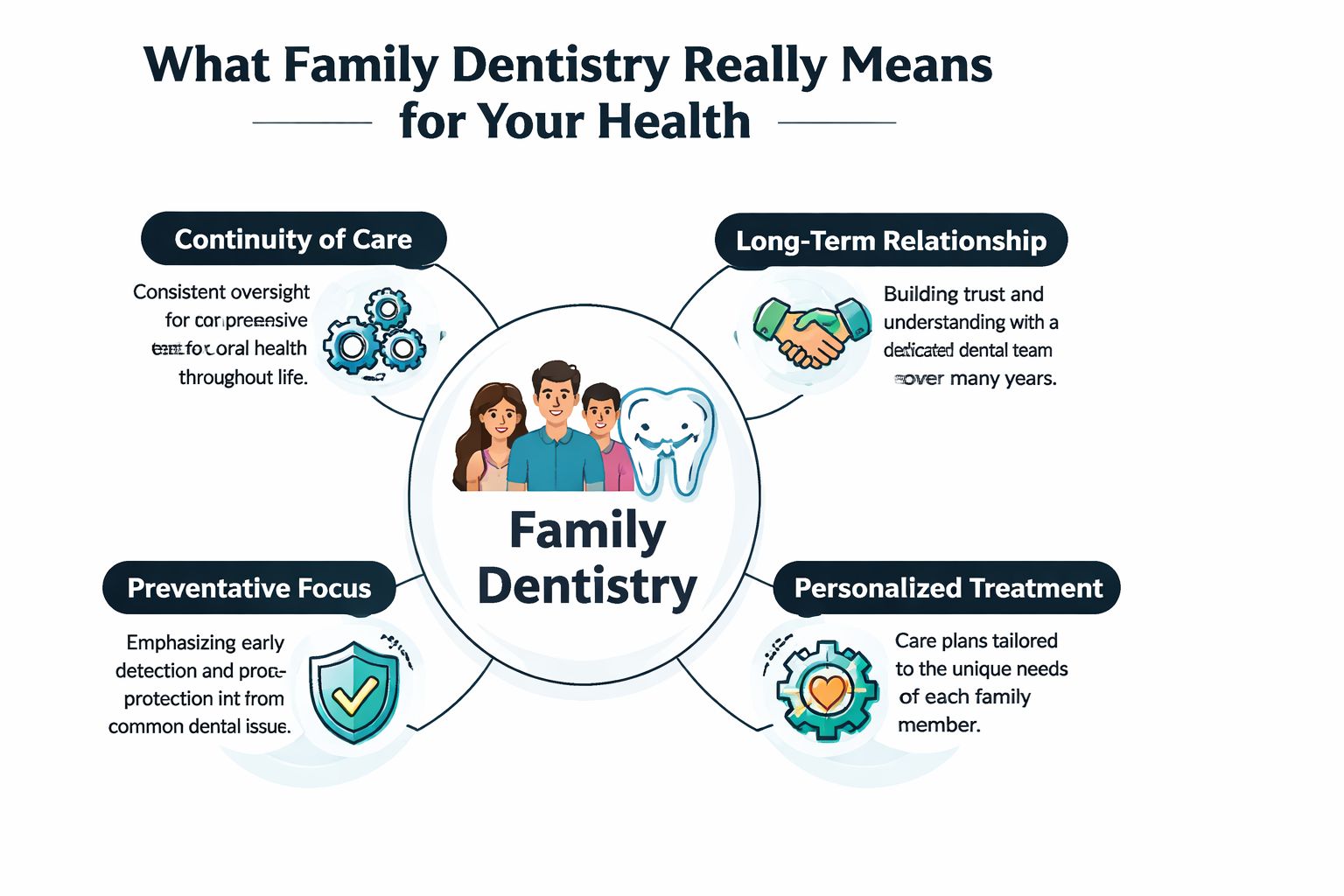
Family dentistry is often described as “dental care for all ages.” That's true, but it's not the whole story. The deeper value is continuity of care. A dentist who sees you over the years doesn't just treat teeth. They learn your habits, your concerns, your past dental work, and how your needs change with age.
That long view matters because oral health is cumulative. Cavities, gum problems, worn fillings, and bite changes don't appear in isolation. They build over time.
According to the CDC, 91% of adults ages 20 to 64 have had cavities, and 25.9% of adults ages 20 to 44 have untreated decay. Those figures, summarized in this CDC-based oral health overview, show why long-term preventive care isn't just a convenience. It's part of managing a very common health issue.
Why continuity changes care
When a dentist sees a patient regularly over many years, several things get easier:
| Benefit | What it means for your family |
|---|---|
| Earlier detection | Small changes are easier to notice when there's a baseline for comparison |
| Personalized prevention | Advice can be tailored to a child, an adult with gum concerns, or a senior with existing dental work |
| More trust | Patients tend to ask better questions when they know the team and feel comfortable |
| Better follow-through | Treatment plans are easier to understand when they're built on an ongoing relationship |
A familiar office also helps people who tend to delay care. Many adults aren't avoiding dentistry because they don't care. They're busy, unsure what they need, or worried they'll be judged for waiting too long. A long-term relationship lowers that friction.
Prevention is easier when the dentist knows your history
Prevention sounds simple, but good prevention is rarely generic. One person may need more attention to gum care. Another may need closer monitoring around old fillings. A child may benefit from fluoride and sealants early, while an adult may need help protecting teeth from wear and breakage.
Practical rule: The best preventive plan is the one built around your actual history, not a one-size-fits-all checklist.
If you want a plain-language overview of how this works day to day, Kali Dental has a helpful article on what preventive dentistry means for a healthy smile in Huntington Beach.
Dental Care for Every Stage of Life
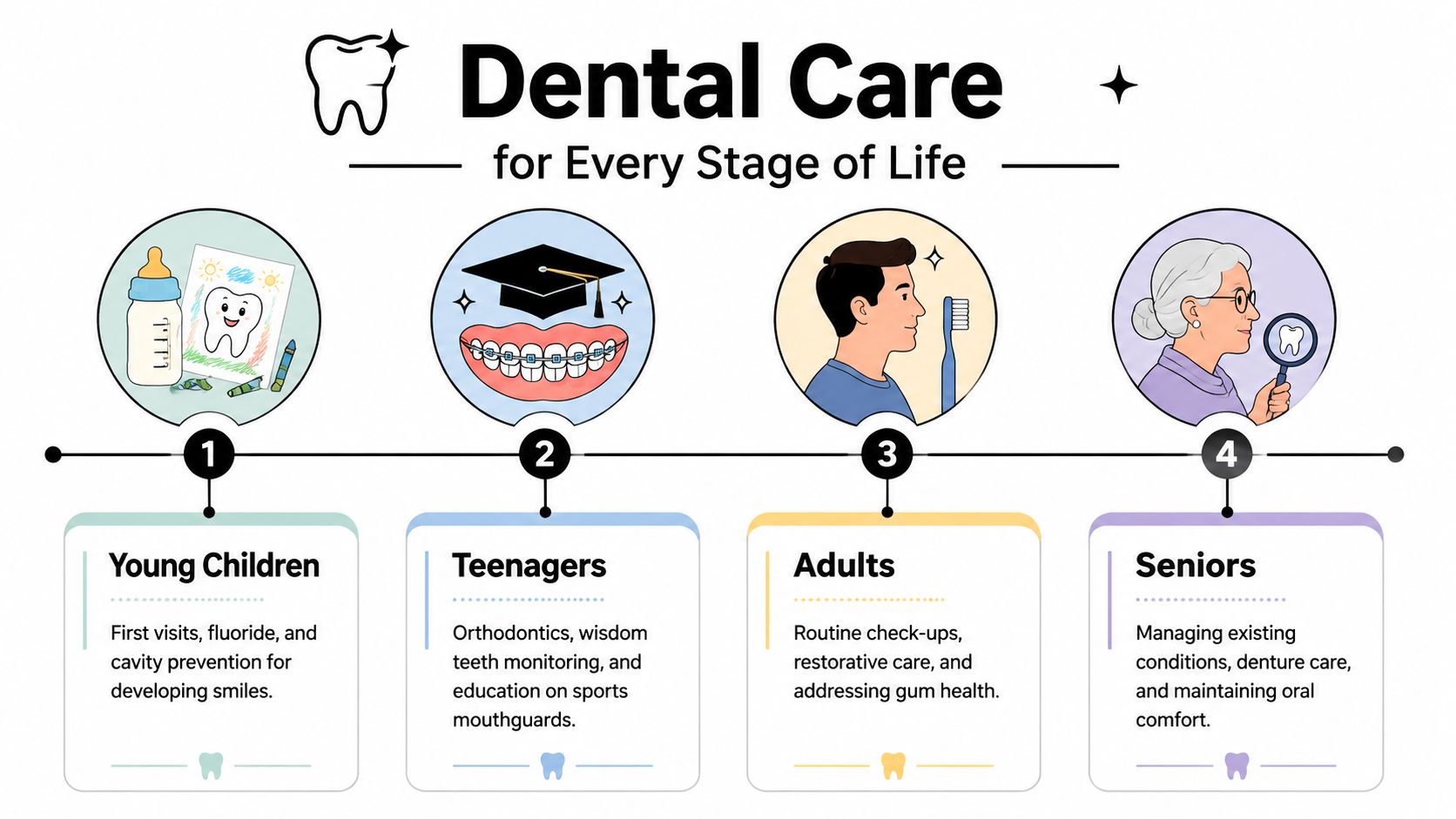
A strong family dentistry model changes with your family. The goal isn't to give everyone the same care. The goal is to give each person the right care at the right time.
According to the CDC, 89% of children ages 5 to 17 had a dental visit in the past year in 2020, while 62.7% of adults had a dental visit in the same period, as reported in this CDC data brief on dental visits. That gap helps explain why a family dentist can be so useful. Kids often stay on schedule. Adults often fall behind.
Young children
For younger children, the focus is usually on comfort, prevention, and habit-building. That means gentle cleanings and exams, fluoride treatments, and sealants when they're appropriate.
Many parents wonder what matters most at this stage. Usually, it's not perfection. It's consistency. Children do better when visits feel normal, calm, and predictable.
A few practical priorities for this age group:
- Early familiarity: regular visits help children see the dental office as part of normal health care
- Cavity prevention: fluoride and sealants can help protect developing teeth
- At-home coaching: brushing support still matters, even when kids want to do it themselves
- Gentle language: simple explanations reduce fear and confusion
Some families also ask about flossing tools for kids. If your child resists string floss, these safe water flossing tips for children offer practical ideas in plain language.
For parents preparing for an early appointment, this article on making your child's first dental visit a positive one can help ease some of the unknowns.
Children often take their cue from the adults around them. If you treat dental visits as routine, they usually start to do the same.
Teenagers and adults
This stage covers a wide range of needs. A teenager may need monitoring as wisdom teeth develop. A young adult may need a tooth-colored filling. A parent may be thinking about gum care, whitening, or replacing a damaged tooth before it gets worse.
Common family dentistry needs in these years include:
| Life stage | Common focus |
|---|---|
| Teen years | routine exams, cleanings, fluoride when needed, wisdom tooth monitoring |
| Young adults | fillings, preventive visits, emergency care when something breaks or hurts |
| Working adults | gum care, whitening, same-day restorations, extractions when necessary |
This is also the stage when people often ignore small symptoms. A little sensitivity. Bleeding when brushing. A rough edge on a tooth. Those problems may not feel urgent, but they're easier to address early than after pain or swelling starts.
Seniors
Older adults often need a different kind of support. The issue may not be new cavities alone. It may be maintaining comfort and function around existing dental work, worn teeth, gum changes, or missing teeth.
Family dentistry can help seniors with:
- Bridges when one or more missing teeth need replacement
- Dentures for comfort, chewing, and daily function
- Routine exams and cleanings to monitor ongoing changes
- Gum care to support the teeth and restorations that remain
A long-term relationship becomes especially valuable. If the dentist has seen the patient through earlier stages of life, treatment decisions tend to be more informed and more personal.
How Modern Technology Creates Stress-Free Visits
Technology in dentistry only matters if it makes care clearer, gentler, or more convenient. Patients usually don't care about the device itself. They care about what it changes. Can they spend less time guessing? Can they avoid messy impressions? Can they get treatment without stretching it across multiple visits?
That's where modern family dentistry has improved in practical ways.
Digital imaging makes conversations easier
Modern digital radiography can reduce radiation exposure by up to 90% compared to traditional film X-rays, while also providing immediate images for chairside review, according to this overview of digital radiography in dental practice.
For patients, the benefit is simple. The dentist can show you what they see right away. Instead of hearing abstract terms, you can look at the image together and understand why a tooth needs monitoring, why a filling may need replacement, or why gum changes deserve attention.
That tends to lower stress because uncertainty drops.
- You see the issue on screen
- Your questions get answered in real time
- Treatment decisions feel more transparent
- Children and adults both benefit from shorter, clearer visits
Digital scans and same-day crowns save time
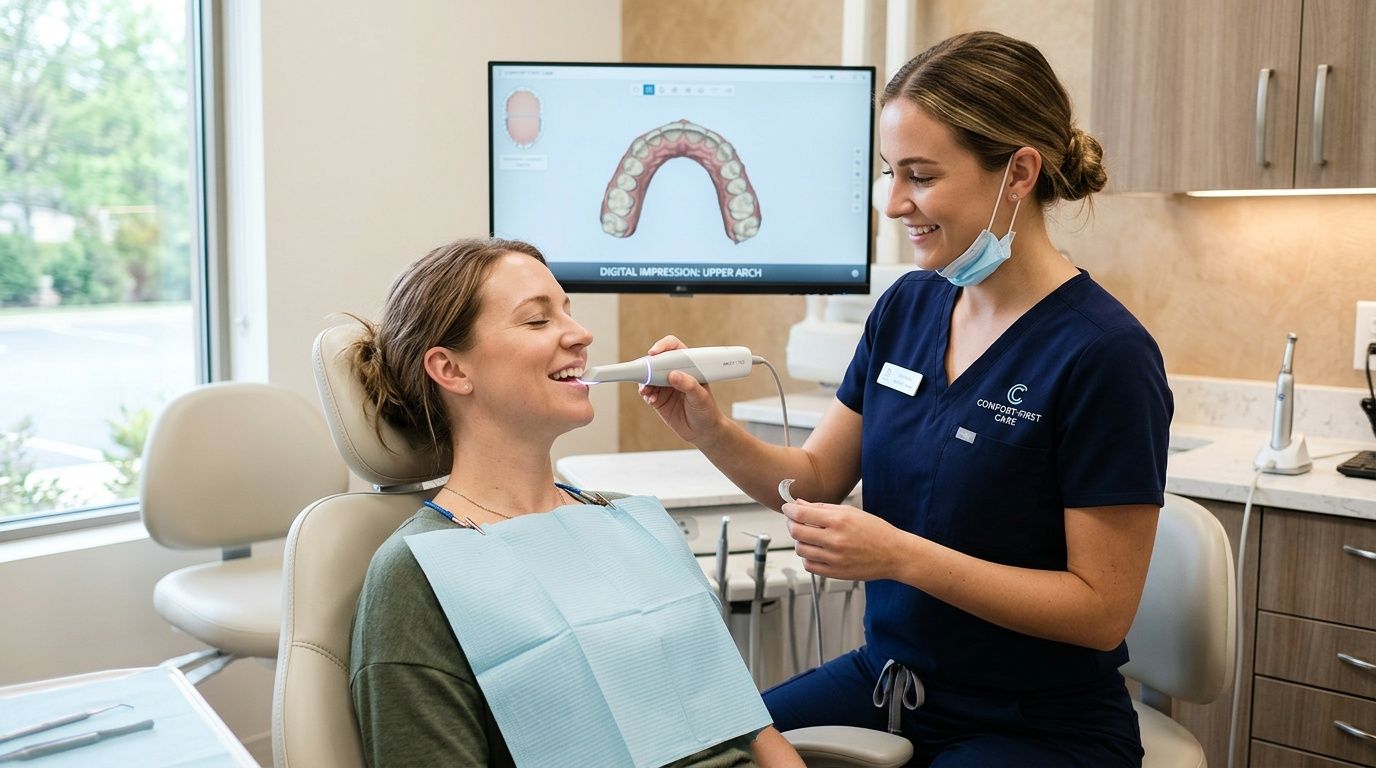
Traditional impressions can be uncomfortable. Many patients dislike the bulky trays and the feeling of material setting in the mouth. Digital scanning changes that experience by capturing a precise image without the same mess and gag-triggering process.
For busy households, one of the biggest practical advantages is same-day restorative care. When a crown can be designed and milled in the office, treatment often becomes more efficient. That can mean fewer interruptions to work, school, and family schedules.
Some of the best dental technology is the kind that quietly removes hassle from the visit.
CBCT imaging can also help when a more detailed view is needed, especially for diagnosis and treatment planning. The point isn't to make care feel high-tech for its own sake. It's to make care more understandable and more efficient.
A good example of this approach is the technology behind a better dental experience in Huntington Beach, which explains how tools like digital imaging and modern scanning support a more personalized dental experience. To see real customer stories and learn more about Kali Dental, visit their success stories page.
Comfort-first care is usually about small improvements
Patients sometimes expect comfort to come from one big feature. In reality, it often comes from smaller things working together:
- Clear images so you know what's happening
- Faster diagnostics so visits feel less drawn out
- Same-day options when a damaged tooth needs timely care
- Better communication because the dentist can explain findings visually
That combination is what many people mean when they talk about modern, gentle dentistry. It doesn't remove every concern, but it does remove a lot of friction.
Addressing Your Family's Common Dental Concerns
Many people assume dental care gets delayed because families are careless. Usually, that's not the reason. More often, people put off care because they feel nervous, embarrassed, confused about what a visit will involve, or unsure how treatment will fit into the budget.
Those concerns are common, and they're reasonable.
If you feel anxious, that doesn't make you difficult
Dental anxiety doesn't only affect children. Adults carry it too, often for years. Some had a rough experience in the past. Some don't like the sounds, the loss of control, or the fear of hearing bad news.
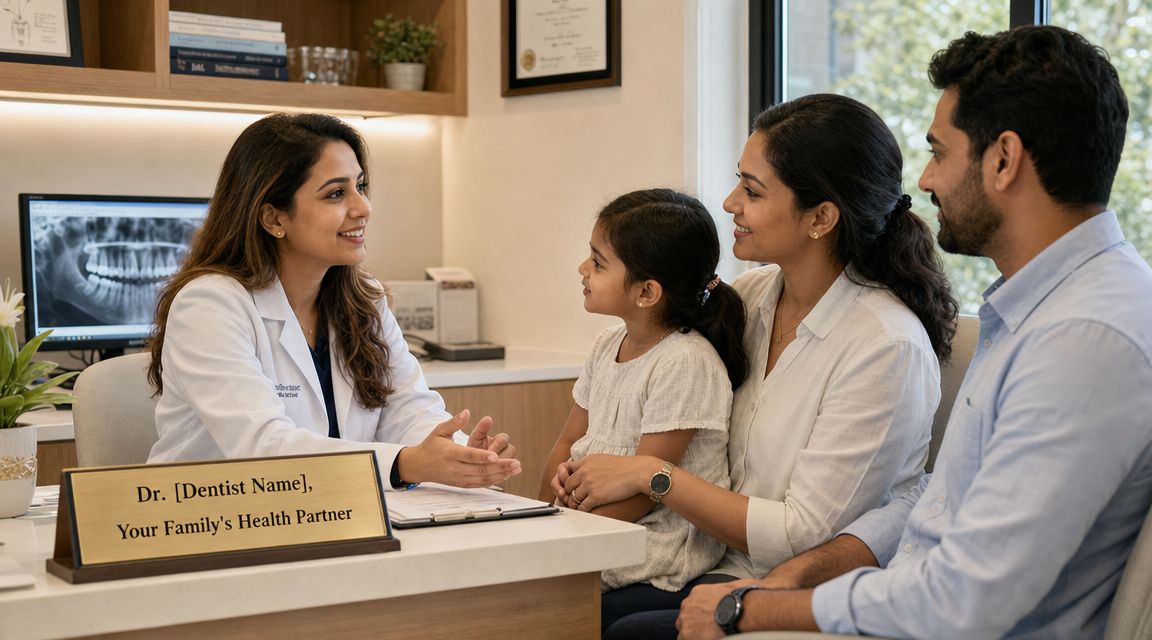
A family practice can help by keeping the process predictable and calm. When the team already knows you, you don't have to start from zero each time. You can say, “I'm nervous about X-rays,” or “Please explain things before you begin,” and that preference becomes part of your care.
Feeling uneasy at the dentist is common. The right office responds with patience, not pressure.
The first visit is usually simpler than people expect
Parents often worry that a child's first appointment will be overwhelming. Adults who haven't been in for a while often worry they'll be judged. Most of the time, the visit is much more straightforward than people imagined.
In many family dentistry settings, a first visit includes:
- A conversation first: medical history, current concerns, and questions
- An exam and cleaning when appropriate: the dentist looks at teeth, gums, and overall oral health
- Digital X-rays if needed: used to see what isn't visible during the exam
- A next-step plan: what looks healthy, what needs watching, and what should be treated
This kind of clarity matters. People tend to relax when they know what's happening and what isn't.
Questions about gum health come up often here too, especially when someone hears the term “deep cleaning” and isn't sure what it means. This explanation of the difference between a regular cleaning and a deep cleaning helps separate routine care from periodontal treatment in simple terms.
Cost and coverage deserve plain answers
Families also need help with the practical side of care. Insurance can be confusing. Coverage may differ for children and adults. Some treatments are preventive, some are restorative, and patients don't always know what falls into which category.
The most helpful dental conversations are transparent ones. Ask what the visit includes. Ask whether X-rays are likely. Ask what treatment is needed now versus what can be monitored. Ask for priorities if more than one issue is found.
A plain checklist can help:
| Question to ask | Why it helps |
|---|---|
| What needs attention now | separates urgent care from watch-and-wait items |
| What is preventive | helps you understand routine maintenance |
| What are my treatment options | gives you choices instead of a single path |
| What can be scheduled later | makes planning easier for families |
When people understand their options, care feels less intimidating and more manageable.
Your Partner in Lifelong Oral Health in Huntington Beach
Family dentistry works best when it feels steady. Not rushed. Not fragmented. Just dependable. One place for cleanings and exams, preventive care, tooth-colored fillings, gum care, same-day crowns, bridges, dentures, pediatric visits, and emergency help when something unexpected happens.
For families in Huntington Beach, that kind of relationship can simplify more than scheduling. It can make dental decisions clearer over time. Children grow up with familiar care. Adults are more likely to stay on track. Seniors get support that fits their changing needs without starting over with a new office.
What a long-term dental home really offers
- Consistency: one record, one team, one history
- Comfort: stress-free visits become more realistic when the environment is familiar
- Convenience: family-friendly dental care fits real life better than scattered appointments
- Perspective: a dentist who knows your history can make more informed recommendations
For dental professionals who are interested in how patient trust is shaped online as well as in person, this actionable guide for dental professionals offers a useful look at reputation management.
If you're looking for a neighborhood dentist for ongoing family care, Dr. Kalvin sees patients at Kali Dental, 19201 Brookhurst Street, Suite 103, Huntington Beach, CA. The office serves Huntington Beach and nearby Orange County communities including Oak View, Goldenwest, Bolsa Chica-Heil, Huntington Harbour, and Central Huntington Beach. Office hours are Monday through Friday, 9:00 AM to 6:00 PM, and Saturday, 8:00 AM to 2:00 PM.
If you want to establish a long-term dental home for your household, Kali Dental provides family dentistry for children, adults, and seniors in Huntington Beach with a comfort-first approach, modern diagnostics, and practical treatment options such as cleanings and exams, fluoride, sealants, tooth-colored fillings, gum care, same-day crowns, bridges, dentures, extractions, wisdom tooth removal, emergency care, and pediatric visits. You can reach the office at (657) 800-5254.