
Direct Answer: Brushing removes soft plaque, but hardened tartar can only be removed with professional tools. Cleanings also catch early problems — cavities, gum disease, and more — before they become expensive.
A lot of patients tell us some version of the same thing: “I brush twice a day, I floss most nights — do I really need to come in every six months?” It’s a fair question, especially when you’re juggling work, kids’ schedules, and a calendar that fills up fast.
But brushing and professional cleanings are doing two very different jobs. One is daily maintenance. The other catches what daily maintenance misses — and by the time you feel it, it’s usually already gotten more complicated.
This article breaks down what a cleaning actually does that your toothbrush can’t, and what happens in your mouth during those months between visits. No scare tactics — just a straight answer to a question we hear all the time at our practice here in Huntington Beach.
What Your Toothbrush Is Actually Doing
Your toothbrush is good at one thing: disrupting soft plaque — the sticky film of bacteria that forms on your teeth every day. If you brush morning and night, you’re doing real work. That plaque doesn’t get a chance to sit and cause damage.
But soft plaque that gets missed — even a small amount in tight spots or along the gumline — starts hardening within 24 to 72 hours. Once it mineralizes into tartar (also called calculus), no amount of brushing will touch it. It bonds to the tooth surface and stays there.
Even the most committed brushers have spots they miss:
- Behind the lower front teeth
- Along the back molars
- Just below the gumline
- Between teeth that sit close together
Those are exactly the spots where tartar builds up quietly over months. And once it’s there, it creates a rough surface where even more bacteria cling on. That’s how mild buildup becomes gum inflammation, and gum inflammation becomes something bigger.
Flossing helps — a lot. But it still can’t scrape hardened deposits off enamel. That’s not a flaw in your routine; it’s just a physical limitation of what soft tools can do.
What a Cleaning Is Actually Doing — Beyond the Polish
A lot of people think of a cleaning as a polish and a floss. The polish part comes at the end and takes about two minutes. The part that actually matters takes much longer.
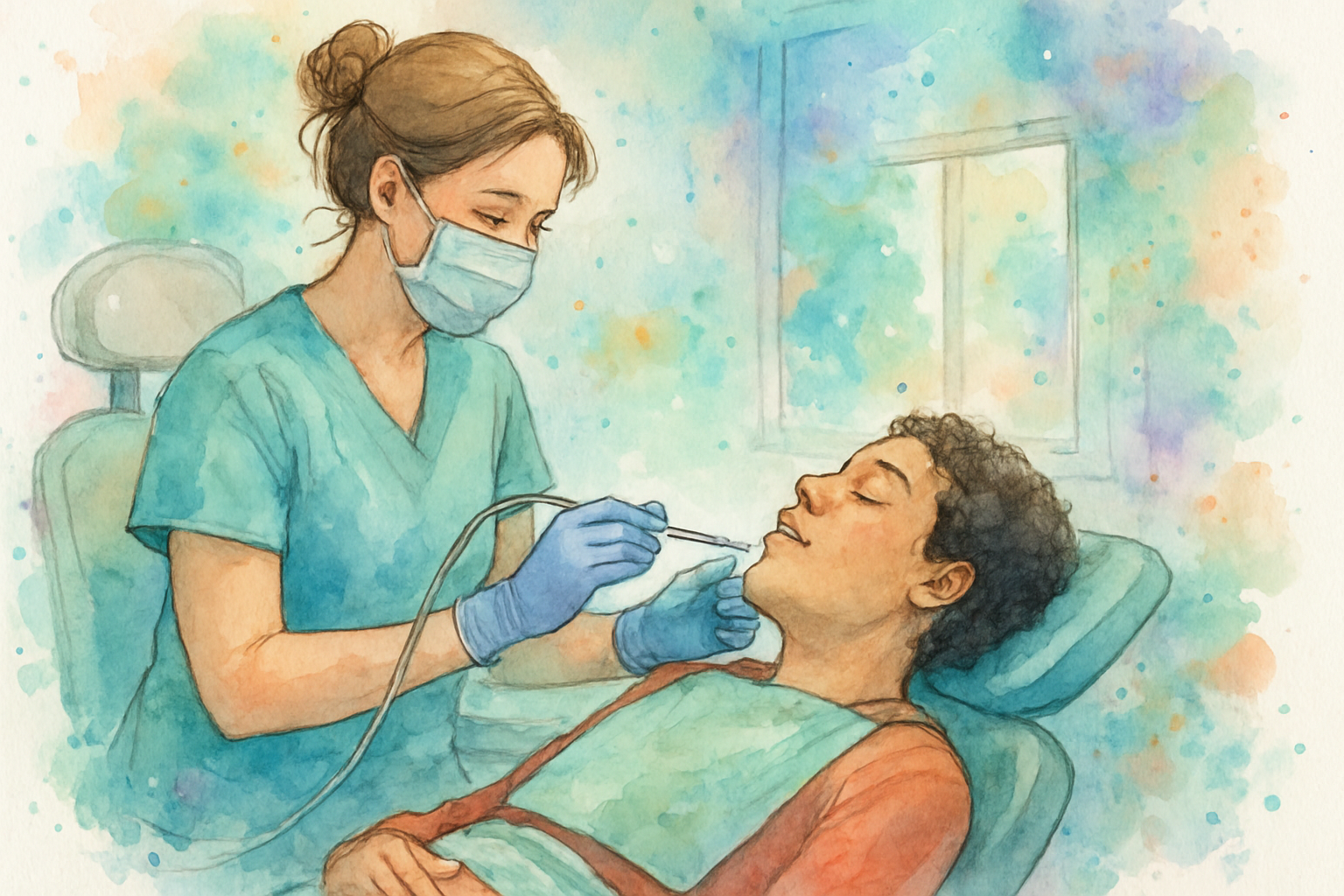
Scaling is the core of a professional cleaning. A hygienist uses hand instruments and ultrasonic tools to physically break apart and remove tartar from every surface of every tooth — including the areas just below the gumline that you can’t see or reach at home. If you’ve ever felt that “scrapy” sensation and wondered what they’re doing, that’s it.
After scaling, the hygienist will also:
- Check your gum pocket depths — the small space between gum and tooth. Healthy pockets measure 1 to 3 millimeters. Deeper than that signals early gum disease.
- Note any areas of recession, sensitivity, or crowding that may need attention.
- Flag spots on the enamel that look like early cavities before they’ve progressed past the point of a simple filling.
That last part is where cleanings earn their value in a way most patients don’t fully appreciate. A cavity caught at a cleaning might cost $150 to $250 to fill. That same cavity, left another year, could reach the nerve and require a root canal — a treatment that runs $900 to $1,500 or more depending on the tooth.
The cleaning isn’t just maintenance. It’s an early warning system.
What Happens in the 6 Months Between Cleanings
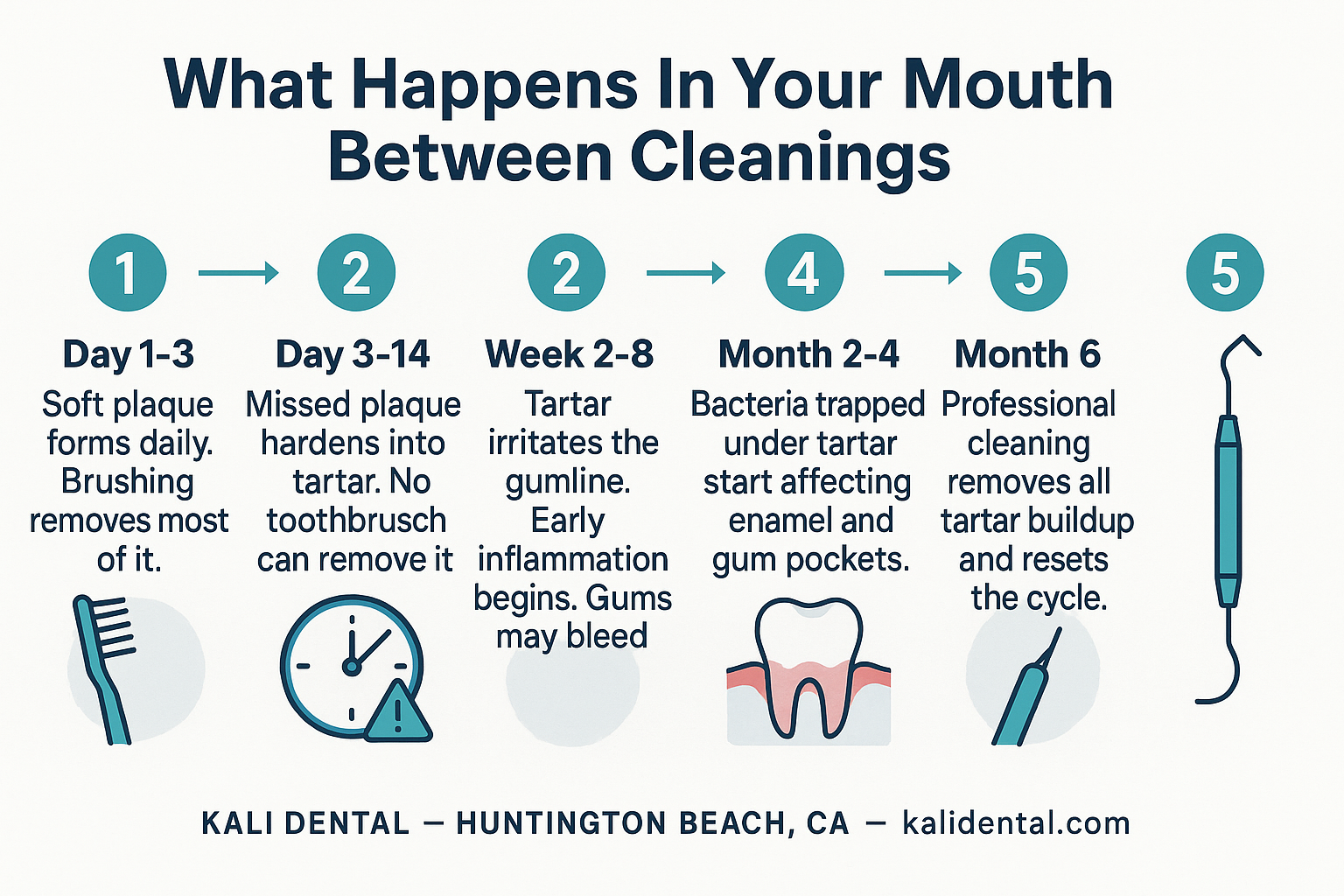
This timeline shows how plaque and tartar develop between professional cleanings — and why the six-month window matters.
The Gum Disease Connection Most People Don’t Think About
Gum disease doesn’t usually hurt in its early stages. That’s what makes it tricky.
Gingivitis — the earliest stage — shows up as gums that look a little red or bleed when you floss. A lot of people assume that means they’re flossing too hard. But in most cases, bleeding gums are a sign of inflammation, not technique.
Left alone, gingivitis can progress into periodontitis — a deeper infection where the bone and tissue holding your teeth in place start to break down. At that stage, a regular cleaning isn’t enough. You’d need a deep cleaning, also called scaling and root planing, which is a longer, more involved procedure that costs significantly more and may require numbing.
In Huntington Beach, a standard cleaning for a patient without insurance typically runs $100 to $180. A deep cleaning per quadrant can run $250 to $400 — meaning a full-mouth deep clean can reach $800 to $1,200 or more. That’s not a scare number; it’s just what untreated early gum disease actually costs when it progresses.
For families in Oak View, Bolsa Chica-Heil, or anywhere else across Orange County who are managing costs carefully, catching gum problems at the gingivitis stage is genuinely the more affordable path. The two-visit prevention model almost always beats the multi-visit treatment model.
Cleaning vs. No Cleaning: What the Cost Difference Looks Like
These are real-world cost comparisons between staying on a regular cleaning schedule versus skipping visits and treating the problems that develop.
| Scenario | Typical Cost in Huntington Beach | What You’re Paying For |
|---|---|---|
| Routine cleaning (every 6 months) | $100–$180 per visit | Tartar removal, gum check, early problem detection |
| Filling caught at a cleaning | $150–$250 | Small cavity treated before it reaches the nerve |
| Root canal (cavity left untreated) | $900–$1,500 | Infection reached the pulp — nerve treatment required |
| Deep cleaning (gingivitis became periodontitis) | $800–$1,200 full mouth | Scaling below the gumline, often with numbing |
| Extraction + implant (tooth lost to disease) | $3,000–$5,000 | Tooth couldn’t be saved; replacement needed |
What About Patients Who Skip Because of Cost or Anxiety?
These are the two most common reasons patients go more than a year — sometimes several years — between cleanings. And we hear them without judgment, because both are completely understandable.
If cost is the barrier, there are real options that don’t involve gambling with your teeth. Patients without insurance often assume they’ll pay full price with no path to savings. But many practices — including ours — offer in-house savings plans that bring preventive care down to a manageable flat annual fee. Getting a cleaning twice a year under a plan like that costs far less than treating one cavity that could have been caught earlier.
If anxiety is the barrier, that’s worth taking seriously too. Dental fear is real, and it’s much more common than people admit. A few things that help patients who come to us after avoiding the dentist for years:
- Telling the team upfront that you’re nervous, so they can adjust their pace
- Knowing you can stop at any time with a simple hand signal
- Coming in for a no-treatment exam first, just to see the space and meet the team
- Bringing headphones or using the in-room TV to stay distracted
Most patients tell us the anticipation was worse than the appointment. And once the buildup is cleared — even after years — you’re starting fresh. There’s no judgment here, and no lecture about how long it’s been.
Frequently Asked Questions About Dental Cleanings
How often do I actually need a cleaning if I brush and floss every single day?
For most adults, every six months is the standard — and brushing well doesn’t change that. Your toothbrush removes soft plaque, but professional tools are the only thing that removes hardened tartar. Some patients with a history of gum disease may need to come in every three to four months instead. Dr. Kalvin will tell you what schedule makes sense for your specific situation after looking at your gum pocket depths and buildup patterns.
My gums always bleed during cleanings. Does that mean something is wrong?
Usually yes — but it’s not a crisis. Bleeding during a cleaning almost always means there’s some level of gum inflammation from bacteria and tartar sitting along the gumline. The good news is that gingivitis is reversible. After a thorough cleaning and a few weeks of consistent home care, most patients see the bleeding stop on its own. If it keeps happening visit after visit, that’s when Dr. Kalvin would look more closely at what’s going on below the gumline.
I haven’t been to the dentist in three or four years. Is a cleaning going to be painful?
It might be more uncomfortable than a routine cleaning, depending on how much buildup has accumulated. More tartar means more scaling, and inflamed gums are more sensitive. That said, it’s very manageable, and the team can go slower if needed. For patients with significant buildup or sensitivity, numbing gel or a local anesthetic can be used to make the process more comfortable. After that first visit, the next one is almost always much easier.
Does it matter what time of year I schedule a cleaning?
Practically speaking, the best time is whenever you’ll actually come in. But if you have dental insurance, year-end timing matters — most plans reset on January 1st, and unused benefits don’t roll over. Scheduling your second cleaning of the year in October or November makes sure you’re not leaving money on the table. Summer is also popular for families in Huntington Beach, since kids are out of school and it’s easier to stack appointments without fighting around the school schedule.
What if I don’t have insurance? Is a cleaning still worth paying for out of pocket?
Yes — especially when you look at what the alternative costs. A cleaning without insurance at a family practice in the Huntington Beach area typically runs $100 to $180. A single cavity that gets caught at that cleaning might cost $150 to $250 to fill. Skip the cleaning, miss the cavity, and that same problem can turn into a root canal or worse within a year or two. Our in-house savings plan is also designed specifically for patients without insurance, making two cleanings per year genuinely affordable.
Can kids skip cleanings if their teeth look fine?
Kids actually need cleanings just as much as adults — sometimes more, because their brushing habits aren’t always consistent and their teeth are more cavity-prone. Sealants applied during or after a cleaning can protect back molars for years and are one of the most cost-effective things you can do for a child’s teeth. If you have kids in elementary school, a summer cleaning is a great time to get them checked before the school year starts.
Ready to Get Back on Track?
Whether it’s been six months or six years, our team at Kali Dental is here to help you start fresh — no lectures, no pressure, just a straightforward cleaning and a clear picture of where things stand. Call us at (657) 800-5254 or book directly at kalidental.com and we’ll find a time that works for your schedule.