
Direct Answer: Brushing removes soft plaque, but once it hardens into tartar, only a dental professional can remove it. Skipping cleanings lets that buildup quietly damage your gums and teeth.
A lot of patients come in and say some version of the same thing: “I brush twice a day, sometimes three times. Why do I still need a cleaning?” It’s a fair question, and it deserves a straight answer — not a lecture.
The short version is that brushing and professional cleanings do completely different jobs. One maintains what’s already clean. The other removes what your brush physically cannot touch — no matter how good your technique is.
This article breaks down exactly what happens during a professional cleaning, where your daily routine falls short, and what the real cost of skipping appointments looks like over time. We’re focused on Huntington Beach families, working adults, and patients who just want to make smart decisions about their dental health without being talked down to.
What Your Toothbrush Actually Does — And Where It Stops
Your toothbrush is good at one thing: removing soft plaque from the surfaces it can reach. Plaque is a sticky film of bacteria that forms on your teeth throughout the day, and brushing twice daily genuinely does clear most of it away.
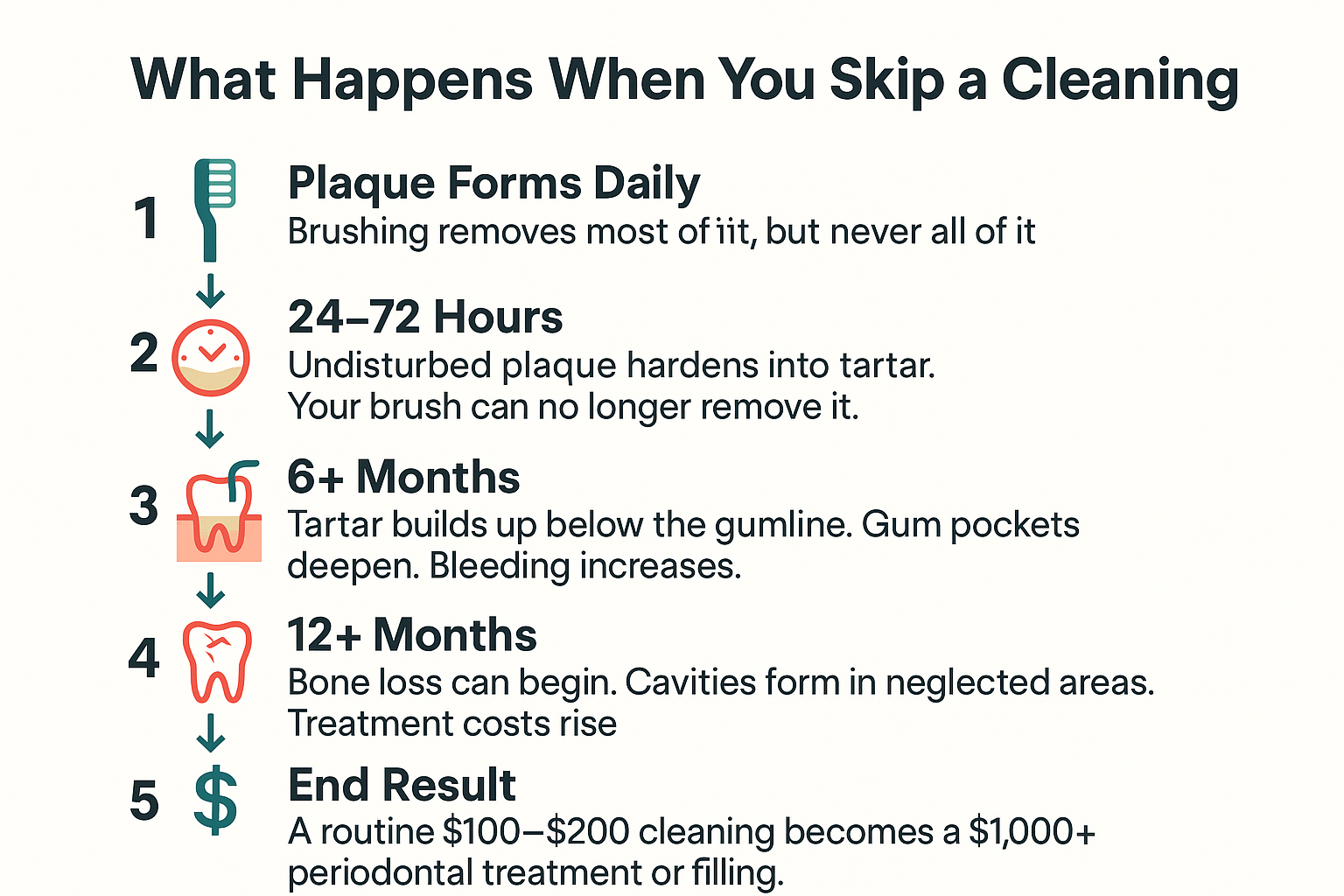
But here’s the catch. Plaque that sits undisturbed for 24 to 72 hours starts to mineralize. It absorbs calcium from your saliva and hardens into a substance called tartar — also called calculus. Once that happens, no toothbrush, no water flosser, no charcoal paste, and no amount of extra effort will remove it.
Tartar tends to build up in places that are already hard to reach:
- Along the gumline, especially on the lower front teeth
- Between teeth, where bristles can’t fully penetrate
- On the back surfaces of rear molars
- Below the gumline, where bacteria do the most damage quietly
For patients in families with kids in the Oak View or Goldenwest neighborhoods, it’s worth knowing that kids accumulate tartar faster than most parents expect — especially around braces or in kids who breathe through their mouths at night. Dental exams for all ages catch this early, before it turns into something that needs more than a cleaning to fix.
What a Professional Cleaning Actually Removes
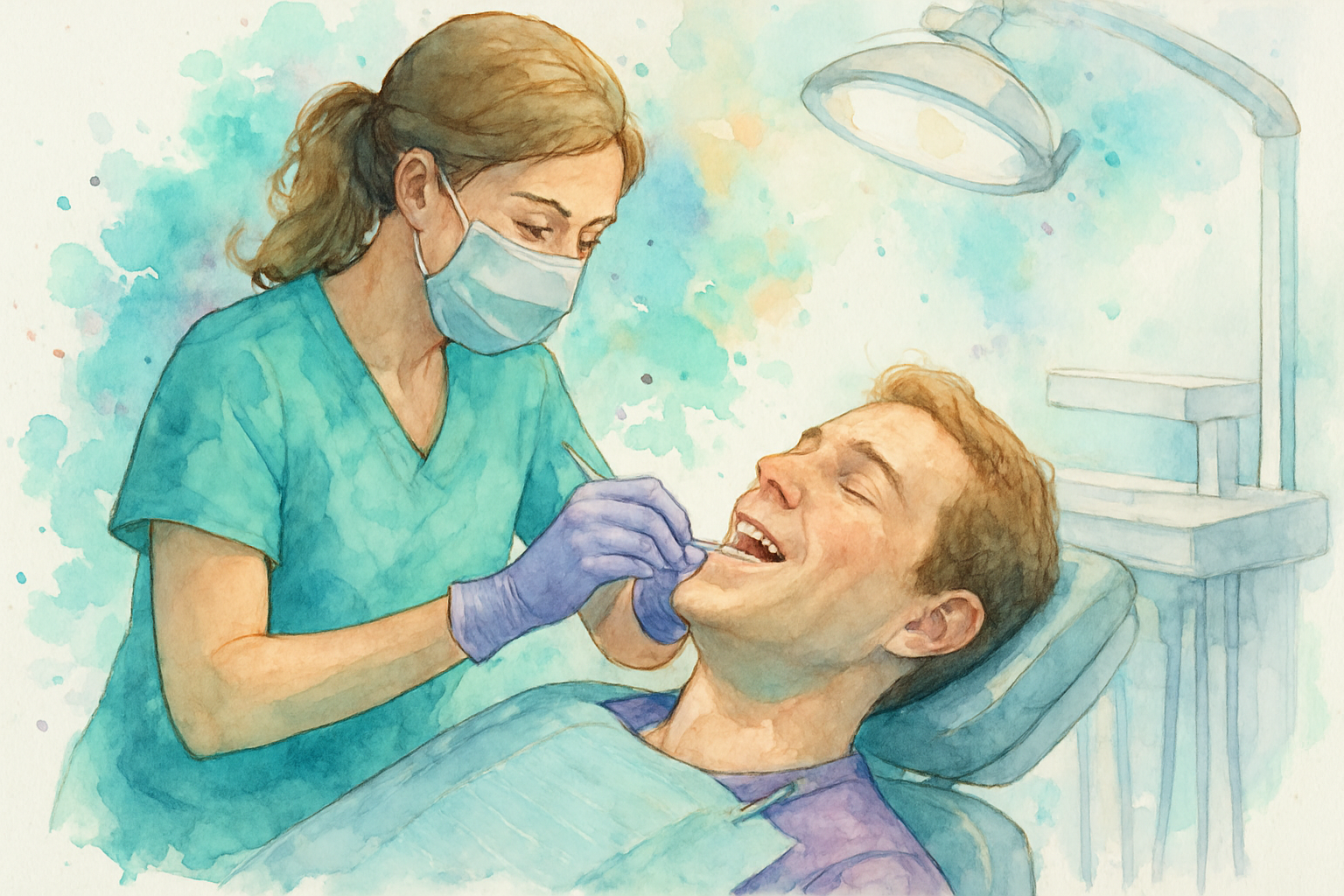
During a professional cleaning, a trained hygienist uses hand scalers and ultrasonic instruments to physically break apart and remove tartar deposits — something that can’t be replicated at home. The ultrasonic tool vibrates at a frequency that shatters mineralized buildup without harming the tooth underneath.
After scaling, the hygienist polishes your teeth with a mildly abrasive paste that clears away surface stains and smooths the enamel. A smoother surface is actually harder for new bacteria to cling to, which gives you a modest head start on your next six-month cycle.
What most patients don’t realize is that the cleaning visit is also when your gum health gets evaluated. The hygienist measures the depth of the pockets between your gums and teeth using a small probe. Healthy pockets measure 1 to 3 millimeters. Anything deeper signals inflammation or early gum disease — the kind that doesn’t hurt until it’s already doing damage.
If you’ve ever noticed blood when your hygienist checks those measurements, that bleeding is your gum tissue telling you something. Our article on why gums bleed during a cleaning explains exactly what’s happening and when it’s a red flag versus something that clears up after consistent care.
What Happens to Your Teeth When You Skip Cleanings
This infographic shows what actually builds up — and what breaks down — when professional cleanings are delayed beyond the recommended six-month schedule.
The Real Cost of Skipping: What Changes After 12 Months Without a Cleaning
In Huntington Beach and across Orange County, a routine prophylaxis cleaning typically runs $100 to $200 without insurance, depending on the practice. That’s the baseline cost when everything is caught on schedule.
When patients skip a year or more, the math shifts significantly. Tartar that’s been sitting below the gumline for that long often requires a deep cleaning — also called scaling and root planing — which is a separate, more intensive procedure done in two appointments. That treatment ranges from $800 to $2,000 in the Orange County market, depending on how many teeth are involved.
And that’s before any cavities, crowns, or other restorative work that might surface once the buildup is cleared. Understanding what a deep cleaning actually involves helps patients know what they’re being told before they agree to treatment — and whether a second opinion makes sense.
For patients without insurance, the cost question is real. Our in-house savings plan brings cleanings and exams to a significantly lower out-of-pocket cost, which is part of why we see so many patients from the Bolsa Chica-Heil and Huntington Harbour areas who want quality care without the corporate dental chain experience. If you’re weighing cost against care quality, this guide on affordable options without insurance lays out the real-world options clearly.
Routine Cleaning vs. Deep Cleaning: What’s the Difference?
Patients often don’t realize these are two completely different procedures with different costs and recovery timelines. Here’s a side-by-side breakdown.
| Factor | Routine Cleaning (Prophylaxis) | Deep Cleaning (Scaling & Root Planing) |
|---|---|---|
| Who it’s for | Patients with healthy or mildly inflamed gums | Patients with gum disease or deep pockets (4mm+) |
| What’s removed | Surface tartar and stains above and just below the gumline | Tartar and bacteria from deep below the gumline, down to the root |
| Number of visits | 1 visit, typically 45–60 minutes | Usually 2 visits, one per side of the mouth |
| Anesthesia needed? | No — generally comfortable | Yes — local anesthesia used in most cases |
| Typical cost (OC, uninsured) | $100–$200 | $800–$2,000 depending on severity |
| Recovery | None — back to normal immediately | Mild soreness for 1–3 days; some sensitivity |
| How often needed | Every 6 months for most adults | Once to address disease; maintenance cleanings every 3–4 months after |
How Busy Families in Huntington Beach Can Actually Stay on Schedule
One of the most common reasons patients fall behind on cleanings isn’t cost or fear — it’s just scheduling. Summer sports, school calendars, and work schedules make it genuinely hard to get the whole family in at once.
A few approaches that work well for families we see from Central Huntington Beach and Fountain Valley:
- Book back-to-back appointments for multiple family members on the same afternoon — one trip, everyone seen
- Use summer break as the reset window — kids are easier to schedule June through August, and it lines up with the back-to-school dental push most insurers support
- Set a December reminder — year-end insurance benefits expire December 31 for most plans, and unused preventive benefits don’t roll over
- Ask about same-day scheduling — our team keeps flexibility in the schedule for patients who can come in on short notice
For families with both adults and younger kids, understanding how a family dental practice actually works makes the logistics clearer — especially if you’ve been splitting appointments between a pediatric dentist and an adult practice.
Frequently Asked Questions About Dental Cleanings
How often do I actually need a cleaning — is every 6 months a real rule or just a guideline?
It’s a real guideline, but it’s not one-size-fits-all. Every 6 months is the standard recommendation for adults with healthy gums and low cavity risk. If you have a history of gum disease, you may be put on a 3- to 4-month maintenance schedule. Some very low-risk patients can stretch to once a year — but that’s a decision your hygienist should make based on your actual gum measurements, not something to assume on your own.
My teeth look and feel fine. Do I really need to come in if nothing hurts?
Yes — and the reason is exactly that dental disease usually doesn’t hurt until it’s advanced. Gum disease causes no pain in its early stages. Cavities don’t hurt until they’re close to the nerve. By the time you feel something, the treatment is almost always more involved and more expensive than if it had been caught at a routine visit.
Will a cleaning hurt? I’ve had bad experiences before.
For most patients with healthy gums, a cleaning is mildly uncomfortable at worst — some pressure, some sensitivity near the gumline, but not pain. If your gums are inflamed from tartar buildup, there can be more sensitivity. We adjust how we work based on each patient’s comfort level, and we never rush through it. If you’ve had a rough experience somewhere else, tell us before we start — that context actually changes how we approach the appointment.
I don’t have dental insurance. Is a cleaning worth paying out of pocket for?
Almost always yes. A $100–$200 cleaning today prevents a $1,000+ treatment later. We also have an in-house savings plan that brings the cost of cleanings and exams down significantly for uninsured patients. You don’t need insurance to afford consistent preventive care here.
My kid brushes well. Do they still need cleanings?
Yes — kids build tartar too, often faster than adults realize, especially on the lower front teeth and around any molars that have come in recently. Kids also can’t physically reach the same areas an adult can. Pediatric cleanings are shorter and gentler, but they’re just as important as adult appointments.
What if I haven’t been to the dentist in 3 or 4 years — will I be judged?
No. We see this regularly, and there’s no lecture waiting for you. The only thing that matters when you come in after a long gap is figuring out where things stand and making a plan. Dr. Kalvin and the team are here to help, not to make you feel bad about the past.
Ready to Get Back on Schedule?
If it’s been more than six months — or longer — since your last cleaning, our team at Kali Dental is ready to help you get back on track without judgment and without pressure. We serve families across Huntington Beach, Fountain Valley, and the surrounding Orange County area, and we keep flexible scheduling for patients who’ve been putting this off. Call us at (657) 800-5254 or book your appointment directly at kalidental.com.