
Direct Answer: Pick the tooth up by the crown, rinse it briefly if dirty, and place it back in the socket or in cold milk. Then call a dentist immediately. The best chance of saving it is within 15 to 30 minutes.
It happens in about half a second. A stray elbow during beach volleyball near the pier, a head-to-head collision at a Sunday rec league soccer game, a surfboard that comes back at you in the shore break off Goldenwest.
One second everyone is playing. The next, a kid is holding a permanent tooth in their hand and nobody knows what to do with it.
I want you to know what to do before that moment, because the window is short. What happens in the first 15 to 30 minutes decides whether that tooth goes back in the mouth or gets replaced later with an implant or a bridge.
Why Summer Means More Knocked Out Teeth Around Huntington Beach
The American Association of Endodontists reports that more than 5 million teeth are knocked out each year in the U.S. Their 2026 survey found only 27 percent of adults knew that a 30-minute response window is critical.
That gap is the whole problem. Most people handle the tooth wrong, drive home, then start searching online, and by then the clock has run out.
Summer here stacks the odds against you. Between June and the end of August, our patients across Oak View, Bolsa Chica-Heil, Huntington Harbour, and Central Huntington Beach are doing all of the following at once:
- Youth soccer and flag football summer leagues that run through August
- Beach volleyball and pickup basketball with no referee and no helmet
- Surfing and skimboarding where boards and elbows fly
- Skateparks and bike trails with hard concrete landings
- Family trips where nobody knows the local dentists
None of that is a reason to keep kids off the field. It is a reason to have a plan in your beach bag and your head.
Step 1: Pick the Tooth Up by the Crown, Not the Root
This is the step most people get wrong, and it is the one that matters most.
Grab the tooth by the crown, meaning the white chewing part you can see when someone smiles. Do not touch or handle the root, the pointed end that was sitting in the gum.
The root is coated in living periodontal ligament cells. Those cells are what let a tooth reattach. Damage them and reimplantation stops being an option.
If the tooth landed in the sand or on turf and is visibly dirty:
- Rinse it gently with water for no more than 10 seconds
- Hold it by the crown the entire time
- Do not scrub it, brush it, or use soap
- Do not dry it off with a towel or napkin
- Do not wrap it in a paper towel or tissue, that dries out the root
I have had parents come in holding a tooth folded inside a dry napkin, which felt like the careful thing to do. Sadly it is one of the fastest ways to lose the tooth. Wet is what keeps it alive.
Step 2: Store It Right, and Milk Beats Water
Once the tooth is clean, it needs to stay moist in something that will not destroy the root cells. There is a clear ranking here.
The best option is putting it right back in the socket. If the person is calm enough and old enough to hold it in place, guide the tooth back into the empty space the right way around and have them bite down softly on a clean cloth or gauze. The American Academy of Pediatrics supports reinserting a permanent tooth right away when possible.
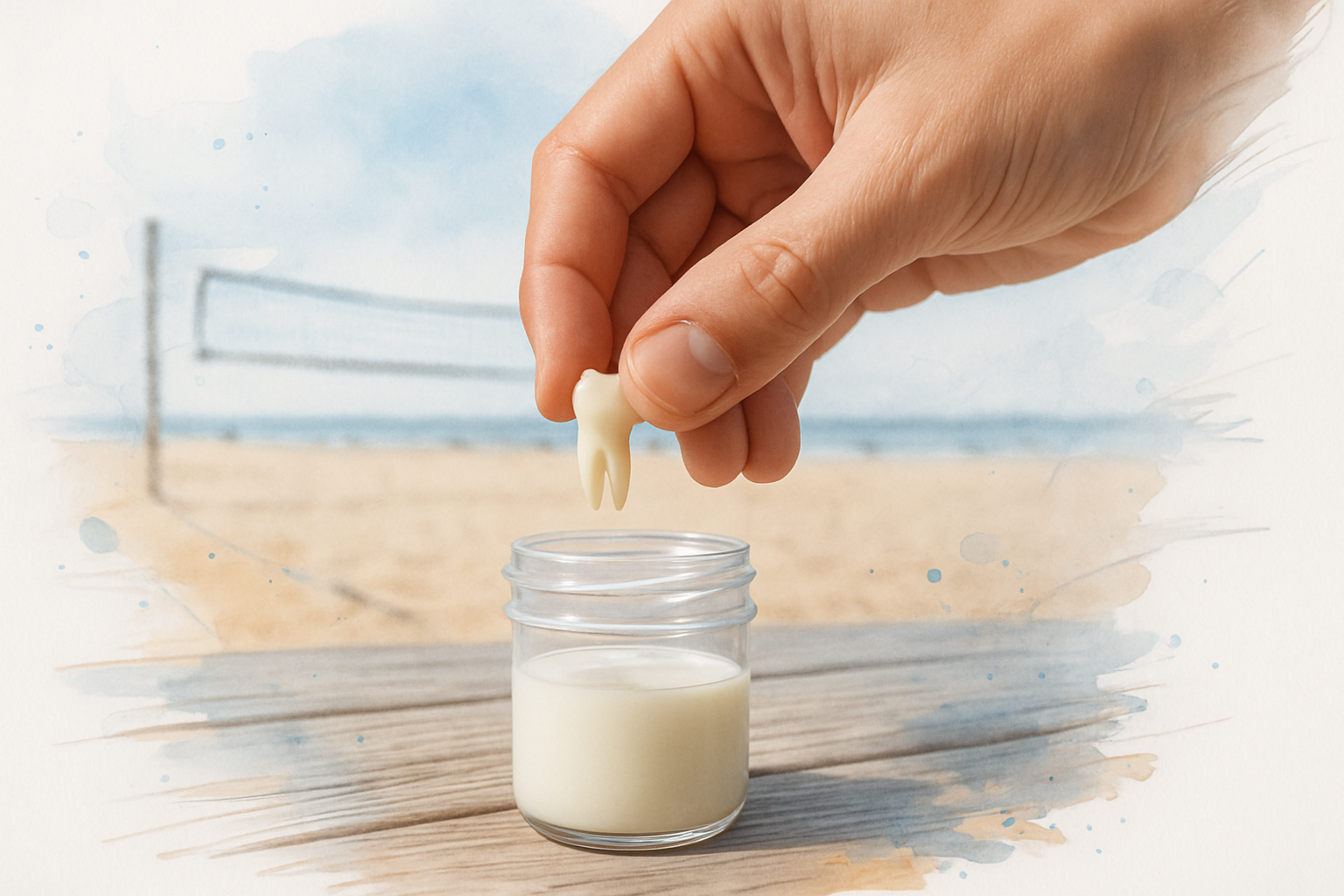
If that is not realistic, and with a scared eight-year-old it often is not, use cold milk in a small clean container. Milk has a mineral balance close enough to your body’s to keep root cells alive for a while.
Saliva works too. Have the person spit into a cup and keep the tooth in it, or tuck the tooth inside their cheek if there is no risk of swallowing it.
Skip tap water. It sounds harmless, but it pulls fluid across the cell walls in the root and damages them fast. Water is only for a quick 10-second rinse, never for storage.
Storage Options, Ranked
Here is how the common options actually compare when you are standing on the sand with a tooth in your hand.
| Storage Method | How Good Is It | What You Should Know |
|---|---|---|
| Back in the socket | Best | Ideal if the person can tolerate it. Bite gently on gauze or a clean cloth to hold it. |
| Cold milk | Very good | Widely recommended backup. Generally buys roughly 30 to 60 minutes. |
| Saliva or inside the cheek | Good | Better than nothing. Watch for swallowing risk with young kids. |
| Tooth preservation kit | Very good | Some sports first aid kits carry one. Follow the package directions. |
| Tap water | Poor | Can damage the root cells. Use for a brief rinse only, never storage. |
| Dry napkin, tissue, or pocket | Worst | Lets the root dry out. This is the most common mistake I see. |
The First 30 Minutes, Step by Step
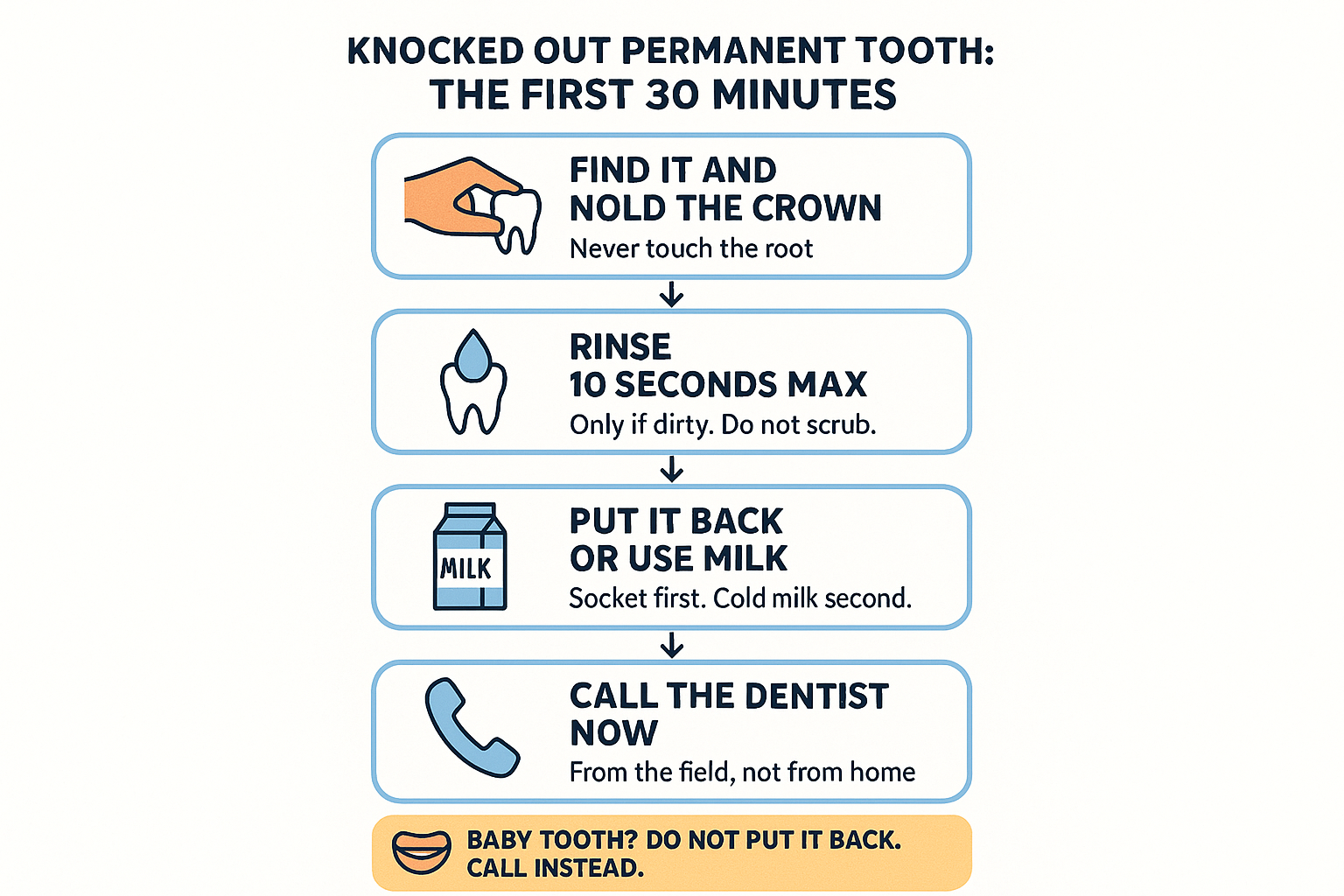
Save this to your phone or print it for the sports bag. It is the sequence I would want any parent or coach on the Central Huntington Beach fields to follow.
Step 3: Call While You Are Still in the Parking Lot
This is where families lose the tooth without realizing it. They handle everything correctly, then drive home, get everyone cleaned up, and start looking for a dentist 40 minutes later.
Make the call before you leave the beach lot or the field. Say the words “a permanent tooth was knocked out” right away, because that phrase moves you to the front of any schedule.
Here is the timeline in plain terms:
- Under 15 minutes back in place: best odds the tooth reattaches
- 15 to 60 minutes in milk or a preservation kit: still a real chance
- Past that window: survival rates drop off sharply
A tooth that cannot be saved is not the end of the road. There are good restorative paths, and understanding when pulling a tooth is the healthiest choice helps take some of the fear out of that conversation. But those paths take months. Thirty minutes of good decisions can save you all of it.
If the tooth is cracked or partly broken rather than fully out, that is a different situation with a slightly slower clock. We walk through it in what to do in the first hour after a broken tooth.
Baby Tooth or Permanent Tooth? The Rules Are Opposite
Every parent needs this one memorized, because doing the right thing for an adult tooth is the wrong thing for a baby tooth.
A knocked out baby tooth should never be put back in. Reinserting it can damage the developing permanent tooth sitting in the bone underneath. Keep your child calm, control any bleeding with gentle pressure from clean gauze, and call the dentist for guidance.
A knocked out permanent tooth is always a true emergency. Handle it by the crown, store it in the socket or cold milk, and get in within the hour.
Not sure which one it is? Kids usually start losing baby teeth around age six and finish somewhere in the early teens. If the child is under six, it is almost certainly a baby tooth. If they are ten or older and it is a front tooth, treat it as permanent and act fast.
When you are unsure whether something needs attention right now or can hold until morning, our guide on what can wait and what can’t covers the warning signs worth acting on.
The One Preventive Step That Actually Changes the Odds
A mouthguard is the cheapest dental insurance there is. The American Dental Association has noted that athletes without one are far more likely to end up with a dental injury.
Boil-and-bite guards from a sporting goods shop are better than nothing. But they tend to be bulky, they loosen up, and kids pull them out because they cannot talk or breathe comfortably. A guard sitting in a gym bag protects nothing.
A custom-fit guard made from a digital scan of your child’s teeth is thinner, stays put, and does not interfere with breathing during a hard sprint. Ours are made from scans rather than the old goopy impression trays, which most kids appreciate.
Summer is also when families finally have time for a full checkup. If you are already planning one before fall sports and school pictures, why summer is the best time for your kid’s dental exam is worth a read.
Frequently Asked Questions About a Knocked Out Tooth
Should I really try to put the tooth back in myself?
For a permanent tooth, yes, if the person can handle it. Rinse briefly, line it up the right direction, and press it gently into the socket, then bite softly on clean gauze. If they are panicking or the socket is bleeding heavily, put it in cold milk instead and get moving.
What if the tooth is chipped instead of knocked out?
Save any pieces you can find in milk and bring them along. A chip is less urgent than a full avulsion, but a crack that reaches the nerve can turn into serious pain fast. Rinse with warm water, use a cold compress on the outside of the cheek, and call the same day.
How fast can I actually be seen for something like this?
We hold same-day slots for urgent situations, and we see patients on Saturdays by appointment. If a permanent tooth is out, say that on the phone first so we can prep the room while you drive over from the beach or the field.
What does this kind of emergency visit cost if I don’t have insurance?
It depends heavily on what the tooth needs, whether a splint is involved, and whether a root canal follows later. Costs vary a lot case to case, so I would not trust any flat number you see online. We give you a number before we start work, we have an in-house savings plan for uninsured patients, and Cherry financing is available if you need to spread it out.
My insurance is out of network. Is it still worth coming in?
For a knocked out permanent tooth, yes, absolutely. The clock matters more than the network. We can still submit a claim on your behalf, and plenty of out-of-network patients get a real portion reimbursed. Our breakdown of what out-of-network actually means explains how that math usually works.
How long until we know if the tooth survived?
A reimplanted tooth is usually splinted to the neighboring teeth for a couple of weeks, then checked at follow-ups over the next several months. Some teeth reattach and last for years. Others need a root canal later, or eventually fail. We are honest with you at every check about what we are seeing.
Have a Plan Before the Next Game
Save (657) 800-5254 in your phone now, before you need it, and keep a small container in the sports bag alongside the sunscreen. Our office on Brookhurst Street keeps same-day time open for urgent situations, and we are here Monday through Wednesday, Friday, and Saturdays by appointment for families across Huntington Beach, Fountain Valley, and the rest of Orange County. If you have questions about a custom mouthguard before fall leagues start, you can call or book online at kalidental.com.