
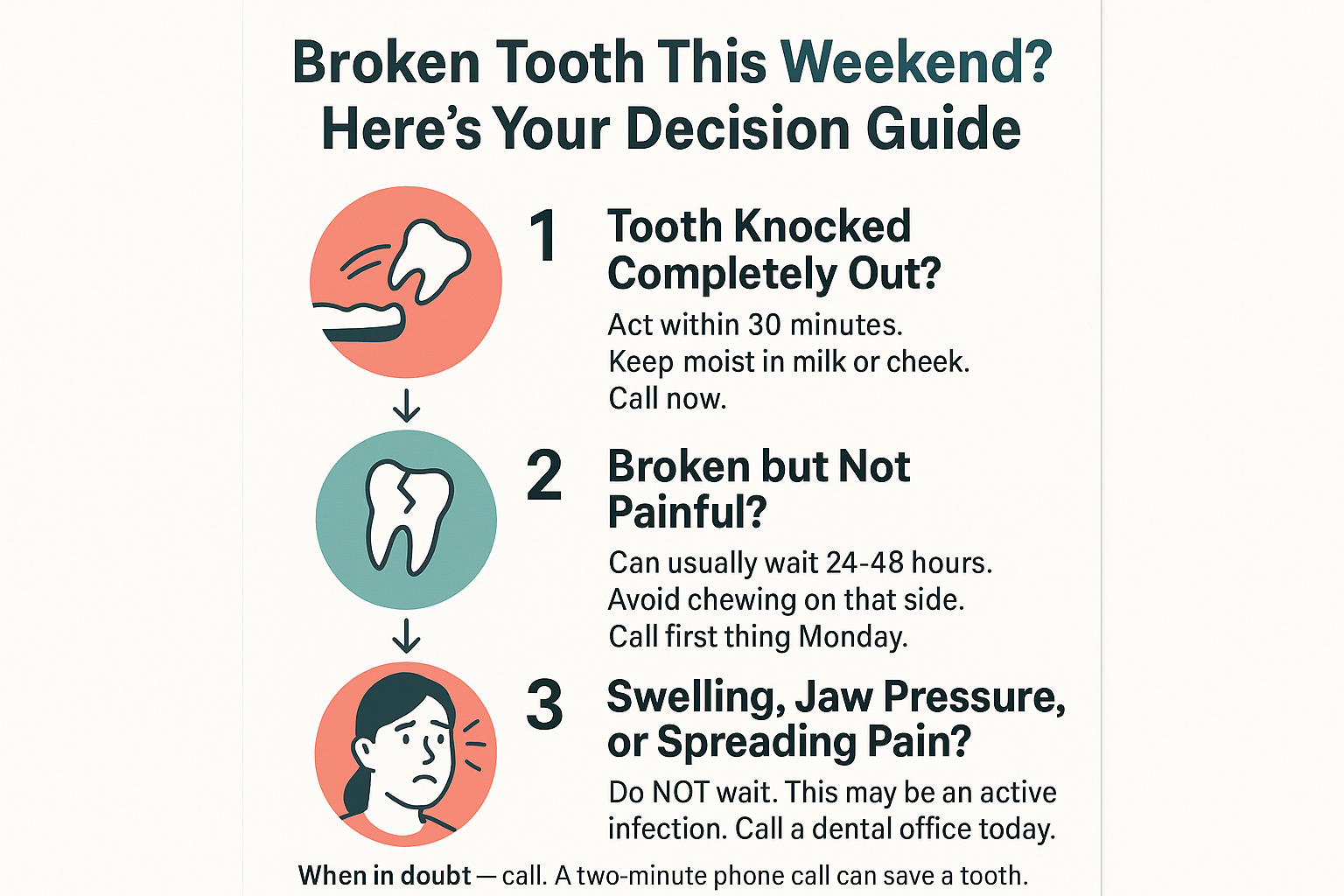
Direct Answer: If your tooth is knocked out, you have roughly 30 minutes to act. If it’s broken but not painful, it can usually wait 24-48 hours. Swelling with jaw pressure means call now.
It happens fast. One moment you’re at the beach volleyball courts near Central Huntington Beach, or your kid is coming off a youth soccer field near Goldenwest — and suddenly someone is holding a piece of their tooth. The first question is always the same: is this a real emergency, or can it wait until Monday?
The honest answer is: it depends on a few specific things, and the difference matters a lot. Some situations have a narrow window where acting fast can save the tooth. Others can safely wait 24-48 hours if you handle things right. And a couple of scenarios should never wait at all.
I’ve seen all of these walk through our door. This article is my attempt to give you a fast, clear framework for making that call — so you don’t waste a critical window, and you don’t spend your weekend in unnecessary panic either.
The Three Scenarios That Actually Matter
Most dental emergency guides try to cover every possible situation. I’m going to skip that. In practice, the calls and situations we see almost always fall into one of three categories — and knowing which one you’re in tells you exactly what to do.
Scenario 1: The tooth is knocked completely out.
This is the one with a real clock on it. According to the American Association of Endodontists, a tooth that has been knocked out has the best chance of successful reimplantation when it’s returned to the socket — or kept properly moist — within 30 minutes. One national survey found that only about 27% of adults even knew this window existed. Most people waste it rinsing the tooth under tap water, wrapping it in a paper towel, or driving to an emergency room. ERs generally cannot reimplant teeth. Do not rinse it. Keep it moist — tucked between your cheek and gum, in a cup of milk, or in saline — and call a dental office immediately.
Scenario 2: The tooth is broken but not painful.
This is the most common call we get on weekends. A cracked or chipped tooth that doesn’t hurt and isn’t bleeding heavily is not a drop-everything situation. The tooth structure is compromised, but you’re not at risk of rapid infection or irreversible damage overnight. You can generally wait 24-48 hours to be seen. Avoid chewing on that side, skip anything very hot or cold, and call first thing in the morning to get on the schedule.
Scenario 3: There’s swelling, jaw pressure, or a spreading ache.
This one should not wait. Swelling around a broken or infected tooth — especially if you feel pressure in your jaw or it’s moving toward your neck — is a sign of active infection. That can progress quickly. If you want more detail on how dental infections spread and what the warning signs look like, this article on toothache pain spreading to the neck explains exactly what’s happening inside. Do not take a wait-and-see approach with swelling.
Quick Reference: Does This Need Same-Day Care?
Use this at a glance when you’re not sure how urgent your situation is.

The 30-Minute Window Most People Don’t Know About
I want to spend a little more time on the knocked-out tooth scenario, because the mistakes people make in those first few minutes are almost always the same — and they’re preventable.
When a tooth gets knocked out completely, the ligament fibers that attach it to the bone are still alive for a short time. That’s what makes reimplantation possible. But those cells dry out fast. Here’s what to do and what to avoid:
- Do keep the tooth moist — in milk, saline, or gently tucked between the cheek and gum
- Do call a dental office immediately, even if it’s a Saturday evening
- Don’t scrub or rinse the root under tap water — this strips the live tissue
- Don’t wrap it in a paper towel or dry cloth
- Don’t drive to an ER first — they treat the trauma, but they can’t reimplant the tooth
Summer in Huntington Beach raises the chances of exactly this kind of injury. Youth baseball and soccer leagues running through August near Goldenwest and Oak View, surfers taking a board to the face at the pier, beach volleyball at the state beach — the exposure is real. One patient called us after a front tooth broke during a weekend activity and was seen at 8am the next morning, with same-day financing approved on the same call she booked. The window was preserved because she called a dental office instead of waiting.
If the tooth cannot be reimplanted, that’s a separate conversation about what comes next. But the only way to know if reimplantation is possible is to get to a dentist while the clock is still running.
Broken Crown? Here’s When to Panic and When Not To
Broken crowns get their own category because they cause a lot of unnecessary alarm — and sometimes not enough alarm, depending on the situation.
A crown that pops off cleanly without any pain is generally not urgent. The crown is protecting the underlying tooth, and if the tooth itself feels fine and there’s no sensitivity, you’re usually okay to wait until the next business day. Store the crown somewhere safe (not in a pocket where it can be lost), and don’t try to glue it back yourself with anything other than temporary dental cement from a pharmacy.
But there are two situations with a broken crown where I’d say don’t wait:
- The crown broke and left a jagged or sharp edge that’s cutting into your cheek or tongue
- The crown came off and the underlying tooth is sensitive to temperature or pressure
Temperature sensitivity after a crown comes off usually means the dentin underneath is exposed — and that can escalate quickly without protection. If you’re in this situation and want to understand more about how same-day crown repair works, this breakdown of same-day crown options is worth reading before your appointment so you know what to expect.
For sharp-edged breaks specifically, dental wax from any drugstore can cover the edge temporarily and protect your soft tissue until you’re seen.
Can It Wait? A Fast Reference by Situation
Here’s a plain-language breakdown of the most common scenarios we hear about — and the honest guidance on timing.
| Situation | Urgency Level | What To Do Right Now |
|---|---|---|
| Tooth knocked out completely | Call immediately — 30-min window | Keep moist, call a dental office now |
| Broken tooth, no pain | Can wait 24-48 hours | Avoid chewing on that side, call in the morning |
| Broken tooth with sharp pain or sensitivity | See a dentist today or first thing tomorrow | Call the office, avoid temperature extremes |
| Crown came off, tooth feels fine | Non-urgent — call next business day | Store crown safely, use temporary cement if available |
| Crown off, tooth sensitive to hot/cold | Prompt care — don’t wait more than a day | Call the office, avoid temperature on that tooth |
| Swelling, jaw pressure, or spreading pain | Do not wait — potential infection | Call now; if after hours, go to urgent care or ER for pain management |
What a Good Emergency Dental Response Actually Looks Like
When you call a dental office about a tooth emergency, the response you get in the first 60 seconds tells you a lot about what kind of care you’re going to receive.
A good response sounds like this: the person who answers checks availability immediately, gives you interim care guidance while you’re still on the phone, and either offers you a same-day or next-morning slot — or tells you honestly what the wait will be. Based on what we’ve seen, urgent care calls convert at nearly 100% when a same-day slot is available and the caller gets real guidance on the phone rather than being told to just ‘come in and we’ll see.’
If you call and get voicemail with no callback option, or you’re told the earliest available is in a week, call the next office. For a dental emergency — especially a knocked-out tooth — time is not on your side.
For situations where you’re also dealing with insurance questions or cost concerns, that shouldn’t stop the call. Many practices, including ours, can walk through financing options in the same conversation. One caller had same-day financing approved through Cherry before she even came in. You don’t have to figure out the money before you figure out the tooth. And if you’re uninsured, our in-house savings plan is worth asking about when you call.
If the situation involves swelling that’s spreading toward your neck or jaw, that falls into a different category — not just urgent, but potentially serious. This article explains exactly what to watch for if pain or swelling seems to be moving beyond the tooth itself. And if you’re ever unsure whether your situation qualifies as a true emergency versus something that can wait, this guide on the difference between a dental urgency and a true emergency lays it out clearly.
Frequently Asked Questions About Dental Emergencies in Huntington Beach
Can I go to an emergency room for a broken tooth?
You can, and it makes sense if you’re dealing with serious bleeding, facial trauma, or swelling that’s spreading rapidly. But for the tooth itself — including a knocked-out tooth — the ER usually can’t do much beyond pain management and antibiotics. They don’t have the equipment to reimplant a tooth or repair a crown. For anything tooth-specific, a dental office is where you need to be.
What do I do if I break a tooth and it’s Sunday night?
First, figure out which of the three scenarios you’re in. No pain, no swelling? You’re likely okay until Monday morning — call as early as possible to get on the schedule. Swelling, pressure, or a tooth that was knocked out entirely? Call a dental office even if it’s after hours — many practices have an after-hours line or check messages regularly. Don’t wait until Monday if infection symptoms are present.
My kid’s tooth got knocked out at a game. Is that different from an adult tooth?
It depends on whether it’s a baby tooth or a permanent tooth. Baby teeth are generally not reimplanted — the attempt can actually damage the developing adult tooth underneath. But a permanent tooth that’s knocked out follows the same 30-minute rule as an adult’s. If you’re not sure which type it is, call a dental office immediately and describe the situation — they can tell you within seconds how to proceed.
How much does an emergency dental visit cost in Huntington Beach?
It varies depending on what treatment is needed once you’re seen. An emergency exam alone is typically separate from any procedure cost, and procedures like root canals or same-day crowns carry their own pricing. The best approach is to call and describe your situation — most offices can give you a ballpark on the phone and discuss payment options before you come in. If you’re uninsured, ask about in-house savings plans, which can reduce costs significantly.
Is it safe to drive yourself to a dental emergency appointment?
If you’re in significant pain or took any pain medication, it’s better to have someone drive you. For a broken tooth that’s uncomfortable but manageable, driving yourself is usually fine. Use your judgment — if the pain is severe enough to affect your focus, don’t drive.
What if I can’t afford the treatment right away?
Call anyway. Many dental offices — ours included — offer same-call financing through options like Cherry, which takes a few minutes to apply for and can be approved before your appointment. Letting cost uncertainty stop you from calling is one of the most common reasons people lose a tooth that could have been saved. The conversation about cost is much easier to have when the tooth is still viable.
Facing a Dental Emergency in Huntington Beach?
If you’re dealing with a broken or knocked-out tooth this weekend and you’re not sure what to do next, the fastest thing you can do is call — not fill out a form. Our team at Kali Dental answers the phone with availability ready and can walk you through interim care while we get you scheduled. Call us at (657) 800-5254 or book online at kalidental.com — we’re here to help you figure out the next right step, whatever that turns out to be.