
Direct Answer: A dental implant in Huntington Beach typically takes 3 to 6 months from surgery to final crown, though patients who need bone grafting first may need 6 to 12 months total.
One of the most common questions we hear from patients in Huntington Beach, whether they’re calling from Oak View or driving in from Fountain Valley, is some version of: ‘How long does the whole implant process actually take?’ Most people picture one appointment and a finished tooth. That’s not how it works, and I’d rather you know that upfront than be surprised three months in.
The honest answer is that the timeline depends on a few specific factors, and one of them, your bone health, is something most patients don’t even know to ask about. When we can skip the bone grafting step, the process moves much faster. When we can’t, it adds time before the main procedure even begins.
What I want to do here is walk you through each phase clearly, give you real time ranges instead of vague answers, and explain what actually drives the schedule. If you’ve been putting off replacing a missing tooth, this article will help you figure out what you’re actually looking at, and whether now is a good time to start.
The Four Phases of a Dental Implant, and What Each One Takes
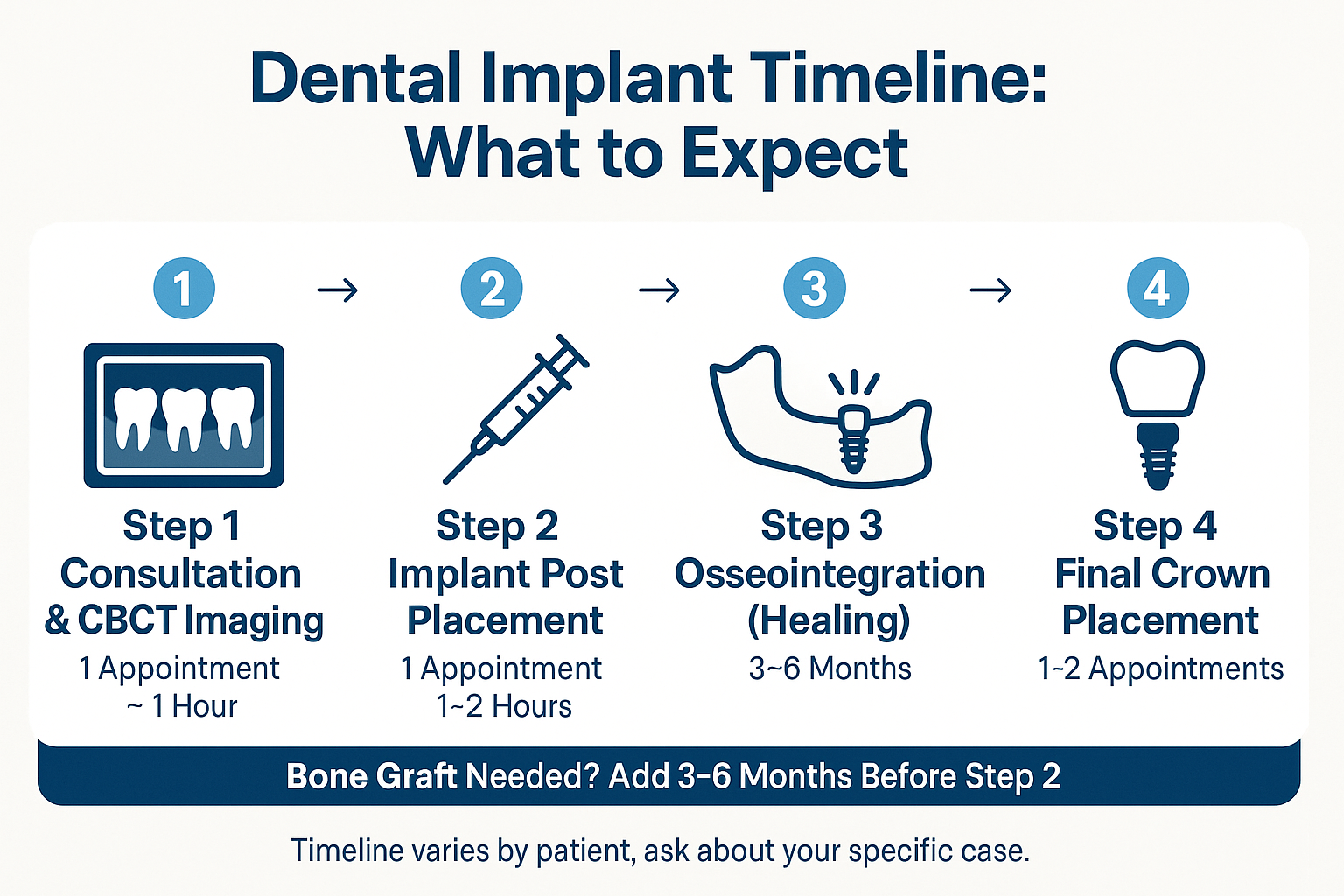
A dental implant isn’t a single procedure. It’s a sequence of steps, and each one has its own timeline. Here’s how the process actually looks from start to finish:
Phase 1: Consultation and imaging, roughly 1 appointment
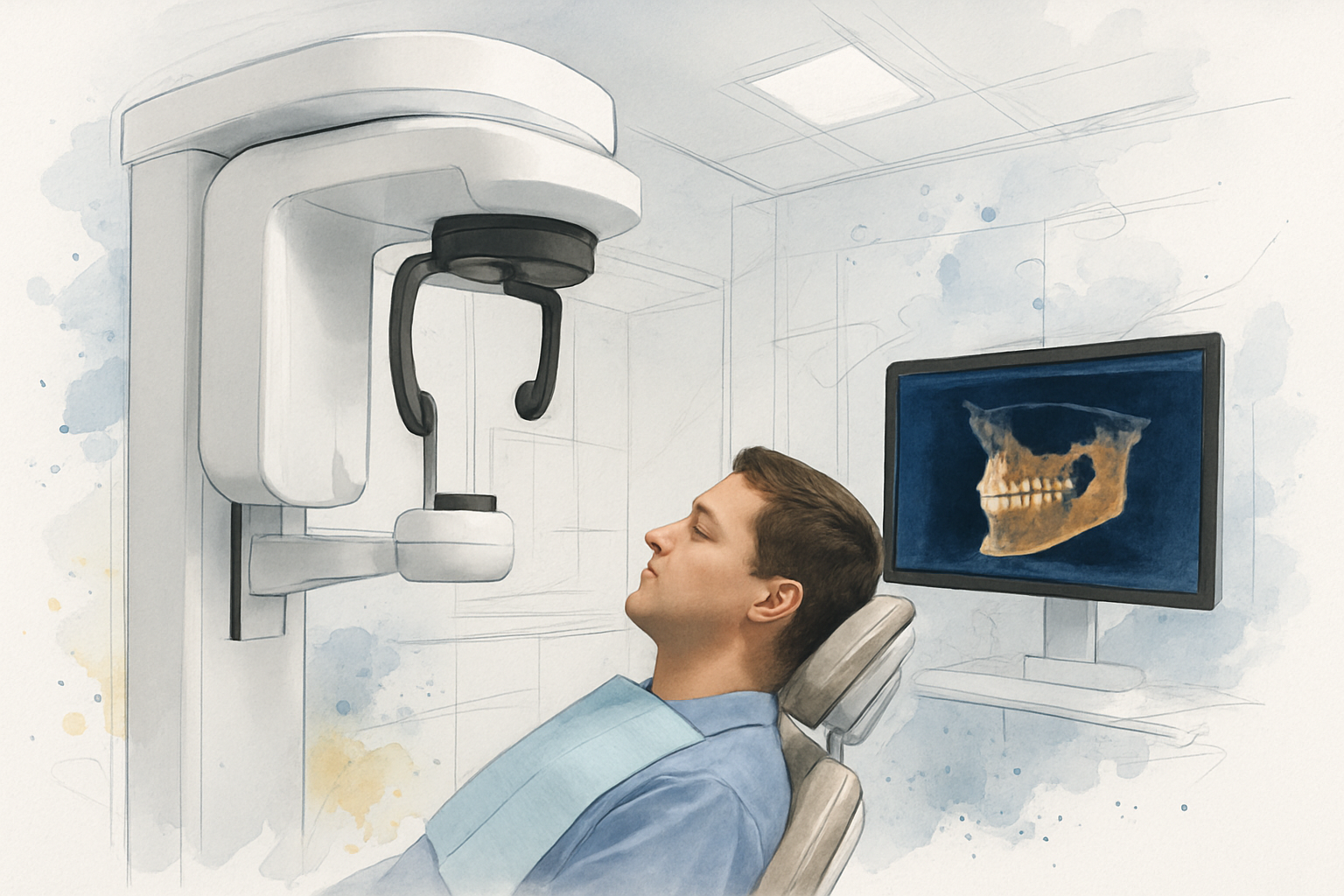
This is where everything starts. We take a full set of digital X-rays and, in most implant cases, a CBCT scan, a 3D image of your jaw that shows us the exact volume and density of your bone. This isn’t extra; it’s how we make a real plan instead of guessing. The consultation appointment takes about an hour, and you leave knowing your options, your likely timeline, and what things will cost before anything is scheduled.
One of our patients described Dr. Kalvin as someone who ‘explained each procedure’ clearly and noted that ‘the price was very reasonable.’ That’s exactly the kind of conversation the first visit is designed to be.
Phase 2: Implant placement surgery, 1 appointment, 1 to 2 hours
The titanium post is placed directly into your jawbone. This is done under local anesthesia and is more straightforward than most patients expect. The appointment itself is brief. But the healing that follows is not.
Phase 3: Osseointegration, 3 to 6 months
This is the waiting phase, and it’s the one that surprises people most. Osseointegration is the process of your jawbone growing around and fusing to the implant post. You can’t rush it. Most patients need 3 to 6 months for this to complete, depending on bone density and overall health.
Phase 4: Final crown placement, 1 to 2 appointments
Once the implant has integrated, we attach the abutment and place the final crown. At our office, same-day crown technology means we can mill the restoration in-house rather than sending it to a lab, which cuts down on the back-and-forth. This phase is usually quick.
Total time for a straightforward case: roughly 4 to 8 months from consultation to finished tooth.
The Factor That Stretches or Shortens Your Timeline: Bone Health
Most patients ask about the implant. Fewer think to ask about their bone. But bone health is often what determines whether your process takes five months or closer to a year.
When a tooth is lost or extracted, the jawbone underneath it begins to shrink. This happens gradually, sometimes quickly, because the bone no longer has a root stimulating it. A tooth that’s been missing for a year or more may have lost enough volume that there isn’t enough bone left to hold an implant securely.
That’s where a bone graft comes in. A graft adds material to the site to rebuild volume and create a stable foundation. But a graft needs its own healing time before the implant post can be placed, typically 3 to 6 months on top of everything else.
Who actually needs a bone graft? The honest answer is: we can’t tell without imaging. This is exactly why the CBCT scan at the consultation matters so much. A standard 2D X-ray shows a flat picture. The 3D scan gives us the actual dimensions of your bone, height, width, density, so we can tell you with confidence whether a graft is necessary or if you can move straight to implant placement.
Some patients who had a tooth pulled recently come in with plenty of bone remaining and skip the graft entirely. Others who’ve had a gap for years find that grafting is the only way to make the implant viable long-term. There’s no way to know which category you’re in without that scan. If you’ve already had a tooth removed and are wondering what comes next, our article on how long it actually takes to recover from a tooth extraction can give you some helpful context on healing timelines before the implant phase begins.
The Dental Implant Timeline at a Glance
Here’s a visual breakdown of each phase, what happens, and how long it typically takes.
Implant Timeline: With and Without a Bone Graft
The single biggest variable in your total treatment time is whether bone grafting is needed before the implant post is placed. Here’s how those two paths typically compare.
| Phase | No Bone Graft Needed | Bone Graft Required First |
|---|---|---|
| Consultation and CBCT imaging | 1 appointment | 1 appointment |
| Bone graft and healing | Not needed | 3-6 months |
| Implant post placement | 1 appointment | 1 appointment |
| Osseointegration (healing) | 3-6 months | 3-6 months |
| Crown placement | 1-2 appointments | 1-2 appointments |
| Estimated total timeline | 4-8 months | 7-14 months |
Why Starting Now Matters More Than You Think
According to the American College of Prosthodontists, roughly 120 million Americans are missing at least one tooth. Many of them have been waiting, sometimes for years, because they assume the process is too long or too complicated to fit into a real life.
But consider this: a patient in Huntington Beach who books a consultation in early June and moves straight to implant placement is typically well into the osseointegration phase by August and looking at a finished crown before the holidays. That’s a meaningful shift in how they feel eating Thanksgiving dinner, taking family photos at Christmas, or heading into a new year with a complete smile.
The timeline feels long in the abstract. It feels very different when you anchor it to something real on your calendar.
For families in Central Huntington Beach and Bolsa Chica-Heil juggling school schedules, summer is actually one of the more manageable times to start. The first few appointments are quick, and the long healing phase requires nothing from you except patience. You’re not taking weeks off work, you’re waiting for biology to do its job.
If you’ve had a tooth removed and haven’t yet looked into replacement options, our article on when pulling a tooth is the healthiest choice covers some of the reasoning that leads patients here, and what they’re weighing when they decide to move forward with an implant.
What Implants Cost in the Huntington Beach Area, and How to Plan for It
Cost is the most common reason patients in the area delay implant treatment. I hear this in consultations regularly, and I understand it. Implants are not inexpensive, and many insurance plans cover little to none of the cost.
What drives the price varies from patient to patient. The main factors are:
- Whether you need one implant or several
- Whether bone grafting is required before placement
- The type of crown or restoration placed on top
- The imaging and diagnostic work at the start
Because these variables stack differently for every patient, I’d encourage anyone shopping by phone to get an actual consultation before comparing numbers. What looks like a cheaper quote elsewhere may not include the graft, the imaging, or the crown, and those aren’t optional line items.
For patients without insurance, we offer an in-house savings plan that helps bring the cost of treatment into a more manageable range. We also offer Cherry financing, which lets patients spread payments over time and takes about two minutes to apply for. A few patients who called us originally asking about CareCredit were surprised to find Cherry worked similarly and fit their budget just as well.
For a deeper look at the cost breakdown specific to Orange County, our article on how much dental implants actually cost in Orange County walks through the variables in detail. And if you’re uninsured and not sure where to start, this article on staying ahead of dental problems without insurance covers some of the tools available to you.
Frequently Asked Questions About Dental Implants in Huntington Beach
Am I a candidate for a dental implant if I’ve had a missing tooth for several years?
Possibly, yes, but bone loss is the main factor to check. When a tooth has been missing for a long time, the underlying jaw bone can shrink, which may mean a bone graft is needed before an implant post can be placed. The only way to know for certain is a CBCT scan, which gives a 3D picture of your bone volume. Many long-term gaps are still treatable with implants; some just require an extra step first.
Does the implant process hurt?
The placement surgery is done under local anesthesia, so you shouldn’t feel pain during the procedure itself. Most patients report feeling some soreness and mild swelling in the days after, similar to what follows a tooth extraction. The osseointegration phase, the long healing window, is generally pain-free because the implant is simply integrating with your bone with no active work happening.
Can I get a temporary tooth while the implant heals?
In many cases, yes. Depending on the location of the implant and your specific treatment plan, there are options to maintain appearance during the healing phase. This is a good question to bring up at the consultation so Dr. Kalvin can walk you through what makes sense for your situation.
What if I’m not sure whether I need an implant, a bridge, or something else?
That’s exactly what the consultation is for. The goal of the first visit isn’t to sell you on any particular treatment, it’s to give you a clear picture of your options, what each one involves, and what each one costs, before you commit to anything. Patients regularly come in unsure and leave with a real plan they feel good about.
Does insurance ever cover any part of a dental implant?
Some plans cover portions of the treatment, commonly the crown or the extraction that preceded the implant, while covering little or nothing of the post placement itself. It varies significantly by plan. If you’re not sure what your plan covers, we can help you work through that during the consultation. For patients without insurance, the in-house savings plan and Cherry financing are the most common tools we use to make the cost manageable.
How long does a dental implant actually last once it’s placed?
With good oral hygiene and regular cleanings, dental implants are designed to be a long-term or even permanent solution. The titanium post itself typically integrates for life. The crown on top may need replacement after 10 to 15 years depending on wear. This is one reason patients often view the upfront cost differently once they factor in that they won’t be replacing the tooth again the way they might with a bridge or denture.
Ready to Find Out Where You Actually Stand?
If you’re missing a tooth and want a straight answer about your options, not a sales pitch, the best next step is a consultation where we can take the imaging and give you a real plan. Kali Dental serves patients throughout Huntington Beach, Fountain Valley, and the surrounding Orange County area, and we’re accepting new patients now. Call us at (657) 800-5254 or book directly at kalidental.com to get started.