
Direct Answer: A single dental implant in Orange County typically involves three separate components and can range widely in total cost depending on your bone health, materials chosen, and whether preparatory work like grafting is needed first.
One of the most common questions I hear from patients in Huntington Beach — and honestly across all of Orange County — is some version of: ‘I got quoted three different prices for an implant. Why is nobody giving me a straight answer?’ It’s a fair frustration. Implant pricing is genuinely confusing, and most offices don’t do a great job explaining why the number looks the way it does.
The short answer is that a dental implant isn’t a single item with a single price tag. It’s a three-part procedure that touches bone, soft tissue, and crown materials — and each of those pieces has its own cost, its own timeline, and its own variables. Two offices quoting ‘an implant’ may be quoting completely different scopes of work.
In this article, I want to walk through the real structure of implant costs in our area, what pushes the number up, and what your actual options are if you’re trying to get this done without depleting your savings account. This is the kind of conversation I wish more patients had before their first consultation.
Why Two Quotes for ‘the Same Thing’ Look Nothing Alike
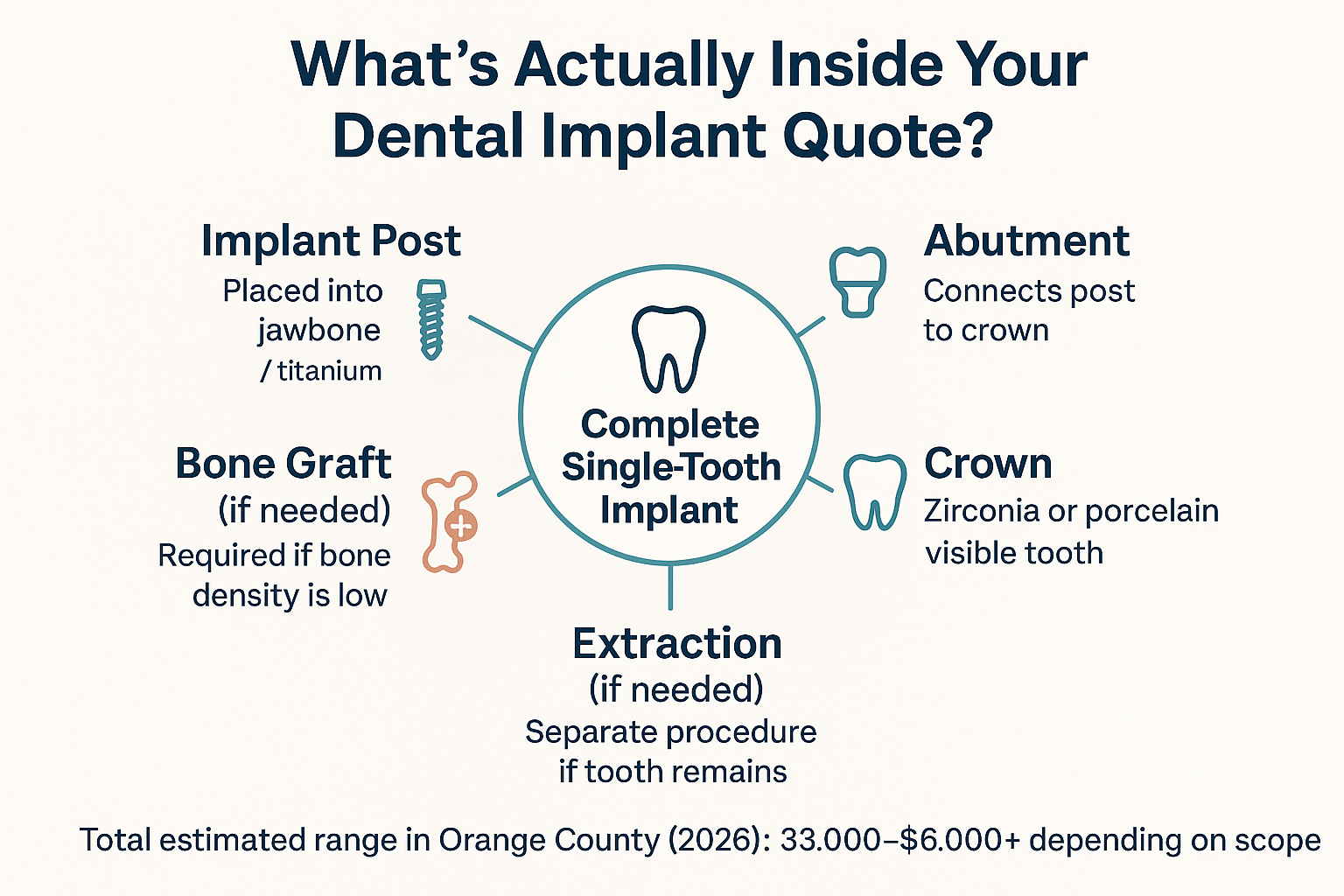
A complete single-tooth implant involves three separate components, and practices quote them differently. Some bundle everything together; others itemize each piece. That alone explains most of the confusion.
Here’s what actually goes into a full implant case:
- The implant post — a titanium screw placed surgically into the jawbone. This is the foundation.
- The abutment — a connector piece that attaches to the post and holds the crown in place.
- The crown — the visible tooth that sits on top. Material choice here (zirconia vs. porcelain-fused-to-metal, for example) affects both cost and appearance.
When you get a quote that seems low, it’s often for the post only — not the full restoration. When a quote seems high, it may include preparatory work the other office didn’t mention. Neither number is dishonest; they’re just measuring different things.
Based on general market context in Orange County in 2026, a fully completed single-tooth implant — post, abutment, and crown combined — tends to fall somewhere in the $3,000 to $6,000 range depending on the provider, materials, and what prep work is required. That’s a wide range, and the variables below explain why. Always ask any office for an itemized treatment plan in writing before agreeing to anything.
The Variables That Push Your Total Higher Than the Base Quote
This is the part most patients aren’t told upfront — and it’s the part that makes the final bill feel like a surprise. There are a few predictable factors that can add cost to an implant case before the implant itself is ever placed.
Tooth extraction. If the tooth being replaced is still in your mouth, it has to come out first. That’s a separate procedure with its own fee. If you’ve been putting off dealing with a failing tooth, that delay can also affect the bone underneath — which leads to the next issue. You can read more about what extraction recovery looks like in our article on what recovery from a tooth extraction actually looks like.
Bone grafting. An implant post needs dense, healthy jawbone to anchor into. When a tooth has been missing for a while — or was lost due to infection — the bone beneath it often shrinks. A bone graft rebuilds that foundation before the implant can be placed. This adds both cost and time to the process, but skipping it when it’s needed is how implants fail.
Crown material. Zirconia crowns tend to cost more than porcelain-fused-to-metal but they’re also more durable and look more like a natural tooth. For front teeth especially, most patients prefer zirconia — and that preference is reflected in the price.
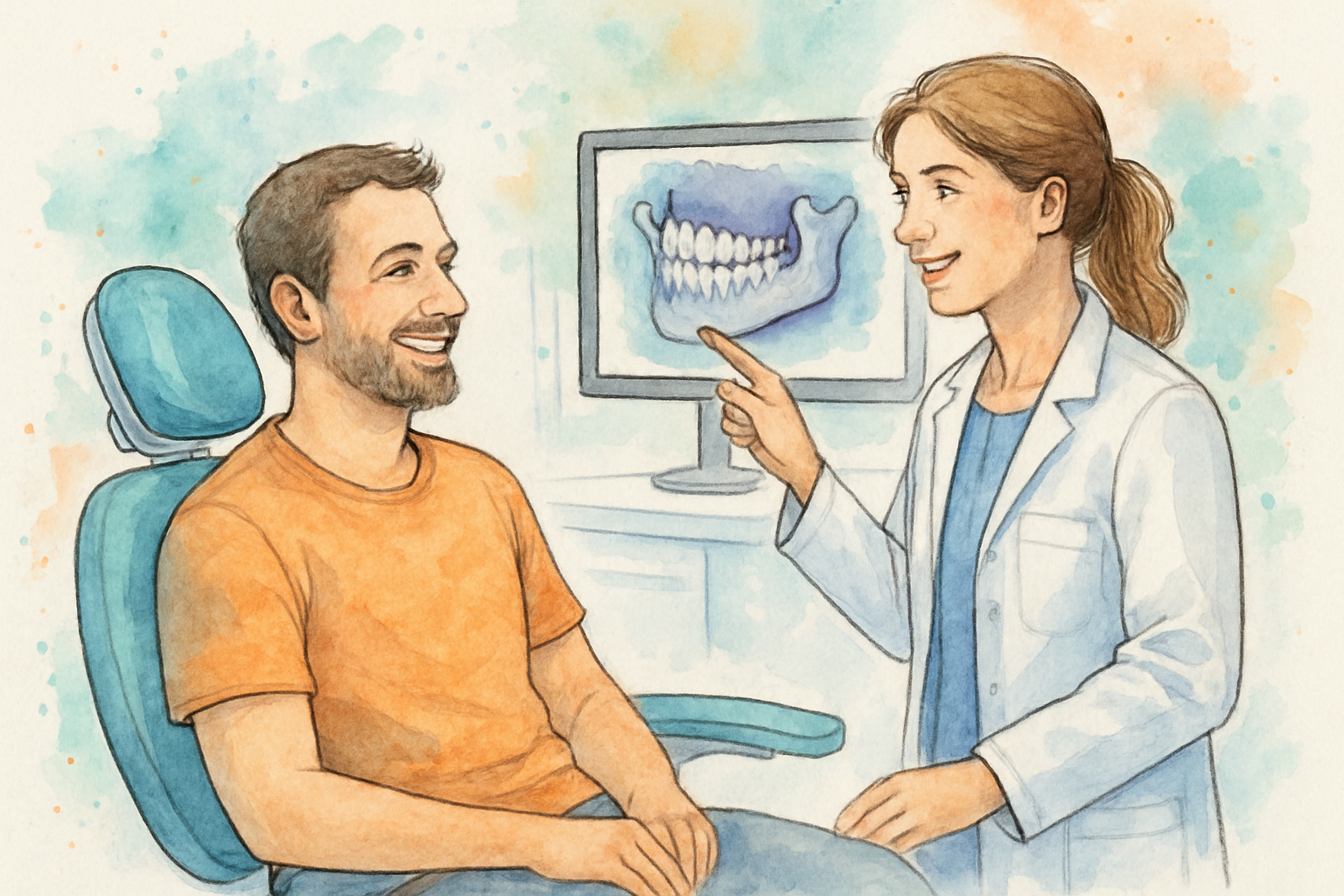
None of these are surprises when the consultation is done properly. A CBCT scan — the kind of 3D imaging we use here — shows bone density, root position, and nerve pathways before we ever pick up a surgical instrument. That means we can walk a patient through their complete treatment roadmap in a single visit, not piece it together as we go.
What Makes Up the Total Cost of a Dental Implant
This infographic breaks down the components and cost drivers of a complete dental implant so you can understand exactly what you’re being quoted.
What Your Insurance Will — and Won’t — Actually Cover
Most patients I talk to assume their dental insurance will take a meaningful bite out of the implant cost. The reality is more complicated, and it’s worth understanding before you walk into a consultation.
Most private dental plans classify implants as a major restorative procedure and cover them at around 50% of the allowed charge — but that reimbursement is subject to your plan’s annual maximum, which typically runs between $1,500 and $2,000 per year. That maximum often has to stretch across your entire dental care for the year, not just the implant.
So in practice: even if your plan pays 50%, the cap may mean you only see $500 to $1,000 of actual coverage applied to an implant that costs several thousand dollars.
Before your consultation, call the member services number on your insurance card and ask these specific questions:
- Does my plan cover dental implants, or just the crown component?
- What is my annual maximum, and how much of it has been used this year?
- Is there a waiting period for major procedures?
- What is my co-pay percentage for major restorative work?
- Does the practice need to be in-network for implant coverage to apply?
If you’re uninsured, you’re actually in a more predictable position — you know your out-of-pocket cost upfront. Our in-house savings plan is worth asking about if you’re paying without coverage. And if you want a broader look at what affordable dental care looks like right now, our article on why 2026 is a breaking point for affordable dental care explains the landscape.
Dental Implant Cost Breakdown: What Each Component Typically Adds
These are general market estimates for Orange County in 2026 — not a price list. Your actual cost depends on bone health, materials, and whether prep work is needed. Ask for an itemized quote from your provider.
| Component | When It’s Needed | Estimated Cost Range (OC Market) |
|---|---|---|
| Implant post (titanium) | Every case | $1,000 – $2,000 |
| Abutment | Every case | $300 – $600 |
| Crown (zirconia or PFM) | Every case | $1,000 – $2,000 |
| Bone graft | When bone density is insufficient | $300 – $1,500+ |
| Tooth extraction | When the failing tooth is still present | $150 – $400 |
| CBCT imaging / consultation | Initial evaluation | $100 – $250 (sometimes included) |
Is There an Affordable Path That Doesn’t Sacrifice Quality?
This is the question most people are quietly sitting with when they search this topic. They’re not ready to book — they’re trying to figure out if an implant is even realistic for their situation.
Here’s what I tell patients who are weighing their options:
Phased treatment is real. Many practices, including ours, can stage implant treatment across multiple visits and billing cycles. The extraction happens first, then bone grafting if needed, then implant placement, then the final crown — each phase spaced weeks or months apart. That spacing also has a clinical purpose (healing time), and it can make the financial side more manageable.
Financing without CareCredit exists. We hear from patients regularly who assume CareCredit is the only dental financing option. We use Cherry financing, which works similarly and takes about two minutes to apply for. Several callers have been surprised to learn this was available when they thought their only option was a card we don’t accept.
The in-house savings plan reduces out-of-pocket costs for uninsured patients. It covers preventive care at low or no cost and applies discounts to restorative procedures, including implant work. If you don’t have insurance, this is worth a conversation before you decide implants are out of reach.
One thing I want to be clear about: there is no version of a quality implant that cuts corners on bone assessment, imaging, or materials. What makes an implant affordable is efficient workflow and honest pricing — not skipping steps. When one of our patients came in for an emergency exam and ended up completing a root canal and same-day crown in a single afternoon, it wasn’t because we rushed — it was because our in-office imaging and milling technology eliminated the need for a second appointment. That same efficiency applies to implant consultations. Dr. Kalvin can build a complete treatment roadmap from a single CBCT scan rather than sending you home to wait for results.
Frequently Asked Questions About Dental Implant Costs in Huntington Beach
Why did one dentist quote me $2,500 and another quoted $5,500 for ‘the same implant’?
Most likely they’re quoting different scopes. The lower number may be the implant post only — before the abutment, crown, or any prep work. The higher number may be a complete case including imaging and a bone graft. Always ask both offices: ‘Does this quote include the post, abutment, and crown, plus any preparatory procedures?’ That question alone will make both numbers make sense.
My insurance says it covers implants. Will it actually pay for most of it?
Probably not as much as you’d hope. Most plans cover implants at 50% of the allowed charge, but that reimbursement is capped by your annual maximum — usually $1,500 to $2,000 for the entire year. Once you factor in what’s already been used on cleanings and other work, the actual implant reimbursement may be $500 to $1,000. Call your insurance before your consultation and ask specifically about your remaining annual maximum and whether implants are covered or excluded.
What if I don’t have insurance at all — is an implant still realistic?
Yes, and patients without insurance often have a clearer picture of costs because there’s no guessing what a plan will or won’t reimburse. Ask about in-house savings plans and financing options like Cherry when you call. Phased treatment timelines can also spread the cost across several months.
How do I know if I need a bone graft before an implant?
You won’t know without imaging. A CBCT scan — a 3D X-ray of your jaw — measures bone density and height at the implant site. If a tooth has been missing for more than a year or was lost due to infection, there’s a reasonable chance some bone loss has occurred. A thorough consultation with proper imaging will tell you exactly what’s needed before any treatment begins.
How long does the full implant process take from start to finish?
For a straightforward case with good bone density, the process typically runs three to six months — mostly waiting for the implant post to fuse with the jawbone (a process called osseointegration) before the crown is placed. If a bone graft is needed, add another two to four months of healing time before the post can even be placed. The consultation and imaging usually happen in a single visit.
Is it worth getting an implant instead of a bridge or denture?
That depends on your situation, but implants have a meaningful long-term advantage: they preserve jawbone. When a tooth root is missing, the bone beneath it gradually shrinks — which affects the shape of your face and the stability of surrounding teeth over time. Bridges and dentures don’t stop that process. Implants do. For patients in their 30s, 40s, and 50s especially, the long-term value is often worth the higher upfront cost. Our article on why cheap dentistry isn’t always the best value goes deeper on this kind of trade-off.
Ready to Get a Clear Picture of What an Implant Would Actually Cost You?
If you’re somewhere in Huntington Beach — whether that’s Oak View, Goldenwest, Huntington Harbour, or anywhere else in the area — and you’ve been putting off this conversation because the pricing felt unclear, a consultation is the fastest way to get real numbers specific to your jaw, your bone health, and your insurance situation. Kali Dental offers implant consultations that include CBCT imaging so Dr. Kalvin can give you a complete, itemized treatment plan in a single visit — no guesswork, no vague ranges. Call us at (657) 800-5254 or book online at kalidental.com when you’re ready to talk through your options.