
Direct Answer: Most people feel sore for 2-3 days after a tooth extraction and are back to normal within a week. The first 24 hours matter most — protecting the blood clot is what drives the whole recovery.
Most people agree to a tooth extraction and then immediately wonder what comes next. Will it hurt a lot? How many days will they need off? What if something goes wrong and they can’t tell? Those questions are completely fair — and surprisingly hard to get a straight answer on.
For patients in Huntington Beach and across Orange County, life doesn’t slow down after a dental appointment. You’ve got work, kids, school pickups in Oak View or Bolsa Chica-Heil, and no time for vague instructions like “rest and take it easy.” You need to know exactly what the healing process looks like, day by day.
This article walks through what actually happens after an extraction — what’s normal, what isn’t, and what you can do to keep the whole process as smooth as possible.
The First 24 Hours: What Your Body Is Doing
The moment a tooth comes out, your body starts building a blood clot in the empty socket. That clot is the foundation of your entire recovery. Everything you do in the first 24 hours is about protecting it.
You’ll leave the office biting down on gauze. Keep firm, steady pressure on it for 30-45 minutes. Once the initial bleeding slows, you can change the gauze if needed — but don’t keep lifting it to check. That disrupts clot formation.
Expect to feel some swelling and dull throbbing as the local anesthesia wears off, usually 2-3 hours after your appointment. This is normal. Dr. Kalvin and our team will tell you what pain relief is appropriate for your situation, but most patients do well with over-the-counter options like ibuprofen taken on schedule — not just when it hurts.
Things to avoid in the first 24 hours:
– Drinking through a straw (the suction can dislodge the clot)
– Spitting forcefully
– Rinsing vigorously
– Smoking or vaping
– Hot food or drinks
– Physical activity that raises your heart rate
And yes — sleep with your head slightly elevated. It reduces overnight swelling and you’ll feel noticeably better in the morning than if you sleep flat.

Days 2 Through 7: The Real Recovery Window
Days two and three are usually when swelling peaks. Your jaw may feel stiff and your face might look puffy on one side. This is normal and expected — it doesn’t mean something went wrong.
By day three or four, most patients notice a real shift. Swelling starts to go down, the soreness becomes more manageable, and soft foods stop feeling like a limitation. Patients who had a straightforward single-tooth extraction are often back to light work activity by day two or three.
Wisdom tooth removals or surgical extractions take longer. If you had a tooth that was impacted or required bone removal, plan for 5-7 days before you feel fully functional. Some patients in that category take a full week before they feel like themselves.
What to eat during recovery:
– Yogurt, applesauce, and smoothies (no straw) on days 1-2
– Scrambled eggs, mashed potatoes, soft pasta by days 3-4
– Most normal foods by day 5-7, avoiding the extraction site
Keep the area clean starting on day two with gentle warm salt water rinses — about a quarter teaspoon of salt in eight ounces of warm water. Swish softly, don’t spit hard. This keeps bacteria from building up without disturbing the healing tissue.
If you’re wondering when pulling a tooth is even the right call, that’s worth understanding before you get to this stage — it helps set the right expectations for why the recovery is worth it.
Your Tooth Extraction Recovery Timeline at a Glance
Here’s a day-by-day breakdown of what healing typically looks like after a standard tooth extraction.
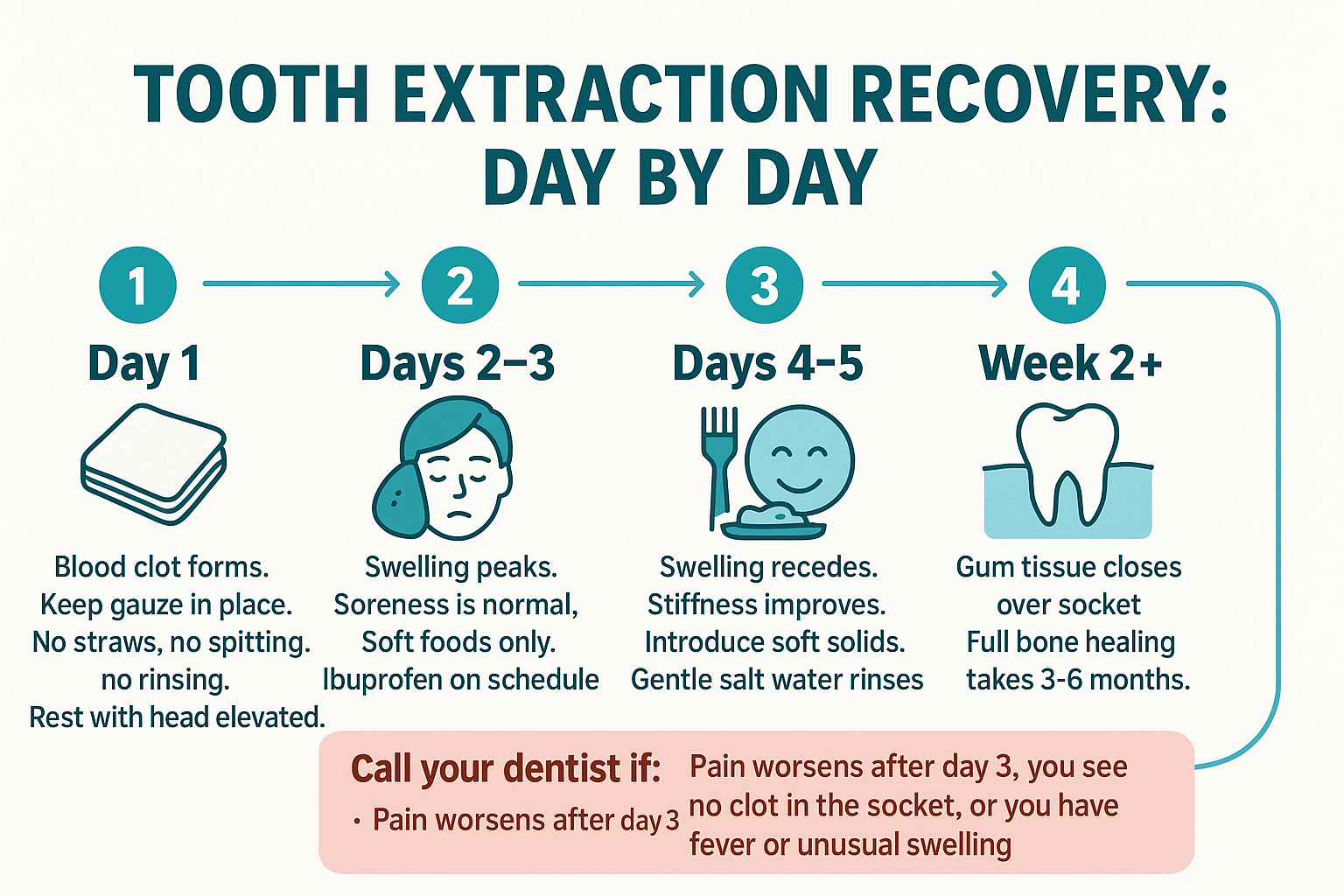
Dry Socket: The One Complication Worth Knowing About
Dry socket is the most common complication after a tooth extraction, and it’s the reason the first 24 hours matter so much. It happens when the blood clot either doesn’t form properly or gets dislodged before the socket heals. Without that clot, the bone and nerve underneath are exposed.
You’ll know something is wrong because the pain gets worse after day two or three, not better. Most people describe it as a deep, radiating ache that can travel toward the ear or jaw. You might also notice a bad taste or smell, or look in the mirror and see an empty-looking hole rather than a dark clot.
Dry socket affects roughly 2-5% of standard extractions but can run as high as 20-30% for lower wisdom tooth removals. Smoking is the single biggest risk factor. People who use tobacco in any form — cigarettes, vaping, or chewing — should be especially careful in the first 48 hours.
If you think you have dry socket, don’t wait it out. Call your dentist. It’s treated with a medicated dressing placed directly in the socket, and most patients feel relief within a few hours of treatment. It’s not a dental emergency in the dramatic sense, but it also doesn’t resolve on its own.
Normal vs. Concerning Symptoms After an Extraction
Not everything that feels off after an extraction is a problem. Here’s a quick reference for what’s expected versus what warrants a call to your dentist.
| Symptom | Normal? | What to Do |
|---|---|---|
| Bleeding that slows with gauze pressure | Yes | Keep gauze in place 30-45 min |
| Swelling that peaks on days 2-3 | Yes | Cold pack in 20-min intervals |
| Dull throbbing as anesthesia wears off | Yes | Take OTC pain relief on schedule |
| Jaw stiffness for several days | Yes | Gentle warm compresses after day 3 |
| Pain that gets worse after day 3 | No | Call your dentist — possible dry socket |
| Fever over 101°F | No | Call your dentist same day |
| Persistent bleeding after 2 hours with gauze | No | Call your dentist immediately |
| Empty-looking socket with bad taste or smell | No | Likely dry socket — call your dentist |
What Happens to the Empty Space — and What to Do About It
After extraction, the gum tissue will close over the socket within one to two weeks for most people. But the underlying bone takes much longer — full healing of the bone can take three to six months.
For patients who’ve lost a tooth and want to keep that space from causing problems down the road, there are real options worth understanding. A missing tooth can cause neighboring teeth to shift gradually over time, which affects your bite and how the surrounding bone behaves. This is especially relevant if the tooth lost was a molar — the workhorses of chewing.
Dental implants are the most permanent way to restore that space, and the post-extraction window is actually the right time to start that conversation because bone levels are still intact. You can read about how dental implants compare to dentures as a replacement option to understand what each path involves before committing.
Not everyone needs to replace a tooth immediately — especially if it was a wisdom tooth. But for any tooth in the visible arch or load-bearing position, leaving the space empty long-term tends to create more work and more cost down the road.
Frequently Asked Questions About Tooth Extraction Recovery
How much pain should I expect after a tooth extraction?
Most patients describe it as a sore, achy discomfort — not sharp or severe — that’s manageable with ibuprofen or acetaminophen. Days one and two are the worst of it. By day three, most people are moving around normally. If the pain is intensifying rather than improving after day three, that’s a signal to call your dentist.
Can I go to work the next day?
For a simple extraction, many people can return to a desk job the next day. Physical or active jobs may need 2-3 days off. Surgical extractions — like impacted wisdom teeth — typically need 4-5 days before you’re ready to be on your feet consistently. When in doubt, take the extra day.
How do I know if the blood clot is still in place?
You won’t be able to see it clearly in the first day or two, which is normal. A healthy socket will look dark and slightly concave. If you look at the site after day two and see what looks like an open, empty hole — and you’re having increasing pain — that’s worth a call to your dentist to rule out dry socket.
What can I actually eat after an extraction?
Stick to soft, cool-to-lukewarm foods for the first couple of days. Yogurt, applesauce, scrambled eggs, mashed potatoes, and soft pasta are all good options. Avoid anything crunchy, hard, or chewy until the area feels comfortable — usually by day five or six for simple extractions. No hot foods or drinks for the first 24 hours.
Is it normal for my jaw to feel stiff?
Yes, especially after a lower molar or wisdom tooth removal. The muscles around your jaw can get inflamed and tight. Gentle warmth on the jaw — not cold — after the first 48 hours can help. The stiffness usually resolves within 5-7 days.
Do I need a follow-up appointment after an extraction?
For routine extractions, a follow-up isn’t always required if healing is going normally. For surgical extractions, a follow-up around 7-10 days out is standard to check that the site is closing properly. Our team will let you know at your appointment what makes sense for your specific situation.
Questions About Your Extraction or Recovery?
If you’re preparing for a tooth extraction in Huntington Beach — or you’re already in recovery and something doesn’t feel right — our team is here to give you a straight answer. Kali Dental serves patients throughout Orange County, from Huntington Harbour to Fountain Valley, with honest care and no pressure. Call us at (657) 800-5254 or book an appointment online at kalidental.com.