
Direct Answer: Brushing removes soft plaque, but once it hardens into tartar, only a dental professional can remove it. Skipping cleanings lets tartar build up silently — even in people with great brushing habits.
A lot of Huntington Beach patients come in and say the same thing: “I brush twice a day, I floss, I use mouthwash — so why do I even need to come in?” It’s a fair question. And the honest answer isn’t what most people expect.
Brushing is genuinely important. But it only gets the soft stuff. There’s a harder, stickier problem that builds up below and along your gumline that your toothbrush simply cannot touch — and if it sits there long enough, it starts doing real damage.
This article breaks down exactly what’s happening inside your mouth between visits, why even dedicated brushers still need professional cleanings every 6 months, and what gets missed when those appointments slide. No scare tactics — just the real explanation.
What Your Toothbrush Actually Can and Can’t Do
Your toothbrush is good at removing plaque — the soft, sticky film of bacteria that forms on your teeth throughout the day. Brushing twice a day breaks that film up before it can cause damage. That part works.
But here’s what most people don’t realize: plaque starts hardening into tartar (calculus) in as little as 24 to 72 hours. Once it mineralizes, it bonds to your tooth surface like concrete. A toothbrush — no matter how good your technique — cannot remove it.
Tartar tends to build up in the spots brushing already misses:
- Behind the lower front teeth
- Along the gumline where bristles can’t angle in
- Between teeth, especially if flossing is inconsistent
- In pockets below the gumline that no brush can reach
And tartar isn’t just cosmetic. It’s a rough surface that traps even more bacteria, which then irritates your gums and slowly breaks down the bone holding your teeth in place. That’s how gum disease starts — quietly, with no pain, in a mouth that gets brushed every single morning.
If you’re noticing any puffiness or bleeding when you floss, that’s worth reading more about — why gums bleed during a cleaning explains what’s actually going on and when it’s a sign to act.
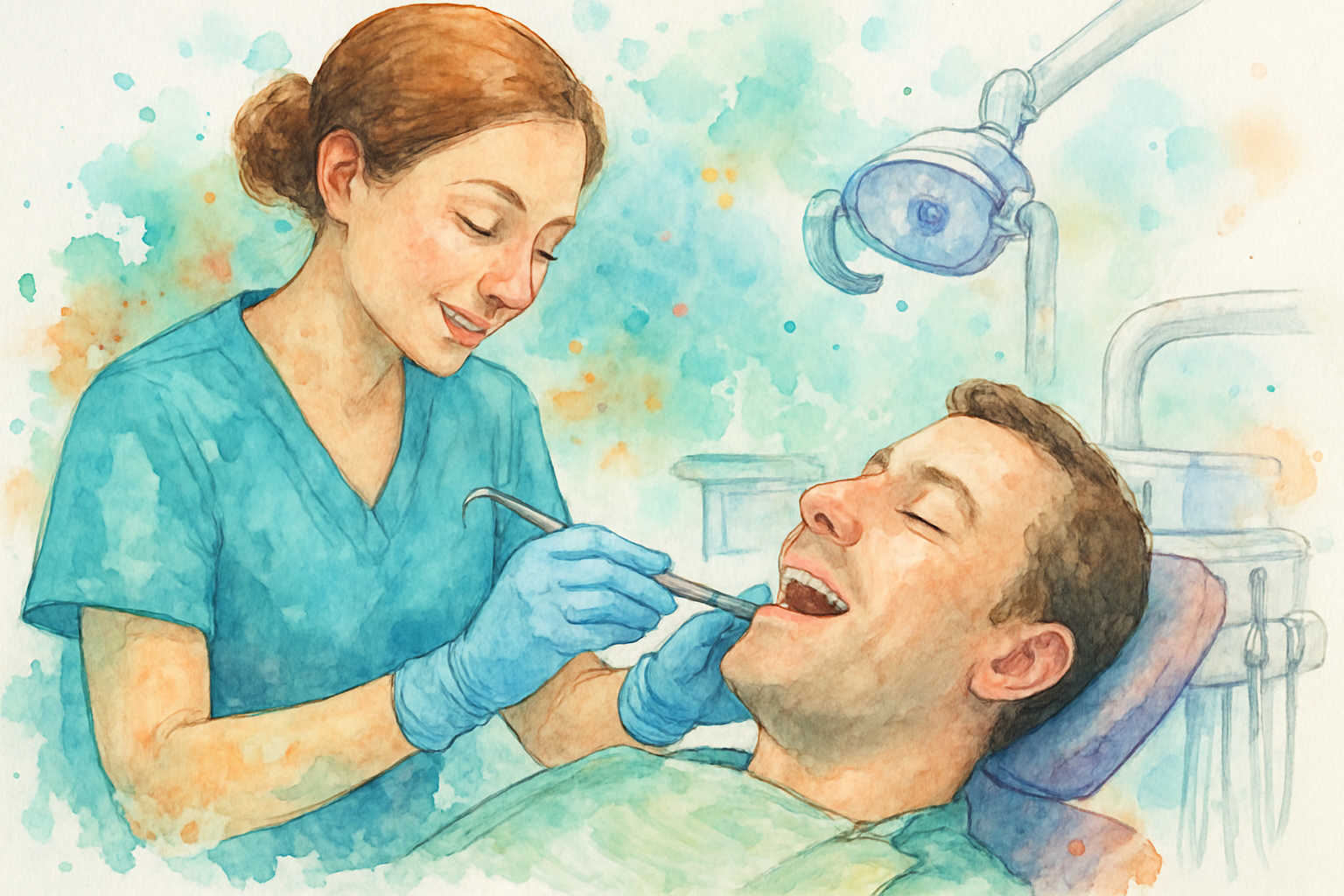
What Actually Happens During a Professional Cleaning
A lot of patients think a cleaning is just a fancier version of brushing. It’s not. There are two distinct things happening during your appointment, and both matter.
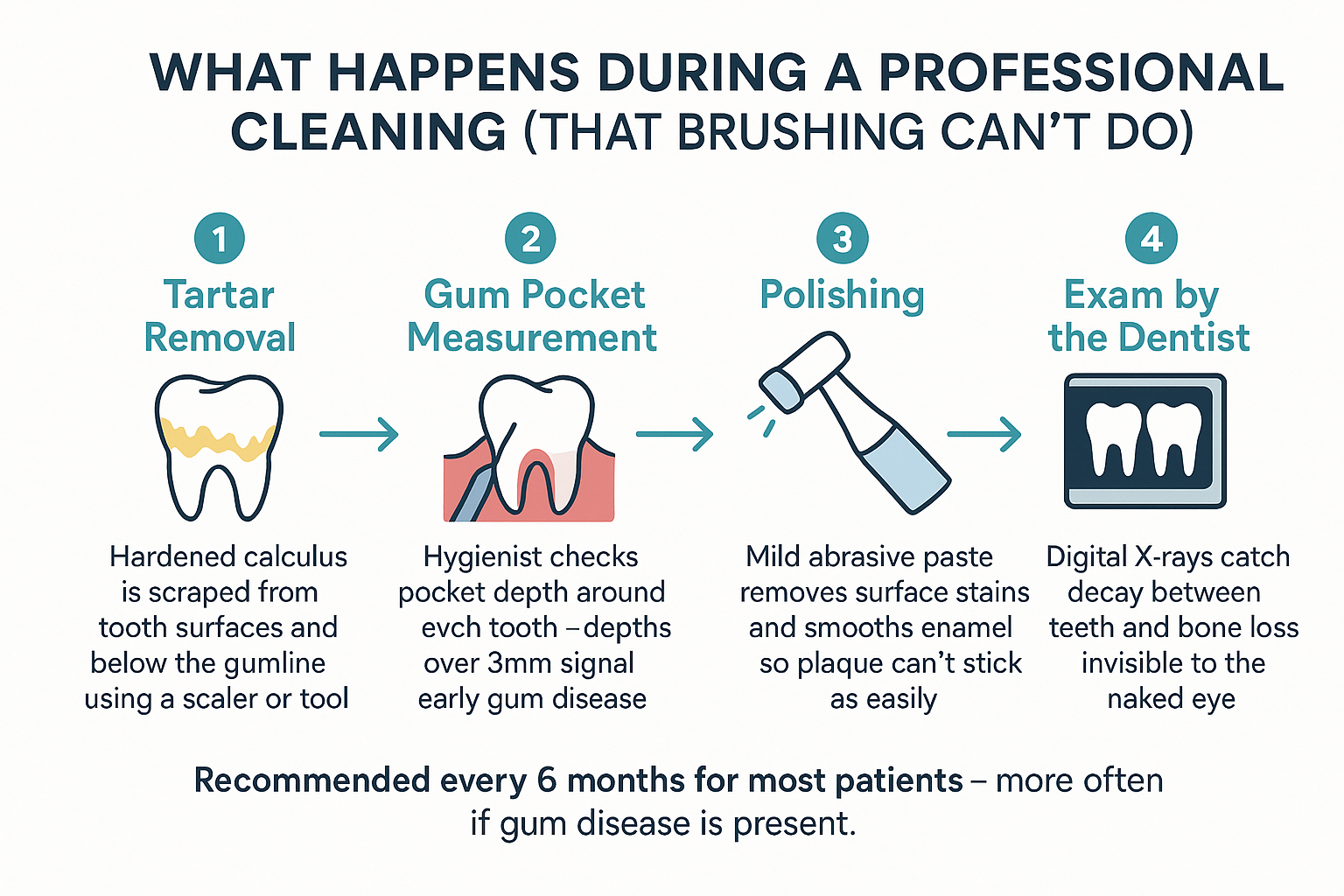
First, the hygienist uses a tool called a scaler (or an ultrasonic instrument) to break tartar off the tooth surface and below the gumline. This is the part no amount of home care can replicate. Once tartar is gone, the bacteria living in it are gone too.
Second, the hygienist polishes the teeth with a mildly abrasive paste. This removes surface stains and leaves the enamel smoother — which actually makes it harder for plaque to stick between visits.
For most patients who come in consistently, this whole process takes 45 to 60 minutes. But for someone who’s skipped a year or two, there’s significantly more tartar to remove — which means the appointment takes longer, can involve more sensitivity, and sometimes requires a deep cleaning instead of a routine one.
That’s not a scare tactic — it’s just what happens biologically. The longer tartar sits, the deeper it grows below the gumline, and the harder it is to remove in one visit.
What a 6-Month Cleaning Appointment Actually Covers
This breakdown shows the key steps of a routine professional cleaning and what each one does that home care can’t replace.
The Part No One Talks About — What the Exam Catches
Cleanings aren’t just about your teeth. The appointment that comes with your cleaning — the exam — is doing something brushing can never do: looking for problems you can’t feel yet.
Decay between teeth is invisible until it’s deep enough to cause pain or sensitivity. Gum disease causes no pain in its early stages — most people have no idea it’s happening. And bone loss from advancing gum disease doesn’t show on the surface at all. It only shows up on an X-ray.
A routine cleaning appointment is the only regular checkpoint where someone with training is actually looking at your mouth with proper tools and lighting. Dr. Kalvin looks for:
- Cavities forming between teeth or under old fillings
- Early signs of gum inflammation or pocket deepening
- Changes in soft tissue that may need monitoring
- Cracked teeth that aren’t painful yet but will be
For families in Oak View, Bolsa Chica-Heil, and Huntington Harbour, this is especially worth thinking about during back-to-school season — kids often go a full year between appointments without parents realizing it. Small cavities found at a routine visit cost a fraction of what a neglected one costs to treat later. You can read more about that in why cheap dentistry isn’t always the best value.
Brushing vs. Professional Cleaning — What Each One Actually Does
This side-by-side shows where home care stops and where a professional cleaning picks up. Both matter — they just do different jobs.
| Task | Daily Brushing & Flossing | Professional Cleaning |
|---|---|---|
| Remove soft plaque | Yes — if done consistently | Yes — thorough removal |
| Remove hardened tartar | No — not possible at home | Yes — requires professional tools |
| Clean below the gumline | Partially — limited by brush angle | Yes — hygienist scales below the margin |
| Detect cavities | No | Yes — during the exam with X-rays |
| Identify gum disease | No | Yes — pocket measurements reveal early signs |
| Polish and smooth enamel | No | Yes — slows future plaque buildup |
| Cost in Huntington Beach area | $5–$15/month in supplies | $100–$200 per visit without insurance |
What About Patients Without Insurance?
One of the most common reasons people skip cleanings is cost — especially in Orange County, where a cleaning without insurance can run $120 to $200 per visit at many offices.
But skipping cleanings tends to cost far more in the long run. A cavity caught early is a $150–$250 filling. The same cavity left another year might need a crown — which runs $1,000 to $1,500 or more. Gum disease that’s caught at a routine cleaning stays manageable. Gum disease that’s ignored for two years may require a deep cleaning at $200–$400 per quadrant.
For patients without dental insurance, what’s the cheapest way to fix your teeth without insurance walks through your real options in detail. And for patients who want a more predictable path, our in-house savings plan at Kali Dental covers two cleanings per year along with X-rays and exams — making it easier to stay consistent without the uncertainty of insurance billing.
Frequently Asked Questions About Dental Cleanings
How often do I actually need a cleaning if my teeth feel fine?
Most adults need a cleaning every 6 months. But ‘feeling fine’ doesn’t mean much when it comes to dental health — gum disease and early decay don’t cause pain until they’re already serious. Six months is the standard interval because that’s roughly how long it takes for tartar buildup to start causing measurable damage in most people. Some patients with a history of gum disease may need to come in every 3 to 4 months.
Does a cleaning hurt?
For most patients, a routine cleaning is mildly uncomfortable at worst — some pressure, some scraping sounds, and occasional sensitivity near the gumline. If you’ve gone longer between visits and have significant tartar buildup, it can be more uncomfortable. Patients with sensitive gums or dental anxiety should let the hygienist know upfront — the pace can be adjusted.
My gums bleed when they clean my teeth. Is that bad?
Bleeding during a cleaning usually means your gums are inflamed from bacteria buildup — it’s a sign of gingivitis, which is the earliest stage of gum disease. The good news is that gingivitis is reversible with consistent cleanings and better home care. Healthy gums typically don’t bleed. If yours do, that’s a reason to come in, not skip the appointment.
Can kids skip cleanings if they don’t have cavities yet?
No — and this is actually more important for kids than for adults in some ways. Children’s teeth and jaws are still developing, and early problems are much easier to address when caught young. Kids should start dental visits by age 1, and routine cleanings every 6 months should continue through childhood. Sealants and fluoride treatments done at these visits can prevent cavities from forming in the first place.
What happens if I skip cleanings for a few years?
Tartar continues building up and pushing deeper below the gumline. Over time this can lead to gum disease, bone loss, and eventually loose or lost teeth. At a certain point, a standard cleaning isn’t enough — you’d need a deep cleaning to remove buildup that’s settled below the gumline. The treatment is more involved, takes longer, and costs more than keeping up with routine care would have.
Ready to Get Back on Track?
If it’s been more than 6 months since your last cleaning — or you honestly can’t remember when you went — it’s a good time to get in. Our team at 19201 Brookhurst Street in Huntington Beach sees patients of all ages, and we work with both insured and uninsured families through our in-house savings plan. Call us at (657) 800-5254 or book an appointment online at kalidental.com — Dr. Kalvin and our team will take it from there.