
Direct Answer: Brushing removes soft plaque, but hardened tartar can only be removed with professional tools. Cleanings also catch problems your toothbrush will never find.
A lot of people in Huntington Beach skip their dental cleanings because they feel like they’re already doing everything right. Two minutes in the morning, two at night, maybe a little flossing — so what’s left for a hygienist to actually do?
Quite a bit, as it turns out. And it has nothing to do with whether you’re a good brusher.
This article breaks down exactly what a professional cleaning does that your toothbrush can’t, why tartar buildup happens even in people with good habits, and what gets missed when cleanings fall off the calendar. No scare tactics — just a straight explanation of what’s actually happening in your mouth.
Your Toothbrush Has Real Limits
Brushing is genuinely important. It removes the soft, sticky layer of bacteria called plaque before it gets a chance to do damage. But here’s the thing about plaque — it starts hardening into tartar (also called calculus) within 24 to 72 hours of forming.
Once that happens, brushing doesn’t touch it. Tartar is mineralized. It bonds to enamel and can only be broken down with metal scaling instruments or ultrasonic tools — the kind your hygienist uses at every visit.
Even people who brush twice a day and floss consistently develop tartar. It builds up fastest in certain spots:
- Behind the lower front teeth, where saliva ducts deposit minerals
- Along the gumline, especially between teeth
- Below the gumline in tiny pockets most brushes can’t reach
- Around old fillings or crowns where surfaces are slightly uneven
If you’ve ever wondered why your gums bleed during a cleaning, this is usually the reason. Tartar near the gumline irritates the tissue, and the cleaning itself disturbs inflamed gum tissue that’s been building up between visits. It’s not a sign something went wrong — it’s a sign the cleaning was overdue.
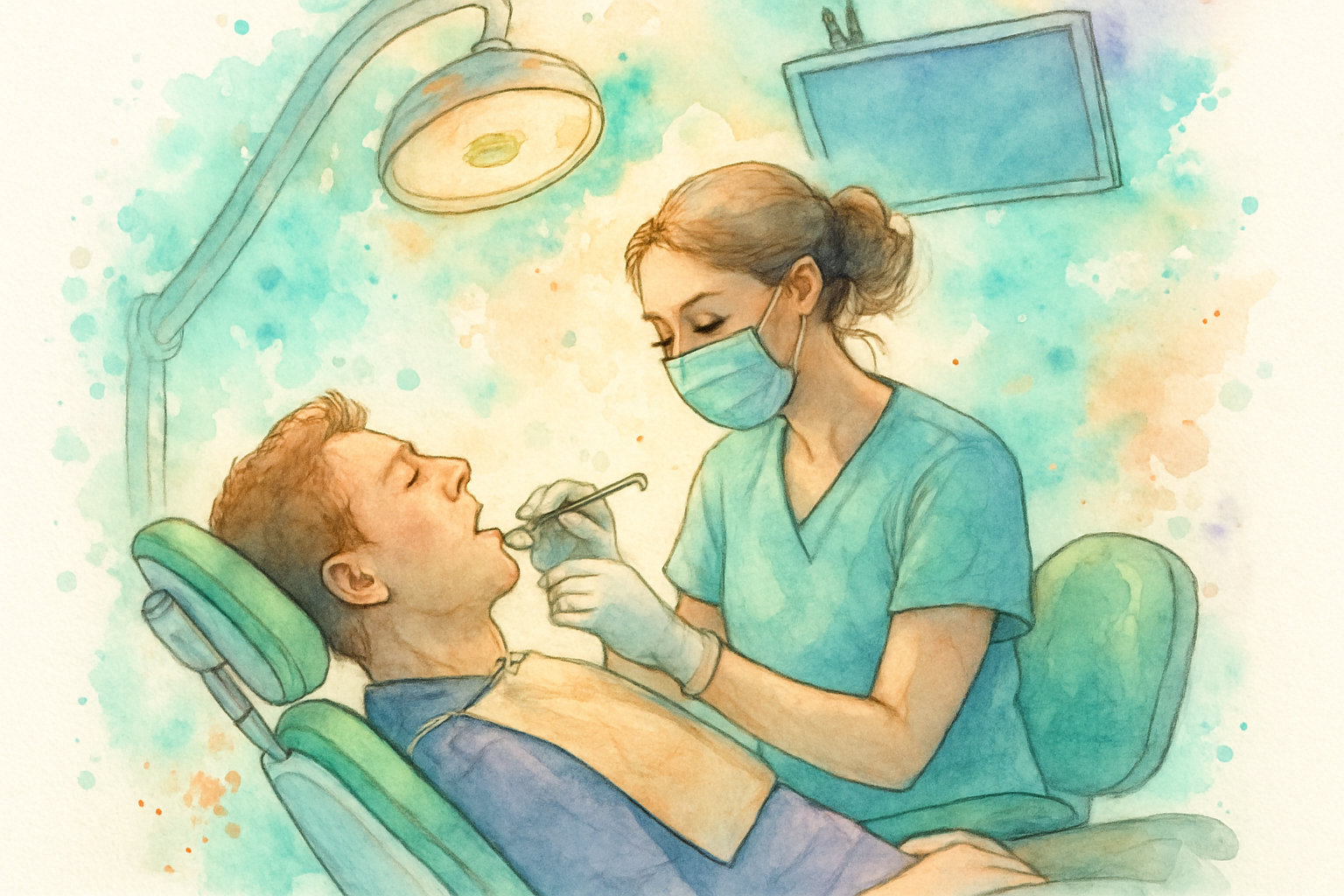
What a Cleaning Actually Does in 45 Minutes
Most patients think a cleaning is just polishing. It’s actually two separate things happening in one appointment, and each one does something your home routine can’t.
Scaling is the removal of tartar and hardened buildup from the tooth surface and just below the gumline. Depending on how long it’s been since your last visit, this can take anywhere from 10 minutes to over 30 minutes of the appointment.
Polishing comes after. The gritty paste and rubber cup remove surface stains and smooth the enamel so bacteria has a harder time sticking going forward. This is the part most people actually remember because their teeth feel different afterward.
But the cleaning is also when your hygienist is actively looking at your mouth up close — measuring gum pocket depths, noting any spots that bleed, and flagging anything that should go in front of the dentist. That assessment is part of every visit, and it’s what turns a cleaning into a true dental exam rather than just a polish.
For patients who haven’t been in for a year or more, or who have early gum disease, a standard cleaning sometimes isn’t enough. A deep cleaning goes below the gumline more aggressively to remove buildup in deeper pockets — that’s a separate procedure with a different purpose, but it starts with the same baseline assessment at your regular visit.
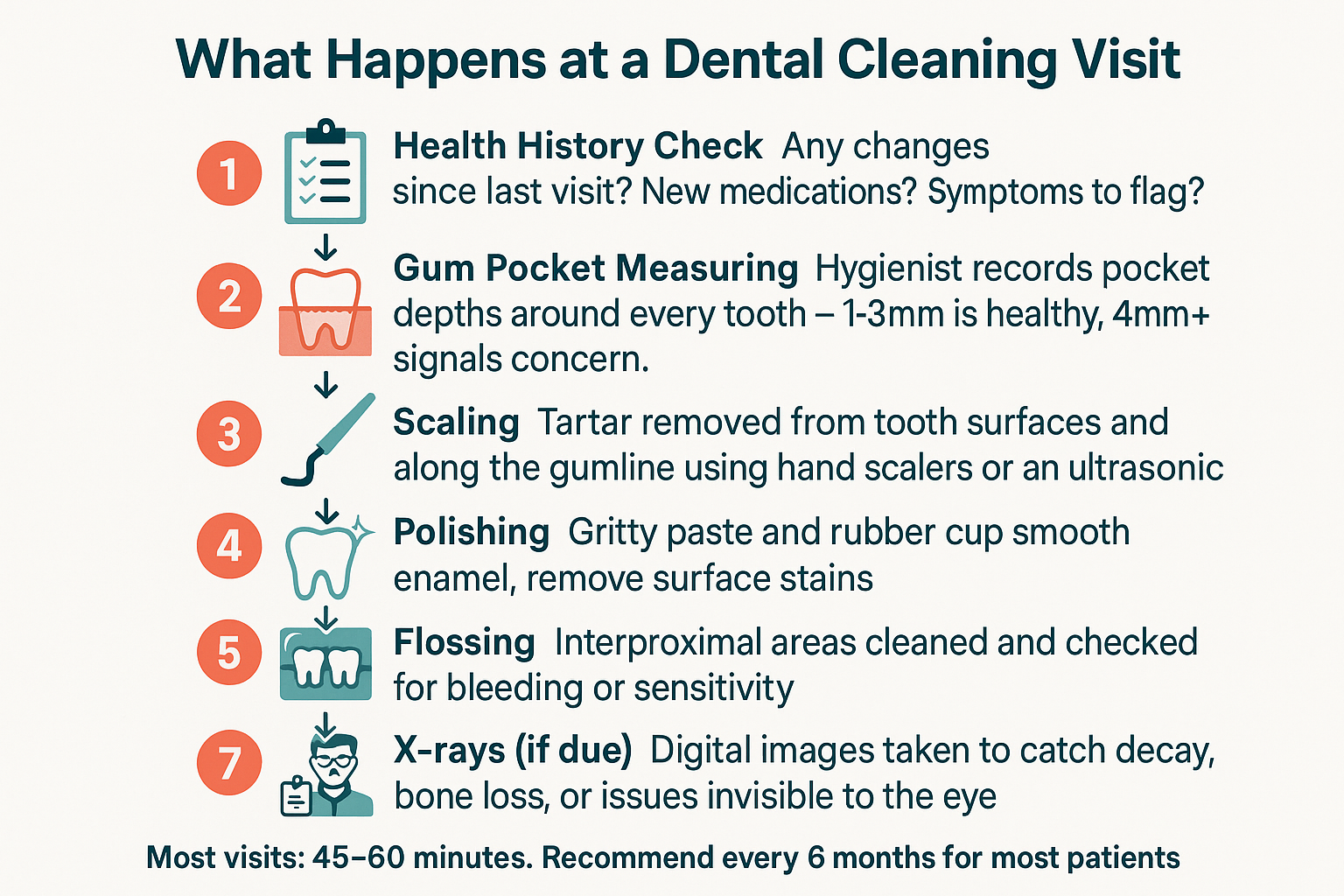
What Happens During a Professional Cleaning — Step by Step
This walkthrough shows exactly what takes place during a standard cleaning appointment, from the moment you sit down to when you leave.
The Problems That Only Show Up at a Cleaning
This is the part most people don’t think about until something goes wrong.
Your toothbrush can’t tell you that a back molar has a small cavity forming between the teeth. It won’t notice that your gum pocket on the lower left went from 3mm to 5mm since last year. And it definitely won’t catch early signs of bone loss — which shows up on X-rays long before you’d feel anything.
Dental problems at early stages are cheap and easy to fix. A small cavity caught at a cleaning might be a $150–$250 filling. That same cavity, left another year, can turn into a root canal, a crown, or both — often $1,500 to $3,000 or more depending on the tooth and what’s needed.
For families in Huntington Beach, understanding the real cost of skipping dental care is important — especially when insurance or budget is tight. Preventive care is almost always the most affordable path, even when it doesn’t feel that way.
And for patients without insurance, that math still holds. Our in-house savings plan at Kali Dental covers cleanings and exams at a flat annual fee — specifically so the cost of a visit doesn’t become the reason someone skips it and ends up needing much more later.
Caught Early vs. Caught Late: The Cost Difference
These are real-world cost comparisons for common dental issues found at routine cleanings versus the same issues treated after significant delay.
| Issue | Caught at Routine Cleaning | Caught After Delay |
|---|---|---|
| Small cavity (early decay) | $150–$250 filling | $800–$1,500 crown if decay reaches pulp |
| Gum inflammation (early gingivitis) | $0 extra — managed at cleaning | $500–$2,000+ for deep cleaning or gum treatment |
| Cracked tooth (hairline) | Monitoring + possible crown | Emergency extraction + implant or bridge: $3,000–$5,000 |
| Bone loss (early stage) | Caught on X-ray, managed with more frequent cleanings | Advanced periodontitis requiring surgery: $2,000–$4,000+ |
How Often You Actually Need a Cleaning
The standard recommendation — twice a year, every 6 months — is a baseline, not a universal prescription.
Some patients genuinely do fine with one cleaning per year. Others need 3 or 4 visits because they have gum disease, a history of heavy tartar buildup, diabetes, or dry mouth from medications. The right frequency is something your hygienist and dentist determine based on your actual mouth, not a generic schedule.
For kids, the 6-month schedule matters a lot — especially during the years when baby teeth are falling out and permanent teeth are coming in. It’s also when sealants and fluoride treatments make the biggest difference in preventing decay. Families in areas like Bolsa Chica-Heil and Oak View who are looking for a single practice that sees every member of the family often find that coordinating everyone’s cleanings on the same schedule is one less thing to manage.
If it’s been more than a year since your last cleaning, the first visit back will likely take longer — there’s more buildup to remove, and your gums may be more sensitive than they would be if you’d been coming regularly. That’s not a reason to keep avoiding it. It’s just what the first visit looks like, and then things go back to normal after that.
Frequently Asked Questions About Dental Cleanings
Does a cleaning hurt?
For most people, a routine cleaning is uncomfortable at most — not painful. If you have sensitive teeth or inflamed gums from tartar buildup, you might feel some tenderness during scaling. Letting your hygienist know ahead of time means they can adjust their approach, go slower, or use a topical numbing gel on sensitive spots. The more regularly you come in, the less buildup there is and the easier each visit gets.
My teeth feel fine. Do I really still need a cleaning?
Yes — because most dental problems don’t cause pain until they’ve been developing for a while. A cavity forming between two back teeth, early gum disease, or even a small crack won’t announce itself until it’s a bigger issue. Feeling fine is a good sign, but it doesn’t mean nothing is happening.
I haven’t been to the dentist in a few years. Should I be embarrassed to come in?
No. Our team sees this constantly and nobody is going to lecture you or make you feel bad about the gap. Life gets busy, costs add up, or anxiety keeps people away for longer than they planned. The only thing that matters when you come in is where things stand now and what we can do going forward. Dr. Kalvin runs a no-judgment practice — that’s not a tagline, it’s just how the team actually operates.
What if I don’t have insurance?
We have an in-house savings plan designed specifically for uninsured patients. It covers your exams and cleanings at a flat annual cost and includes discounts on other treatments. It’s not insurance — it’s a straightforward membership that makes preventive care affordable without the paperwork. You can ask about it when you call or when you come in.
Can my whole family get cleanings on the same day?
Often, yes. We see patients of all ages and can usually schedule family members back-to-back so you’re not making multiple trips. If you have kids in school, summer and school breaks are the easiest time to get everyone in. We’re familiar with the school calendars for families across Huntington Beach and try to work with your schedule.
How long does a cleaning take?
A standard cleaning with a full exam typically runs 45 to 60 minutes. If X-rays are due, add another 10–15 minutes. If it’s been a long time since your last visit and there’s significant tartar buildup, the hygienist may need closer to 75–90 minutes to do a thorough job. We’ll give you a realistic time estimate when you book.
Ready to Get Back on Track?
Whether you’re due for your regular cleaning or it’s been a few years since your last visit, our team at Kali Dental is ready to help — no judgment, no pressure. We see patients from across Huntington Beach, Fountain Valley, and the surrounding Orange County area, and we have options for families, individuals, and patients without insurance. Call us at (657) 800-5254 or book your appointment online at kalidental.com — we’ll take care of the rest.