
Direct Answer: Strips work for mild surface stains on healthy natural teeth. Professional whitening fits deeper staining, sensitive teeth, or a firm deadline, because the gel is stronger and the visit is supervised.
Whitening is everywhere right now. Strips at the drugstore on Brookhurst, LED kits from an ad you scrolled past, charcoal pastes, and professional treatments at a dental office. Most people I talk to are not confused about whether they want whiter teeth. They are confused about which category their situation actually falls into.
That matters more than the brand you pick. A patient in Huntington Harbour with light coffee staining and a patient in Oak View with grayish discoloration from an old injury need two completely different plans. One of them will be thrilled with a $40 box. The other will spend three weeks on strips and see almost nothing.
So here is how I walk patients through the decision. Stain type first, sensitivity second, existing dental work third, timeline last.
Start with the kind of stain you have, not the product
There are two broad kinds of tooth discoloration, and they behave very differently.
Extrinsic staining sits on the outside of the enamel. It builds up from the stuff most of us drink every day.
- Coffee, including the second cup you get on the way to work
- Black tea and dark sodas
- Red wine
- Tobacco
- Dark sauces and berries
This kind of stain responds well to peroxide. It also partly comes off during a professional dental cleaning, which is why some people are surprised at how much brighter their teeth look walking out of a routine appointment.
Intrinsic staining lives inside the tooth. Common causes include tetracycline antibiotics taken as a child, fluorosis, a tooth that took a hit years ago, or simple aging as enamel thins and the yellower dentin underneath shows through.
Here is the honest part. Over the counter products do very little for intrinsic staining. Professional whitening does more, but it still has limits, especially with banding from tetracycline. For those patients, veneers or bonding usually give the result they were picturing in the first place.
If you are not sure which type you have, that is a two-minute conversation at an exam.
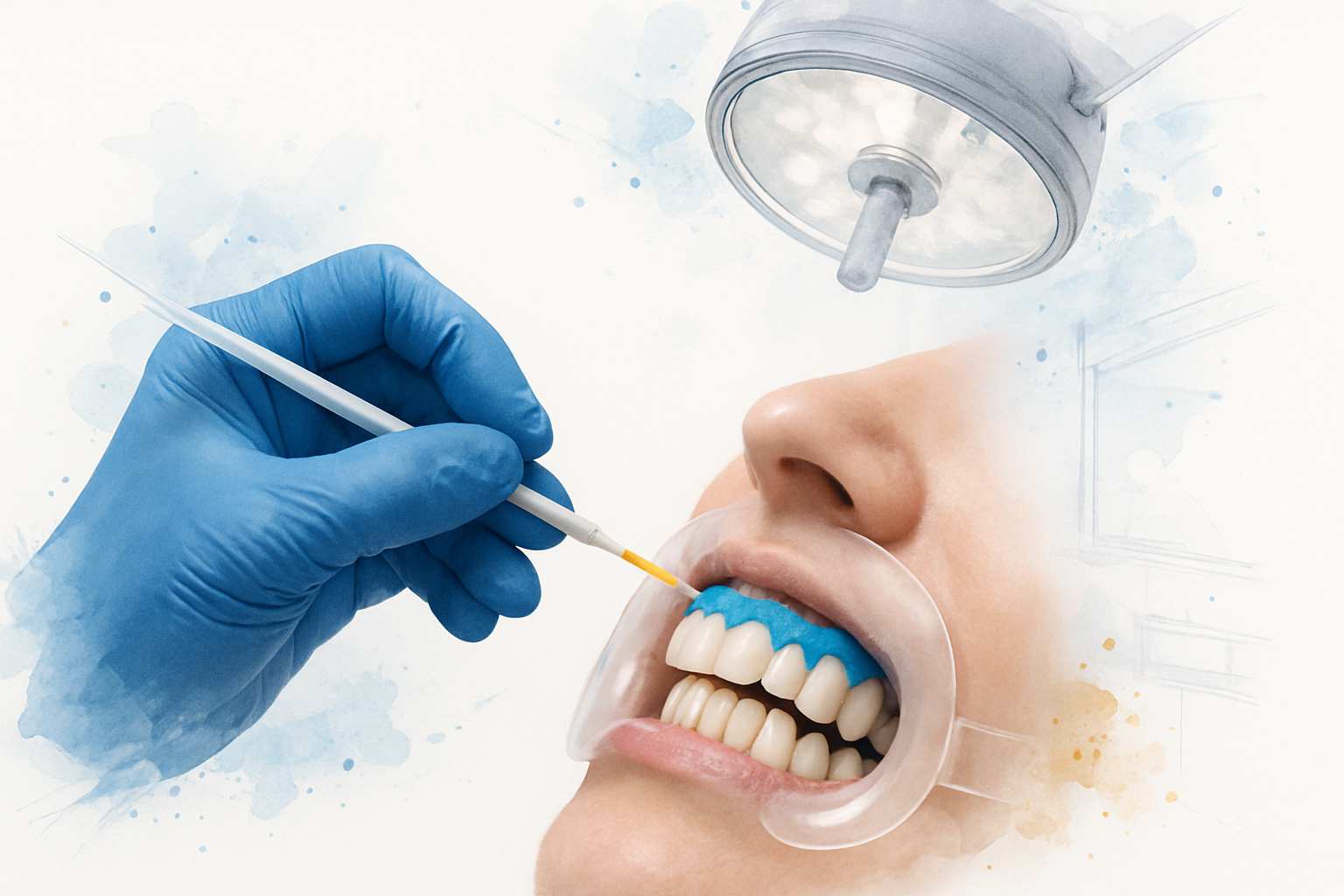
Where strips work fine, and where they hit a ceiling
I am not anti-strip. For a healthy mouth with mild surface staining, strips are a reasonable place to start and they cost very little.
But they have a real ceiling, and it comes down to chemistry and contact.
- Lower peroxide concentration. Store products use a weaker gel than what a dental office can apply, so shade change is slower and tops out sooner.
- Generic fit. One shape has to work for every mouth. Gel leaks onto gums, and crowded or rotated teeth get uneven coverage.
- No effect on dental work. This is the big one.
Whitening gel does not change the color of crowns, veneers, bonding, or tooth-colored fillings. Plenty of people finish a whitening kit and notice their natural teeth lifted a few shades while the front crown stayed exactly where it was.
If you have visible restorations up front, sequence matters. Whiten first, let the color settle, then match new work to the new shade. When a crown does need replacing, same-day crown technology makes that shade match easier to control in one sitting.
Strips are a reasonable starting point when your teeth are healthy, your staining is surface level, and you have no untreated decay or gum inflammation. They disappoint when any of those are false.
If your teeth are already sensitive, strips are usually the wrong first move
Sensitivity is the number one reason people quit whitening halfway through. It is not a sign something went wrong. Peroxide temporarily opens the microscopic channels in enamel, which lets cold, heat, and pressure reach the nerve more easily. The American Dental Association lists tooth sensitivity and gum irritation as the two most common side effects of whitening.
For most people that fades within a day or two. For someone who already winces at iced coffee, wearing a full-strength strip for the full recommended time can be genuinely painful.
What changes in an office setting:
- A protective barrier is placed on the gums so the gel stays on enamel only
- Desensitizing treatment can be applied before and after
- Timing is adjusted mid-session if you start feeling it
- We check for cracks, recession, and untreated decay first, since whitening over any of those is what turns discomfort into real pain
That last point deserves emphasis. Whitening does not fix a cavity, and it will make an exposed root surface very unhappy. Anyone with dental anxiety already knows how quickly a bad experience sets you back, which is why we would rather rule things out first than have you white-knuckle a kit at home.
Three whitening paths, side by side
Here is the practical comparison I sketch out for patients. Costs vary widely by product, office, and how much whitening you actually need, so treat these as general market context rather than a quote.
| Option | Best fit | Timeline and general cost context |
|---|---|---|
| Over the counter strips or kits | Mild surface staining, healthy teeth and gums, no front restorations, no sensitivity history | 2-4 weeks of daily use. Typically the lowest cost path, often well under $100 at a local drugstore. |
| Custom take-home trays from a dental office | Moderate staining, busy schedules, patients who want to control session length, teens and adults alike | Trays made after a digital scan, then 1-2 weeks of short daily wear. Mid-range cost; ask for an exact figure since it varies by office. |
| In-office professional whitening | A firm deadline, tougher staining, or sensitivity that needs supervision and gum protection | Usually one appointment. Highest cost of the three, and cosmetic whitening is generally not covered by dental insurance. |
A quick way to narrow it down
If you only remember one thing from this article, make it this decision path.
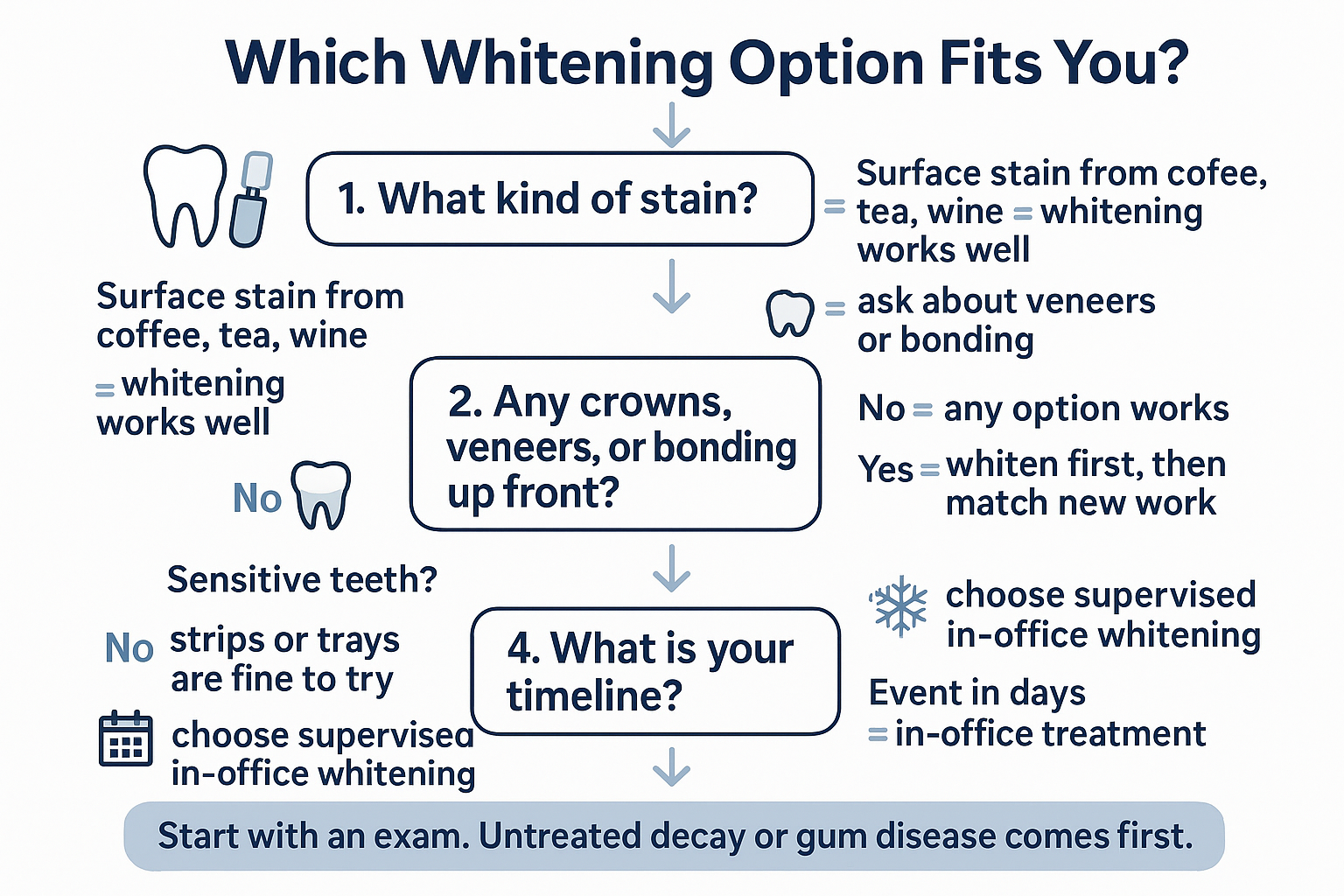
The middle option most people never hear about
Custom take-home trays get skipped in almost every online whitening conversation, and I think that is a mistake.
They are made from a digital scan of your own bite, so the gel stays on the tooth surface instead of pooling on your gums. The gel itself is stronger than what you buy off a shelf. You wear them in short sessions at home over one to two weeks, on your own schedule.
We see this used constantly by working parents and by families with teenagers. In one recent month, a parent stopped by just to pick up trays for their daughter, which is about as normal a Huntington Beach errand as it gets between school pickup and a practice at Edison.
Trays make sense when:
- You want a bigger shade change than strips can deliver
- You cannot block out a chunk of a weekday for an in-office session
- You want to touch up once or twice a year instead of restarting from scratch
- You have mild sensitivity and want to control how long each session runs
One more scheduling note. If you are whitening ahead of something specific, and several people call us every year about job interviews, weddings, and graduation photos, build in a buffer. Finish whitening at least a week before the event so any temporary sensitivity settles and the shade stabilizes.
For anyone weighing cost without dental coverage, our guide on the cheapest ways to fix your teeth without insurance covers how in-house savings plans change the math on elective work.
Frequently Asked Questions About Whitening Strips vs. Professional Treatment
Does whitening damage enamel?
Used as directed, peroxide whitening does not strip enamel away. The temporary sensitivity comes from the enamel’s microscopic pores opening up, not from erosion. The bigger risk is overuse, so following the schedule on the product or the one your dentist gives you matters.
How long do results last?
Usually six months to two years, depending almost entirely on habits. Daily coffee or red wine pulls that shorter. Custom trays make touch-ups easy because you already own the trays and just need more gel.
Will whitening work if I have fillings in my front teeth?
The natural tooth around them will lighten, but the filling material will not. If those fillings are noticeable, plan on replacing them after whitening so the new material can be matched to your new shade.
Does dental insurance cover teeth whitening?
Almost never. Whitening is classified as cosmetic, so it comes out of pocket on most plans. That is also true for patients who are out of network, and our post on what out of network really means breaks down where coverage does and does not apply.
Can I whiten if I have a cavity or bleeding gums?
Not yet. Peroxide reaching an untreated cavity or inflamed gum tissue hurts, and it can make an existing problem worse. Get the exam and cleaning done first, then whiten. It is a short delay for a much better experience.
Not sure which whitening path fits your teeth?
If you are somewhere between the drugstore aisle and a professional treatment, an exam sorts it out quickly. We can tell you what kind of staining you have, whether sensitivity is likely to be an issue, and which option is worth your money. Our team is here in Huntington Beach at 19201 Brookhurst Street, and you can reach us at (657) 800-5254 or book online at kalidental.com whenever you are ready.