
Direct Answer: After a tooth extraction, eat soft, cool foods for the first 24 hours, avoid straws and rinsing, and expect peak swelling around day two or three before it gradually improves.
You just got home with a wad of gauze in your mouth and a list of instructions that somehow left you with more questions than answers. Can you eat oatmeal? Is the throbbing normal? What exactly is dry socket and are you about to get it? These are the things patients actually ask us after an extraction, and vague answers like “eat soft foods” don’t cut it.
I want to give you something more useful: a real, hour-by-hour and day-by-day picture of what tooth extraction recovery looks like, what you can eat at each stage, and how to tell the difference between normal healing and something worth calling us about.
Whether you had a simple extraction or a surgical one, like a wisdom tooth removal, the first four days are where most of the important decisions happen. Getting them right makes the rest of the healing process significantly smoother.
The First 24 Hours: Protect the Clot Above Everything Else
The blood clot that forms in the extraction socket is not just a healing byproduct. It IS the healing. That clot is what keeps the exposed bone protected and allows new tissue to grow in.
If that clot gets dislodged, you end up with what’s called dry socket, and it is considerably more painful than the extraction itself. Your dentist will need to treat it with a medicated dressing placed directly into the socket, which means a follow-up visit you didn’t plan for. The American Dental Association notes that dry socket occurs in roughly 2-5% of extractions overall but at a much higher rate with lower wisdom teeth.
Here is what causes dry socket and what to avoid in those first 24 hours:
- No straws. The suction is enough to lift the clot out.
- No vigorous rinsing. Swishing hard does the same thing. If you rinse at all, let water fall out of your mouth gently.
- No smoking. The suction AND the chemicals in smoke both work against clot formation.
- No spitting forcefully for the same reason.
- Bite down gently on the gauze your dentist placed. Change it every 30-45 minutes if it becomes soaked, and apply steady pressure.
If bleeding hasn’t slowed after 20 minutes of steady, gentle pressure, that’s worth a call. Light oozing mixed with saliva that makes everything look very red is normal. Active bleeding that fills the gauze quickly is not.
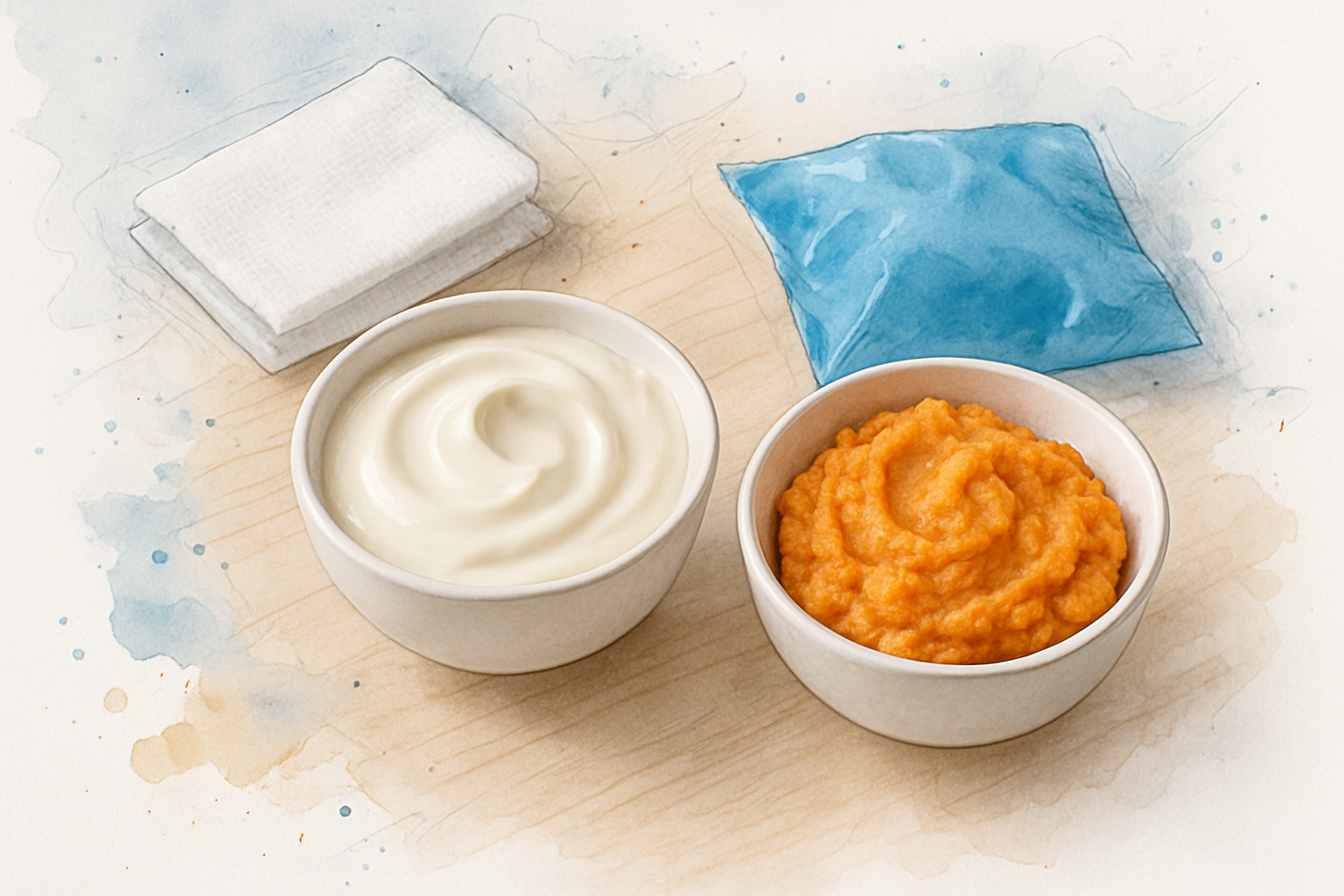
What to Eat After a Tooth Extraction: A Day-by-Day Breakdown
“Soft foods for a few days” is technically accurate but practically useless. I hear this complaint from patients regularly. So here is what that actually means in real terms.
Day 1 (first 24 hours): Stick to cool or room-temperature foods only. Heat increases blood flow to the area and can disturb the clot. Good options:
- Smooth yogurt with NO fruit pieces or granola mixed in
- Plain applesauce
- Cold broth or lukewarm soup (not hot)
- Smoothies eaten with a spoon, not a straw
- Pudding or gelatin
- Ice cream or a cold smoothie bowl
Avoid oatmeal on day one if it’s served hot. Warm is borderline. Cool oatmeal that has no chewy toppings is fine.
Days 2-3: Swelling usually peaks around day two or three, and your mouth may feel more tender even though you’re technically further along in healing. You can expand what you eat, but stay with soft textures:
- Scrambled eggs
- Soft pasta that doesn’t require much chewing (think overcooked, not al dente)
- Mashed potatoes without hard mix-ins
- Soft fish like tilapia or cod
- Ripe banana or soft canned fruit
- Warm (not hot) soups
Day 4 and beyond: Most patients with a straightforward extraction can begin returning to a more normal diet. Cut food into small pieces, chew on the opposite side from the extraction site, and avoid anything hard, crunchy, or sticky until the socket is more fully closed. Seeds and small food particles are worth avoiding because they can lodge in the socket.
For a deeper look at what the overall healing timeline looks like, this breakdown of tooth extraction recovery covers what to expect week by week.
Day-by-Day Food Guide After Tooth Extraction
Use this as a quick reference when you’re standing in the kitchen trying to figure out if something is okay to eat.
| Day | Safe to Eat | Avoid |
|---|---|---|
| Day 1 | Smooth yogurt, cold applesauce, gelatin, ice cream, cool broth, spoon-fed smoothies | Hot foods, straws, crunchy or chewy anything, oatmeal with toppings |
| Days 2-3 | Scrambled eggs, soft overcooked pasta, mashed potatoes, soft fish, ripe fruit | Hard bread, chips, raw vegetables, seeds, extremely hot foods |
| Day 4+ | Most soft foods, small-cut normal meals on the opposite side | Hard candies, popcorn, sticky foods, anything requiring heavy chewing near the site |
Normal Discomfort vs. Something That Needs Attention
This is honestly the question most people are searching for when they type “tooth extraction recovery” into their phone at 11pm. I get it. Here is how to read what your body is telling you.
Normal signs of healing:
- Swelling that increases through day two or three and then starts to go down
- Some aching or soreness that responds to over-the-counter pain relief
- Light oozing or pinkish saliva for the first day
- Mild jaw stiffness, especially if the extraction was surgical
- Bruising along the jaw or cheek (more common with lower extractions)
Signs worth calling about:
- Pain that gets WORSE after day three instead of better. This is the clearest sign of dry socket.
- A bad taste or odor coming from the socket that wasn’t there before.
- Fever above 101F, especially combined with swelling that’s getting larger.
- Numbness that lingers beyond the first day after the local anesthetic wore off.
- Bleeding that won’t stop after 20 minutes of firm, steady pressure.
Pain increasing after day three is the key signal here. Healing discomfort trends downward. Dry socket and infection trend upward. If yours is trending the wrong way, please don’t wait it out. Understanding what normal post-extraction pain looks like can help you make that call.
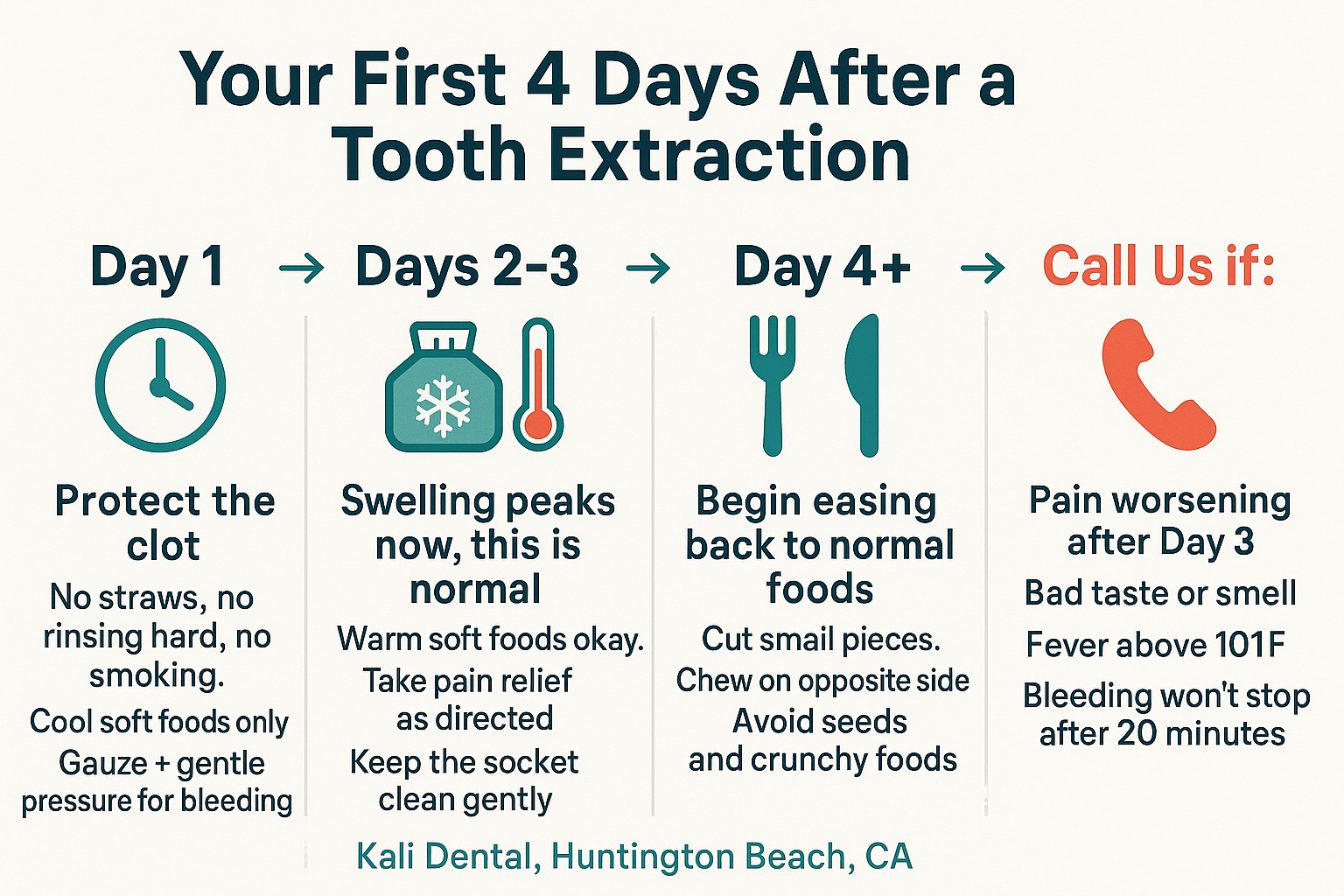
Your First 4 Days After a Tooth Extraction
Here is a simple visual overview of the recovery timeline, what to expect each day, and the key rules that protect your healing.
If Your Extraction Was Surgical: Recovery Takes a Bit Longer
Not all extractions are equal, and it matters that you know which kind you had. A simple extraction involves a tooth that came out cleanly in one piece. A surgical extraction, such as an impacted wisdom tooth removal, involves cutting into gum tissue and sometimes sectioning the tooth before removal.
If you had a surgical extraction, a few things are different:
- Sutures (stitches) may have been placed. Some dissolve on their own within 7-10 days. Others need to be removed at a follow-up appointment. Your aftercare instructions will specify which type you have.
- Swelling and jaw soreness last longer, often peaking further into the week and taking a full 7-10 days to substantially improve.
- The food timeline shifts back by a day or two. What I described as “Day 4” foods for a simple extraction may be more like “Day 6-7” for a surgical case.
If a bone graft was placed at the same time, which is sometimes recommended when a patient is considering a dental implant later on, there are additional instructions about protecting the graft material. You will typically be told not to disturb the site at all in the first several days, and certain foods and activities are off-limits for longer than a standard extraction.
If you want to understand the full cost picture for wisdom tooth removal before your appointment, this breakdown of wisdom tooth removal costs in Huntington Beach is a useful starting point.
The Question Most Patients Don’t Think to Ask Before Leaving
When a permanent tooth is removed, the jawbone underneath it starts to change. Without a tooth root to stimulate it, the bone in that area gradually shrinks, a process called resorption. This happens slowly, but it does happen, and it affects both the shape of your jaw and your options for replacing the tooth later.
If a dental implant is something you might want down the road, the best time to have that conversation is at or shortly after the extraction, not six months later. Bone preservation options, including the graft I mentioned above, are much easier to address at the time of the extraction than they are after resorption has already begun.
I am not raising this to push you toward a decision. I am raising it because it’s the kind of thing patients wish someone had mentioned sooner. If you are curious about what implants cost and how the process works, this overview of dental implant costs in Orange County is worth reading before your next appointment.
And if you’re not sure what long-term tooth replacement even looks like for your situation, that conversation is best had with your dentist before the window gets narrower.
Frequently Asked Questions About Tooth Extraction Recovery
Can I drink coffee after a tooth extraction?
Not on day one. Hot liquids increase blood flow to the area and can disturb the clot. On day two or three, if you drink it warm rather than hot and avoid using a straw, most patients are fine. But when in doubt, wait.
Is it okay to eat oatmeal after getting a tooth pulled?
Yes, but not hot oatmeal on the first day. Cool or lukewarm plain oatmeal without crunchy toppings is a reasonable day-two option. Avoid granola, nuts, seeds, or anything mixed in that requires chewing or could get lodged in the socket.
How do I know if I have dry socket?
Pain that gets worse after day three is the most telling sign, especially if you also notice a bad taste or smell from the site. Dry socket means the clot has been lost and the bone is exposed. It’s very treatable, but it requires a visit to have a medicated dressing placed. Don’t try to manage it at home.
My cheek is really swollen on day two, should I be worried?
Probably not. Swelling that peaks around day two or three and then gradually decreases is a completely normal part of healing. Keep icing in 20-minute intervals for the first 24-48 hours. If swelling is still increasing on day four or five, or you develop a fever, that’s when it’s worth calling.
When can I go back to eating normally?
For a simple extraction, most patients are back to a fairly normal diet by day four or five, eating on the opposite side and avoiding very hard or sticky foods for another week. For surgical extractions or wisdom teeth, give it closer to a week before you start testing normal textures. Your dentist’s specific instructions for your case take priority over any general timeline.
Do I really need a follow-up appointment after an extraction?
If sutures were placed or a bone graft was done, yes. A follow-up lets your dentist confirm healing is going the right direction and, if needed, remove any sutures that didn’t dissolve. Even without those factors, if your pain is not improving by day four, coming in is the right call rather than waiting to see what happens.
Questions About Your Recovery? We’re Easy to Reach.
If you’re in Huntington Beach, Oak View, Goldenwest, or anywhere nearby and you’re not sure whether what you’re feeling after an extraction is normal, our team at Kali Dental is happy to talk it through. We’d rather answer a quick question and put your mind at ease than have you wait on something that could have been handled early. Call us at (657) 800-5254 or book an appointment online at kalidental.com.