
Direct Answer: Sometimes, yes. If one real stage of implant treatment happens before December 31 and the next happens after January 1, each stage bills against a different annual maximum. Your plan’s rules decide.
You have been living with a gap back there for a year, maybe two. You chew on the other side, you smile a little differently in photos, and you keep telling yourself you will deal with it. Then October rolls around and you realize your dental benefits reset on January 1 and you never touched this year’s maximum.
I get this call every fall from people in Central Huntington Beach, Oak View, and over in Fountain Valley. The question is almost always the same: if I start now, can I use this year’s benefits and next year’s on the same implant?
The honest answer is sometimes, and it depends less on billing tricks than on scheduling. Below I will walk through the calendar math, where an implant case naturally splits into stages, what actually drives your out of pocket cost, and what to do if your plan does not cover implants at all.
What “two years of benefits” really means on an implant case
Most dental plans work on a calendar year. You get an annual maximum, you use what you use, and whatever is left disappears on December 31. It does not roll over.
General market context puts typical PPO annual maximums somewhere in the $1,000 to $2,000 per person per year range, though plenty of plans sit outside that. An implant case with a graft and a crown can run well past a single year’s maximum, which is exactly why the two year idea comes up.
The split works like this. If a genuine stage of treatment is completed before December 31, it bills against this year’s maximum. If the next stage happens after January 1, it bills against the fresh one.
Two things to confirm before you build a plan around this:
- Your plan year may not be the calendar year. Some employer plans reset in July or October. Pull up your benefits summary or call the number on your card.
- The date of service rules. Carriers care when the work was actually done, not when you signed a treatment plan. You cannot move December work into January on paper.
If you want the broader version of this, I wrote about what unused dental benefits can still cover before December 31.

Where an implant case naturally splits
Implant treatment already comes in stages. That is why this is a scheduling conversation and not a billing maneuver.
A typical case moves through these steps:
- CBCT scan, exam, and planning. 3D imaging shows bone height, bone width, and where the nerve sits.
- Extraction with ridge preservation, if the failing tooth is still in place. Whether grafting is needed depends on bone density and jaw health.
- Healing. Usually a few weeks to a few months before the site is ready.
- Implant placement. The titanium post goes into the jaw, guided by that scan.
- Integration. The bone fuses to the post. This commonly takes several months and cannot be rushed.
- The crown. The final restoration goes on top, milled in office in many cases.
Healing time sets the pace here, not paperwork. For a lot of patients, the scan, the extraction, and the graft land in year one, and placement or the crown lands in year two. That is not us gaming anything. That is just how bone works.
One practical note. When the scan, the surgical stage, and the crown all happen in one Huntington Beach office, you avoid the schedule drift that shows up when a case gets handed between a surgical specialist and a general dentist. I covered that handoff in detail in how implant care gets split between providers. If you want the full clinical pacing, here is a realistic implant timeline.
Which stages usually land in which benefit year
This is a general pattern, not a promise. Your bone, your plan, and your start date all move these around.
| Stage | Typical timing | Likely benefit year |
|---|---|---|
| CBCT scan, exam, treatment plan | First visit | Year one |
| Extraction with ridge preservation | Same visit or within weeks | Year one |
| Healing and bone fill | Several weeks to a few months | No billing during this window |
| Implant placement | After the site heals | Year one or year two, depending on start date |
| Integration period | Commonly several months | No billing during this window |
| Final crown | After integration | Year two in most December starts |
The coverage levers that decide your actual number
Implant coverage varies more than almost anything else in a dental plan. Two neighbors on Goldenwest with the same employer can land in very different places.
Here is what I check first:
- Does the plan treat implants as a major service, or exclude them outright? Some plans pay a percentage on major work. Others say no implants at all, full stop.
- Missing tooth clause. If the tooth came out before your current plan started, some carriers will not cover replacing it.
- Waiting periods. Newer plans often make you wait before major work is eligible.
- Whether the implant body and the crown bill separately. They often do, which matters a lot for a two year split.
- Whether a bone graft is part of the case. Grafting is sometimes covered, sometimes not, and it changes the total.
Most plans pay generously on preventive care and far less on major work. The American Dental Association’s patient guide to implants is a decent plain English starting point if you want to understand the procedure before you talk coverage.
I am not going to hand you a flat implant price in a blog post, because the only number worth planning around is a written estimate for your mouth and your plan. The one fixed figure I can give you is our published $150 new patient exam and X-rays, which is where most of these conversations start anyway. For the wider picture, see what implants actually cost in Orange County.
A realistic fall timeline for a December start
Most two year plans fall apart on logistics, not on clinical grounds. Here is the runway you actually need.
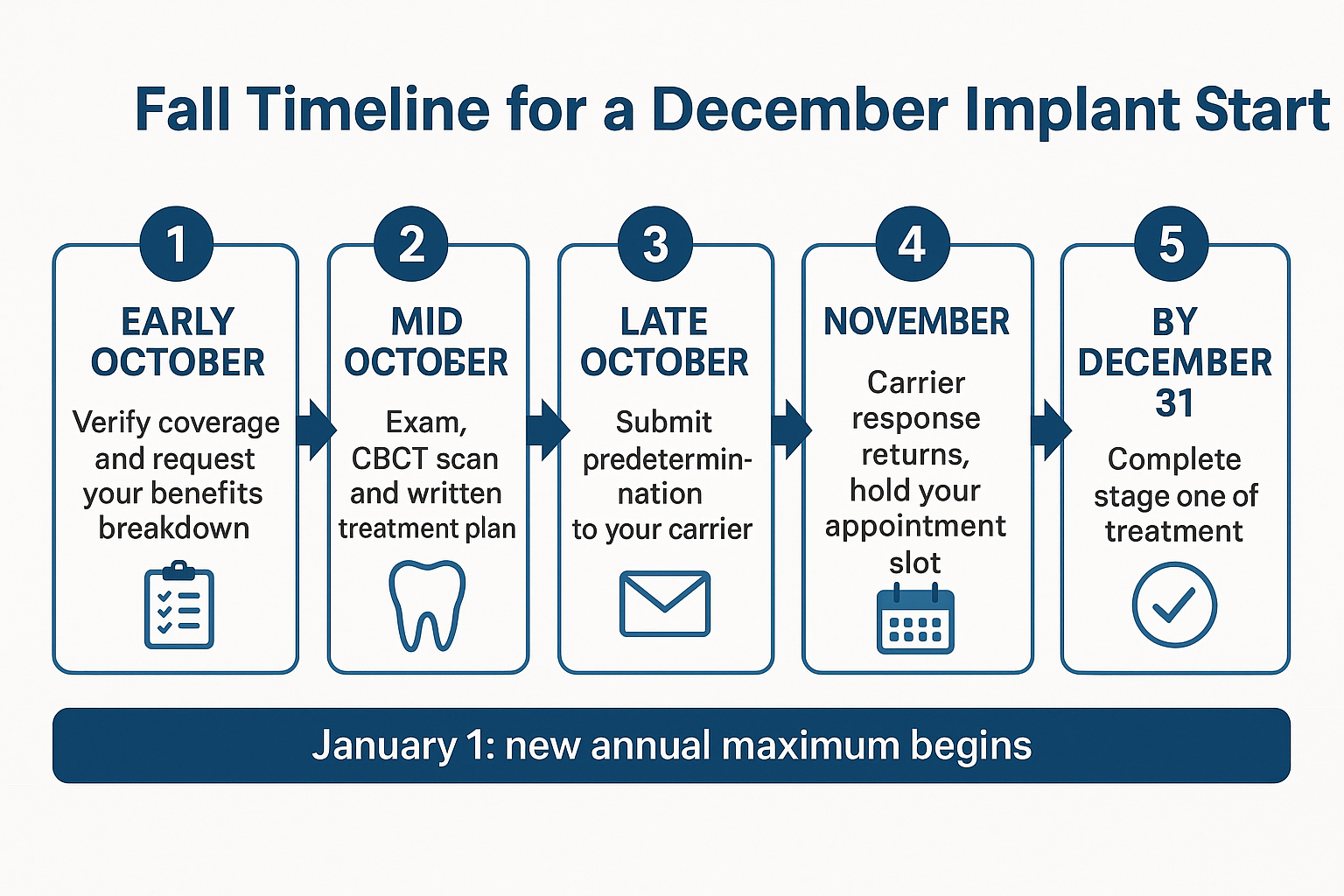
Start the paperwork in October, not the week before Christmas
This is where good plans die. Not in the chair, in the inbox.
Predetermination requests for major work can take weeks with some carriers. Basic coverage verification is usually faster, often a day or two, but a predetermination is a different animal. If you ask for one on December 15, you are asking a carrier to turn it around during the slowest two weeks of their year.
December appointment slots also go fast, because everybody else is doing the same math you are. Our schedule tightens further than most: we are closed Thursdays, and Saturday hours run 8am to 2pm by appointment only. That shrinks the usable December calendar quite a bit.
Two habits that keep this from stalling:
- Ask for a written predetermination, not a verbal estimate over the phone.
- Hold a tentative appointment while coverage is being verified. If the answer comes back yes, the spot exists. If it comes back no, you cancel and you have lost nothing.
I have watched a lot of motivated people say “I need to check my coverage before I can book” and then never circle back. HR goes quiet around the holidays, portals get slow, and the window closes. Holding a soft slot is the simplest fix I know. If you want a script for the money conversation, read what to ask before treatment starts.
If your plan excludes implants, or you have no plan at all
Then the calendar split saves you nothing, and I would rather tell you that straight than let you chase it.
Your real question becomes whether to phase treatment for cash flow reasons instead. The good news is that phasing for cash flow follows the same clinical stages, so you are not compromising the result. You are spreading the cost across the natural healing gaps.
Two different tools help here, and they are not the same thing:
- An in house savings plan. This is not insurance. It is a membership that reduces the cost of care at one office, with no annual maximum and no waiting on a carrier.
- Third party financing. We work with Cherry, which takes a few minutes to apply for. We do not accept CareCredit, and I would rather you know that before you call than after.
If CareCredit is the card in your wallet, here is a rundown of what other dental financing options exist.
The part that makes any of this work
A two year benefits plan only holds up if somebody sits down and maps the stages and the dollars with you in writing. Verbal estimates evaporate. A stage by stage breakdown does not.
That is the thing patients from Huntington Harbour to Fountain Valley mention over and over in reviews. One patient put it this way: “I especially appreciate how transparent they were with billing and showed me exactly how it was broken up.” That is Michael F., and it is the standard we try to hold on every case.
Ask for a plan that shows what happens at each visit, what each stage costs, what your plan is expected to pay, and what is left for you. If an office will not put that on paper, that tells you something.
Frequently Asked Questions About Implants and Two Benefit Years
Can I just have the implant placed in December and billed in January?
No. Carriers go by date of service, not date of billing. The work has to actually happen in the year you want it applied to, which is why this is a scheduling question rather than a paperwork one.
How late is too late to start before December 31?
It depends on whether you need a predetermination. If your plan requires one for major work, October is a comfortable start and late November is tight. If you only need coverage verified, that is usually a day or two, so a December first stage can still be realistic. Our Thursday closure and appointment-only Saturdays do narrow December availability, so earlier is better.
What if I use up this year’s maximum and the second stage is not ready until the year after next?
That happens, and it is fine. Healing and integration set the schedule, not the calendar. If the crown lands two benefit years later, it still bills against whatever maximum is active that year. Nothing is lost by waiting for the bone to be ready.
Does the implant post and the crown count as two separate claims?
On many plans, yes. The surgical placement and the final restoration are often coded and billed separately, which is exactly what makes a two year split possible. Your benefits breakdown will show how your plan handles each one.
I am out of network. Is this still worth doing?
Often it is. Out of network care can still be submitted to your plan for reimbursement, and plenty of patients are surprised by how much comes back. Ask for an estimate that shows both the fee and the expected reimbursement so you are comparing real numbers.
What does the first visit actually include?
An exam, X-rays, and in implant cases a CBCT 3D scan so we can see bone volume and nerve position before anyone talks about surgery. Our published new patient exam and X-rays fee is $150, and the implant planning conversation starts from what that scan shows.
Thinking through a fall implant start?
Dr. Kalvin and our team are seeing implant consults this fall for patients across Huntington Beach, Fountain Valley, and the rest of Orange County, including the scan, the planning, and a written stage by stage breakdown. If you want to talk through how your own plan year lines up with treatment, you can reach us at (657) 800-5254 or book online at kalidental.com.
