
Direct Answer: Morning jaw soreness, temple headaches, and flattened teeth usually point to nighttime grinding. A custom night guard made from a scan of your bite is the standard way to protect your teeth.
You wake up, and your jaw feels tight. Maybe there’s a dull ache right at your temples, or your back teeth feel sore for no reason you can name. By mid-morning it fades, so you forget about it until it happens again next week.
That pattern is one of the most common signs of nighttime teeth grinding, also called bruxism. And it’s one of the most under-diagnosed problems I see in adults, mostly because it happens while you’re asleep and nobody is around to tell you.
I want to walk you through what grinding actually does to your teeth, how a custom night guard differs from the boil-and-bite kind at the pharmacy on Brookhurst, and why catching this early is so much cheaper than fixing it later.
How to Tell If You’re Grinding at Night
Most people don’t find out from the grinding itself. They find out from the symptoms it leaves behind in the morning.
Here’s what patients describe to me most often:
- Jaw stiffness or soreness within the first hour of waking, especially near the hinge in front of your ears
- Headaches at the temples that fade as the day goes on
- A partner or roommate mentioning a squeaking or grinding sound during the night
- Teeth that look flat across the biting edges instead of having natural peaks and grooves
- New sensitivity to cold drinks or sweets that wasn’t there a year ago
- A chipped front tooth edge you can’t trace to any specific accident
One detail I always point out: grinding damage is usually symmetrical. If the same spot is worn down on both sides of your mouth, that’s a habit, not an injury.
The soreness can also spread. Jaw muscles connect into the neck and shoulders, which is why some people show up thinking they slept wrong. We covered that overlap in more detail in why a toothache can make your neck and shoulder hurt.
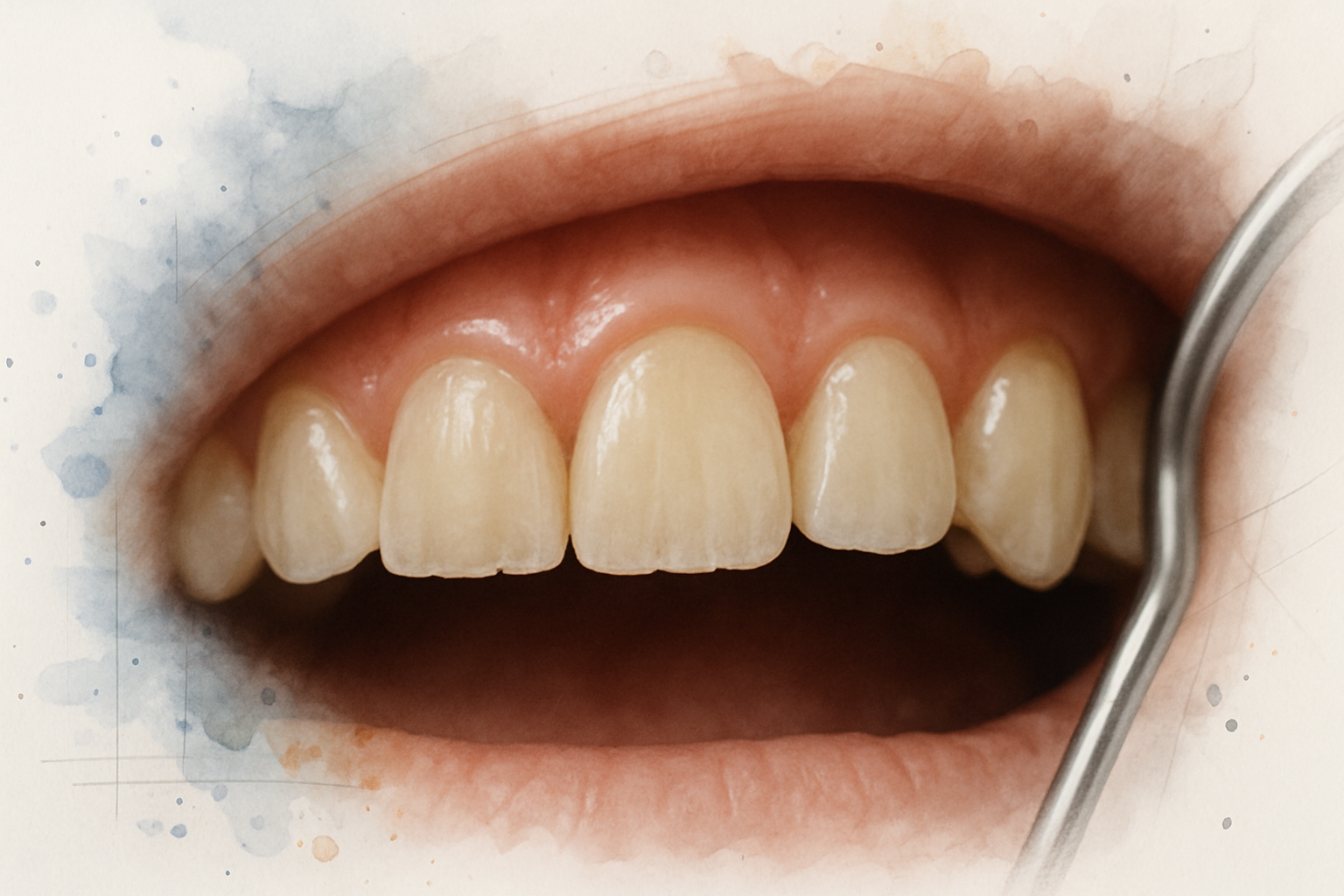
What Years of Grinding Actually Does to Your Teeth
The pressure your jaw generates at night is far higher than what you use to chew a sandwich. And it goes on for hours, night after night, with no food in the way to cushion it.
That pressure causes damage in a predictable order:
- Enamel wears down first. Once it’s thin, the softer dentin underneath is exposed, which is where the cold and sugar sensitivity comes from.
- Hairline cracks form in the tooth structure. You often can’t see or feel these, but they show up on X-rays and during an exam. A cracked tooth that gets caught early can sometimes be handled with a filling or crown. One that splits deeper may need a root canal or removal.
- Gums recede. Chronic flexing at the gumline pushes tissue back, exposing root surfaces that decay faster than enamel.
- Teeth can loosen in advanced cases, because the bone supporting them is under constant strain.
A cracked or chipped tooth is one of the first things I connect back to grinding during an exam. When someone comes in with a broken cusp and no story about biting a popcorn kernel, nighttime clenching is usually the answer.
The National Institutes of Health also links bruxism to stress, sleep issues, and bite problems, which lines up with what I see day to day.
Catching it at the worn-enamel stage means a night guard and monitoring. Catching it after a tooth splits means restorative work. That gap is the whole reason I bring it up at routine visits.
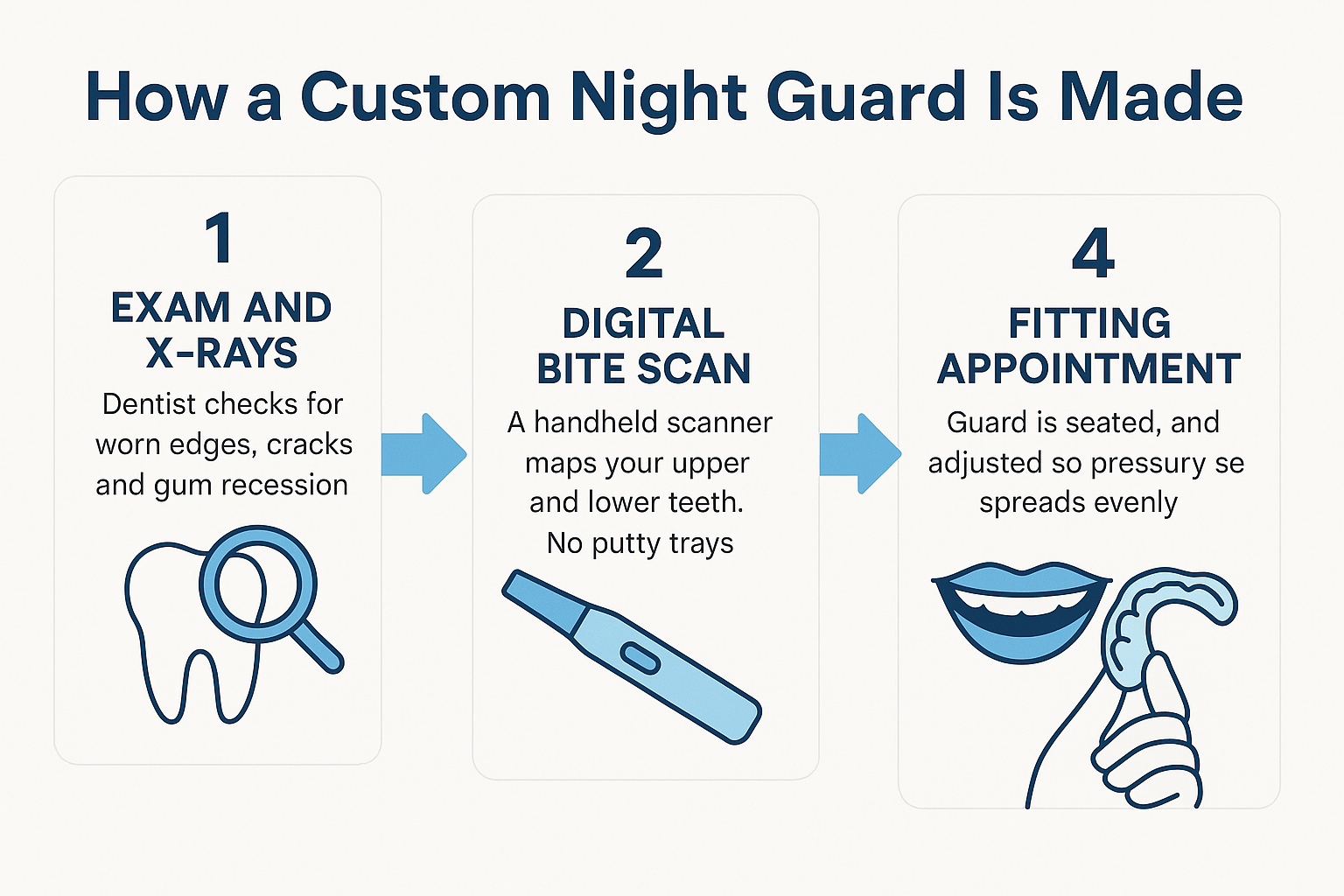
Getting a Custom Night Guard: What the Process Looks Like
Most patients are surprised at how short the process is. Here’s the sequence from first visit to wearing it.
Custom Night Guard vs. the Drugstore Version
This is the question I get most. If a boil-and-bite guard costs a fraction of a custom one, why not start there?
The honest answer is that fit changes everything. A custom guard is made from a digital scan of your actual bite, so it sits evenly on every tooth and spreads the force across the whole arch. A generic tray you soften in hot water only approximates your bite.
When the fit is off, two things tend to happen:
- Pressure concentrates on a few teeth instead of being shared, so those teeth take more punishment
- Your jaw muscles work harder to hold the guard in place, which can leave you more sore in the morning, not less
I’ve had patients bring in over-the-counter guards that were already chewed through in a few months. That tells me the material wasn’t holding up to their bite force.
A custom guard also gets checked and adjusted at a fitting visit. If it rocks or feels high on one side, that gets corrected before you ever sleep in it. A drugstore guard has nobody checking that for you.
And a practical note from one of our reviews: a patient who needed night guards mentioned they “were made very quickly, which I really appreciated.” Turnaround matters when your jaw already hurts.
Prevention Cost vs. Repair Cost: The Practical Math
This is the comparison that usually convinces people who have been putting it off. Dental costs vary widely by case and by office, so treat these as general market context rather than a quote.
| What You’re Paying For | Typical Cost Range in Orange County | What It Buys You |
|---|---|---|
| New patient exam and X-rays | Kali Dental’s posted new patient exam and X-rays is $150 | Confirms whether grinding damage is present and how far along it is |
| Custom night guard | Generally a few hundred dollars, varies by material and lab | Protects existing teeth from further wear and cracking |
| Crown for a cracked tooth | Often well over a thousand per tooth, varies widely | Repairs one tooth after damage has already happened |
| Root canal plus crown | Can run several thousand for a single tooth | Saves a tooth where the crack reached the nerve |
| Rebuilding multiple worn teeth | Highly variable, often the largest treatment plan a patient faces | Restores bite function after years of untreated grinding |
Why Grinding Shows Up When Life Gets Busy
Bruxism has a strong link to stress, and living near the water doesn’t make anyone immune to that.
The patterns I notice locally are pretty consistent. Grinding complaints tend to spike during the school year crunch, around year-end when people are racing insurance deadlines, and during stretches when someone’s work schedule flips or a big financial decision is hanging over them.
That’s part of why grinding is sometimes temporary and sometimes chronic. Some people clench hard for three stressful months and then stop. Others do it for years.
A lot of people also clench during the day without noticing. Try checking in with yourself at these moments:
- Sitting in traffic on Beach Boulevard or the 405
- Staring at a screen during focused work
- Lifting something heavy or exercising
- Reading something that irritates you
Your teeth should rest slightly apart when your mouth is closed and relaxed. If they’re touching, that’s a clench. Simply noticing it and letting the jaw drop is a habit worth building, and it costs nothing.
None of this replaces a real look at your teeth. But it explains why grinding often comes and goes, and why the damage builds quietly. If you’re overdue for a look, what actually happens at a dental exam walks through the visit step by step.
Frequently Asked Questions About Night Guards and Teeth Grinding
Will insurance cover a night guard?
Many dental plans include some coverage for a night guard, but the amount varies a lot by plan and some treat it as a limited benefit. Insurance questions come up on roughly a quarter of the calls we get, so it’s worth asking the office to check your specific plan before you commit.
How long does a custom night guard last?
It depends on how hard you grind and the material used. Some people get several years out of one, while heavy grinders wear through faster. Bring it to your cleaning visits so it can be checked for thin spots and cracks.
Does a night guard stop the grinding itself?
Not exactly. It doesn’t stop your jaw muscles from working at night. What it does is put a protective layer between your upper and lower teeth so the force hits the guard instead of your enamel. Many patients also report less morning jaw soreness once the bite is evenly supported.
I already have a cracked tooth. Is it too late for a night guard?
No. Repairing the damaged tooth and protecting the rest are two separate jobs, and you usually want both. Fixing a crown or filling without addressing the grinding often means the new work takes the same beating the original tooth did.
How quickly can I get one?
The scan itself takes only a few minutes. After that it’s fabrication time, then a short fitting visit to confirm it seats correctly. It’s a two-appointment process for most people, not a long treatment plan.
Wondering if your jaw pain is grinding?
If you’ve been waking up sore or you’ve noticed your teeth looking flatter than they used to, a straightforward exam and X-rays will tell you where things stand. Our office on Brookhurst Street sees patients from Oak View, Goldenwest, Huntington Harbour, Fountain Valley, and across Orange County, and we keep the conversation no-pressure from start to finish. You can reach us at (657) 800-5254 or book online at kalidental.com whenever it’s convenient for you.