
Direct Answer: California law requires a dentist to review your recent X-rays before aligners first move your teeth, and to share their license details. Mail-order kits often skip the exam that catches hidden problems.
You see the ad on your phone one night. A low monthly payment, trays in the mail, no office visits. Then you check what a dentist charges for the same looking result and it is a bigger number with a scan appointment attached.
That question comes up in our office more than you would guess, usually tucked into a routine cleaning call. One caller booked a cleaning and asked us to also take off the leftover attachments from aligner treatment she had started somewhere else.
I am not here to talk you out of anything. I want you to see what you are actually buying with each option, starting with a California law most people shopping kits have never heard of.
California Already Settled Part of This Argument in Law
Assembly Bill 1519 was signed in October 2019 and took effect January 1, 2020. It changed what is legally expected of any dentist treating a California patient, including one working through an app.
Three pieces of it matter if you are comparing mail-order clear aligners vs dentist-supervised aligners in California:
- It is unprofessional conduct for a treating dentist to skip reviewing your most recent radiographs or equivalent bone imaging before orthodontic appliances are first used on you.
- Anyone delivering dental services by telehealth must make the treating dentist’s name, phone number, practice address, and California license number available to you before treatment starts.
- No agreement can stop you from filing a complaint with the Dental Board of California.
In plain terms: if nobody looked at a recent X-ray of your teeth and bone before trays started moving them, that falls short of the California standard.
And you should always be able to name the dentist responsible for your case and look up their license. If a company cannot hand you that information in one click, that tells you something about who owns the outcome.
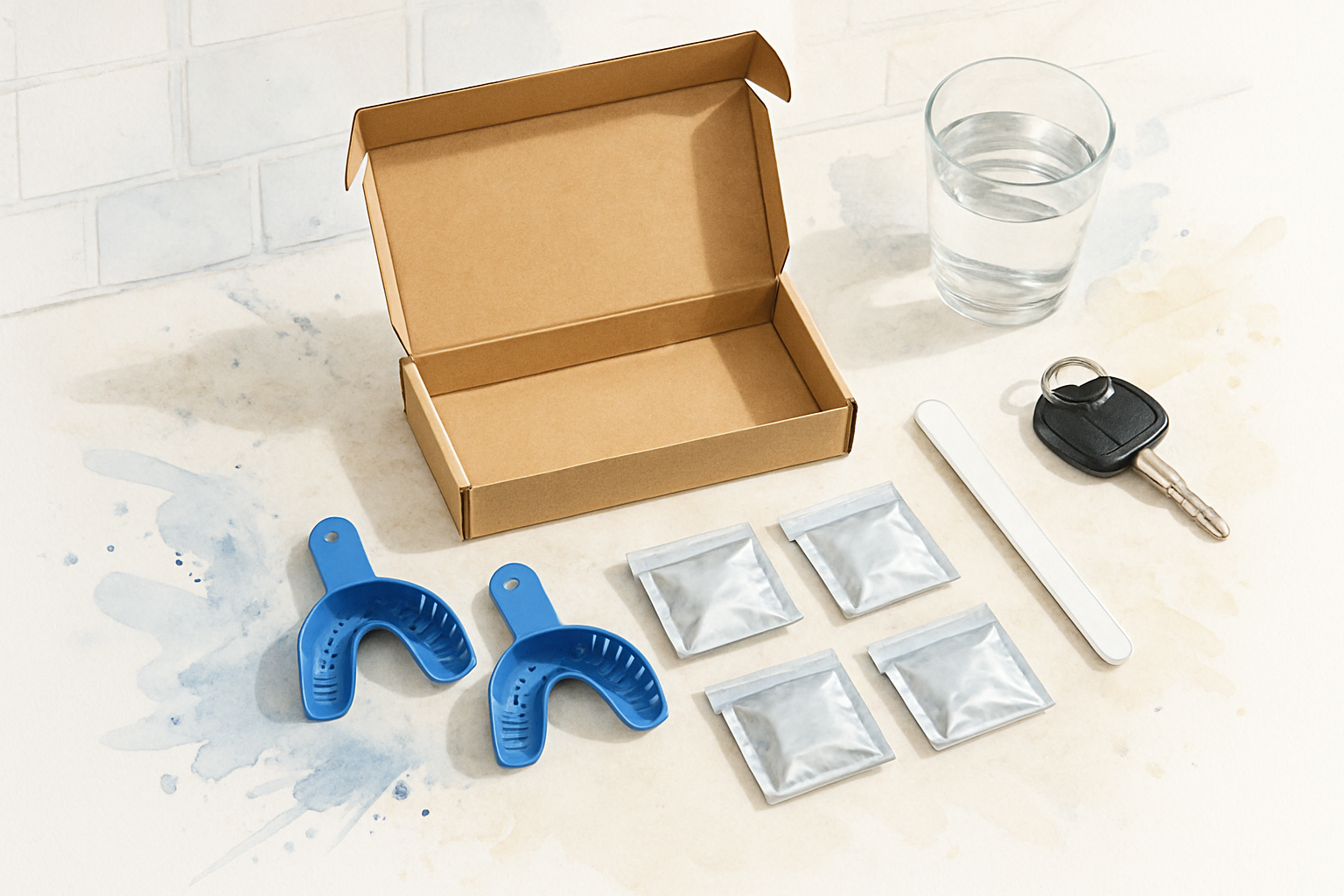
What an X-Ray Shows That a Smile Photo Never Will
A photo of your smile shows the crowns of your teeth. That is the visible top of an iceberg, and the part that decides whether a case should move at all is underwater.
Imaging is how we see:
- Root angle and root length, which decide how far a tooth can safely be pushed
- Bone level around each tooth, since teeth with bone loss behave very differently under pressure
- Hidden decay under an old filling or between tight contacts
- An abscess quietly forming at a root tip
- An impacted tooth that has no room to come in
None of those show up in putty or a selfie. The American Association of Orthodontists’ advocacy materials make the same point about direct-to-consumer treatment without a proper exam and X-rays, and they point patients to the FDA’s MAUDE database for reporting problems tied to these products.
Here, a records visit is less dramatic than people expect. We use digital scanning instead of the goopy trays you remember, and we add CBCT 3D imaging when the bite or the bone raises a real question.
Patients tell us the imaging part is the easiest thing they did that week. That surprises almost everyone over 40.
What You Are Actually Buying in Each Model
The monthly payment is not the product. This is a closer look at what is included and what is not.
| What’s involved | Mail-order kit model | Dentist-supervised plan |
|---|---|---|
| Exam before trays start | Photos and a mailed impression, usually no in-person exam | In-person exam with a licensed dentist |
| X-rays or 3D imaging | Often not taken or not reviewed | Required under California law before appliances are first used |
| Cavities or gum issues found first | Not screened for | Treated or stabilized before trays begin |
| Who is treating you | Remote dentist you may never meet | A named dentist with a verifiable California license |
| If a tooth stops tracking | Email or app support | An in-person visit and a mid-course correction |
| Records afterward | Held by the company | Stay in one local chart you can transfer |
Four Things That Should Happen Before Trays Move Anything
This is the short version of what California expects and what a records visit covers.
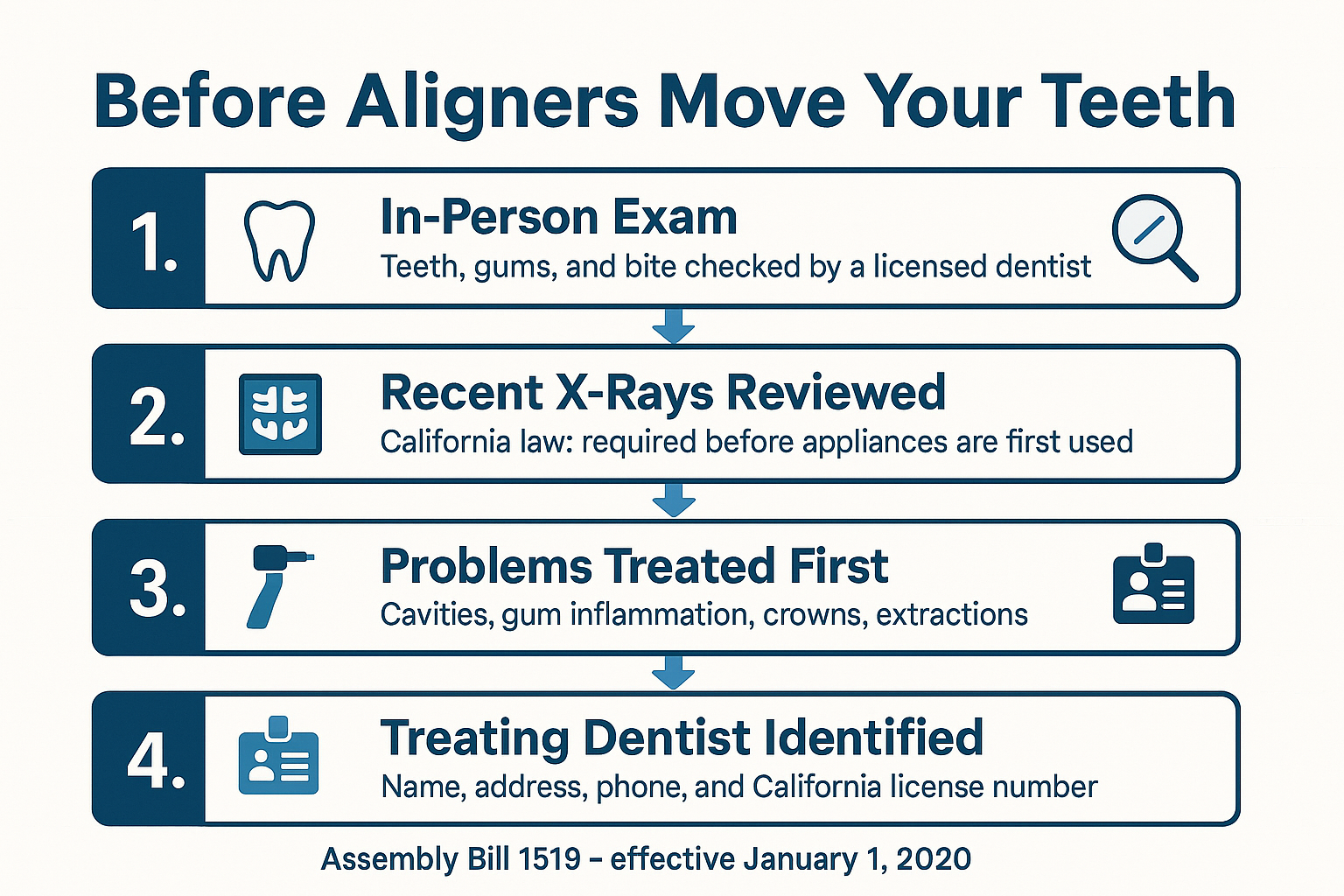
What Clear Aligners Handle Well, and What Has to Come First
This is where people get burned, and it is almost never about the trays themselves. It is about case selection and sequencing.
The honest sweet spot for clear aligners is:
- Crowding, the classic crooked lower front teeth
- Spacing and gaps
- Mild to moderate bite issues
Trays are worn in roughly two-week stages, each one moving teeth a small amount. That works beautifully when the foundation underneath is healthy.
It works badly when it is not. A tooth that needs a crown, an untreated cavity, inflamed gums, or a tooth that has to come out all need to be handled before trays start. Moving a tooth with active gum disease is a bad trade, and a tooth that gets crowned mid-treatment changes the shape the trays were built around.
That sequencing is the whole argument for having one dentist plan the thing. If you want the daily wear-and-life details, we cover those separately in what adults in HB actually deal with during aligner treatment, and the brand question comes up in SureSmile versus Invisalign.
The Risk Nobody Advertising Kits Mentions
Smile Direct Club, one of the largest mail-order aligner companies, filed for bankruptcy in 2023. The FTC had fielded thousands of complaints from customers reporting poor results, refund trouble, and no clinical support when something went sideways.
When a company like that closes, customers mid-treatment become orphan patients. The trays stop coming, the records are hard to get, and the teeth are halfway somewhere.
We hear a softer version of the same story in our office. One patient reached out after prepaying for work somewhere else and finding that the office would not help her when the result was not right. That feeling of having paid and having nobody on your side is the real cost people do not price in.
What a local plan gives you instead is pretty simple:
- A licensed dentist you can drive to in fifteen minutes
- Records that live in one chart, and that you can move to another office if you ever want to
- Someone who owns the outcome when a tooth does not track
What Actually Drives the Price in Orange County
I am not going to throw a number at you, because a number without your records is a guess. Practices and orthodontists around Orange County publish wide public ranges for aligner treatment, often from a few thousand dollars up toward the eight thousand mark for full cases.
Mail-order kits price well below that, and the reason is structural. The model leaves out the diagnosis, the monitoring, and any correction later.
What moves your number up or down:
- Case length, measured in months, and how many trays that takes
- Whether restorative work like a filling or crown has to come first
- Whether attachments or refinements are needed partway through
- Retainers afterward, which are not optional if you want to keep the result
- How your plan treats orthodontic coverage, which works nothing like your cleaning benefit
That last one trips up a lot of callers. Many plans carry a separate lifetime orthodontic maximum, and some skip adult ortho entirely, which is worth checking in how to tell what your dental card covers.
Financing through Cherry and an in-house savings plan for uninsured patients both exist locally. And if two offices quote you thousands apart, there are usually real reasons for the gap. An exact figure only comes out of a records visit.
Why This Comes Up So Often in Huntington Beach
Our city’s median age sits around 44, and the 45 to 64 group is the largest cohort here. A big share of the people asking me about aligners are adults circling back to crowding someone mentioned to them decades ago.
Usually the trigger is a photo. Someone sees a holiday picture, notices the lower front teeth, and starts searching that night.
Which is why January is the busiest stretch for aligner questions locally. Scan appointments fill faster in the first few weeks of the year than any other time.
If you work and have kids, the schedule matters too. Our hours run Monday through Wednesday and Friday, 9am to 6pm, with Saturday 8am to 2pm by appointment and Thursdays closed. For parents in Oak View, Bolsa Chica-Heil, and Huntington Harbour, that Saturday block is often the difference between getting a records visit done and putting it off another year.
If you already have a plan in hand from somewhere else and it just does not sit right, a second opinion is a normal thing to ask for.
What a Records Visit Looks Like Under One Roof
Everything in that sequence happens in one building with Dr. Kalvin: the exam, the digital scan, CBCT imaging when it is warranted, the SureSmile trays, and any filling or crown that has to come first. Nothing gets mailed to a stranger.
The new patient exam with X-rays is listed at $150, which is where most people start before any aligner conversation happens.
Our team carries a 4.99-star average across 190-plus Google reviews, and the scan visit itself is the part patients mention most. As one review put it: “Sarah scanned my teeth for clear aligners and she was very sweet and caring as well.”
That is roughly the whole pitch for supervised care. Someone in the room with you, a chart that stays put, and a name on the license.
Frequently Asked Questions About Mail-Order Aligners and California Rules
Is it illegal to buy mail-order aligners in California?
No. Buying them is not illegal. But AB 1519 makes it unprofessional conduct for the treating dentist to skip reviewing your most recent X-rays or equivalent bone imaging before orthodontic appliances are first used, and the law requires that dentist’s name, address, phone, and California license number be available to you before treatment. If a company cannot show you those things, that is a real red flag.
I already started a mail-order kit. Can a local dentist take over?
Often, yes, but it starts with an exam and current imaging to see where your teeth actually are. We also get calls from people who just want leftover attachments removed so they can stop and reset. Either way, nobody is going to lecture you about it.
Do I need X-rays if I just had them at another office?
Maybe not. If your X-rays are recent and you can get them transferred, they may be enough to review. The requirement is that current imaging gets looked at, not that it gets retaken for the sake of it.
Why do I have to fix a cavity before starting aligners?
Because a filling or crown changes the shape of the tooth, and the trays are built to that shape. Fix it after the fact and the trays no longer fit the way they were designed to. Gum inflammation is the bigger concern, since moving teeth through unhealthy bone makes things worse.
Will my dental insurance help with clear aligners?
Sometimes. Orthodontic coverage is usually a separate category with its own lifetime maximum, and a fair number of adult plans exclude it. It is worth confirming the ortho benefit specifically rather than assuming your cleaning coverage carries over.
Want Someone to Actually Look at Your Case?
If you have been comparing kits and plans and want a straight read on whether aligners even fit your situation, consultations and records visits are available at our Brookhurst Street office in Huntington Beach, including Saturday mornings by appointment. You can reach us at (657) 800-5254 or book online at kalidental.com whenever you are ready to have your own teeth looked at.
