
Direct Answer: Clear aligners can fit around a busy adult life in HB, but they require 20-22 hours of daily wear and some honest adjustments to eating, drinking, and speaking habits, especially in the first couple of weeks.
Most adults asking about clear aligners in Huntington Beach aren’t really asking whether they’ll work. They’re asking whether treatment will make a client meeting awkward, whether they’ll have to explain themselves at dinner, and whether they can get through a weekend surf trip to Bolsa Chica without the whole thing becoming a project.
Those are fair questions. And most aligner providers, whether a corporate chain or a mail-in kit, don’t answer them upfront. So by the time people start treatment, they’re surprised by the 20-22 hour wear requirement, the temporary speech adjustment, and the fact that yes, you do have to take them out every time you eat anything.
This FAQ is meant to fill that gap. I want you to go into aligners with a realistic picture, not a sales pitch version of one. If clear aligners are a good fit for your life, you’ll know it by the end. And if they’re not, that’s worth knowing too.
Do I really have to wear them 20-22 hours a day?
Yes, and this is the question that trips up more new patients than almost any other. Most people assume aligners offer more flexibility than they do. The 20-22 hours of daily wear is not a guideline, it’s the minimum that makes the treatment actually work.
Each tray is applying gentle, continuous pressure to move your teeth into a new position. When the trays are out, that pressure stops. If you consistently fall short of the wear time, your teeth won’t track with the trays, and you may end up needing extra aligners or extending your treatment timeline.
In practice, that means you’re wearing them during work meetings, during your commute, and while you sleep. The trays come out to eat, drink anything other than water, and brush your teeth. That’s it. For most people living an active HB life, the math works out fine, but it does require building a habit, especially in the first few weeks when taking them in and out feels less automatic.
What does eating and drinking actually look like?
You remove the aligners for every meal and every drink except plain water. That part catches people off guard because it sounds simple in theory, but in practice, it changes your relationship with snacking.
Long lunches, happy hours at a spot near Huntington Harbour, or a slow dinner with family, those are all fine, because your trays are out the whole time. The friction shows up with the small stuff: the coffee you sip over two hours at your desk, the quick snack between meetings, the smoothie after a workout. Each of those requires removing your trays, rinsing your mouth, and putting them back in after.
A few things that help people stay on track:
- Designate eating windows rather than grazing throughout the day
- Keep a small case with you at all times so you have somewhere clean to put the trays
- Rinse with water before putting the trays back in if you can’t brush right away
- Plan your longest out-of-tray stretches around mealtimes, not random snacking
The people who struggle most are those who didn’t realize how much they grazed until the aligners made it inconvenient. It’s not a deal-breaker, it’s just an adjustment worth knowing about before you start.
Will anyone notice the aligners, or the attachments?
The trays themselves are nearly invisible in normal conversation. Most people won’t notice them unless they’re looking closely, and even then, many assume it’s just the natural sheen of teeth.
What surprises some patients are the attachments, small tooth-colored dots bonded to specific teeth that give the aligner something to grip for more complex movements. Not every patient needs them, and whether you do depends on your treatment plan. But if you do have attachments, they are visible up close. They’re designed to blend in, and most people stop noticing them quickly, but it’s worth knowing they exist before your first scan.
One of our patients described the consultation experience this way: “Sarah scanned my teeth for clear aligners and she was very sweet and caring as well.” That process, a digital scan, a real conversation about what treatment involves, and time to ask questions before committing, is exactly how a good aligner consultation should go. You should never walk out of a consultation with more questions than you came in with.
Is there really a lisp? And how long does it last?
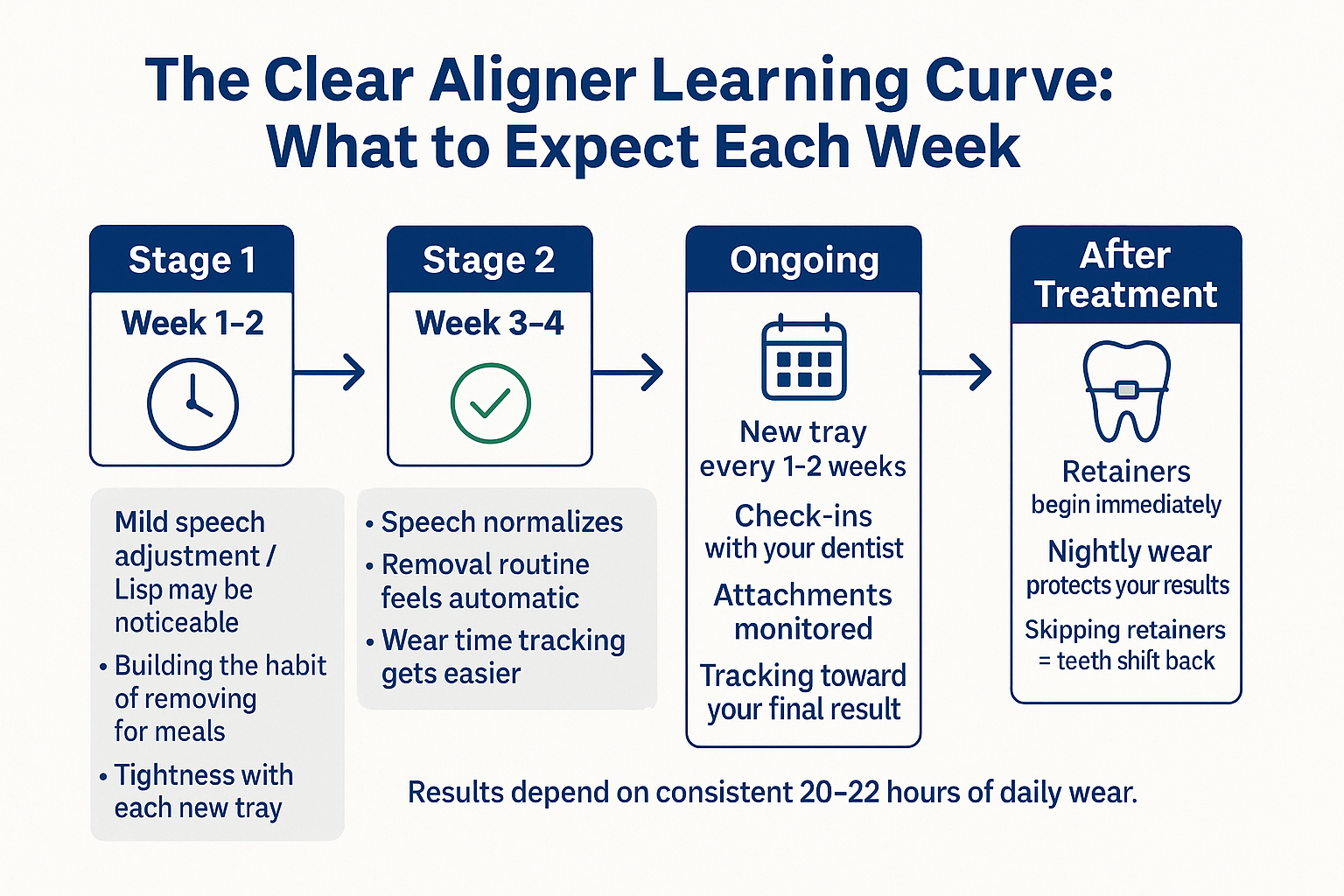
Yes, and I appreciate that most aligner providers skip this part entirely. A mild lisp or change in speech is common in the first one to two weeks of wearing aligners. The trays add a small amount of plastic to the back of your front teeth, and your tongue needs time to recalibrate.
The good news is that it fades, and it fades faster if you actually talk more rather than less. The instinct is to stay quiet to avoid the awkwardness, but the tongue adapts through use. Reading aloud, taking calls, keeping your normal social schedule, all of that speeds up the adjustment.
For working adults who spend their days in meetings or on the phone, the first two weeks can feel noticeable. By week three, most people have adapted fully and stop thinking about it. It’s a real thing, it’s temporary, and it’s not something you should find out about after you’ve already started treatment.
The Clear Aligner Learning Curve: Week by Week
Here’s an honest look at what the first month of clear aligner treatment typically feels like for adults.
What happens when treatment ends? Do I still have to wear something?
This is the question patients almost never ask, and it’s the one they most often wish they’d asked sooner. When your aligner treatment ends, you will need to wear a retainer, and in most cases, you’ll need to wear it indefinitely to keep your results.
Teeth have memory. The fibers that hold them in place will slowly pull them back toward their original position if there’s nothing holding them in the new one. The retainer is what holds them there.
Most people transition to nightly retainer wear after an initial more-intensive period. It becomes quick and easy once it’s part of your routine. But if you stop wearing it, even months or years after treatment, your teeth can shift. The degree of shifting varies by person, but it does happen.
If you’ve done the work to straighten your teeth, the retainer is the step that makes that work permanent. It’s worth building the habit from day one of post-treatment, not treating it as optional.
For a broader look at how aligner treatment fits into a real adult schedule, this article on fitting clear aligners around a real adult schedule goes deeper on the day-to-day side.
Clear Aligners vs. Mail-In Kits: What the Difference Actually Means
A lot of adults consider mail-in aligner options as a lower-cost alternative. Here’s what the tradeoffs look like in practice.
| Factor | Provider-Led Aligners | Mail-In / Direct-to-Consumer |
|---|---|---|
| Initial assessment | In-person exam, X-rays, digital scan | Photos or impressions mailed in, no clinical exam |
| Monitoring | Regular check-ins; dentist adjusts plan if needed | Remote only; limited ability to catch problems early |
| Attachments | Available when treatment requires them | Not available, limits what can be treated |
| Gum/bone health check | Included before treatment starts | Not assessed, existing issues can worsen |
| Retainers after treatment | Provided and monitored by your dentist | Mailed to you; no follow-up care |
| Who it’s right for | Mild to moderate cases; patients who want oversight | Only the mildest cases with no underlying issues |
Are teens and adults treated differently?
The mechanics of the aligners are similar, but compliance looks different. Adults generally stick to the wear schedule better because they chose the treatment and they’re paying for it. Teens sometimes need more check-ins and reminders to stay on track.
Some aligner systems designed for teens include small wear indicators, tiny blue dots that fade over time to show whether the trays are being worn consistently. Adults rarely need this, but it can be a useful tool for younger patients and their parents.
The American Association of Orthodontists notes that compliance is the single biggest variable in aligner outcomes across all age groups. A provider who monitors progress in person and adjusts the plan when something isn’t tracking is far more valuable than a system that just mails you the next tray and hopes for the best.
The difference between a good aligner outcome and a disappointing one is almost never the technology. It’s whether someone is watching your progress and catching problems before they compound.
Frequently Asked Questions About Clear Aligners in Huntington Beach
Can I wear clear aligners through a work meeting or presentation without it being obvious?
Yes. The trays are clear, and in normal conversation most people won’t notice them. The first week or two may bring a slight speech adjustment, but by week three most patients sound completely normal. If you have a big presentation in your first two weeks of treatment, it’s worth letting your provider know, they can sometimes time your tray changes around it.
What happens if I miss a few hours of wear time consistently?
Your teeth won’t track with the trays the way they’re supposed to. In mild cases this means your treatment takes longer. In more significant cases, you may need refinement trays, additional sets made after your initial series to get your teeth where they were supposed to be. Consistent 20-22 hours of daily wear is what the treatment plan is built around. Occasional short gaps happen and are fine. Regularly falling short by two or three hours per day adds up quickly.
I started aligners with another provider and stopped mid-treatment. Can I pick up where I left off?
This comes up more than you’d expect. We’ve had callers ask about exactly this situation, including questions about whether there’s a cost to remove bonded attachments from a previous provider. The honest answer is that it depends on where your teeth currently are versus where your existing trays were designed to take them. The best first step is an in-person scan and exam so we can see what’s changed and what options make sense. Don’t assume your old trays are still accurate, teeth move back faster than most people expect.
How visible are the attachments on my teeth?
Attachments are tooth-colored and designed to blend in, but they are visible up close, especially on front teeth. Whether you need them depends on your treatment plan. Not everyone does. During your consultation, we’ll show you exactly what your plan involves so there are no surprises after you start.
How long does the lisp actually last?
For most adults, one to two weeks. Talking more speeds it up, the tongue adapts faster through use. If you stay quiet to avoid the awkwardness, it tends to linger longer. By week three, the vast majority of patients have adjusted completely.
What do retainers after treatment look like, and how long do I need to wear them?
Retainers are typically clear trays similar to your aligners. Most providers recommend nightly wear indefinitely, not just for a few months. Teeth have a natural tendency to drift back toward their original position, and the retainer is what prevents that. Skipping retainers, even years after treatment, can lead to noticeable shifting. Building the nightly habit from day one of post-treatment is the simplest way to protect what you’ve done.
Ready to Get a Straight Answer About Clear Aligners?
If you’re somewhere in Huntington Beach, Oak View, Goldenwest, Central HB, or anywhere nearby, and you’ve been circling the aligner question for a while, the best next step is a real consultation where someone actually looks at your teeth and tells you what’s realistic. Our team takes digital scans, walks you through what treatment would involve for your specific situation, and doesn’t rush you into anything. Call us at (657) 800-5254 or book online at kalidental.com, we’re open Monday through Wednesday, Friday, and Saturdays by appointment.