
Direct Answer: Yes, clear aligners can work around a real adult schedule, but the 20-to-22-hour daily wear requirement means you need a practical plan for meals, meetings, and travel, not just good intentions.
Most adults who ask us about clear aligners already know the basics. They know the trays are nearly invisible. They know treatment takes months, not years. What they actually want to know is whether the whole thing is realistic for someone with a real job, a social life, and a schedule that doesn’t pause for dental treatment.
In Huntington Beach, that question comes up a lot. Between client lunches, summer events on the water, and the kind of active social calendar that’s just part of life here, adults want specifics, not a general pitch about how aligners straighten teeth.
This article gets into the actual daily logistics: when the trays come out, what a realistic week looks like for a working professional, and what the difference is between doctor-directed treatment and a mail-order kit you order from an ad.
The 20-to-22-Hour Rule and What It Actually Means Day to Day
The core requirement for clear aligner treatment is that you wear the trays for 20 to 22 hours per day. That leaves you a 2-to-4-hour window for eating, drinking anything other than water, and cleaning both your teeth and the trays.
For most working adults, that window gets used up faster than expected. A morning coffee, a lunch break, an afternoon snack, and dinner, even with efficient habits, you can burn through your window without thinking about it. The patients who do best with aligners are the ones who treat that window intentionally.
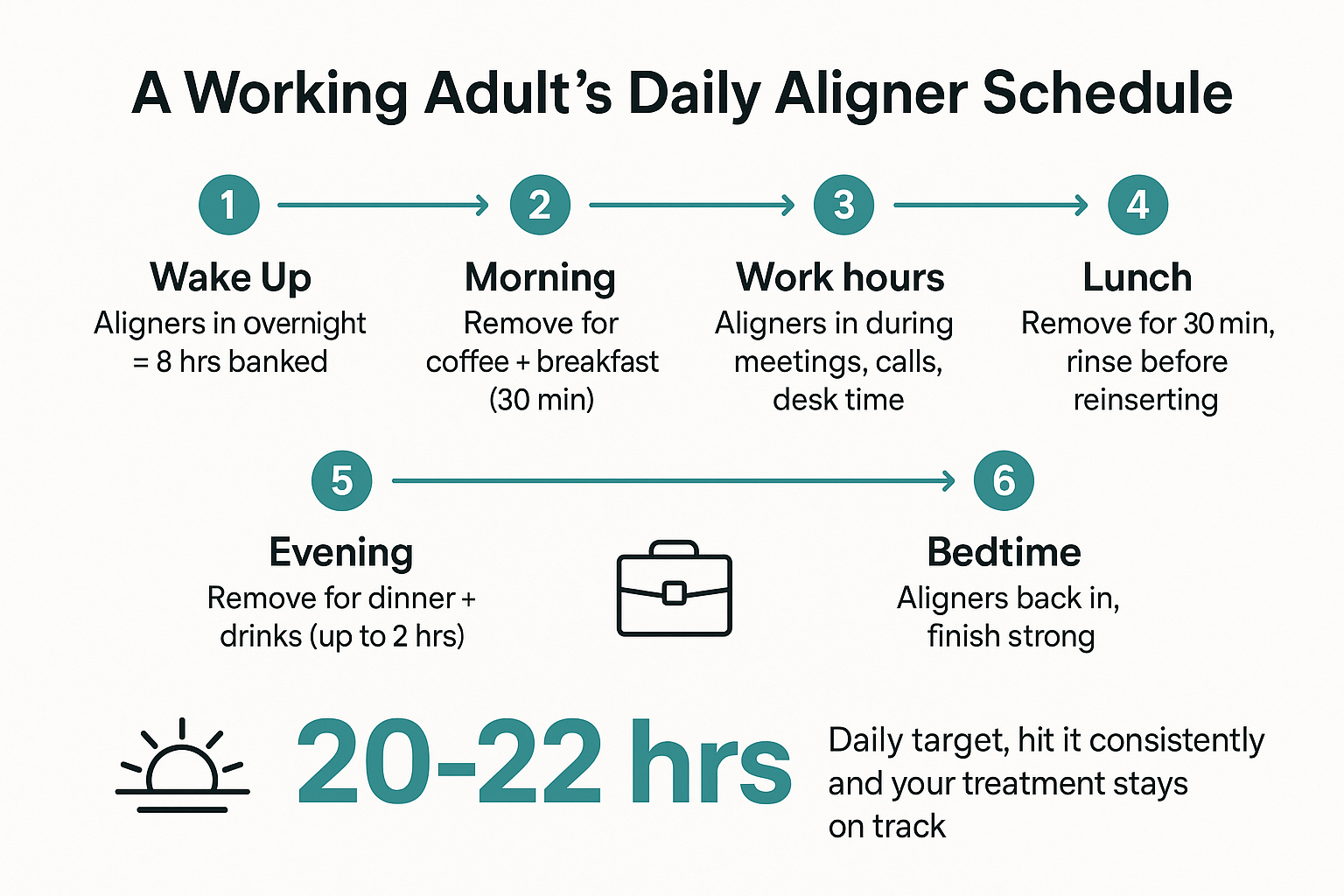
Here’s what a typical weekday actually looks like for someone managing this well:
- Morning: Remove trays for coffee and breakfast. Brush, floss, and rinse before putting them back in. About 30 minutes total.
- Midday: Remove for lunch. Rinse the trays and your mouth before they go back in. Another 30 minutes.
- Evening: Remove for dinner and any evening drinks. This is usually the longest window, and it’s where most of the flexibility lives.
- Overnight: Aligners stay in while you sleep, which is actually where you bank a significant chunk of your daily wear time.
The math works, but it requires treating removal and reinsertion as a habit, not an afterthought. Adults who go into treatment with that mindset see much better results than those who assume it will sort itself out.
The Questions Adults Actually Ask After They’ve Done Some Reading
We hear from people who have already researched aligners and want to go past the introductory talking points. One caller mentioned she was already mid-treatment and thinking ahead to aligner attachment removal, that’s the kind of specific, informed question that tells us the person has done their homework.
Here are the questions that actually come up once someone is serious:
Does treatment affect speech? Yes, briefly. Most people notice a slight lisp or extra saliva in the first 3 to 5 days of each new tray. It resolves quickly as your mouth adjusts. If you have a big presentation in week one, it’s worth knowing this upfront.
Can I still drink coffee in the morning? You can, but the trays come out first. Coffee with trays in will stain them and can trap warm liquid against your teeth. The fix is simple: take them out, drink your coffee, brush, put them back in.
What happens if I miss a day? Missing occasional hours is not catastrophic, but it does add up. Teeth move on a schedule, and if you’re consistently under the 20-hour minimum, you may not be ready for the next tray when you’re supposed to advance. Your dentist monitors this at check-in visits and can adjust the plan, but only if you’re honest about your wear time.
What does treatment in a restaurant actually look like? You excuse yourself, remove the tray, eat, and rinse before putting it back in. A small travel case fits in any pocket or purse. It becomes routine faster than most people expect.
A Realistic Day of Aligner Wear for a Working Adult
This shows how a working adult in Huntington Beach can distribute their wear time across a typical weekday and still hit the 22-hour target.
Doctor-Directed Treatment vs. Mail-Order Kits, What the Difference Actually Is
This is where most of the marketing noise lives, and it’s worth cutting through it plainly.
Mail-order aligner companies send you trays based on impressions you make at home. There is no X-ray, no scan of your bone structure, and no dentist examining how your teeth actually sit in your jaw. You follow a preset plan with no clinical check-ins.
Doctor-directed treatment, regardless of which aligner brand is used, works differently:
- A digital scan maps the current position of every tooth.
- A dentist reviews the scan and maps out each movement in sequence.
- You see the projected final position before treatment starts.
- Check-in visits confirm your teeth are actually moving as planned.
- If they’re not, the plan gets adjusted before the problem compounds.
That last point matters more than it sounds. Teeth don’t always move exactly as modeled. Without someone reviewing your progress, small deviations go uncorrected, and some mail-order patients end up needing alignment corrections afterward that could have been avoided. The American Association of Orthodontists has been direct about the risks of unsupervised aligner treatment for exactly this reason.
About 1 in 3 orthodontic patients today is an adult, according to the AAO, and much of that growth is tied to clear, removable options. But the results depend heavily on whether someone with clinical training is monitoring the process.
Why Summer Is a Popular Time to Start, and What the First Appointment Looks Like
There’s a practical reason adults in Huntington Beach tend to start aligner treatment in summer. The first few days of any new tray come with an adjustment period, minor discomfort, slightly altered speech, more awareness of the trays in general. Starting during a period with more flexibility in your social schedule just makes that easier to manage.
If you’re the kind of person who has events every weekend from June through August, the timing logic reverses, that’s worth thinking through before you start. But for someone whose summer includes a few slower weeks, it can be a good window to get past the initial calibration.
As for what the first appointment actually looks like: we do a digital scan of your teeth, no goopy impressions, and generate a model that shows both where your teeth are now and where they’d be at the end of treatment. You see that projection at the consultation. We talk through timeline, whether aligners are the right fit for your case, and what the realistic cost range looks like based on your specific situation.
One patient described the experience this way in a recent review: “Sarah scanned my teeth for clear aligners and she was very sweet and caring.” There’s no pressure and no commitment at that first visit. It’s an information session as much as anything else.
If you’re curious about how we approach scheduling for patients who are managing multiple treatments or have broader dental goals, our article on family dentistry in Huntington Beach covers how we build care plans that work across different timelines.
Clear Aligners: Common Adult Concerns and Honest Answers
These are the questions we hear most often from adults in Huntington Beach who are seriously considering aligner treatment.
| Concern | What’s Actually True | What Helps |
|---|---|---|
| Speech changes | Mild lisp is common in the first 3-5 days of each new tray | Read aloud at home, most people adjust within a week |
| Coffee and morning drinks | Trays must come out before anything except water | Build removal into your morning routine from day one |
| Missing wear time | Consistent shortfalls push back your treatment timeline | Track daily wear; your dentist reviews progress at check-ins |
| Restaurant logistics | Removal takes under a minute with a travel case | Keep a case and a small dental kit in your bag or car |
| Cost without insurance | Most dental insurance plans offer limited or no aligner coverage | In-house savings plans can reduce out-of-pocket costs, ask at your consult |
| How long treatment takes | Varies widely based on case complexity, months to over a year | Your scan and projected plan will give you a specific estimate |
Frequently Asked Questions About Clear Aligners for Adults
Can I wear my aligners during work video calls and meetings?
Yes, and most people do. Aligners are designed to be worn during normal daily activity, including work. The slight speech adjustment in the first few days of a new tray is usually noticeable only to you, not to the person on the other end of a call.
What if I’m traveling and forget my next set of trays?
Wear your previous set and contact your dentist as soon as possible. Moving forward to the next tray without guidance isn’t recommended, and going without any tray allows teeth to shift back. This is one reason having a real clinical relationship, not a mail-order plan, matters.
Does my dental insurance cover clear aligners?
Some plans include orthodontic benefits that can apply to aligner treatment, but coverage varies a lot by plan and often has a lifetime cap. If you’re uninsured or your plan doesn’t cover aligners, ask about in-house savings options at your consultation, they can make a real difference in out-of-pocket cost. Our article on staying ahead of dental costs without insurance covers this in more detail.
What happens if my teeth aren’t moving the way they should?
This is exactly why check-in visits exist. If your teeth aren’t tracking with the projected plan, your dentist can adjust the tray sequence, add refinements, or take a new scan. With mail-order treatment, there’s no one to catch this, which is where correction cases come from.
Is there an age limit for clear aligner treatment as an adult?
No. Adults of essentially any age can be candidates for aligner treatment, as long as their gum and bone health is in good shape. That’s one thing a comprehensive exam, including X-rays, confirms before treatment starts. If you’ve been putting off a first cleaning for a while, that’s a good starting point before any cosmetic or alignment work.
How much do clear aligners cost in Huntington Beach?
Cost depends heavily on case complexity, how much movement is needed, how many trays are required, and how long treatment runs. Simpler cases cost meaningfully less than complex ones. The best way to get a real number is a consultation with a scan, which gives your dentist a clear picture of what your case actually involves.
Ready to See What Your Teeth Could Look Like?
If you’re a working adult in Huntington Beach, whether you’re in Oak View, Bolsa Chica-Heil, or anywhere else across the Orange County area, and you’ve been turning the aligner question over in your head, a consultation is the most useful next step. Kali Dental offers digital scanning and a projected treatment preview so you can see the end result before making any commitment. Call us at (657) 800-5254 or book an appointment at kalidental.com, no pressure, just a real conversation about whether this fits your life.