
Direct Answer: A lost filling that doesn’t hurt is usually not a same-night emergency. Most teeth hold fine for a few days, but aim to have it looked at within one to two weeks.
Let me answer the real question first, because I know that is why you are here. A filling that fell out and does not hurt is almost never a middle of the night problem. You are not in danger, and you do not need to go sit in an emergency room.
But here is where I will push back on the usual advice. People hear “not an emergency” and translate it into “not a problem,” and then the tooth sits open for three months. The lack of pain is exactly why the repair tends to get bigger and more expensive.
So in this article I want to give you a timeline you can measure yourself against: the first 48 hours, the first week, and what tends to shift after a month. I will also explain why the replacement is sometimes a crown instead of another filling, and the exact questions I would ask before anyone starts drilling. We see this constantly at our office on Brookhurst near Garfield, and the patients who come in early almost always have the shorter appointment.
How Long a Lost Filling Can Actually Wait
Here is the honest version, based on what walks through our door in Huntington Beach week after week.
The first 48 hours. Nothing dramatic is happening. If there is no pain, no swelling, and no sharp sensitivity to cold, you can get through a weekend. Rinse with warm salt water after meals and chew on the other side.
The first week to two weeks. This is the window I would actually aim for. The tooth is still intact, the decay underneath has not had time to spread much, and a straightforward filling is still the likely fix.
After a month. This is where the math changes. Food packs into the open space every single day, the thin walls of the tooth flex without the filling supporting them, and a tooth that was a filling in week one becomes a crown by month three. I have seen teeth hold fine for months and I have seen them split in nine days. There is no way to know which one you have from the outside.
One reviewer put her situation plainly: “A flossing mishap dislodged a filling in my front teeth.” She called on a Monday morning after a holiday weekend and was seen that day. That is the right instinct, even when nothing hurts.
A Timeline You Can Measure Yourself Against
Use this as a rough guide for a lost filling with no pain. Swelling, fever, or throbbing pain changes everything and means you should call right away.
| Time Since It Fell Out | What Is Usually Happening | What I’d Do |
|---|---|---|
| 0 to 48 hours | Tooth is intact. Exposed inner surface may feel odd but not painful. | Rinse with warm salt water. Chew on the other side. Call when the office opens. |
| 3 days to 2 weeks | Food packs in daily. Decay under the old filling keeps working. | Best window for a simple repair. Book an appointment. |
| 2 to 6 weeks | Tooth walls flex without support. Sensitivity to cold often starts. | Still fixable, but the odds of needing a crown go up. |
| Past 2 months | Higher chance of a cracked wall, deeper decay, or nerve involvement. | Expect a larger restoration and a longer visit. |
| Any point with pain or swelling | Possible nerve involvement or infection. | Call the same day. This is no longer a wait-and-see situation. |
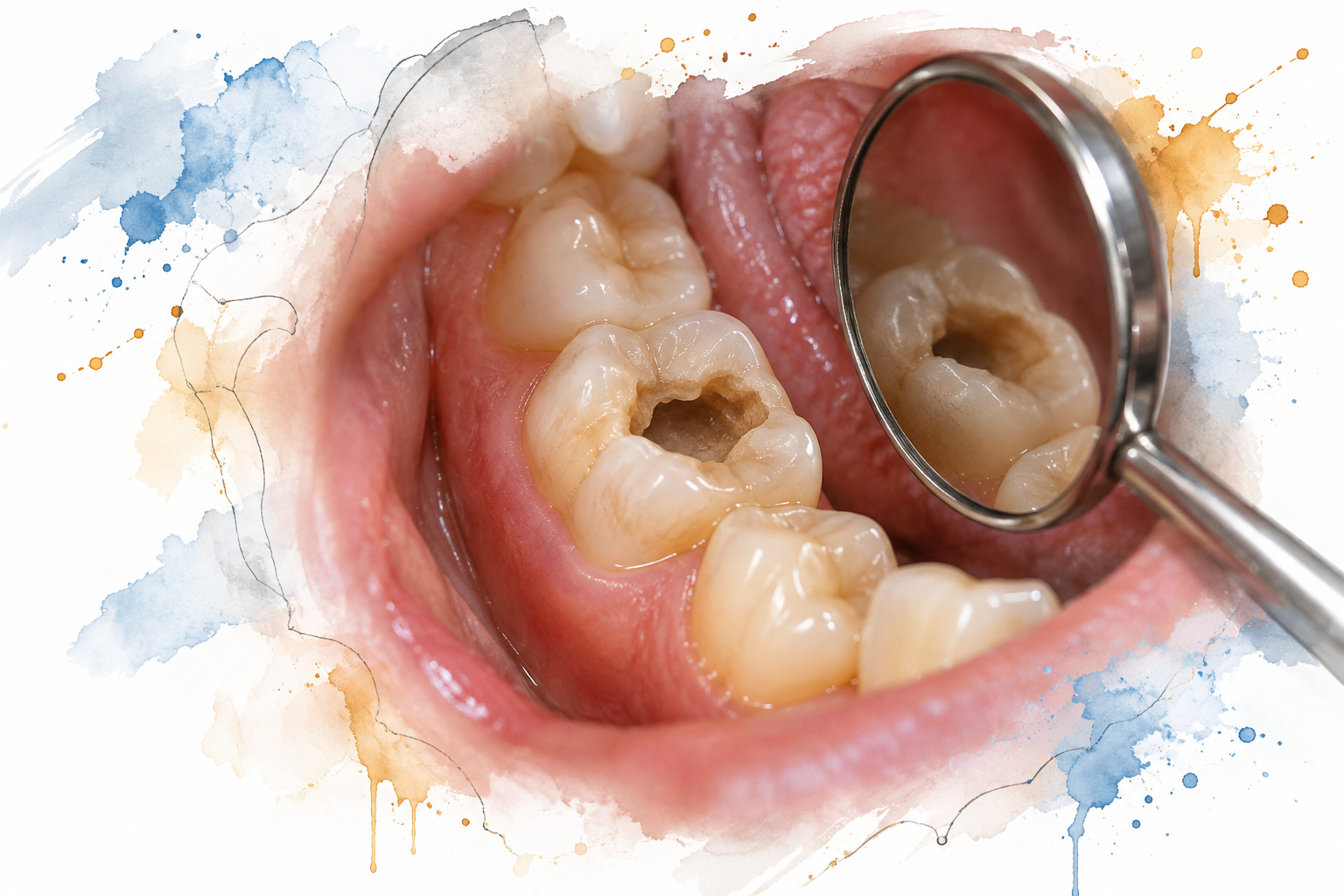
Why a Tooth With a Hole in It Can Feel Completely Fine
This is the part nobody explains well, and it is the reason good people wait six months.
A filling sits in a space that was carved out after decay was removed. The outer layer of a tooth, the enamel, has no nerve endings at all. So when the filling pops out, you can be left with a visible hole that your tongue finds a hundred times a day and still feel nothing, because the nerve deep inside the tooth is not yet exposed or irritated.
What is actually going on day to day:
- Food packs into the gap at every meal and sits against the inner tooth structure
- Bacteria get a protected pocket that a toothbrush bristle cannot reach
- The remaining tooth walls flex under chewing pressure without the filling bracing them from the inside
- Decay that was already there often caused the filling to loosen in the first place, and it keeps going
That last point matters most. Fillings rarely fall out of a healthy tooth for no reason. In most cases the bond failed because decay crept in underneath, which means the problem started before the filling came out. The National Institute of Dental and Craniofacial Research describes tooth decay as a process that keeps advancing once the protective surface is breached, which is exactly what an open filling space does.
Signs that the tooth is moving in the wrong direction: a zing with cold water, pressure pain when you bite down on that side, a rough edge that suddenly feels sharper, or gum tissue around the tooth that stays sore.
Why You Might Not Get Another Filling
Most people assume a lost filling gets a new filling. Often it does. But not always, and I would rather you hear that now than in the chair.
Quick distinction worth making: a crown is a separate piece that can sometimes be cleaned up and re-seated on the tooth. A filling is bonded material that has to be rebuilt from scratch, so there is nothing to put back in. Keep the piece if you found it, but do not expect it to go back in.
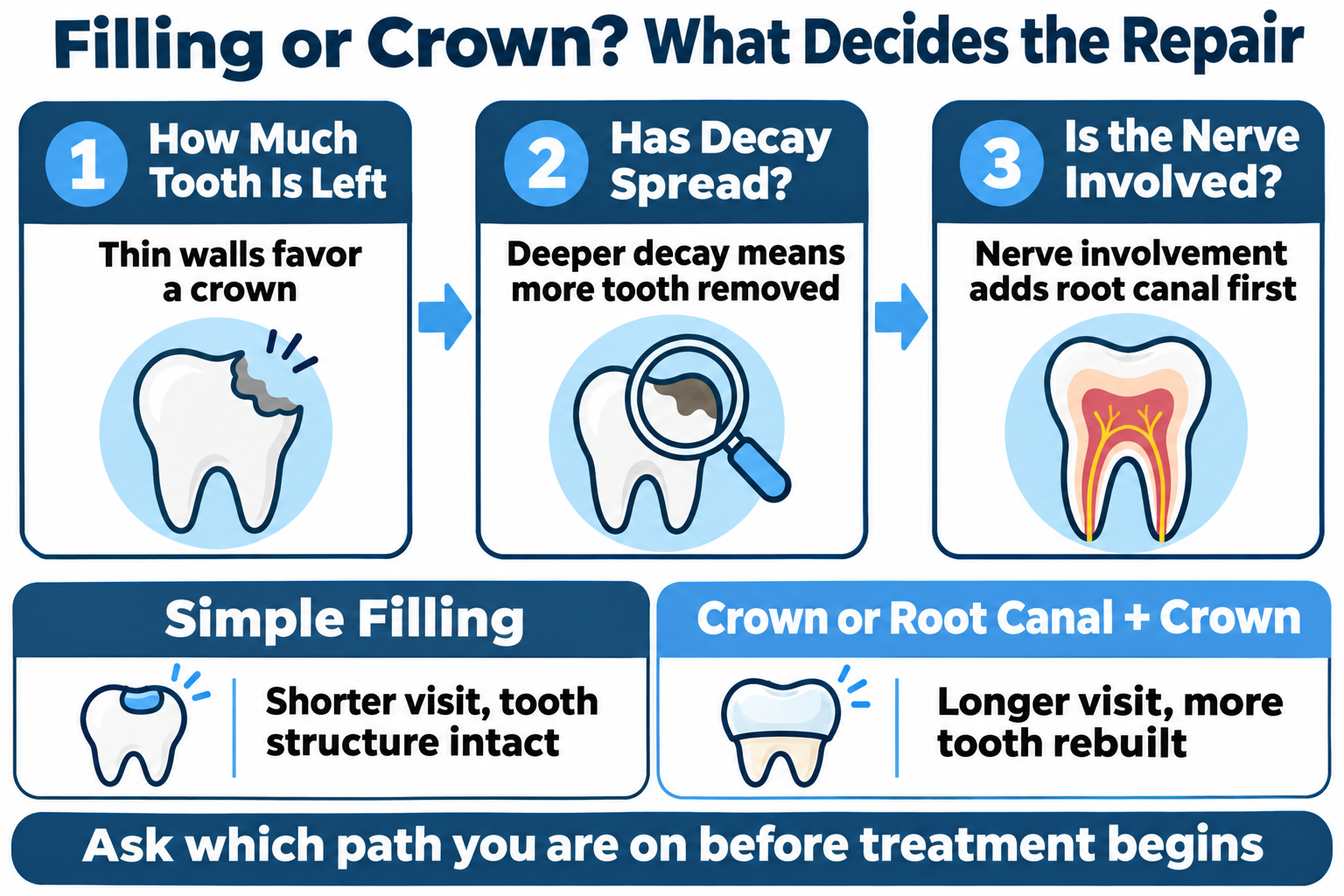
Three things decide which direction your repair goes:
- How much tooth is left. If the filling was large and the remaining walls are thin, another filling will just fail again. A crown wraps the tooth and holds it together.
- Whether decay has spread. A shallow spot gets cleaned out and filled. Decay that has traveled under the walls means more tooth has to come out, which pushes you toward a crown.
- Whether the nerve is involved. If decay has reached the pulp, root canal therapy comes first, then a crown on top.
Time in the chair varies with each path. A simple filling is usually a short visit. Because we mill crowns in our own office instead of shipping a mold to an outside lab, a same-day crown is possible in one sitting rather than a temporary and a two week wait. For working parents in Oak View or Bolsa Chica-Heil trying not to burn two half days of PTO on one tooth, that is the part that usually matters.
What Decides Filling vs. Crown
Three checkpoints determine whether your lost filling becomes a simple refill or a larger restoration.
What to Ask Before Anyone Picks Up a Drill
Cost worry and urgency usually show up together. About one in eight of the calls we tracked last spring included a pricing question, and I think that is healthy. The most useful review I have read on our own profile came from a patient whose advice to others was to ask for the price before agreeing to any service. She was right.
None of the large practices in Orange County publish procedure pricing on their websites, so you are not being rude by asking. Asking is normal and expected.
Here is the short script I would use anywhere, including with us:
- “Is this a filling or a crown?” Get the answer before treatment, not after.
- “What happens to this estimate if the nerve turns out to be involved?” That is the single biggest cost swing on a lost filling.
- “Can I get the number in writing before you start?” A written estimate with the insurance portion broken out ends most billing surprises.
- “What does this cost if I skip insurance entirely?” Worth asking if you are uninsured or out of network.
On actual dollars, I will not pretend there is one number. Costs across Orange County vary with the size of the repair, the material, and whether a root canal enters the picture, and a crown lands in a very different range than a simple filling. The only figure I can state as ours is the $150 new patient exam with X-rays, which is what tells you which repair you are looking at in the first place. For everything else, get the quote in writing. If insurance is the sticking point, it is worth confirming your plan is accepted before you book and understanding what out of network actually costs you.
The Real Obstacle Is Usually the Calendar
In my experience, the tooth is rarely what delays people. The schedule is.
So here are our hours in plain text so you can plan around them instead of guessing:
- Monday, Tuesday, Wednesday, Friday: 9am to 6pm
- Thursday: closed
- Saturday: 8am to 2pm, by appointment
- Sunday: closed
If your filling came out on a Thursday night, Friday morning is your first real opening. If you work standard hours, that Saturday block is the one most Huntington Beach families use.
One pattern worth knowing locally: Thanksgiving week and the stretch from December 19 through January 5 are when families from Central Huntington Beach, Huntington Harbour, and Fountain Valley try to clear dental work before benefits reset. Those days fill first, often weeks ahead. If your tooth can wait but you want it handled before year end, booking in early November beats calling on December 20.
And if the situation changes before your appointment, with swelling, fever, or pain that will not quit, that is a different article. Read what can wait and what can’t and call.
Frequently Asked Questions About a Filling That Fell Out
Can I put the filling back in myself?
No. A filling is bonded material that was shaped inside the tooth, so there is no way to reseat it. Over the counter temporary filling material can cover a sharp edge for a few days, but it is a bandage, not a repair, and it can trap bacteria if it stays in too long.
It still doesn’t hurt after three weeks. Do I really need to go in?
Yes, and I would not wait much longer. No pain means the nerve has not been irritated yet, not that the tooth is fine. The cost of waiting is almost never pain. It is the difference between a filling and a crown.
What if it came out of a front tooth?
Front teeth are usually more urgent for appearance than for structure, and most people call within a day or two for exactly that reason. The good news is that a front tooth repair is often cosmetic bonding, which tends to be a shorter visit than a back molar rebuild.
Will I need a root canal?
Most of the time, no. Root canal therapy comes into play when decay reaches the pulp inside the tooth, and the usual warning signs are lingering pain with heat, throbbing at night, or a swollen gum. A digital X-ray at the exam answers this question in minutes rather than leaving you to guess.
Can I get seen the same day if I call?
Often yes, depending on the day. We hold room in the schedule for urgent problems, and a lost filling usually fits into a short slot. Thursdays and Sundays are the exceptions since the office is closed.
Want Someone to Take a Look at It?
Dr. Kalvin and our team keep room in the schedule for same day problems like this one, and the in-office milling setup means a lot of repairs wrap up in a single visit instead of a temporary and a second trip across town. Kali Dental is at 19201 Brookhurst Street, Suite 103 in Huntington Beach, a few minutes from Fountain Valley and most of central Orange County. When you want a look at it, you can call (657) 800-5254 or book online at kalidental.com.
