
Direct Answer: Gum tenderness after a filling usually comes from the clamp, matrix band, or injection site and fades in a few days. Soreness that worsens after day three, or sharp pain on biting, needs a recheck.
You got a filling last week. The numbness wore off, you went back to normal life, and the gum next to that tooth still feels raw and puffy. Now you are wondering whether something went wrong with work you already paid for.
I hear this call often from patients around Huntington Beach, and it is almost never the disaster people picture. But the answer depends entirely on which thing actually hurts, and most people lump two very different problems together.
So let’s separate them. I’ll walk through gum soreness versus tooth soreness, the one cause that gets fixed in a short visit, and the signs that mean you should stop waiting it out.
A sore gum and a sore tooth are two different conversations
When we place a filling, a few things press on your gum tissue that have nothing to do with the tooth itself.
- The rubber dam clamp that holds the isolation sheet in place grips the gum around the tooth
- The matrix band and wedge that shape the side of the filling push the tissue away from the tooth
- The injection site for the numbing medicine can stay tender and bruised for several days
All three leave tissue that is sore, slightly swollen, and unhappy when your toothbrush hits it. That kind of soreness is a tissue bruise, and it behaves like one. It is worst on day one or two and clearly better by day four or five.
Tooth pain is a different animal. If the sharp feeling shows up when you bite down, or when something cold hits it, that is the tooth talking, not the gum.
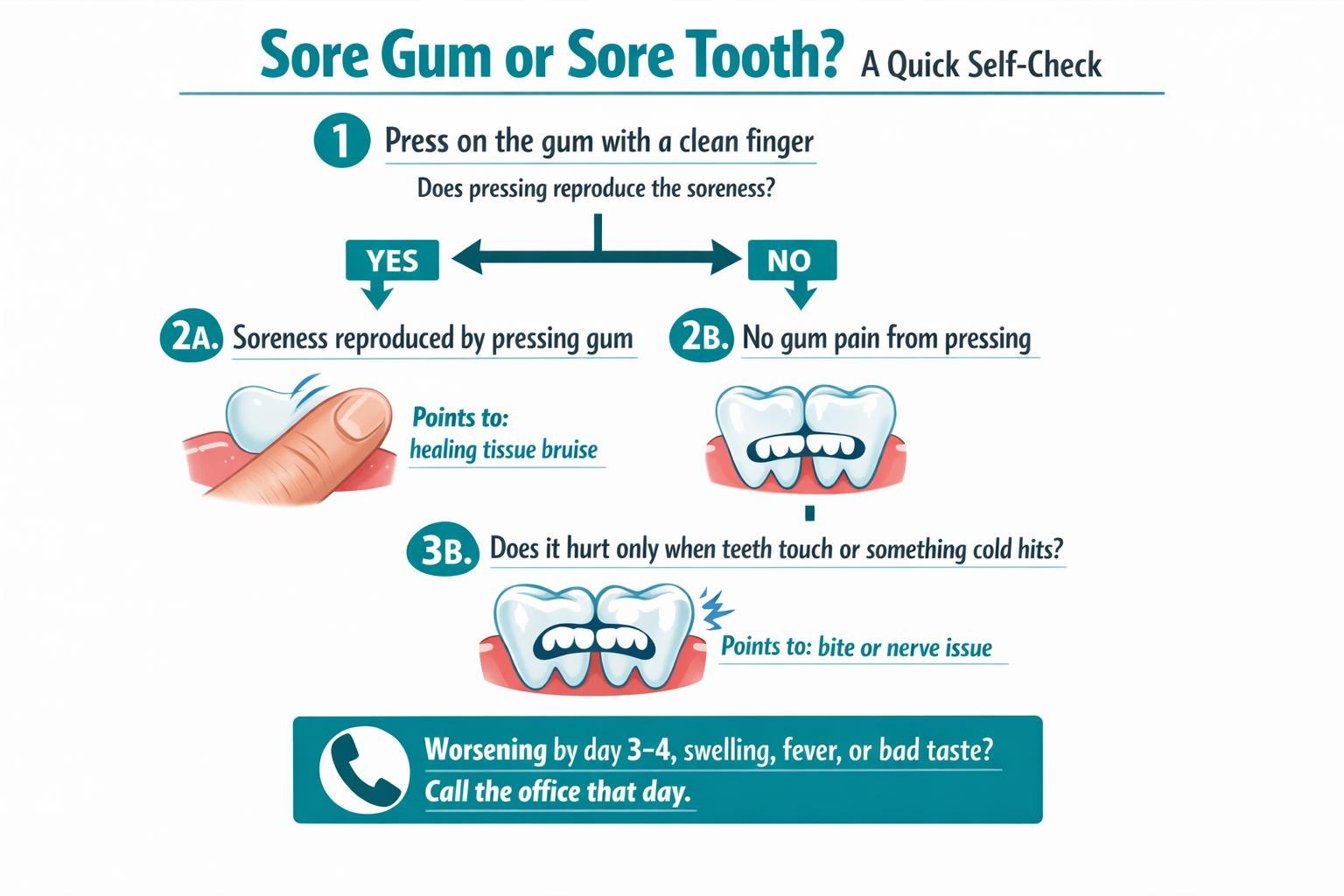
A week out, the question I ask on the phone is simple: can you press on the gum with a clean finger and reproduce it, or does it only happen when your teeth touch? One answer points to healing tissue. The other points to the bite or the nerve.
And calling the office that placed the filling is a normal thing to do. It is not a complaint, it is follow-up.
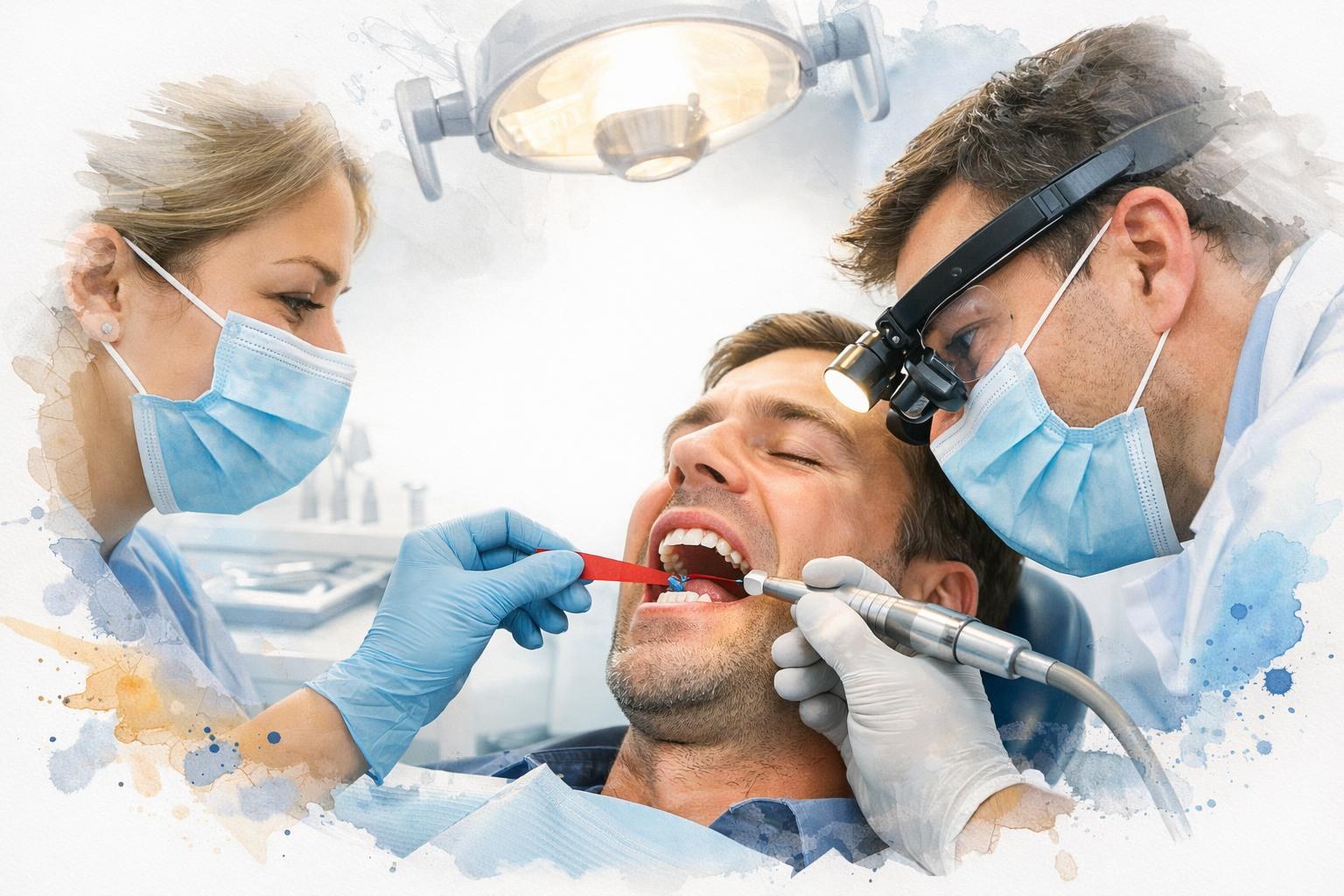
The most common fixable cause: a filling that sits a hair too high
Here is the one I see most often, and it is the easiest to correct. When you are numb in the chair, you cannot feel your natural bite. You close down, it feels fine, you go home.
Then the numbness fades, and a day or two later that tooth is hitting first on every chew. The signature is specific:
- Pain when you bite or chew, not a constant background ache
- It started a day or two after the appointment, not immediately
- Chewing on the other side feels completely normal
- The gum around it may get sore and inflamed because the tooth is being overloaded
A tooth that takes all the force before its neighbors do gets bruised at the ligament. That ligament soreness spreads into the gum, which is why people call about gum pain when the real cause is the bite.
The fix is usually short. We put a strip of marking paper between your teeth, have you tap and grind, and the high spot shows up as a colored dot. Then we polish that spot down by a fraction of a millimeter and check again until the contacts are even.
Most people walk out feeling the difference the same day, though the bruised ligament can stay tender for another few days while it calms down.
A lot of callers assume any return visit means another procedure and another bill. Ask the office directly what a bite adjustment involves for you, since practices handle post-treatment rechecks differently. If you want a wider framework for cost questions, this guide on what to ask before treatment starts is a good starting point.
What normal healing looks like day by day
This is the rough pattern I describe to patients on the phone. Use it as a trend line, not a stopwatch.
| Timeframe | What is normal | What is not |
|---|---|---|
| Days 1-2 | Gum tender and puffy near the clamp or injection site, mild ache | Throbbing that pain relievers do not touch |
| Days 3-4 | Soreness clearly fading, brushing is easier | Soreness getting worse instead of better |
| Days 5-7 | Gum nearly normal, maybe slight tenderness to pressure | Sharp pain on biting, cold pain that lingers |
| Week 2-4 | Mild cold sensitivity on a deep filling, fading over time | Night pain, swelling, bad taste, or fever |
Sore gum or sore tooth? A quick self-check
Before you call, run through this. It takes thirty seconds and it tells us a lot.
Deep fillings near the nerve: when sensitivity is healing and when it is not
If your cavity was deep, the filling ended up close to the nerve. That is the honest compromise of a deep filling. We are saving a natural tooth instead of taking it out, and the nerve inside has been irritated for a while before we ever got there.
So some lingering cold sensitivity for two to four weeks is common. The nerve is inflamed and slowly settling. It should trend downward week over week.
What tells me it is crossing into a real nerve problem:
- Cold pain that lingers 15 to 30 seconds or more after the drink is gone, instead of stopping right away
- Pain that wakes you up at night or starts on its own with no trigger
- Pain that shifts from sharp to a deep, dull throb
- Swelling, a pimple on the gum, a bad taste, or fever
That last line is the one that moves a call to the front of the schedule. Swelling plus fever is not a wait-and-see situation.
When a nerve does not settle, root canal therapy is how we keep the tooth. I know that is the phrase people dread, and I know plenty of folks would rather ride it out than hear it. But the cases caught early are the straightforward ones. We use digital X-rays and CBCT 3D imaging to see what is happening at the root, and most root canals we do are finished in a single visit.
The National Institute of Dental and Craniofacial Research explains how decay progresses toward the pulp, which is worth a read if you want the underlying biology.
Timing it around a Huntington Beach work week
People here rarely call the minute something hurts. They push it to the weekend, then the weekend fills up with soccer at Edison Park or a trip out to the Harbour, and suddenly it is three weeks later.
Two scheduling realities worth knowing if you need a recheck:
- We are closed Thursdays, so a Wednesday afternoon flare-up means planning for Friday
- Saturdays run 8am to 2pm by appointment only, which is the slot most working patients in Oak View and Bolsa Chica-Heil end up using
There is also a seasonal wrinkle. Cold sensitivity questions climb every December and January. A filling placed in November plus a cold drink in January can feel connected even when they are not, and sometimes the real culprit is a different tooth or receding gum line entirely.
My practical rule: if soreness is getting worse by day three or four instead of better, call. Improving slowly is fine. Moving backward is not.
If Saturday is your only realistic window, here is what a single Saturday visit can actually cover.
What to say when you call so you get triaged right
A well described symptom gets handled correctly. A vague one gets a callback and a lost week.
Have these five answers ready:
- When it started relative to the filling appointment
- What sets it off: biting, cold, heat, or nothing at all
- Whether it is sharp or dull, and whether it lingers
- Whether it wakes you up at night
- Whether there is swelling, a bad taste, or fever
That is not being dramatic. It is the exact information that lets our team decide whether you need a five minute bite check or a scan and a longer block of time.
And please do not end the call planning to call back later. I have watched too many people mean it sincerely and never get around to it, usually because the pain dipped for a day and then came roaring back on a Thursday.
If fear is part of what is keeping you from picking up the phone, telling your dentist that before you sit down changes how the whole appointment goes.
Frequently Asked Questions About Gum Soreness After a Filling
Is it normal for my gum to bleed when I brush near a new filling?
A little bleeding for the first few days is common, especially where the clamp or wedge sat. Keep brushing the area gently rather than avoiding it, because skipping it lets plaque build up and makes the inflammation last longer. Bleeding that is still happening at the two week mark is worth a look.
Can food getting stuck between my teeth cause this?
Yes, and it is more common than people think. If the contact point between the new filling and the neighboring tooth is slightly open, food packs in there every meal and the gum underneath gets inflamed and sore. The telltale sign is that floss shreds or drops through with no resistance. It is fixable, but it usually means reshaping or replacing that surface of the filling.
How long should I wait before I call about this?
If the soreness is clearly improving, give it a week. If it is the same or worse by day three or four, call then. Swelling, fever, or a bad taste means call that day, not next week.
Does a sore gum after a filling mean I will need a root canal?
Usually no. Gum tissue soreness and a high bite account for most of these calls, and neither one leads to a root canal. The cases that do need one tend to announce themselves with lingering cold pain, night pain, or swelling, not with a tender gum.
Will I be charged for coming back in to have the filling checked?
That varies by office and by what is found, so ask directly when you call rather than assuming. A quick bite check and a recheck of the area is a different situation than new treatment, and you should get a clear answer before anything is done. We talk through costs up front rather than after.
Still Not Sure If That Filling Feels Right?
Following up after the appointment matters as much as the appointment itself, and it shows up in what our Huntington Beach patients write about us, including one who noted we “even checked in on my recovery after my appointments.” If a filling still feels off, our team is happy to take a look and tell you plainly what we see. You can reach us at (657) 800-5254 or at kalidental.com.
