
Direct Answer: A store-bought guard covers your teeth. A custom one is scanned to your bite so it contacts evenly, which protects enamel without making your jaw muscles work harder.
You are in the pharmacy aisle on Brookhurst with a boil-and-bite night guard in one hand, reading the back of the box, trying to decide if the dentist version is worth the difference. You already know you grind. You are just trying to solve it without a long treatment plan.
I get this question more in the fall and winter than any other stretch of the year. Our winters here never freeze, so nobody blames the weather, but the holiday calendar and the year-end work crunch show up in people’s jaw muscles all the same.
So here is the honest comparison: what changes with fit, what changes with materials, and what each type can and cannot do for you.
Custom night guard vs store bought: what you are actually comparing
Drugstore guards come in two basic forms. A stock guard is molded to an average mouth and comes ready to wear. A boil-and-bite guard is a soft thermoplastic tray you soften in hot water and press onto your teeth with your fingers and tongue.
A dentist-made guard starts from a scan of your actual arches and your actual bite. In our office that scan goes straight into design software, and the appliance is printed or milled right here instead of being mailed out to a lab.
The practical differences land in three places:
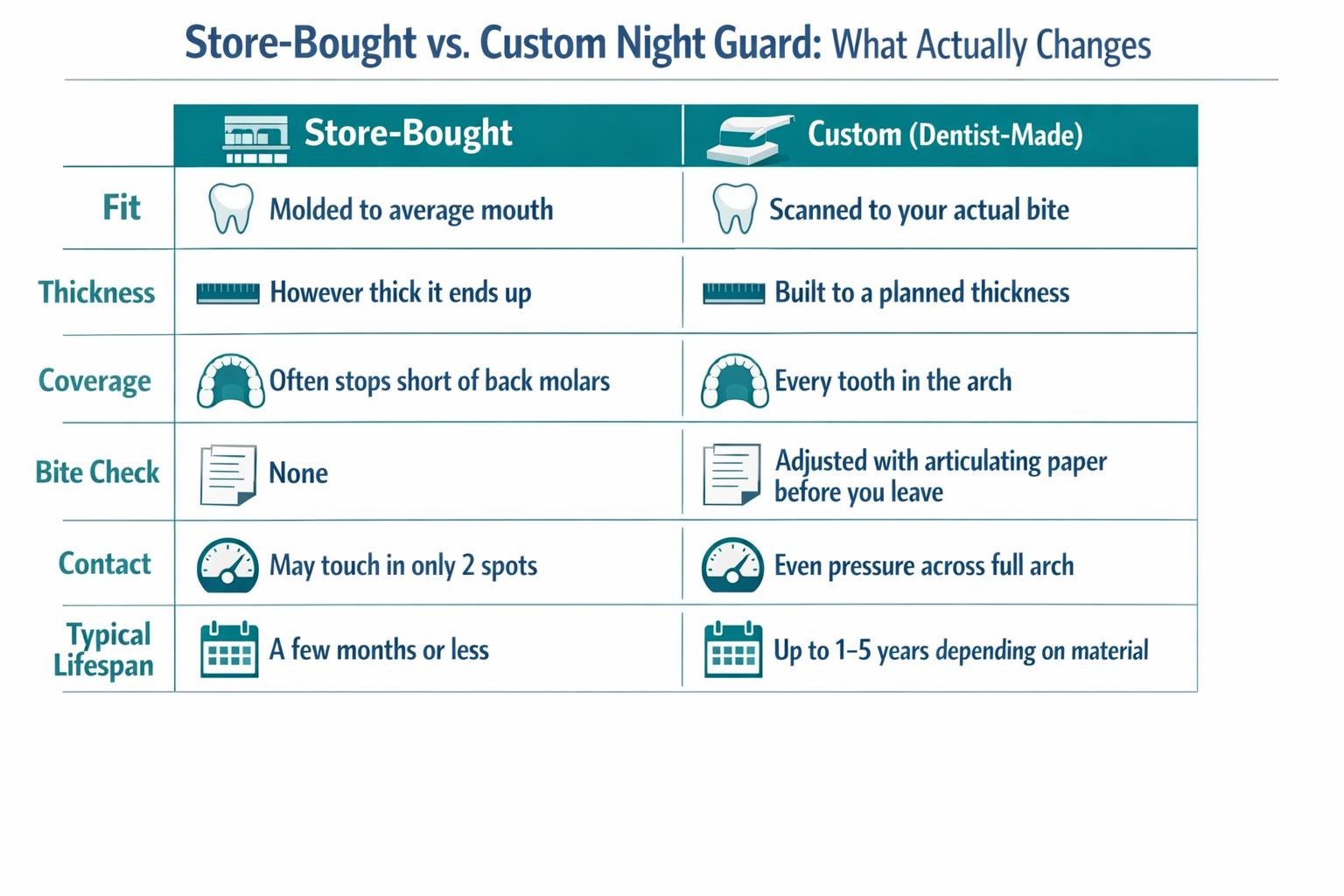
- Thickness control. A custom guard is built to a planned thickness. A boiled one ends up however thick it ends up.
- Coverage. Custom guards cover every tooth in the arch. Store guards often stop short of the back molars, which is exactly where most clenching force lives.
- Bite check. A dentist adjusts the guard in your mouth before you take it home. Nobody adjusts a drugstore guard.
I am not going to tell you a store-bought guard does nothing. For an occasional light grinder with no crowns and no cracked teeth, it is better than sleeping with nothing. The trouble starts when the fit is off and you do not know it.
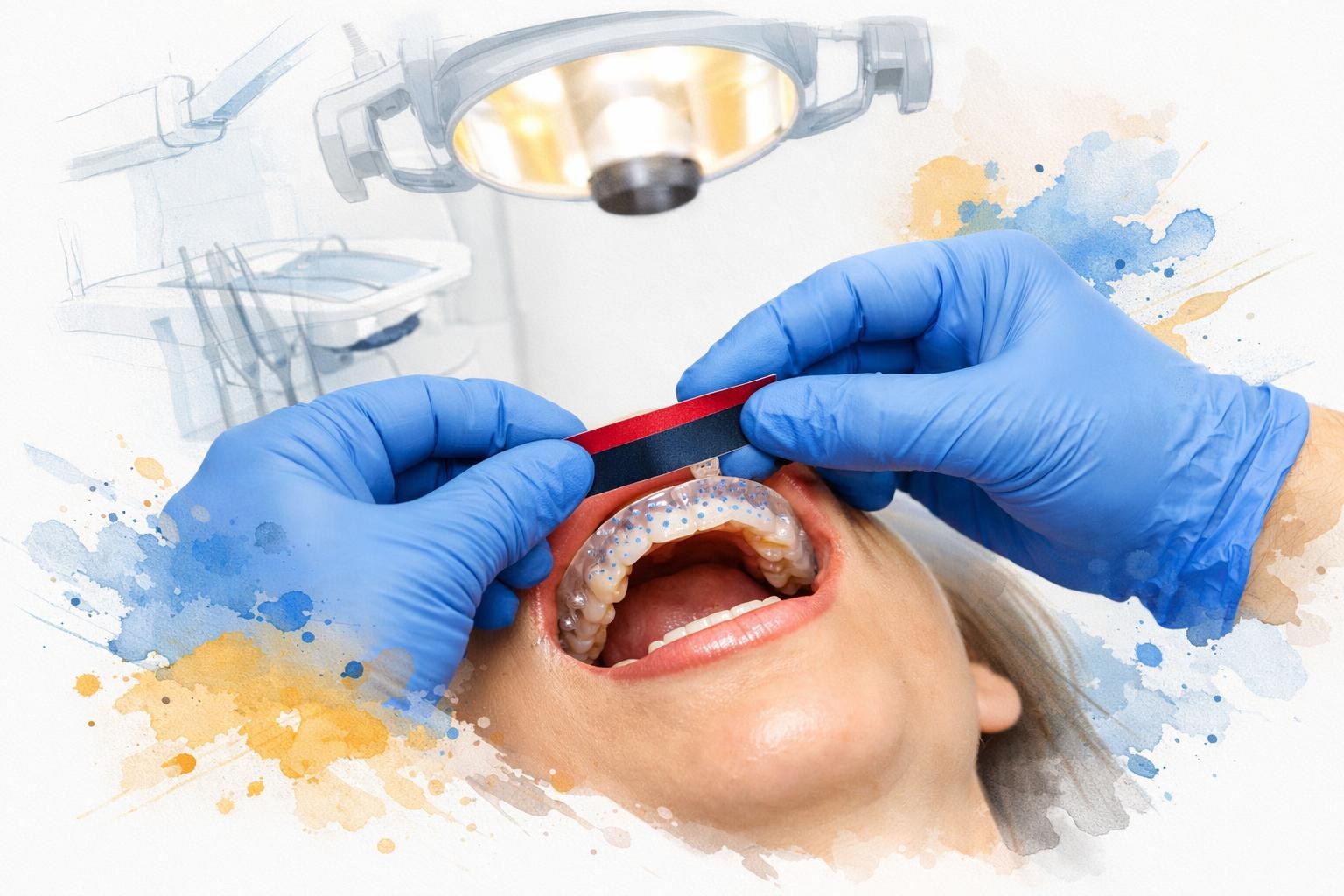
Fit is the whole argument
When I say a guard fits, I do not just mean it stays on. I mean even contact across the arch. Close your mouth on a well-made guard and your back teeth and front teeth land on it at the same moment with the same pressure.
Now picture a guard that only touches in two spots. Every night, for six or eight hours, all of your clenching force funnels into those two teeth. That is how a guard you bought to protect your teeth ends up moving them instead.
Two-point contact also tends to make jaw muscles sorer, not better. Your muscles keep hunting for a stable closing position all night and never find one.
Here is what a dentist is actually doing at that delivery appointment:
- Seating the guard and checking it does not rock
- Marking the contacts with articulating paper so you can see the dots
- Adjusting the high spots until the marks spread evenly across the arch
- Checking that you can slide your jaw side to side without catching
- Confirming it comes off easily in the morning without prying
That last step matters more than people expect. A guard that hurts to remove is a guard that lives in a drawer after a week, and then you are out the money with nothing to show for it.
If you are still not certain you grind at all, read Waking Up With Jaw Pain? You Might Be Grinding at Night first, then come back to the appliance question.
Soft, dual laminate, or hard: match the material to how you grind
Most drugstore options come in one softness. But a heavy clencher and a light grinder need different things, and this is the part I walk patients through before I recommend anything.
Soft guards are flexible, cushiony, and easy to get used to. For some clenchers, that softness acts like a chew toy. The jaw senses something squishy and squeezes harder, and the guard shreds fast.
Dual laminate guards are soft on the tooth side and hard on the outside. They are comfortable to seat but hold their shape against real force, which makes them a reasonable middle ground for most adults.
Hard acrylic guards are the ones I lean toward for heavy clenchers, for people with several crowns, and for anyone who has already cracked a tooth. They do not invite chewing, and the bite surface stays flat and even far longer.
We see the wear side of this constantly through crowns and cracked teeth. A patient points at a chip and asks what happened, and the answer is usually months of force on an unprotected molar. For context on how common nighttime grinding is, the American Dental Association’s patient guide on teeth grinding is a straightforward read.
Night guard types side by side
Lifespans vary a lot by how hard you grind, so treat these as general ranges rather than promises.
| Type | Best suited for | How long it tends to last |
|---|---|---|
| Store-bought boil-and-bite | Occasional light grinding, no crowns, short-term use | A few months, often less |
| Soft custom guard | Light grinders, patients new to wearing a guard | Roughly 1 year with normal wear |
| Dual laminate custom guard | Moderate clenching, mixed grinding patterns | Often 2-3 years |
| Hard acrylic custom guard | Heavy clenchers, patients with crowns or cracked teeth | Commonly 3-5 years |
What changes when a dentist makes it
A quick side-by-side of the differences that actually affect your teeth.
A night guard is armor, not a cure
I want to set this expectation now so you are not disappointed in month two. A night guard protects enamel, fillings, and existing crowns from the force. It does not stop your jaw from clenching.
So when someone comes in for a guard, I also look at what else is feeding the problem:
- Stress patterns and sleep habits, which spike for a lot of people through the holiday stretch and year-end deadlines
- Bite alignment, including teeth that hit before the others when you close
- Existing crowns and old fillings that are already taking uneven force
- Any history of cracked teeth, which changes which material I recommend
For the working parents I see from Central Huntington Beach and Oak View, grinding often tracks right along with the calendar. It quiets down in June and comes roaring back in October. A guard carries you through those stretches without losing tooth structure you cannot get back.
What actually drives the cost
Pricing comes up constantly on our phones, and I would rather explain what moves the number than throw out a figure that may not match your mouth or your plan.
Here is what changes the price of a custom guard:
- Material and thickness. Hard acrylic built for a heavy clencher costs more than a thin soft guard.
- Upper or lower arch, and whether you need full coverage
- Where it is made. A scanned and printed in-house appliance moves on a different timeline than one shipped to an outside lab
- How your plan codes it. Some dental plans treat a night guard as a covered appliance, some exclude it, and some apply it against your annual maximum, which matters if you have other work planned this year
Before anything gets made, ask for an itemized estimate that shows the appliance code, your estimated plan portion, and your out-of-pocket. Patients tell us regularly that seeing the billing broken out line by line is what made them comfortable saying yes.
If your benefits reset January 1, it is also worth reading Is It Worth Using Your Dental Benefits Before They Expire? and What ‘Affordable Dentist’ Really Means in Huntington Beach before you decide on timing.
Frequently Asked Questions About Night Guards
Can I just try a store-bought guard first and upgrade later?
You can, and plenty of people do. My only caution is to pay attention to how your jaw feels after two weeks. If you wake up sorer than before, stop wearing it and get the fit looked at, because that usually means uneven contact.
How long does a custom night guard take to get?
It depends on where it is made. When the scan, design, and fabrication all happen in the same office, the turnaround is short. When it goes out to an outside lab, you are usually waiting a couple of weeks for it to come back and then a second appointment to fit it.
Will a night guard fix my jaw pain?
Often it helps a lot, because it stops the grinding force from loading your teeth and muscles the same way. But it is not a cure for clenching, and if the pain is severe or your jaw is locking or clicking, that deserves an exam rather than an appliance bought off a shelf.
Does a night guard work if I have crowns or implants?
Yes, and I would argue it matters more in that case. Porcelain can chip under grinding force, and protecting restorative work you already paid for is one of the better reasons to go custom and go hard-material.
How do I know when to replace it?
Look for worn-through spots, cracks, a change in how it seats, or a smell that does not go away after cleaning. Bring it to your next cleaning and have someone look at the wear pattern with you. The wear itself tells you a lot about how you are grinding.
Thinking through your night guard options?
If you want someone to look at your wear pattern and talk through material, fit, and an itemized estimate before anything is made, our team in Huntington Beach is happy to walk through it with you. We handle the scan, the design, and the appliance here in the office rather than mailing it out, which is why patients usually have theirs back quickly. You can reach us at (657) 800-5254 or at kalidental.com.
