
Direct Answer: A bone graft rebuilds jawbone that shrank after a tooth was lost. If the ridge is too narrow or short to hold an implant, grafting comes first, then healing, then the implant.
You lost the tooth a while back. Maybe two years, maybe five, maybe longer than you want to admit out loud. You learned to chew on the other side and stopped thinking about it until the day you decided you finally wanted it fixed.
Then somebody said the word graft, and the whole thing started to feel complicated and expensive again. I hear this hesitation constantly from people across Huntington Beach, and almost always with the same quiet fear underneath it: did I wait too long?
You very likely did not. A bone graft for a dental implant is not a penalty for putting things off. It is a step that rebuilds the foundation so the implant has something solid to hold onto, and plenty of people in your exact spot still end up with an implant.
Why a Long Gap Changes the Plan
Your jawbone is not just sitting there. It exists to hold teeth, and it responds to chewing pressure. Take the tooth away and the bone in that spot slowly gives up ground.
Most of the shrinking happens in the first 6 to 12 months after the tooth comes out. But it keeps going quietly for years after that, mostly in width before height.
That is why two people with the same missing molar can get two completely different answers. One lost it last spring. The other lost it in 2019 and has a ridge that is now too thin to hold a post without help.
Huntington Beach skews a little older than the state average, with a median age right around 44 and a big share of residents in the 45 to 64 range. So the long-gap patient is extremely common here. One message that came through our website said it plainly: the writer was only 45, had been without teeth for months, and had already paid elsewhere for a set that never fit right.
If your tooth is coming out next week instead, that is a different conversation. What happens to your jawbone right after an extraction covers the fresh socket side of this. This article is about the ridge that already healed and already shrank.
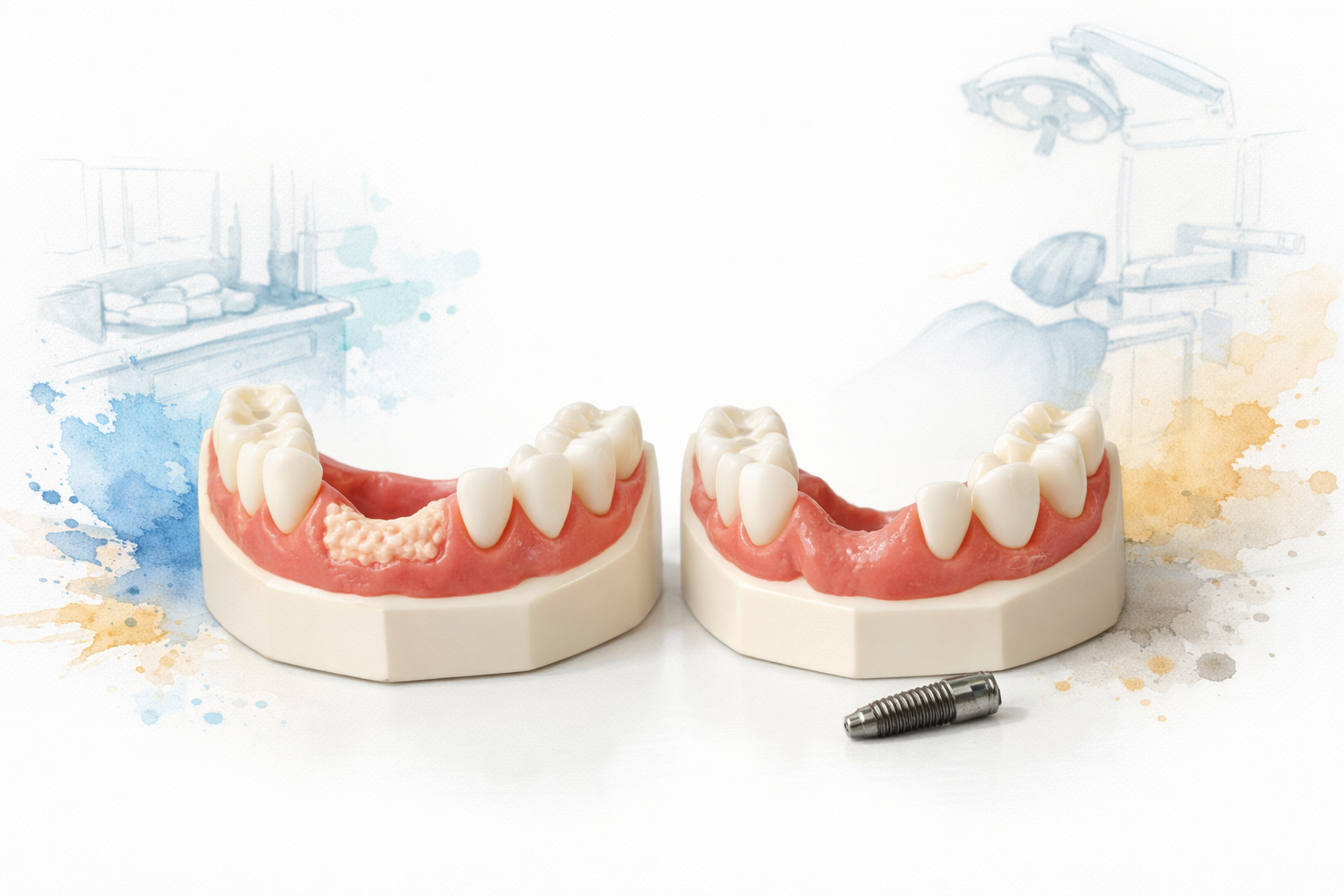
Nobody Can Tell If You Need a Bone Graft by Looking in Your Mouth
Here is the honest part. Your gums can look completely fine over a ridge that has lost a third of its width. A flat 2D X-ray does not settle it either, because it shows height but tells you almost nothing about thickness.
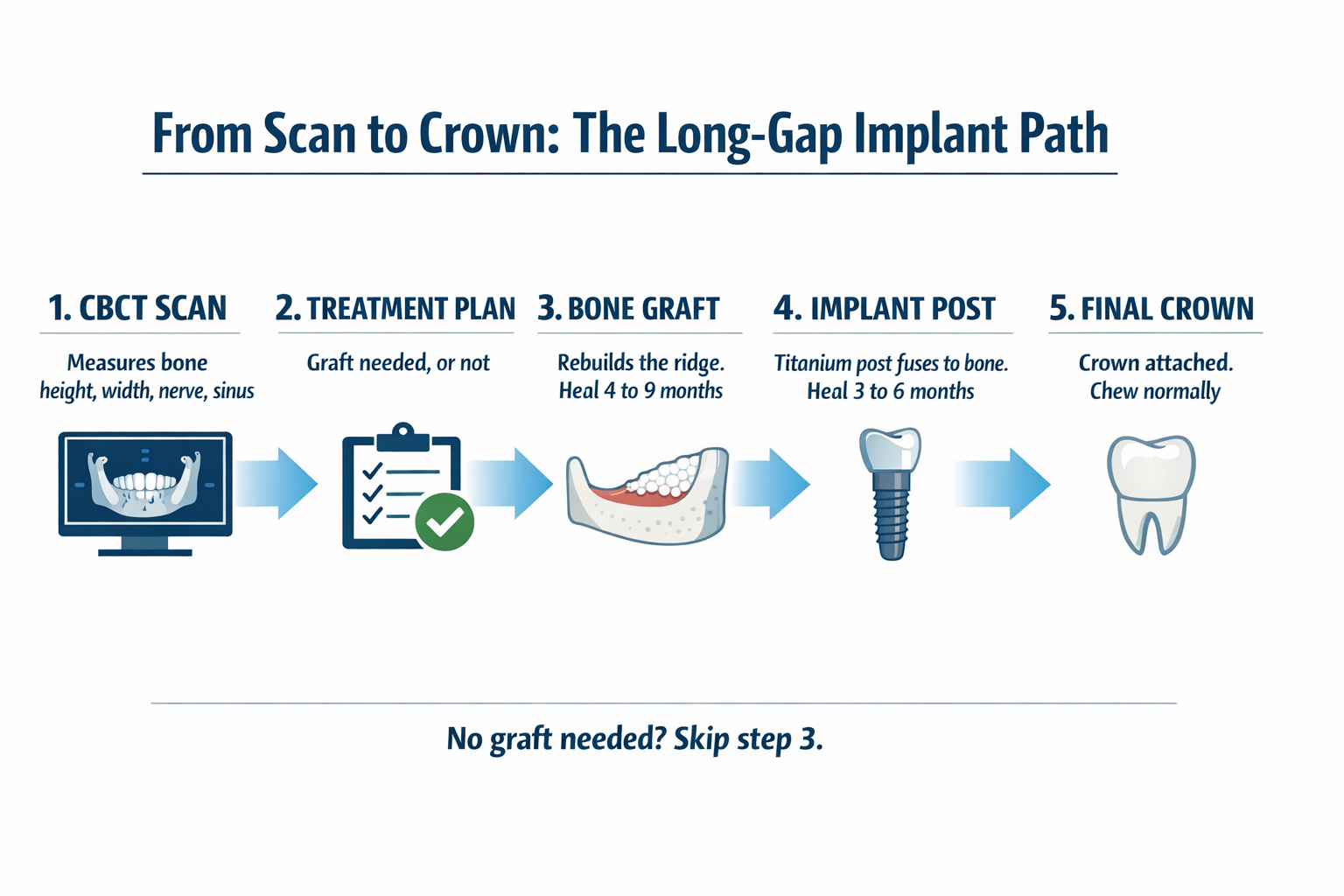
The step that actually answers the question is a CBCT scan, a 3D image of your jaw. We take it in our office, it takes under a minute of actual scanning, and you sit upright the whole time.
What we are measuring on that scan:
- Bone height, meaning how tall the ridge is from the top down
- Bone width, which is the one that quietly disappears after a long gap
- Bone density, or how solid the bone is in that specific spot
- Where the nerve runs in the lower jaw, since the implant has to stay clear of it
- How far the sinus has dropped in the upper back jaw, where the floor tends to sink into the space a molar used to occupy
The scan gives one of three answers: yes, there is enough bone and the implant can be placed; no, not yet; or here is the specific amount of bone that needs rebuilding first.
That is why I tell people driving over from Huntington Harbour or Central Huntington Beach that the consult is a measuring appointment. You are there to get numbers, and Dr. Kalvin will pull the scan up on the screen and walk you through what he sees before anyone talks about scheduling anything.
Three Kinds of Grafts, Three Very Different Calendars
People hear “bone graft” and picture one procedure. It is really three different situations, and the difference shows up on your calendar far more than it shows up in the chair.
1. Socket preservation at extraction. A small amount of grafting material goes into the socket the same day the tooth comes out. It holds the shape of the ridge while it heals so there is something to work with later.
2. Ridge rebuild years later. This is the long-gap situation. The ridge already narrowed, so bone has to be added and given months to mature before a post can go in.
3. Sinus lift. Upper back teeth only. The sinus floor has dropped into the space, so it gets gently raised and bone is placed underneath it.
The pattern worth understanding: a graft placed at extraction usually costs you waiting time once. A rebuild years later stacks healing on top of healing. That is the real reason the same implant takes about six months for one person and over a year for another, something I get into more in how long implants actually take here in Huntington Beach.
Families around here tend to start treatment in the windows they can actually control. Thanksgiving week, winter break from roughly December 19 to January 5, and February break come up again and again as the launch points people choose.
Graft Type and What It Does to Your Timeline
These are general ranges, not promises. Your own healing, bone quality, and health history move them.
| Situation | When It Happens | Typical Wait Before the Implant Post |
|---|---|---|
| Socket preservation | Same day as the extraction | Roughly 3 to 4 months |
| Ridge rebuild after a long gap | A separate visit, years after tooth loss | Roughly 4 to 9 months depending on how much is rebuilt |
| Sinus lift, upper back jaw | Before or sometimes with implant placement | Roughly 6 to 9 months |
| No graft needed | Scan shows enough height and width | Implant can often be placed at the surgical visit |
What Happens Between the Scan and the Crown
Here is the sequence most long-gap implant cases follow, start to finish.
What Actually Moves the Price of a Graft
Cost is the question people lead with on the phone, and a graft is usually the line item that makes an implant quote jump. I am not going to throw a number at you, because a number written for someone else’s jaw is worthless to you.
What I can tell you is what moves it:
- How much bone is being rebuilt. A small fill in a socket and a full ridge rebuild are not in the same neighborhood.
- Whether grafting material is needed at all, and how much of it
- Whether a sinus lift is part of the plan
- Whether an extraction is happening the same day
- Whether imaging and the final crown are bundled into the quote or priced as separate items later
That last one causes more sticker shock than anything else. A quote that covers only the post is not a quote for an implant.
One reviewer who was unhappy with us gave advice I will repeat without arguing: ask for the price before agreeing to any service, and get a detailed estimate in writing. That is fair, and it should be true at any office you walk into.
A couple of practical notes. We work with Cherry financing rather than CareCredit, which surprises some callers, and there is more on that in what dental financing options exist when CareCredit is not accepted. We also run an in-house savings plan for patients without insurance.
And if you do have coverage, annual maximums commonly land somewhere in the $1,000 to $2,000 range, which is part of why staged treatment often spans two benefit years. Starting in December can sometimes stretch two years of benefits across one case.
Bone Volume and Candidacy Are Two Separate Questions
People mix these up all the time, and it causes unnecessary panic.
Bone height and width decide whether an implant can physically be placed, or whether something needs to be rebuilt first. That is a measuring problem with a measurable fix.
Healing factors decide whether the implant will integrate and stay healthy once it is in. Active gum disease, smoking, and uncontrolled diabetes all sit in this bucket, and the American Dental Association treats them as real considerations in implant planning.
Gum disease is the one that catches people off guard. If your gums are actively inflamed, that usually has to be treated and stable before implant planning moves forward, which means the first visit is a starting line and not a surgery date.
None of these are automatic disqualifications. The usual sequence is treat, stabilize, scan, then plan. Smokers can be candidates, people with diabetes can be candidates, and people who have been away from a dentist for years can be candidates.
Local search for implant terms in Orange County tends to spike in January, which tells me a lot of people spend the fall deciding and the new year acting. If that is you, getting gum health handled now puts you in a better position later.
Why Having It All in One Place Helps
The thing I hear most from people who have been shopping around is that they are tired of being handed off. Scan at one place, surgery at another, crown somewhere else, and nobody owns the plan.
Our office does the CBCT imaging, the planning, and the restoration side under one roof, with in-office milling and 3D printing for crown work. Dr. Kalvin reviews the scan with you and will tell you straight when a graft is needed and when it is not.
That is the part our reviews keep circling back to. As one patient who brought her parents in for extensive work put it, “He made sure we were all comfortable with all our options before we committed to one.”
Frequently Asked Questions About Bone Grafts for Dental Implants
How long can a tooth be missing before an implant is off the table?
There is no cutoff. I have seen gaps that are 20 years old still work out, because grafting can rebuild what was lost. The length of the gap mostly affects whether a graft is needed and how long the whole process takes, not whether an implant is possible.
Does a bone graft hurt more than the implant itself?
Most patients tell me it feels similar to a routine extraction, and a small graft is often the easier of the two appointments. You are numb for the procedure, and soreness usually fades over several days. Swelling for the first 2 to 3 days is normal.
Can I just get a bridge or denture instead and skip the graft?
You can, and for some people that is the right call. A bridge anchors to the teeth on either side, and a denture sits on the gums. Neither one stops the bone from continuing to shrink, which matters if you might want an implant later.
Will my insurance cover a bone graft?
It depends entirely on your plan. Some cover grafting as part of implant treatment, some cover it only when tied to an extraction, and some exclude implant-related work altogether. We verify this before treatment starts so the estimate you see reflects your actual plan.
What if the scan shows I need more bone than I expected?
Then you get a number and a timeline instead of a guess, and you get to decide what to do with that. Nobody is going to push you into scheduling surgery at a consult. Plenty of people take the scan results home and think about it for a few months.
Wondering Whether Your Gap Needs a Graft?
A CBCT scan answers that question with measurements instead of guesses, and Dr. Kalvin will walk through the images with you and say plainly when a graft is needed and when it is not. Our Brookhurst Street office is open Monday through Wednesday and Friday from 9am to 6pm, Saturdays from 8am to 2pm by appointment, and closed Thursdays. We are accepting new patients from Oak View, Goldenwest, Bolsa Chica-Heil and across Huntington Beach at (657) 800-5254 or at kalidental.com.
