
Direct Answer: A straightforward single-tooth implant usually takes 3 to 6 months from consultation to final crown. Cases that need bone grafting first often run 9 to 12 months or longer.
Most people assume the first question I get about implants is “does it hurt?” It isn’t. The question I hear more than any other, on the phone and in the chair, is “how long is this going to take?”
And it’s usually tied to something real. One caller this spring told our front desk she needed her tooth handled before a round of job interviews. Others are thinking about a wedding, a class reunion, or just being able to chew normally again by the holidays.
So here’s the honest version, without the vague “it depends” answer. I’ll walk through the real dental implant process timeline for Huntington Beach patients, what each phase actually involves, and the one factor that stretches it the most.
The Honest Answer on Implant Timing
For a straightforward single-tooth implant with healthy bone underneath, plan on 3 to 6 months from your first consultation to the day the final crown goes in. Some cases run closer to 6 to 8 months depending on healing.
If you need bone grafting first, the range shifts. Those cases commonly run 9 to 12 months or longer, because the graft has to heal before the implant post can go in.
What surprises people is where the time actually goes. It is not spent in the dental chair. Here’s roughly how the hours break down:
- Consultation and 3D imaging: about one visit
- Implant post placement: often under an hour of surgical time
- Healing and fusing to the bone: 3 to 6 months of waiting, no appointments needed
- Crown placement: one visit, sometimes same-day
So you might spend three or four appointments total across half a year. The rest is your jaw doing its job. The American Dental Association describes this same healing-driven sequence, and it is why no office anywhere can compress it into a weekend.
For a closer look at how these phases play out locally, we also covered how long dental implants actually take in Huntington Beach.
The Four Phases, Explained
Understanding the phases makes the wait a lot easier to sit with. Here is what each one is doing.
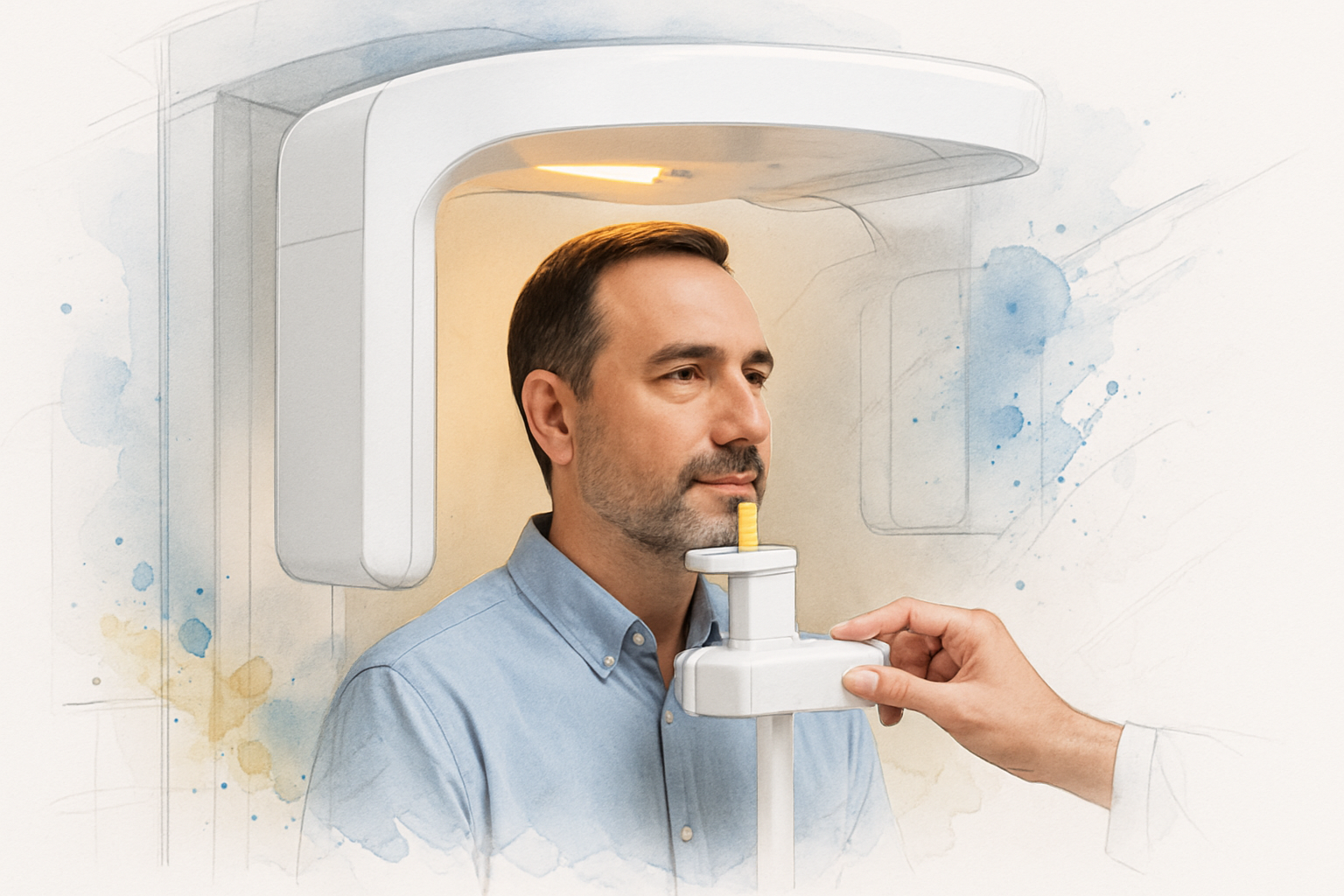
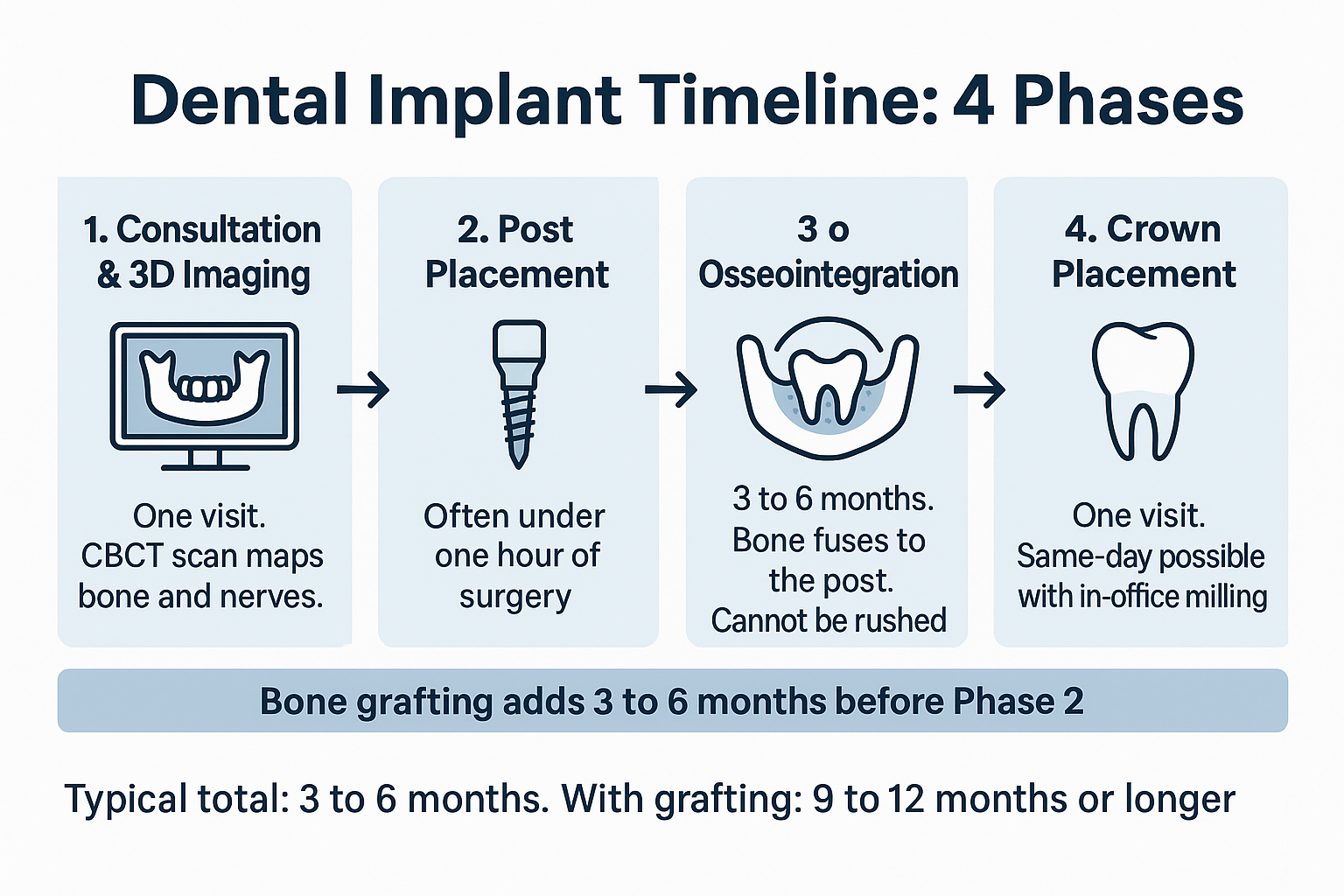
Phase one: consultation and imaging. Dr. Kalvin uses CBCT 3D imaging to look at bone density, nerve position, and the exact spot the post needs to go. This is not a flat X-ray, it is a detailed map of your jaw, and it is what makes placement accurate instead of approximate.
Phase two: placing the post. This is a surgical appointment, but for a single tooth it is typically under an hour. Local anesthesia, a small titanium post set into the bone, then you go home.
Phase three: osseointegration. This is the long stretch, usually 3 to 6 months, while the bone grows around and locks onto the titanium. You cannot speed this up. Not with supplements, not with a different office, not with a bigger budget.
Phase four: the crown. Once the post is stable, we take a digital scan and place the tooth on top. With in-office milling, qualifying cases can get that crown the same day, which is a real difference for people who don’t want another week off work.
One patient wrote that they came in for a cleaning and left with two new crowns “all completed in under three hours.” That same milling technology is what shortens the back end of implant treatment.
Implant Timeline at a Glance
Here’s the sequence laid out for a typical single-tooth case in Orange County. Your own timing depends on your bone, your healing, and whether an extraction is involved.
| Phase | Typical Time | What’s Happening |
|---|---|---|
| Consultation and CBCT imaging | 1 visit | Mapping bone density, nerve location, and placement site |
| Extraction, if needed | Under 30 minutes, 1-2 weeks healing | Removing a tooth that can’t be saved |
| Bone graft, if needed | 3-6 months healing | Rebuilding bone volume so the post has something to anchor to |
| Implant post placement | Often under 1 hour | Titanium post set into the jaw |
| Osseointegration | 3-6 months | Bone fuses to the post, no appointments required |
| Final crown | 1 visit, sometimes same-day | Digital scan, milled crown, placement |
The Implant Timeline, Step by Step
This breakdown shows where the months actually go in a standard single-tooth implant case.
Bone Grafting: The Part Nobody Expects
This is the factor that stretches timelines the most, and it catches people off guard. When a tooth has been gone for a while, or was lost to infection, the bone underneath shrinks.
Bone needs stimulation from a tooth root to hold its volume. Take the root away and the ridge slowly narrows. That’s why someone missing a molar for six years often needs more preparation than someone who lost a tooth last month.
If there isn’t enough bone to anchor the post securely, we place a graft first and let it heal before anything else happens. I get asked “can we just skip that?” fairly often, and the answer is no for a practical reason: a poorly anchored implant fails, and a failed implant costs more time and more money than a well-planned one.
A graft is not a complication. It is planning that protects a result you want to keep for decades.
If an extraction is part of your plan, ridge preservation at the time of removal can sometimes reduce how much grafting you need later. Worth asking about. We also broke down how long recovery from a tooth extraction takes if that’s your starting point.
Insurance and Money Can Add Months Too
Here is a timing trap that has nothing to do with your jaw. Some dental plans have a waiting period after an extraction before they’ll cover an implant in that spot. That can quietly add 2 to 4 months to your total if nobody checks early.
Call your plan before you schedule anything. Ask two specific questions: is there a waiting period after extraction, and is the implant post covered separately from the crown? Those two answers change the calendar more than most people realize.
Cost is the other thing that stalls people. Implant pricing in Orange County varies quite a bit depending on grafting, imaging, and the crown material, so I won’t throw a number at you here. We wrote a fuller breakdown on what dental implants actually cost in Orange County, and an exact figure should always come from an exam.
For patients who want to start before savings catch up, Cherry financing is available. No hard credit check, and approval takes about 60 seconds. We don’t accept CareCredit, which is worth knowing before you call.
And if you’re uninsured, that doesn’t disqualify you. Our in-house savings plan exists for exactly that situation, and plenty of patients across Oak View and Central Huntington Beach use it. More on that in our guide to staying ahead of dental problems without insurance.
The Clock Starts at the Consultation, Not the Crown
This is the piece I most want people to walk away with. If you’re hoping to have a working tooth in place before a wedding next spring or before the end of the year, the countdown begins the day you get imaged, not the day the crown goes on.
Work backward from your date. A straightforward case needs roughly half a year of runway. A case with grafting needs closer to a year.
So if you want to be well into the process before 2026 closes out, the practical move is getting the consultation and CBCT scan done in the next few weeks. Not because anything is urgent, but because bone healing runs on its own schedule and nothing changes that.
One more scheduling note for working folks in Huntington Harbour and Bolsa Chica-Heil: we’re closed Thursdays, and Saturday appointments run 8am to 2pm by appointment. Those Saturday slots fill up, especially in summer when families are juggling swim meets and camp drop-offs.
Frequently Asked Questions About Implant Timing
Will I be walking around with a gap for six months?
Usually not. Depending on where the tooth is and how your bite works, a temporary tooth can often be made so you’re not showing a space while the implant heals. Ask about this at the consultation, because the answer depends on the location and your bone.
Can I get an implant the same day my tooth is pulled?
Sometimes, yes. Immediate placement is possible when there’s enough healthy bone and no active infection. But it isn’t the right call for every case, and the CBCT scan is what tells us. If there’s infection or the bone is thin, waiting and healing first gives a far more predictable result.
Why can’t osseointegration be sped up?
Because it’s biology, not a procedure. Your bone cells grow into the microscopic surface of the titanium post over 3 to 6 months. Loading an implant before that bond is solid is how implants fail.
How much does the first visit cost?
Our new patient exam and X-rays are $150. An implant consultation includes the imaging needed to see whether grafting is in the picture, and any treatment estimate comes with the number in writing before you commit to anything.
I’m nervous about the surgery part. What actually happens?
You’re numbed thoroughly first, and for a single implant the placement is often under an hour. Blankets, neck pillows, and in-room TVs are there for a reason. Tell us up front that you’re anxious. It genuinely changes how we pace the appointment.
What if I already have a treatment plan from another office?
Bring it in. Second opinions are common with implants because the plans vary so much, especially around whether grafting is truly needed. You’ll get a straight read on it, no pressure either way.
Thinking About Where to Start?
If you’re mapping out an implant timeline in Huntington Beach, Fountain Valley, or anywhere nearby in Orange County, the consultation and 3D scan are what turn guesses into an actual calendar. Our team is currently welcoming new patients, and Saturday appointments are available by request. You can reach us at (657) 800-5254 or book online at kalidental.com whenever you’re ready to look at your options.