
Direct Answer: Your first cleaning after a long gap starts with X-rays and an exam, then moves to removing buildup your toothbrush can’t reach. The visit takes a bit longer than routine, but it’s almost always far less uncomfortable than you expect.
If you haven’t been to the dentist in two, three, or five or more years, the hardest part usually isn’t getting there — it’s working up the nerve. We hear this all the time. People in Huntington Beach, from Goldenwest to Huntington Harbour, put off their cleaning not because they don’t care about their teeth, but because they don’t know what to expect and they’re quietly dreading the moment someone makes them feel bad for waiting.
We don’t do that here. Life gets busy. Work runs long. Kids have schedules, insurance lapses, and money gets tight. Whatever your reason, it’s a reason — not a character flaw. Our job is to figure out where your mouth is right now and help you move forward from there, full stop.
This article walks through what actually happens at that first appointment back, how we figure out whether a standard cleaning or something more is needed, and what the visit is likely to feel like. No surprises.
What the Appointment Actually Looks Like, Step by Step
When someone comes in after a long break, the appointment follows a clear sequence. Nothing is rushed, and nothing happens without us explaining what we’re doing first.
Here’s how it typically goes:
- Digital X-rays first. Before we clean anything, we need to see what’s going on below the surface. X-rays show us bone levels, any spots of decay that aren’t visible to the eye, and the overall health of your gums — all things that change how we approach the cleaning.
- A physical exam. Dr. Kalvin looks at your gums, checks each tooth, and notes any areas of concern. This is when we get a real picture of where things stand.
- The cleaning itself. Once the exam is done, we remove the plaque and tartar that have built up — the stuff that brushing and flossing simply can’t get, no matter how diligent you are.
If you’ve been away for a few years, plan for the appointment to run a bit longer than a typical maintenance visit. That’s not a sign anything is wrong — it just means there’s more to address, and we take our time doing it right.
For more on what happens during the cleaning itself, this breakdown of what’s actually happening during a professional dental cleaning goes into more detail.
Standard Cleaning vs. Deep Cleaning — What’s the Actual Difference?
One of the first things patients ask when they’ve been away for a while is whether they’re going to need a deep cleaning. And honestly, a lot of people brace for it like it’s a punishment for missing appointments. It’s not — and it’s also not something that happens automatically.
Here’s the real distinction:
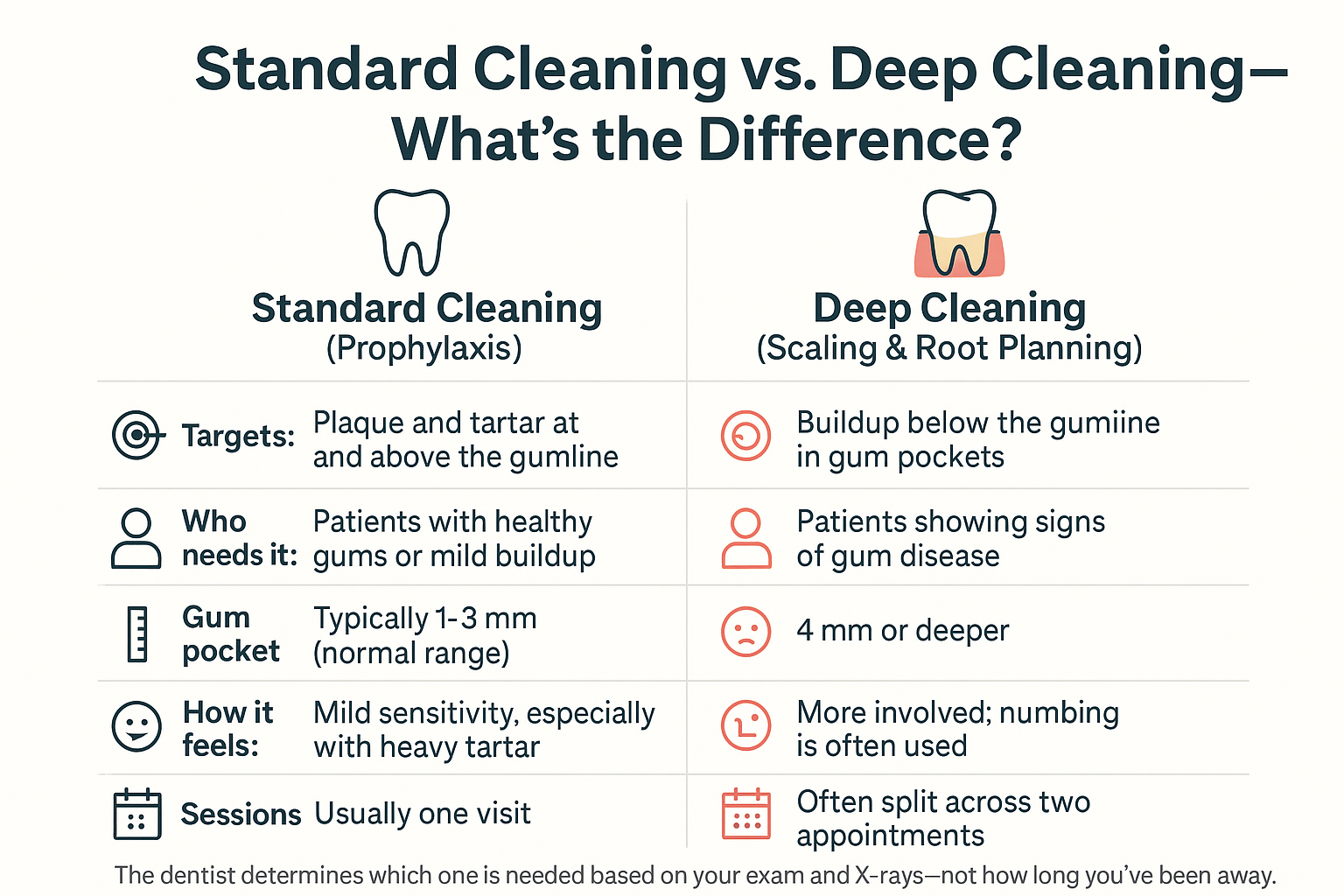
- A standard cleaning (sometimes called a prophylaxis) addresses plaque and tartar at and just above the gumline. It’s what most people get at routine checkups.
- A deep cleaning — clinically called scaling and root planing — goes below the gumline, into the pockets between your teeth and gums. It’s recommended specifically when there are signs of gum disease: deeper pockets, bone loss, persistent inflammation.
The decision between the two is made based on what the exam and X-rays actually show — not based on how long you’ve been away. Some patients who haven’t been seen in three years need a standard cleaning. Some people who came in eight months ago need a deep cleaning. It depends on what’s happening with your gums.
If you’re curious about how to read the signs yourself before your visit, this article on how to tell if you actually need a deep cleaning is worth a read. And if your gums bleed during cleanings, here’s a plain-language explanation of why that happens.
Standard Cleaning vs. Deep Cleaning at a Glance
Here’s a side-by-side look at how these two procedures differ — what each one involves, when it’s recommended, and what to expect.
Will It Hurt? An Honest Answer
I won’t tell you there’s zero discomfort, because that’s not always true — and you deserve a straight answer.
If you have significant tartar buildup or your gums are inflamed, some sensitivity during the cleaning is normal. The scaling instruments work at and around the gumline, and that area can be tender, especially when it hasn’t been cleaned professionally in a while.
But here’s what I can tell you from what patients consistently report: the visit is almost always far less uncomfortable than they imagined it would be. The fear of the appointment tends to be worse than the appointment itself.
We check in throughout the cleaning and adjust as needed. If you’re feeling too much sensitivity, we slow down or take a short break. And if you genuinely need it, numbing is available — just ask.
Yasmeen, a patient who described herself as having the worst dental anxiety, put it simply after her visit: ‘If you have a fear of the dentist or dental work come here! I have the worst anxiety and the doctor was so great and comforting especially during the procedure. I will never go to another dentist ever.’
That’s the experience we try to create for everyone who walks in nervous.
What a First-Visit Cleaning Typically Includes
New patient visits cover more ground than a routine maintenance appointment. Here’s what you can generally expect to be included — and what affects the final cost.
| Item | Included in First Visit? | Notes |
|---|---|---|
| Digital X-rays | Yes — typically | Full set for new patients; frequency depends on your history |
| Comprehensive exam | Yes | Dr. Kalvin reviews gums, teeth, bite, and overall oral health |
| Standard cleaning | Yes, if gum health allows | Addresses buildup at and above the gumline |
| Deep cleaning | If needed — determined by exam | Separate from a standard cleaning; may require additional visits |
| Fluoride treatment | Sometimes included or available | Ask upfront; adds protection, especially after heavy buildup removal |
| Treatment plan discussion | Yes | Dr. Kalvin walks through any findings and next steps — no pressure |
What It Actually Costs — and What to Ask Before You Book
Cost is a real concern, especially for patients without insurance. In the Huntington Beach area, a new patient exam and cleaning at a private practice can vary quite a bit depending on the office, what X-rays are included, and whether a standard or deep cleaning turns out to be necessary.
The best thing you can do is ask upfront: What does the new patient visit include, and what’s the out-of-pocket cost? A good office will give you a straight answer before you ever sit down in the chair.
If you don’t have insurance, ask specifically whether the practice has an in-house savings or membership plan. These plans typically cover routine care — exams, X-rays, cleanings — at a flat annual rate, which makes budgeting predictable instead of stressful. Our in-house savings plan exists specifically for patients in this situation.
For a broader look at how to manage dental costs without insurance, this guide on staying ahead of dental problems without coverage walks through practical options. And if you want to understand why preventive visits actually save money in the long run, this piece on preventive dental care costs breaks it down clearly.
One caller we spoke with summed it up well — she’d been putting off her appointment for years because of cost, time, and fear, and was worried the visit would add up to more than she could handle. When she finally came in and we walked through everything together, the relief was visible. That’s the conversation we want to have before you talk yourself out of coming.
What It Feels Like to Walk Back In After a Long Break
The emotional part of returning to the dentist after years away is real, and it doesn’t get talked about enough.
There’s usually a low-grade worry about being judged — like someone’s going to look at your X-rays and make you feel guilty. We’ve heard versions of this from patients across Huntington Beach, from Oak View to Bolsa Chica-Heil. It’s one of the most common things people share when they finally call.
What they almost always say afterward is that it wasn’t like that at all. The team was kind. Dr. Kalvin explained what he saw without making it a lecture. They felt like a person, not a problem to be managed.
Abbey F. said it better than I could:
‘I hadn’t been to the dentist in years due to costs & time & some fears. Kali Dental worked with me across all boards to ensure a pleasant & comfortable visit. I will literally fly back for an appointment with Kali Dental!!’
She’s describing exactly what we try to make possible for every patient who comes in after a long gap — meeting you where you are, addressing the barriers that kept you away, and making sure the visit itself doesn’t give you another reason to wait.
Frequently Asked Questions About Getting a Cleaning After a Long Gap
Is the dentist going to judge me for not coming in sooner?
No — and honestly, this fear keeps more people away than almost anything else. A good dental team’s job is to help you move forward, not to make you feel bad about the past. We see patients all the time who haven’t been in for years, and the conversation is always about what we can do now, not what you should have done differently.
How long will my first cleaning appointment take?
Plan for more time than a standard maintenance visit — typically 90 minutes to two hours for a new patient with a longer gap between visits. That includes X-rays, a full exam, the cleaning itself, and a conversation about what Dr. Kalvin found. If a deep cleaning turns out to be needed, some of that work may be scheduled across two appointments.
Will I automatically need a deep cleaning because I’ve been away so long?
No. A deep cleaning is recommended based on the health of your gums — specifically whether there are signs of gum disease like deep pockets or bone loss. Some patients who’ve been away for years need a standard cleaning. The exam and X-rays tell us what’s actually needed.
What if I don’t have dental insurance?
Ask about our in-house savings plan. It’s designed for exactly this situation — patients without insurance who want predictable, affordable access to routine care. A flat annual fee covers your exams, X-rays, and cleanings, so there’s no guessing what the visit will cost. You can also call us at (657) 800-5254 to ask what the new patient visit includes and what the out-of-pocket cost looks like before you book.
What if I’m really anxious about pain during the cleaning?
Tell us before we start — that’s the most useful thing you can do. We check in throughout the appointment and adjust the pace as needed. Numbing is available if the sensitivity becomes too much. Most patients are genuinely surprised by how manageable it turns out to be, but we take every concern seriously and work around it.
Do you see patients who haven’t been to a dentist in five or more years?
All the time. There’s no threshold where we turn someone away or treat them differently. Whether it’s been two years or ten, the process is the same: we figure out where things stand, explain what we found, and work through a plan that fits your situation.
Ready to Finally Get That Appointment on the Calendar?
If you’ve been putting this off, you’re not alone — and you’re not going to walk in here and get a lecture. Our team at Kali Dental in Huntington Beach is accepting new patients, including people who haven’t been seen in years and people without insurance who need a clear picture of what things will cost before they commit. Call us at (657) 800-5254 or book online at kalidental.com — and if you have questions before you come in, we’re happy to answer them over the phone.