
Direct Answer: Brushing removes soft plaque, but hardened tartar can only be removed with professional tools. Cleanings also catch problems early — before they become expensive.
You brush in the morning. You brush at night. Maybe you even floss — which already puts you ahead of most people. So when someone tells you to come in for a cleaning twice a year, it’s fair to wonder what exactly a hygienist is going to do that you haven’t already done yourself.
This question comes up constantly in our Huntington Beach office, especially from patients in Oak View and Goldenwest who are careful about their health but haven’t been to a dentist in a couple of years. They’re not neglectful — they just genuinely don’t understand what a professional cleaning adds that good home care doesn’t.
The answer is more specific than most people expect. It comes down to two things your toothbrush physically cannot do, no matter how good your technique is. Understanding those two things will change how you think about cleanings — not as a reminder to brush better, but as a completely separate layer of care.
What Your Toothbrush Actually Can’t Remove
Plaque is the soft, sticky film that builds up on your teeth throughout the day. Brushing removes it well — that’s exactly what it’s designed to do. But here’s where most people’s understanding stops short.
When plaque isn’t fully removed, it hardens. Within 24 to 72 hours, plaque exposed to the minerals in your saliva can begin calcifying into tartar (also called calculus). Tartar isn’t soft. It bonds to enamel and to the surface below the gumline, and no toothbrush — manual or electric — can break it loose.
By the time tartar has been sitting on a tooth for a few weeks, only a metal scaler or an ultrasonic cleaning tool can remove it. That’s not a failure of your brushing — it’s just how tooth chemistry works. Even patients with excellent home hygiene accumulate some tartar, particularly in the spots that are hardest to reach:
- Behind the lower front teeth — where saliva glands sit close to the surface
- Around the gumline — where the brush angle is awkward
- Between teeth — where floss helps but doesn’t reach below the gum
Left in place, tartar creates a rough surface that attracts even more bacteria. That’s where gum disease starts — not from skipping brushing, but from the slow accumulation of something only a professional can clear away. You can read more about what to expect at a routine dental cleaning and why it goes beyond what home care covers.
The Second Thing Cleanings Do — And Why It’s Arguably More Important
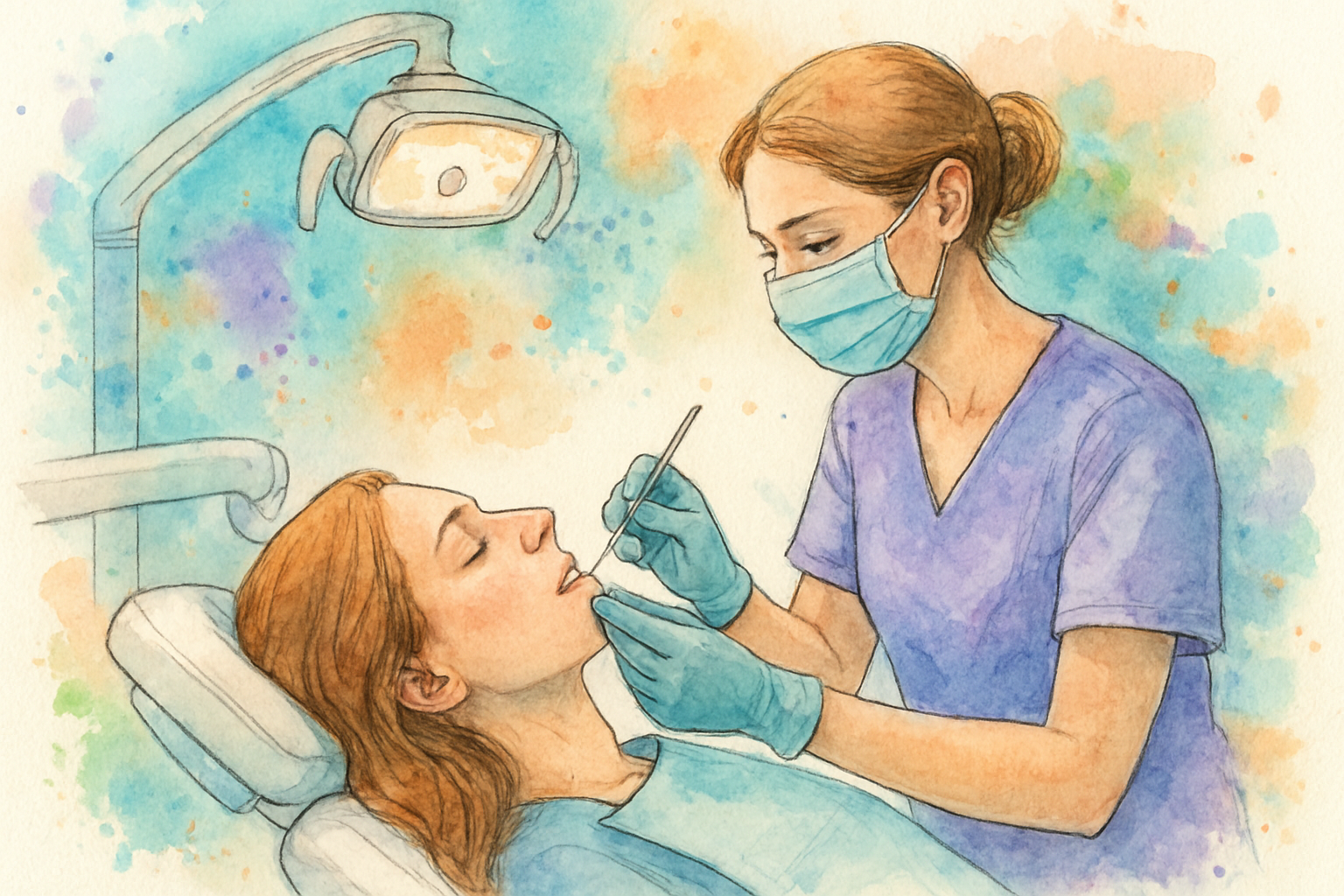
Removing tartar is the mechanical part of a cleaning. But there’s a second function that most patients don’t think about until they’re sitting in the chair for something that could have been caught six months earlier.
Every cleaning at our office includes a full exam by Dr. Kalvin. That exam isn’t just a formality. It’s a structured check of every surface in your mouth for things that develop silently — with no pain, no visible sign, and no warning until they’ve progressed.
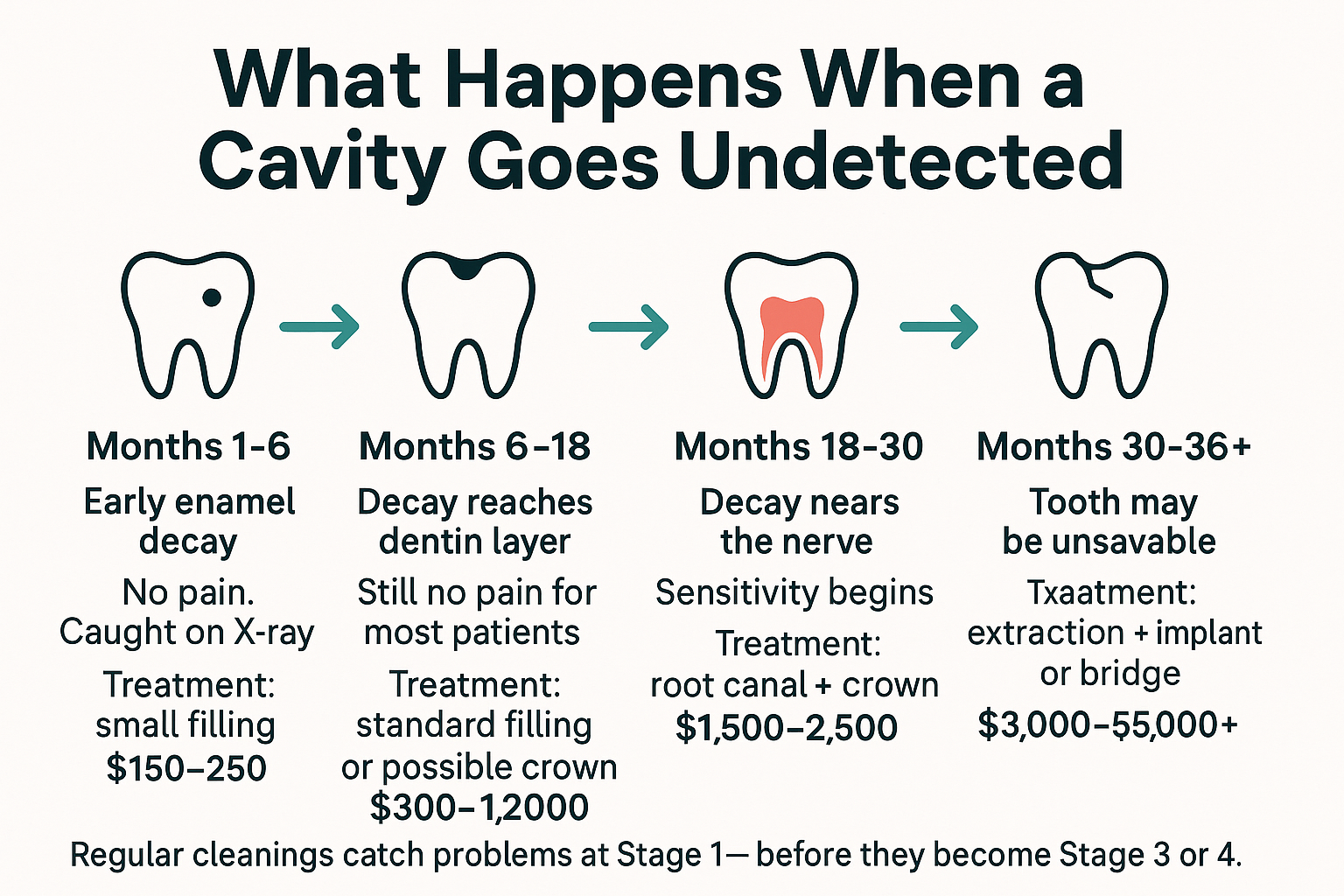
The most common example is a cavity forming between teeth. You can’t see it. It doesn’t hurt yet. But on digital X-rays, it shows up as a small shadow — and at that stage, a simple filling fixes it. Wait another year, and that same cavity may reach the nerve and require a root canal. The difference in cost and complexity between those two outcomes is enormous.
Here’s what Dr. Kalvin is actually checking for during a cleaning exam:
- Early-stage cavities between teeth and below old restorations
- Gum pocket depth — measurements above 3mm signal early gum disease
- Cracked or worn enamel from grinding (very common in active, stressed adults)
- Changes to existing crowns, fillings, or bridges that may be failing
- Soft tissue irregularities that warrant a second look
None of these things cause pain in their early stages. That’s exactly why waiting until something hurts is the most expensive way to manage your dental health. Families in Huntington Harbour and Central Huntington Beach who come in consistently end up spending far less over time because small problems get caught before they become big ones.
For a closer look at why early detection changes the cost of dental care, it’s worth understanding how quickly conditions like gum disease progress once they get past the early stage.
What Happens to a Cavity You Don’t Know About
This timeline shows how an undetected cavity progresses over 12 to 36 months — and what the treatment looks like at each stage.
Brushing vs. Professional Cleaning: What Each One Actually Does
Most people think of cleanings as a more thorough version of brushing. They’re actually different tools solving different problems — here’s how they compare.
| Task | Daily Brushing & Flossing | Professional Cleaning |
|---|---|---|
| Removes soft plaque | Yes — if technique is good | Yes, thoroughly |
| Removes hardened tartar | No — not possible at home | Yes — only way to remove it |
| Cleans below the gumline | Partially — 1–2mm at most | Yes — up to 3–4mm with scaling |
| Detects early cavities | No | Yes — via X-rays and exam |
| Measures gum pocket depth | No | Yes — at every visit |
| Polishes enamel surface | Partially | Yes — removes surface stain buildup |
| Checks existing restorations | No | Yes — crowns, fillings, bridges reviewed |
| Frequency needed | Twice daily | Every 6 months for most patients |
What About Patients Who Haven’t Been in a While?
A lot of people in the Bolsa Chica-Heil and Oak View neighborhoods tell us the same thing when they finally come in: they’ve been meaning to schedule for a couple of years, but they kept putting it off because they figured they were doing okay at home.
If that sounds familiar, know that you’re not going to be judged for it. Our approach is to start from where you are — not where we wish you’d been.
For patients who haven’t had a cleaning in more than 18 to 24 months, a single standard cleaning appointment sometimes isn’t enough to address the buildup that’s accumulated. In those cases, Dr. Kalvin may recommend a deep cleaning (also called scaling and root planing), which targets tartar that has migrated below the gumline. It’s a more involved process done in sections, usually over two appointments.
The good news is that even patients with significant tartar buildup or early gum disease respond well to treatment when they start. Gum disease in its early stages — called gingivitis — is reversible with professional cleaning and improved home care. Once it progresses to periodontitis, it becomes a condition you manage rather than reverse.
For uninsured patients worried about cost, our in-house savings plan covers cleanings, exams, and X-rays at a significantly reduced rate — with no insurance paperwork involved. A standard cleaning and exam for an adult member runs considerably less than paying full price out of pocket.
If you’re in Orange County and haven’t been seen in a while, coming in now rather than waiting another six months genuinely changes what your treatment looks like.
Kids and Cleanings — Why Starting Early Changes Everything
For families in Huntington Beach, one of the most common questions we hear from parents is when to start bringing kids in for cleanings — and whether it really matters when their teeth are just going to fall out anyway.
It matters a lot. Primary teeth hold space in the jaw for permanent teeth. When a baby tooth is lost early to decay, surrounding teeth can shift into that space and create alignment problems that require correction later. Cavities in primary teeth also hurt — and they can affect how a child feels about dental care for years.
We recommend a child’s first visit around their first birthday or when their first tooth appears, whichever comes first. Cleanings and fluoride treatments become part of the routine from there, and pediatric dental visits at our office are designed to feel calm and familiar from the start.
Summer is also a natural time to schedule — school schedules open up, and families across Huntington Beach are already in a rhythm of appointments and activities. Getting a cleaning done in June or July means your child heads back to school with a clean bill of dental health, and you’ve used your benefits before the year-end rush hits in November and December.
Frequently Asked Questions About Dental Cleanings
How often do I actually need a cleaning if I brush and floss every day?
For most adults with healthy gums and no active decay, every 6 months is the standard recommendation. But some patients — especially those with a history of gum disease, diabetes, or heavy tartar buildup — may be advised to come in every 3 to 4 months. Dr. Kalvin will tell you what interval makes sense based on what he sees at your exam, not a generic schedule.
Will a cleaning hurt?
Most patients with healthy gums feel little to no discomfort during a cleaning. If your gums are inflamed or you have significant tartar buildup near the gumline, there can be some sensitivity — but we work at your pace and can apply topical numbing gel if needed. Patients who were nervous the first time almost always tell us the next visit felt much easier.
I don’t have dental insurance. Can I still afford regular cleanings?
Yes. Our in-house savings plan is designed specifically for patients without insurance. It covers two cleanings, exams, and X-rays per year at a flat annual fee — no claims, no denials, no surprise bills. Many uninsured patients in Huntington Beach and Fountain Valley find it ends up being less expensive than maintaining insurance with a monthly premium.
My teeth look fine and nothing hurts — do I still need to go?
This is the most common reason people skip appointments, and it’s also why so many people end up in more involved treatment than they expected. Cavities between teeth, early gum disease, and cracking from grinding all develop without pain in the early stages. By the time something hurts, the problem has usually been there for months. A cleaning and exam is how you find out what’s actually going on — not how your teeth feel.
What’s the difference between a regular cleaning and a deep cleaning?
A regular cleaning (called prophylaxis) cleans at and just below the gumline — appropriate for patients with generally healthy gums. A deep cleaning (scaling and root planing) goes further below the gumline to remove tartar from the root surface itself. It’s used when gum pockets have deepened beyond 4mm, indicating gum disease has progressed. Dr. Kalvin will only recommend a deep cleaning when the X-rays and measurements show it’s actually needed.
How long does a cleaning appointment actually take?
For most adults, a cleaning and exam together takes about 45 to 60 minutes. If X-rays are included (which we typically take once a year), add another 10 to 15 minutes. We do our best to respect your time — especially for working patients and parents with school pickup schedules.
Ready to Get Back on Track?
Whether your last cleaning was six months ago or six years ago, our team at Kali Dental is here to meet you where you are — no lectures, no pressure, just an honest look at where your oral health stands and what it’ll take to keep it there. We serve families and individuals across Huntington Beach, Fountain Valley, and the broader Orange County area, and our in-house savings plan makes it possible for uninsured patients to get quality care without the sticker shock. Call us at (657) 800-5254 or book an appointment online at kalidental.com — we’d be glad to see you.