
Direct Answer: Brushing removes soft plaque, but it can’t touch hardened tartar or reach below the gumline. A professional cleaning removes what your toothbrush physically cannot.
A lot of people in Huntington Beach ask us some version of the same question: if I brush twice a day and floss most nights, why do I still need to come in for a cleaning? It’s a fair question — and honestly, it deserves a straight answer instead of the usual “it’s just important” non-answer.
The short version is that brushing and flossing do a lot of good work, but they can only reach so far. There’s a category of buildup that forms in your mouth over time that no toothbrush — no matter how good — can remove on its own.
This article breaks down exactly what happens between your cleanings, what your brush misses, and why skipping that twice-yearly appointment tends to cost a lot more than just the appointment itself.
What Brushing Actually Does (And Where It Stops)
Brushing is doing real work every time you do it. It removes soft plaque — the sticky film of bacteria that forms on your teeth throughout the day. Flossing pulls that same film from between your teeth where your brush can’t reach. Between the two habits, you’re doing most of what matters.
But here’s the problem: plaque that gets missed hardens into tartar, sometimes called calculus, within 24 to 72 hours. Once it hardens, it bonds to your tooth surface like cement. Your toothbrush bristles cannot break it loose — not even an electric brush on its highest setting.
Tartar tends to build up in predictable spots:
- Along the gumline, especially on the lower front teeth
- In the tight spaces between teeth that floss skims over
- Below the gumline, in shallow pockets your brush never reaches
Once tartar is present, it acts like a rough surface that attracts even more plaque and bacteria. That’s when gum irritation, early gum disease, and eventually bone loss can start — often without any pain as a warning sign. Families in neighborhoods like Oak View and Bolsa Chica-Heil who stay consistent with twice-yearly cleanings are much less likely to face those bigger, more expensive problems down the road.
What a Cleaning Actually Involves
Most people think of a cleaning as a quick polish at the end of their appointment. But the part that actually matters comes before that — and it’s called scaling.
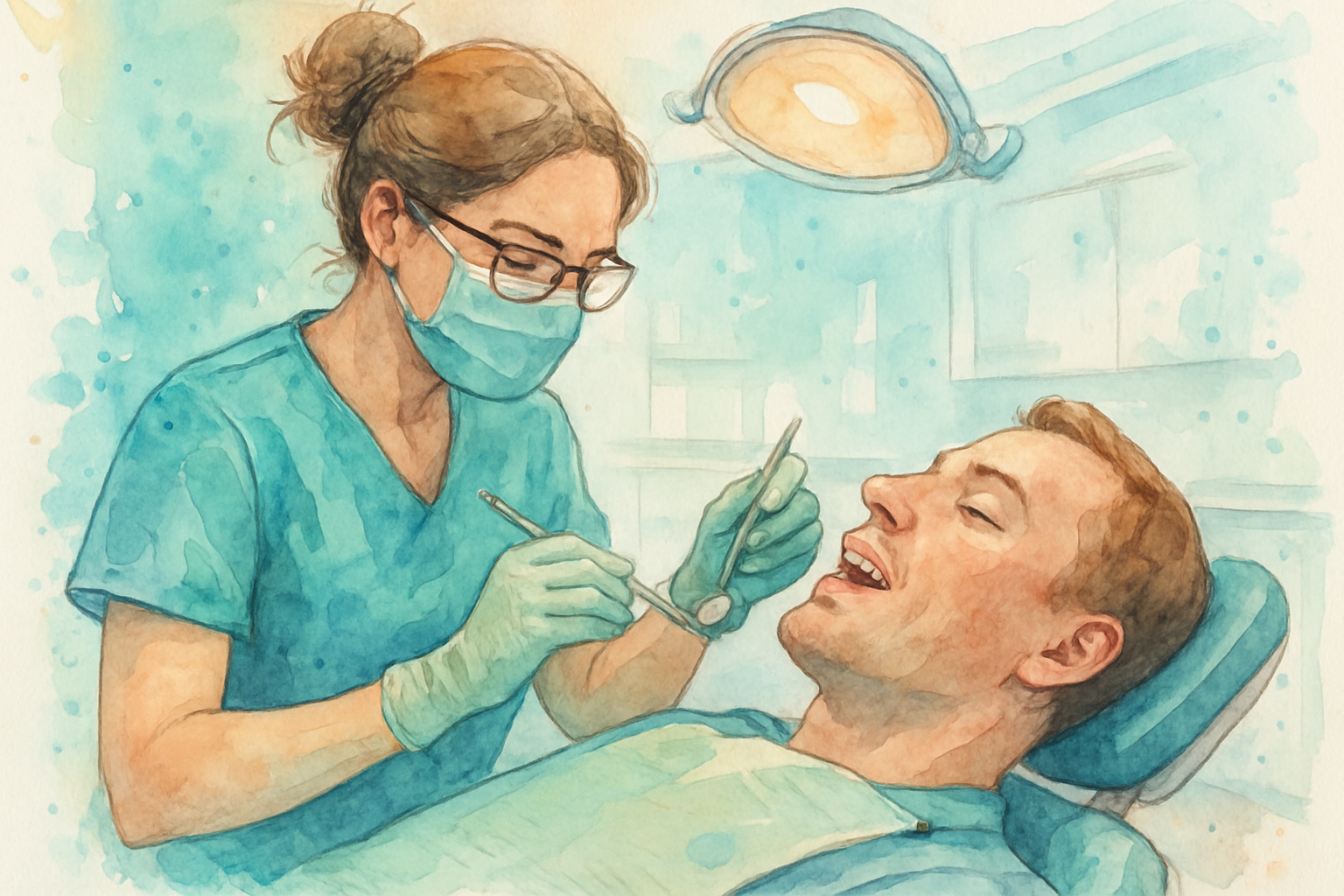
Scaling is when a hygienist uses a small metal instrument (or an ultrasonic tool that vibrates at high frequency) to break tartar away from the tooth surface and below the gumline. It’s thorough, methodical work that takes time to do right. For patients who haven’t been seen in a year or two, that process can take significantly longer than for someone who comes in every six months.
After scaling, the hygienist polishes your teeth with a slightly abrasive paste that removes surface stains and smooths the enamel — which makes it harder for plaque to grab hold again quickly. Then Dr. Kalvin does a full exam: checking for cavities, evaluating your gum health, looking at your bite and jaw, and reviewing any digital X-rays taken during the visit.
That exam is the other reason cleanings matter beyond just clean teeth. It’s when problems get caught early — a small cavity that takes one appointment and a modest filling versus a tooth that’s gone months longer and now needs a crown. In Orange County, a standard filling runs $150–$300. A crown is typically $1,200–$1,800 or more. Catching it early is almost always the cheaper path.
What Happens to Your Teeth Between Cleanings
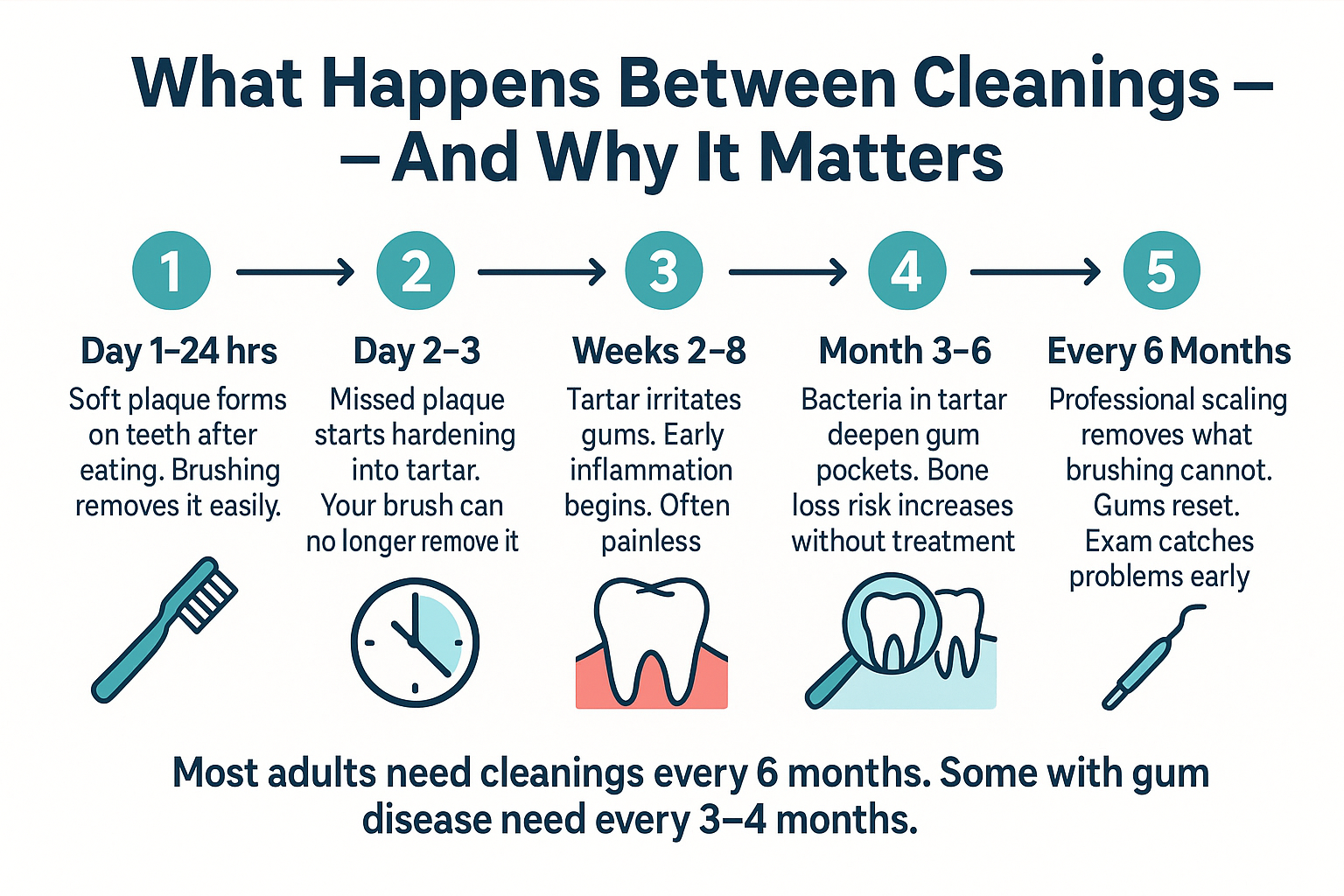
This infographic shows the timeline of what builds up in your mouth between professional cleanings — and why the six-month window is the right interval for most people.
Brushing vs. Professional Cleaning: What Each Actually Removes
People often assume these two things are doing the same job. They’re not — and this table shows exactly where the difference lies.
| What Needs Removing | Daily Brushing & Flossing | Professional Cleaning |
|---|---|---|
| Soft plaque on tooth surfaces | Yes — removes effectively | Yes — removes any remaining |
| Plaque between teeth | Partially — floss helps | Yes — scaling reaches all gaps |
| Hardened tartar (calculus) | No — cannot remove | Yes — only method that works |
| Buildup below the gumline | No — brush doesn’t reach | Yes — scaling goes sub-gingival |
| Surface stains | Partially — toothpaste helps | Yes — polishing removes more |
| Early cavity detection | No | Yes — exam included with cleaning |
| Gum disease monitoring | No | Yes — pocket depth measured |
The Hidden Cost of Skipping Appointments
We hear from patients — especially uninsured ones — who’ve gone two, three, even five years without a cleaning because they couldn’t justify the cost. That’s completely understandable. But the math tends to work against waiting.
A standard cleaning and exam in Huntington Beach runs roughly $150–$250 out of pocket for uninsured patients at most private practices. That’s the twice-yearly number that keeps your mouth stable.
Skip those appointments long enough, and tartar buildup turns into gum disease. Early-stage gum disease (gingivitis) is still reversible with a professional cleaning. But once it progresses to periodontitis — where pockets deepen and bone loss begins — the treatment changes. You’re no longer looking at a routine cleaning. You’re looking at a deep cleaning (scaling and root planing), which typically runs $500–$1,000+ per quadrant and requires multiple appointments.
For patients without insurance, that’s a significant difference. Our in-house savings plan was built specifically to make the preventive appointments affordable so patients don’t get pushed into the more expensive treatments by default.
And for families in Huntington Harbour or Central Huntington Beach juggling multiple kids and two adults — keeping everyone on a regular cleaning schedule as a family tends to be far cheaper than handling dental problems one crisis at a time.
How Often Do You Actually Need a Cleaning?
Most adults need a cleaning every six months. That’s not arbitrary — it’s based on how long it typically takes for tartar to build up to the point where it starts causing damage.
But that interval isn’t the same for everyone. Some patients need to come in every three to four months, including:
- People with a history of gum disease, even if it’s been treated
- Patients with diabetes, which raises gum disease risk significantly
- Smokers or former smokers
- Anyone with deep gum pockets that collect bacteria more quickly
- Patients undergoing certain medications that cause dry mouth or gum changes
Dr. Kalvin determines the right interval based on what he actually sees during your exam — not a one-size-fits-all schedule. If you’ve been coming in every six months and your gums are consistently healthy, that’s working. If there are signs of progression, it makes sense to come in more often and get ahead of it.
For kids, the recommendation is also typically twice a year starting young, both for cleanings and to catch any early developmental issues with their teeth and bite.
Frequently Asked Questions About Dental Cleanings
My teeth feel totally fine — do I really still need a cleaning?
Yes, and this is actually the most common reason people delay. Most dental problems don’t cause pain until they’re well advanced. Cavities, gum disease, and even bone loss can progress silently for months. A cleaning is also an exam, and that exam catches problems when they’re small and inexpensive to fix.
Does a cleaning hurt?
For most patients with healthy gums, a cleaning is uncomfortable at most — not painful. If your gums are inflamed from tartar buildup, scaling can feel sensitive in those areas. We can apply a topical numbing gel if needed, and we take our time so patients aren’t gripping the armrests. Patients who’ve been anxious about cleanings in the past regularly tell us our appointments felt much gentler than they expected.
What if I don’t have dental insurance?
We offer an in-house savings plan specifically for patients without insurance. It covers your cleanings and exams at a flat annual rate and gives you discounts on other treatments. A lot of our patients in Huntington Beach use it as their alternative to traditional insurance — especially working adults and families who find premiums aren’t worth it for their situation. Ask our team for the current plan details when you call.
How long does a cleaning appointment take?
A routine cleaning and exam typically takes 45 to 60 minutes. If it’s been a while since your last visit and there’s more tartar buildup, it may take longer. We’ll always let you know what to expect when you book.
Can I get my cleaning and my kids’ cleanings done the same day?
We see patients of all ages, so yes — we can often schedule family appointments back-to-back or at the same time. A lot of families from Oak View and Goldenwest do this to make one trip work for everyone. Just let us know when you call and we’ll do our best to coordinate.
I haven’t been to the dentist in a few years. Is that going to be a problem?
We don’t judge gaps in care — we just pick up where you are now. If it’s been a few years, your first appointment may take a bit longer, and Dr. Kalvin may recommend X-rays to get a full picture of what’s going on. The sooner you come in, the more options you have. Waiting longer rarely makes anything easier or cheaper.
Ready to Get Back on Track?
Whether your last cleaning was six months ago or six years ago, our team at Kali Dental is ready to meet you where you are — no lectures, no pressure, just a thorough appointment in a calm environment. We serve families across Huntington Beach, Fountain Valley, and the wider Orange County area, and we offer an in-house savings plan for patients without insurance. Call us at (657) 800-5254 or book online at kalidental.com to schedule your cleaning and exam.