
Direct Answer: Brushing removes soft plaque, but hardened tartar can only be removed with professional tools. Cleanings also catch problems early — before they become expensive.
A lot of patients say the same thing when we ask how often they brush: “Every single day, morning and night.” And they mean it. So when we recommend coming in every six months, the question is fair — if I’m doing everything right at home, what exactly are you doing that I can’t?
It’s one of the most common things we hear from families in Huntington Beach, whether they’re coming in from the Oak View neighborhood or driving down from Huntington Harbour. And the honest answer isn’t “you need us to clean your teeth better than you can.” The honest answer is more interesting than that.
There are two things happening at a professional cleaning that your toothbrush simply cannot do — and understanding them changes how you think about dental visits entirely.
Your Toothbrush Has a Limit — Here’s Where It Stops
Brushing works really well on soft plaque — the thin, sticky film that coats your teeth throughout the day. Twice-daily brushing, done well, clears most of that film before it causes real damage.
But plaque that sits on teeth for 48 to 72 hours without being fully removed starts to harden. Once it mineralizes — a process called calculus formation, or tartar — it bonds to the tooth surface at a microscopic level. No amount of brushing will remove it at that point. The only way to get it off is with metal instruments or an ultrasonic scaler in a dental setting.
And here’s the part that surprises people: even great brushers get tartar buildup. It doesn’t mean you’re doing anything wrong. Your saliva chemistry, your diet, the shape of your teeth, and spots your brush simply can’t reach all contribute. The area behind your lower front teeth and along the gumline are the most common buildup zones — and they’re almost impossible to keep fully clear at home.
Left long enough, tartar:
– Pushes the gumline away from the tooth
– Creates pockets where bacteria concentrate
– Triggers gum inflammation that can progress to periodontal disease
– Contributes to bad breath that doesn’t go away with mouthwash
A professional cleaning removes that buildup before it starts doing structural damage. That’s the first reason cleanings matter even when you brush every day.
The Second Reason Has Nothing to Do With Cleaning
The cleaning itself is only part of what happens at a preventive visit. The other part — the exam — is where problems get caught before you feel them.
Dental decay doesn’t hurt in its early stages. Neither does early gum disease. By the time a cavity becomes sensitive, it’s usually already reached the inner layer of the tooth. By the time your gums bleed regularly, there may already be some bone loss underneath. Pain is a late signal in dentistry, not an early one.
Dr. Kalvin uses digital X-rays and a full clinical exam at these visits to look for things that don’t show up in a mirror and don’t cause symptoms yet:
– Cavities forming between teeth
– Early-stage gum recession
– Cracks in enamel that can worsen under chewing pressure
– Changes in existing fillings or older restorations
– Bone levels around the roots of teeth
Catching a cavity when it’s small means a filling — typically around $150–$300 in the Huntington Beach area depending on size and location. Catching it after it reaches the pulp means a root canal, which runs $900–$1,500 or more before the crown that follows. That’s not a scare tactic; it’s just how dental problems compound when they go undetected.
The six-month schedule exists because that’s roughly how long it takes for small, manageable problems to become large, expensive ones. Some patients with a history of gum issues need to come in every three to four months. Others with very stable mouths might go once a year. Dr. Kalvin will tell you honestly which category you’re in.
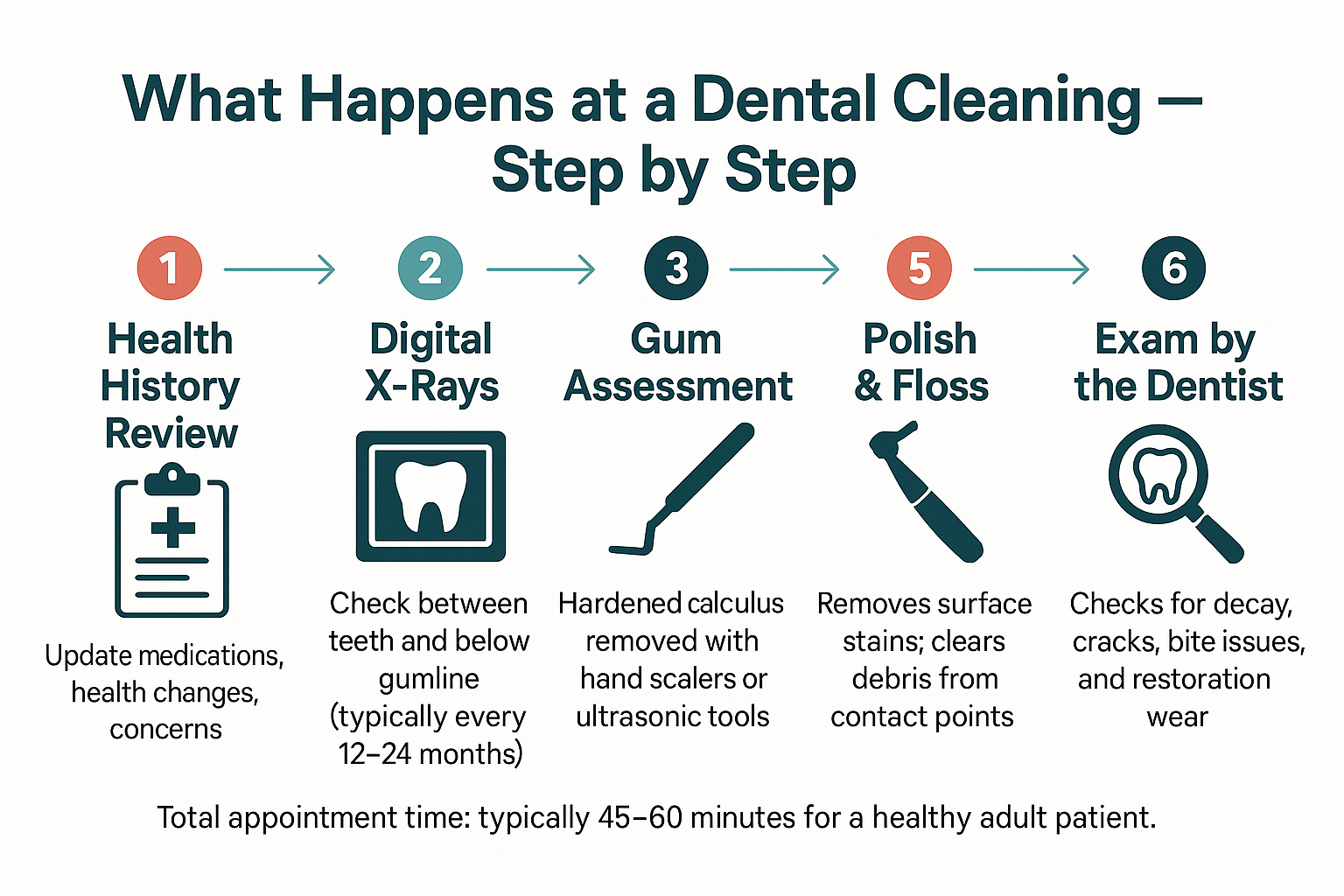
What Actually Happens at a Dental Cleaning Visit
Most patients don’t realize how much ground a single cleaning appointment covers. This breakdown shows each step from check-in to checkout.
Home Care vs. Professional Cleaning — What Each Actually Does
Both matter. But they’re doing different jobs. Here’s a plain-language breakdown of what each one handles and what it can’t.
| Task | Daily Brushing & Flossing | Professional Cleaning |
|---|---|---|
| Remove soft plaque | Yes — very effective | Yes — also effective |
| Remove hardened tartar | No — impossible once hardened | Yes — only way to remove it |
| Polish surface stains | Partially — with whitening toothpaste | Yes — polishing paste and tools |
| Detect cavities early | No | Yes — X-rays and visual exam |
| Measure gum pocket depth | No | Yes — at every visit |
| Catch cracks or failing restorations | No | Yes — part of clinical exam |
| Keep breath fresh | Yes — temporarily | Yes — removes bacterial buildup at the source |
What About Patients Who Haven’t Been in a Few Years?
This comes up a lot, and we want to be direct about it: you don’t need to feel embarrassed. Gaps in dental care are extremely common, especially for adults managing busy schedules, tight budgets, or anxiety about what they’ll be told.
For patients who’ve been away for a while — say two or more years — the first visit back may involve a bit more work. There may be more tartar buildup to clear, which sometimes requires a deeper cleaning called scaling and root planing rather than a standard prophy. That’s more involved and usually costs more, but it gets you back to a healthy baseline.
If cost is a concern, we run an in-house savings plan for patients without dental insurance. It covers exams, X-rays, and two cleanings per year at a flat annual fee — and includes discounts on other treatments. For a lot of uninsured patients in Huntington Beach and Fountain Valley, it’s what makes regular care actually affordable.
You can read more about why regular cleanings matter for long-term dental health and what to expect if you’re returning after a long gap. The most important thing is just coming back — whatever condition your mouth is in right now, we’ve seen it before and we’re not here to judge.
A Note for Parents With Kids in School
If you’ve got kids in Huntington Beach schools, August and early September are the best windows for their annual dental checkup. Most pediatric cleanings and exams for kids take 30–45 minutes, and getting them done before the school year kicks into full gear is a lot easier than squeezing them in between practices and homework nights.
Dr. Kalvin sees kids as young as toddler age, and we take extra time with younger patients to make the visit low-pressure. Sealants and fluoride treatments are often applied at these visits — both are covered by most insurance plans and are among the most cost-effective ways to prevent cavities in kids who are getting their permanent molars.
If your family has hit the end of summer without getting cleanings scheduled, take a look at how back-to-school timing affects dental visit planning for some practical scheduling guidance.
Frequently Asked Questions About Dental Cleanings
How often do I actually need a cleaning if I brush and floss every day?
For most adults with healthy gums and no history of gum disease, every six months is the standard recommendation. But it’s not a universal rule. If you’ve had periodontal disease in the past, Dr. Kalvin may recommend coming in every three to four months to keep things stable. And if your teeth are in very good shape and you’ve been consistent for years, once a year may be discussed. The right interval depends on your specific mouth, not a general guideline.
Do cleanings actually hurt?
For most patients with healthy gums, a standard cleaning is mildly uncomfortable at most — some scraping sensation and maybe a little sensitivity along the gumline. If your gums are inflamed or you have significant buildup, it can be more sensitive. We have topical numbing gel available, and we go at your pace. Let us know if anything is bothering you and we’ll adjust.
What’s the difference between a regular cleaning and a deep cleaning?
A regular cleaning (called a prophylaxis) cleans above and just at the gumline — it’s a maintenance visit for a healthy mouth. A deep cleaning (scaling and root planing) goes below the gumline to clear tartar from the root surfaces and is used when gum disease is present. Deep cleanings are usually done in two appointments — one side of the mouth per visit — and may involve local anesthetic. They cost more than a standard cleaning and are typically covered in part by dental insurance.
I don’t have insurance. How much does a cleaning cost in Huntington Beach?
Out-of-pocket, a standard adult cleaning and exam in the Huntington Beach area typically runs $150–$250 depending on the practice and what’s included. Our in-house savings plan covers two cleanings, your annual exam, and X-rays for a flat yearly fee — and gives you discounts on any other treatment. It’s worth asking about when you call, especially if you’re uninsured or your insurance doesn’t include dental.
Can I skip the X-rays if I just want a cleaning?
You can decline X-rays, but we’d encourage you to think about why we recommend them. X-rays let Dr. Kalvin see between teeth and below the gumline — areas where decay and bone loss happen first and where no visual exam can reach. We don’t take them at every visit; typically it’s once a year for most patients or every 18–24 months if things look stable. They’re also a low dose of radiation — significantly less than a cross-country flight.
My teeth look fine and nothing hurts. Do I really need to come in?
This is exactly when you should come in. Dental problems almost never hurt in their early stages — that’s the nature of enamel and dentin. By the time a cavity causes sensitivity or a gum issue causes pain, it’s usually already progressed to a more involved fix. Coming in when everything feels fine is what keeps it that way.
Ready to Get Back on Track?
Whether your last cleaning was six months ago or six years ago, our team at Kali Dental is ready to meet you where you are — no lectures, no pressure, just honest care. We serve families and individuals across Huntington Beach, Fountain Valley, and the surrounding Orange County communities, and we keep our schedule open for patients who’ve been putting this off. Call us at (657) 800-5254 or book your appointment online at kalidental.com — we’ll take care of the rest.