
Direct Answer: Brushing removes soft plaque, but it can’t touch hardened tartar. Only professional tools can remove tartar — and that buildup is what leads to cavities and gum disease.
A lot of patients ask us some version of the same question: ‘I brush twice a day and floss — do I really still need to come in for a cleaning?’ It’s a fair question, and honestly, it shows you’re already doing a lot right. But the answer is yes, and there’s a specific biological reason why.
Here in Huntington Beach, we see this pattern all the time. Patients from Oak View, Goldenwest, and Central HB come in after skipping a year or two, convinced their solid home routine has things covered. What we find under the surface tells a different story.
This article focuses on two things that actually matter: what your toothbrush physically cannot do, and what happens in your mouth when tartar builds up unchecked. Skip the fluff — let’s talk about what’s actually going on.
What Your Toothbrush Is Actually Good At (And Where It Stops)
Brushing is genuinely effective — we’d never say otherwise. A good two-minute brush, twice a day removes the soft bacterial film called plaque from the surfaces of your teeth. That matters a lot. Plaque is the starting point for both cavities and gum disease.
But here’s the problem. Plaque that doesn’t get brushed away within 24 to 72 hours starts to calcify. Once it hardens into tartar (also called calculus), no toothbrush on earth can remove it — not yours, not an electric one, not one sold for $200 on Amazon. The mineral deposits bond to the tooth surface and require a metal scaler or an ultrasonic cleaning tool to break free.
Brushes also have real limits on where they can reach:
- The space between teeth — floss helps here, but even floss misses the curves just below the gumline
- Below the gumline — a toothbrush can’t clean the shallow pocket between your tooth and gum tissue
- Back molars — the anatomy of your jaw makes full bristle contact difficult, especially on lower second molars
- Around older dental work — crowns, bridges, and fillings create micro-edges where buildup hides
This isn’t a critique of your brushing habits. It’s just biology. Why do gums bleed during a cleaning? — that’s often the first visible sign that tartar has been sitting undisturbed for too long.
What Tartar Actually Does to Your Mouth Over Time
Tartar isn’t just cosmetic. It’s a rough, porous surface that bacteria love to colonize. Once it’s on your teeth — especially below the gumline — it becomes a permanent irritant to your gum tissue.
Your gums respond to that irritation by pulling back slightly, creating a deeper pocket. That pocket collects more bacteria, which triggers more inflammation, which causes more recession. This is how periodontitis — advanced gum disease — develops in people who thought they were doing everything right.
By the time patients notice symptoms like persistent bad breath, bleeding when they brush, or visible gum recession, the process has usually been building for 12 to 24 months. That’s why the standard recommendation is a professional cleaning every 6 months — not because dentists are being conservative, but because that’s roughly how long it takes for tartar accumulation to start causing measurable damage in most adults.
The cost difference is also worth understanding. A routine cleaning in Huntington Beach typically runs $100–$180 without insurance. A deep cleaning — the treatment needed once gum disease has set in — usually starts at $300–$600 per quadrant, and most mouths have four. Catching things at the cleaning stage isn’t just better for your health. It’s dramatically better for your wallet.
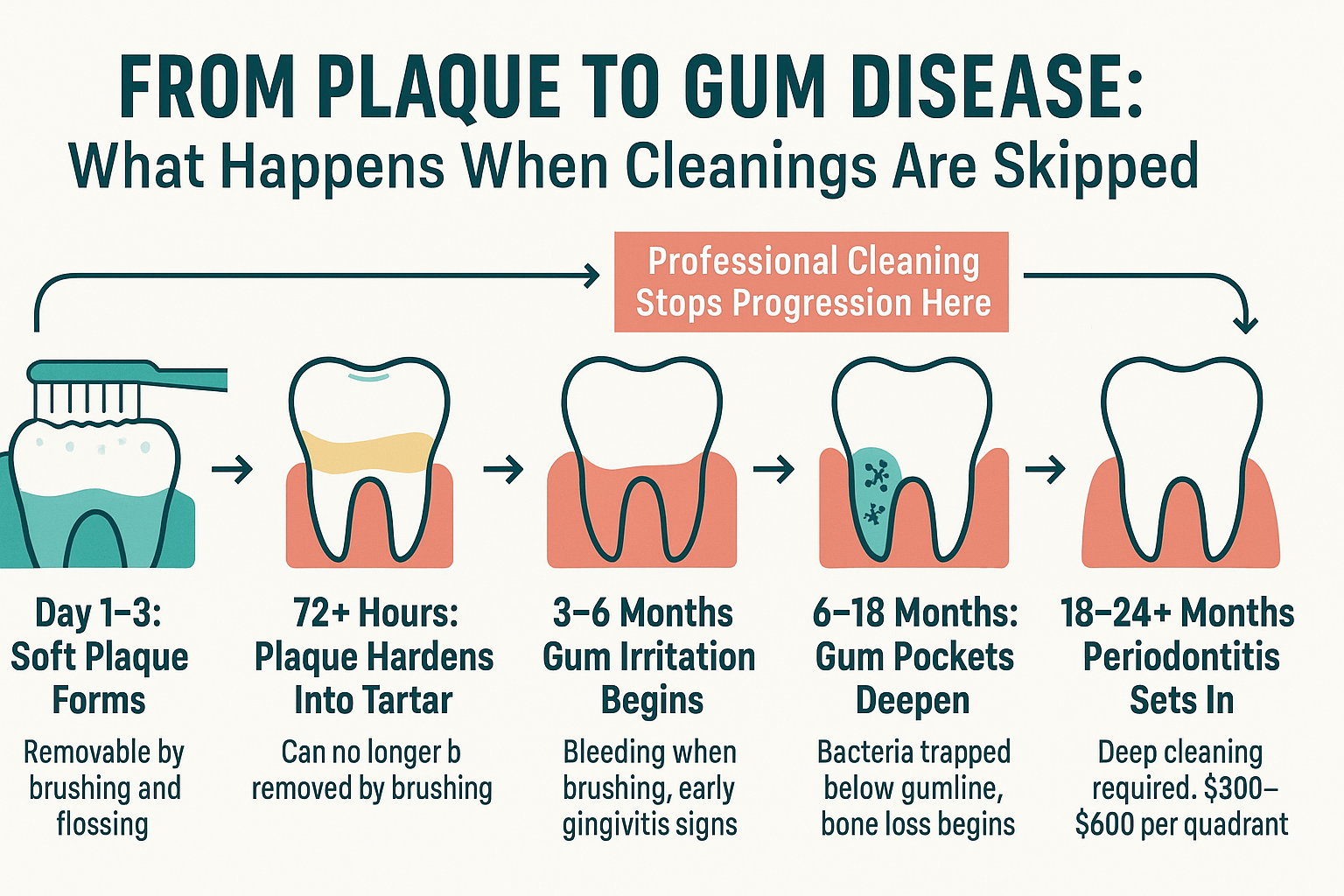
From Plaque to Gum Disease: How It Builds Over Time
This infographic shows the progression from normal plaque to full gum disease — and where a professional cleaning interrupts that timeline.
Brushing vs. Professional Cleaning: What Each One Actually Does
This isn’t about one being better than the other — they do completely different jobs. Both are necessary.
| Task | Daily Brushing & Flossing | Professional Cleaning |
|---|---|---|
| Removes soft plaque | Yes | Yes |
| Removes hardened tartar | No | Yes |
| Cleans below the gumline | Partially | Yes — with specialized tools |
| Checks for early cavities | No | Yes — visual + X-ray exam |
| Polishes enamel surface | Partially | Yes — removes surface stains |
| Identifies gum recession | No | Yes — measured at every visit |
| Cost | $5–$15/month in supplies | $100–$180 per visit without insurance |
What Actually Happens During a Cleaning (So You Know What to Expect)
A lot of patients who avoid the dentist do so because they don’t know what’s coming. So here’s exactly what happens at a routine cleaning appointment — no surprises.
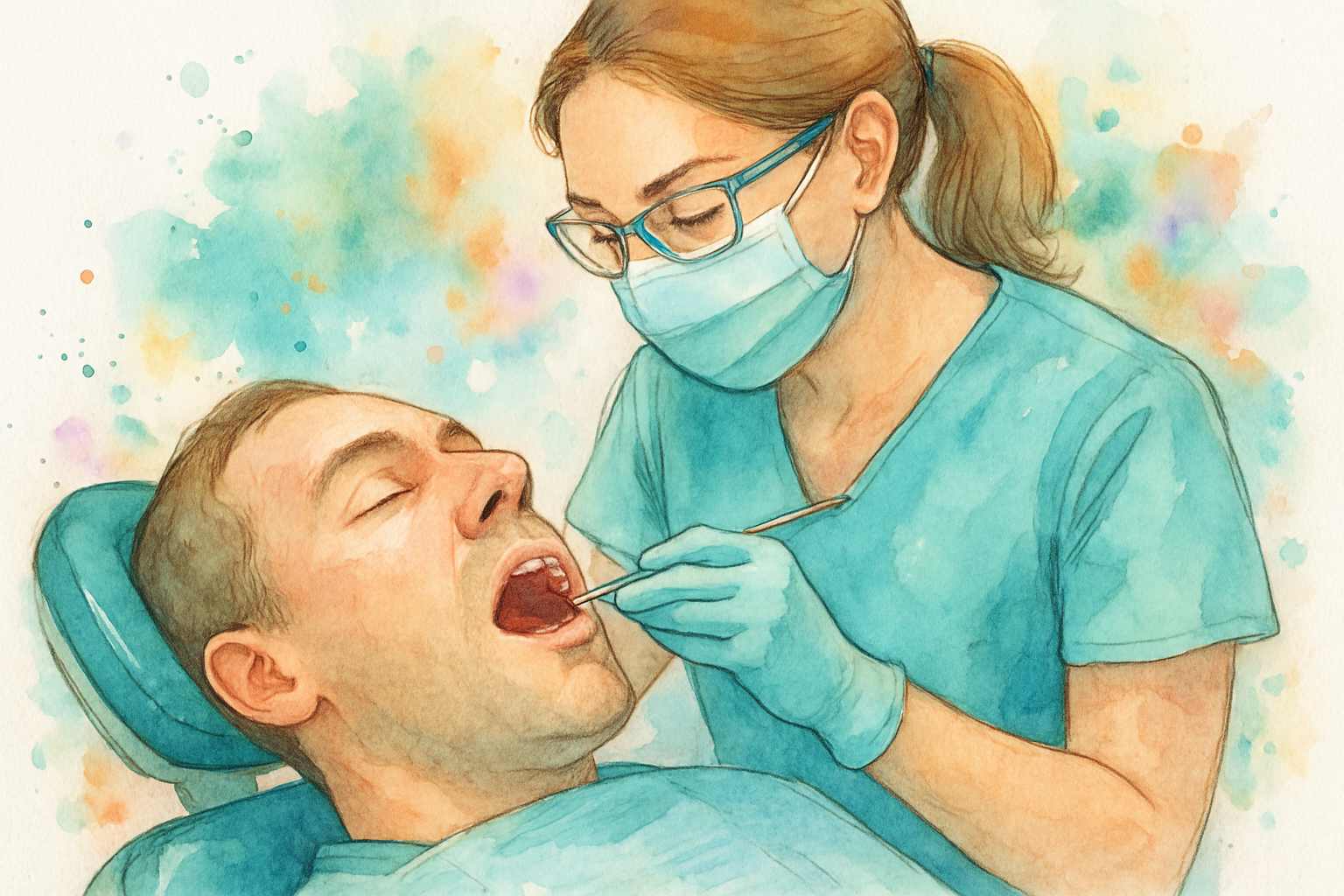
When you come in, a hygienist starts with a visual check of your gums, teeth, and any existing dental work. If X-rays are due (usually once a year), digital X-rays are taken first — these use far less radiation than older film X-rays and the images are ready in seconds.
Then the cleaning itself:
- Scaling — the hygienist uses a scaler (hand tool) or an ultrasonic device to break up tartar above and just below the gumline
- Polishing — a slightly gritty paste and a rotating brush buff the tooth surfaces, removing soft stains and smoothing the enamel
- Flossing — a thorough pass between every contact point to clear any remaining debris
- Fluoride treatment — often applied at the end as a quick rinse or gel to strengthen enamel, especially for kids and patients prone to cavities
The whole appointment usually runs 45 to 60 minutes for a routine cleaning. Patients who haven’t been in for a year or more may need a bit longer. At our office, we’ve added neck pillows, blankets, and in-room TVs so the time passes more comfortably — especially for patients who come in with some anxiety about the process.
If it’s your first visit or your kids’ first cleaning, our team sees patients of all ages under one roof — from toddlers to grandparents — so you don’t have to manage multiple providers.
The Uninsured Patient Question: Is a Cleaning Worth the Out-of-Pocket Cost?
For families in Huntington Beach without dental insurance, the calculus on preventive care feels different. Spending $100–$180 every six months adds up, especially for a family of four.
But skipping cleanings almost always costs more over time. A cavity caught at a cleaning might need a $150–$250 filling. That same cavity left alone for another year can reach the nerve and require a root canal — which runs $900–$1,400 in the Huntington Beach area before a crown.
For uninsured patients, we run an in-house savings plan that reduces the cost of cleanings, exams, X-rays, and most other services significantly. It’s designed specifically for people who need consistent care but aren’t covered through work or a marketplace plan. It’s not a replacement for insurance — it’s a straightforward discount membership that makes regular visits actually affordable.
If cost has been the reason you’ve been putting off care, that’s a real concern and we don’t dismiss it. But most patients find the plan pays for itself with a single cleaning and exam visit.
Frequently Asked Questions About Dental Cleanings
How often do I actually need a cleaning if I brush and floss regularly?
For most adults, every 6 months is the standard recommendation — and it’s not arbitrary. That’s roughly how long it takes for tartar to accumulate to the point where it starts irritating gum tissue. Some patients with a history of gum disease may need to come in every 3 to 4 months during an active treatment period. Your hygienist will tell you honestly which schedule makes sense for your mouth.
Does a cleaning hurt? I’ve had bad experiences before.
For most patients with healthy gums, a routine cleaning is more uncomfortable than painful — pressure, scraping sensation, maybe some sensitivity near the gumline. If your gums are inflamed from tartar buildup, there can be more sensitivity. We use a gentler ultrasonic scaler that many patients find easier to tolerate than traditional hand tools. And if you want a break or need a moment, just raise your hand — we stop.
My gums always bleed at cleanings. Does that mean something is wrong?
Bleeding during a cleaning usually means the gum tissue is inflamed, which is most often a sign of early gingivitis. It’s very common and typically reversible with consistent cleanings and better home care. It’s not a reason to avoid coming in — in fact, it’s a reason to come in sooner. Here’s a more detailed explanation of why gums bleed during cleanings if you want to understand what’s happening.
Do kids need cleanings too, or just cavity checks?
Kids absolutely need cleanings — in some ways more than adults. Children’s enamel is thinner and more vulnerable to acid from food and drinks. A cleaning also gives us a chance to apply fluoride treatments and sealants that act as a physical barrier against cavities on the back molars. We recommend kids start coming in by age 1 or when their first tooth appears, and every 6 months after that.
What’s the difference between a regular cleaning and a deep cleaning?
A regular cleaning — called a prophylaxis — addresses tartar and plaque above the gumline and just at the gumline. A deep cleaning, or scaling and root planing, goes well below the gumline into the pockets between the tooth and gum tissue. It’s required when gum disease has progressed beyond gingivitis. Deep cleanings are done under local anesthetic and usually treated one or two quadrants at a time. A routine cleaning every 6 months is specifically designed to prevent you from ever needing the deep version.
What if I haven’t been to the dentist in a few years — will I be judged?
No. We see this regularly and it doesn’t change how we treat you. Life gets busy, costs add up, anxiety keeps people away — there are real reasons people fall off the schedule. Dr. Kalvin’s entire approach is built around making patients feel safe, not shamed. Whatever’s been going on, we start from where you are now.
Ready to Get Back on Schedule?
If it’s been more than six months — or more than a few years — since your last cleaning, the best move is just to book it and get back on track. Kali Dental is located at 19201 Brookhurst Street in Huntington Beach, and we’re currently welcoming new patients from across the area, including families from Bolsa Chica-Heil, Huntington Harbour, and Fountain Valley. Call us at (657) 800-5254 or book online at kalidental.com — and if you’re uninsured, ask about our in-house savings plan when you call.