
Direct Answer: Brushing removes soft plaque, but hardened tartar can only be removed by a dental professional. Cleanings also catch early problems before they turn into expensive ones.
A lot of people in Huntington Beach skip their dental cleanings for the same reason: they think they’re doing enough at home. Two minutes of brushing, maybe some floss on a good night — that should cover it, right? It’s one of the most common things we hear from patients who come in after a long gap.
The honest answer is that brushing and flossing do a lot of good work, but they physically cannot do everything. There’s a layer of buildup that forms below the gumline and in the tight spaces between your teeth that no toothbrush — manual or electric — can reach once it hardens. And once it hardens, it stays until a hygienist removes it.
This article explains what actually happens during a professional cleaning, why tartar buildup is such a different problem from everyday plaque, and what you’re risking when cleanings get pushed back year after year. We’ll keep it practical and skip the lecture.
What Your Toothbrush Actually Can and Can’t Do
Brushing is genuinely important — we’re not going to tell you otherwise. It removes the soft, sticky film of plaque that forms on your teeth throughout the day. When you brush twice a day and floss regularly, you’re doing real work to protect your enamel and gums.
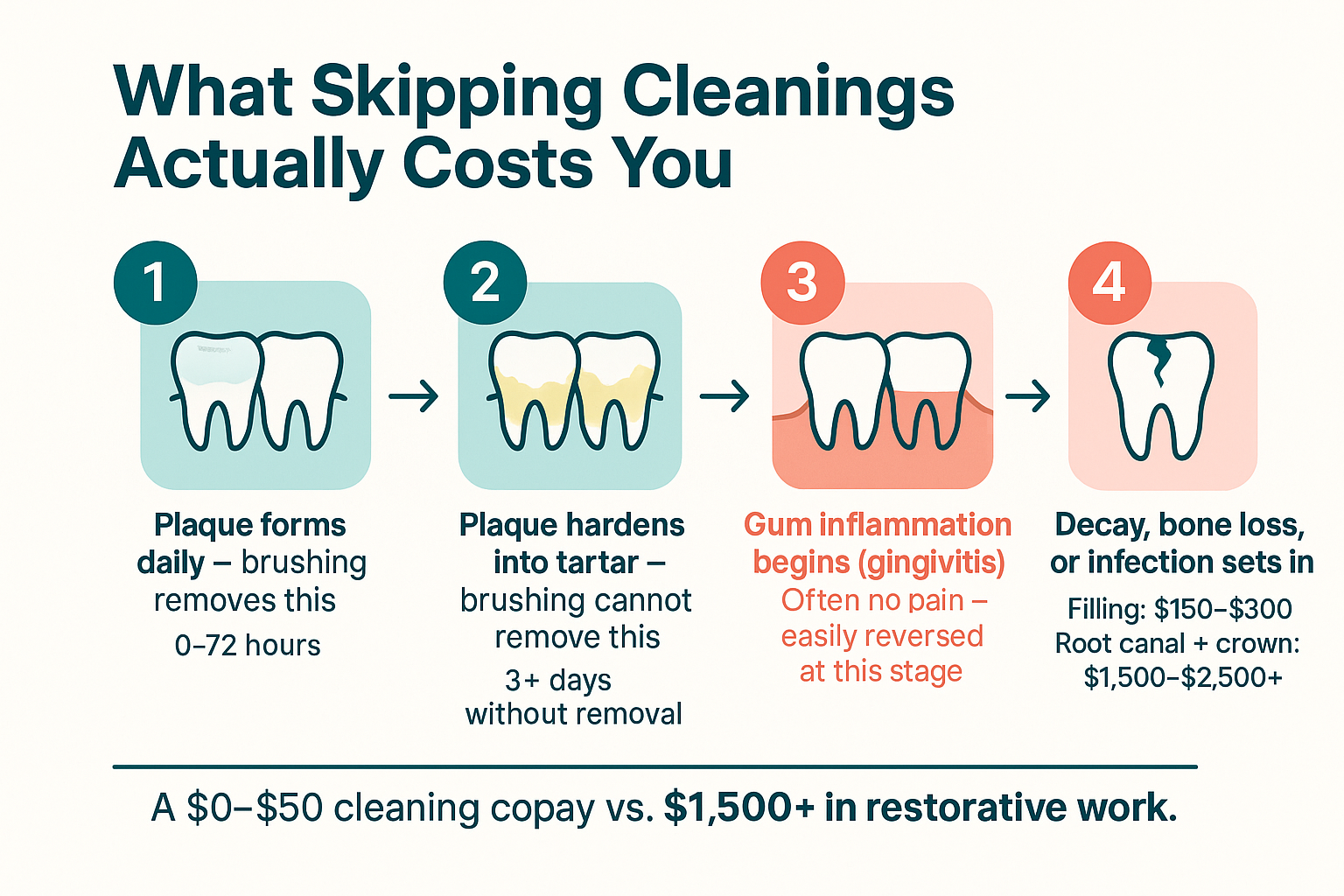
But here’s where the biology gets tricky. Plaque that isn’t removed within about 24 to 72 hours starts to mineralize — it absorbs calcium from your saliva and hardens into tartar, also called calculus. Once that happens, it bonds to the tooth surface. No amount of brushing will touch it.
Tartar tends to build up fastest in spots that are already hard to clean:
- Behind the lower front teeth, where salivary glands sit nearby
- Along the gumline on the back molars
- Between teeth where floss doesn’t always reach the base
- Below the visible gumline, in the pocket between tooth and gum tissue
A hygienist uses a scaler — a small metal instrument — to physically break that calcified deposit off the tooth surface. Some offices also use an ultrasonic scaler that vibrates at a frequency high enough to shatter tartar without damaging enamel. Neither of those tools is something you can replicate at home, and they’re not something you’d want to try.
What the Exam Catches That You Would Miss Entirely
Cleanings and exams are scheduled together for a reason. The cleaning removes the buildup so Dr. Kalvin can actually see what’s happening on the tooth surface underneath. And what he often finds are problems that have no symptoms yet — which is exactly when they’re cheapest and easiest to fix.
Cavities in early stages don’t hurt. Most people don’t feel anything until a cavity has worked its way deeper into the tooth, closer to the nerve. At that point, a simple filling becomes a root canal conversation. In Huntington Beach and across Orange County, a filling typically costs between $150 and $300 out of pocket. A root canal runs $900 to $1,500 or more before the crown.
The other thing that goes undetected without regular visits is gum disease. About half of adults over 30 have some form of it, and most have no idea. Early gum disease — called gingivitis — shows up as slight bleeding or puffiness that a lot of people chalk up to brushing too hard. Left alone, it progresses to periodontitis, which involves bone loss and can eventually lead to tooth loss.
If you’ve ever wondered why your gums bleed during a cleaning, that’s often the first visible sign that inflammation is already underway — not a sign that the hygienist is being too rough.
Digital X-rays at the exam add another layer. They show bone levels, decay between teeth that isn’t visible on the surface, and any changes from one visit to the next. Our office uses CBCT digital imaging, which gives Dr. Kalvin a far more detailed picture than traditional film X-rays ever could.
What Happens to Your Teeth When You Skip Cleanings
This timeline shows how dental problems typically progress when professional cleanings are skipped — and what that costs at each stage.
Cleaning vs. Skipping: What the Cost Difference Looks Like
These are real cost ranges for common dental procedures in the Huntington Beach and Orange County area, comparing what a twice-yearly cleaning catches versus what gets missed.
| Caught at a Cleaning | Typical Cost to Fix Early | Cost If Left Untreated |
|---|---|---|
| Small cavity (early enamel decay) | $150–$300 (filling) | $900–$1,500+ (root canal) |
| Gingivitis (early gum inflammation) | $0–$50 copay (cleaning) | $500–$4,000 (deep cleaning or periodontal treatment) |
| Cracked tooth (hairline, no symptoms) | $300–$700 (crown) | $1,500–$3,000+ (extraction + implant) |
| Tartar buildup (routine removal) | Included in cleaning visit | Accelerates bone loss over time |
How Often You Actually Need to Come In
The standard recommendation of twice a year — every six months — works well for most adults with generally healthy teeth and gums. But that’s a starting point, not a rule that applies to everyone the same way.
Some patients need to come in every three to four months. This includes people who:
- Have a history of gum disease or bone loss
- Build tartar unusually fast (some people just do, genetically)
- Have diabetes, which affects gum healing
- Smoke or use tobacco products
- Wear braces or have crowded teeth that trap debris more easily
On the flip side, patients with very stable gum health and low cavity risk sometimes maintain well on an annual schedule — though that’s a conversation to have with Dr. Kalvin after an exam, not an assumption to make on your own.
For families in neighborhoods like Goldenwest or Bolsa Chica-Heil with kids in school, the twice-yearly schedule lines up well with summer break and the winter holidays — two natural windows to get the whole family in without disrupting the school year. Family dentistry for all ages means you can do it all in one place rather than coordinating between separate practices.
If You Don’t Have Insurance, Here’s What to Know
One of the most common reasons people skip cleanings isn’t laziness — it’s cost. Dental insurance in Orange County often has a $1,000 to $1,500 annual maximum, and a lot of working adults either have no coverage at all or have plans with high deductibles that make them feel like insurance is barely worth it.
For uninsured patients, a cleaning and exam in the Huntington Beach area typically runs anywhere from $150 to $300 without a plan. That’s a real number, and we understand it’s not nothing.
Our in-house savings plan is built for exactly this situation. It covers cleanings, exams, and X-rays for an annual fee, and members get reduced rates on any restorative or cosmetic work they need during the year. It’s not insurance — it’s a straightforward way to make preventive care affordable without the paperwork.
If you’re comparing what different offices charge and wondering whether cheaper always means a better deal, the short answer is that it depends on what you’re actually getting. A cleaning that skips the full exam or uses outdated X-ray equipment isn’t saving you money if it misses something that costs $1,500 to fix six months later.
Frequently Asked Questions About Dental Cleanings
Does a cleaning hurt? I’ve avoided going because I’m nervous about the scraping.
For most patients with generally healthy gums, a cleaning is uncomfortable at most — not painful. The scraping sensation from the scaler is the part people dread, but it usually feels like light pressure rather than pain. If you have sensitive gums or significant buildup, there can be some tenderness, and we can adjust how we work. We also offer neck pillows and blankets to help you feel settled, and if you’re genuinely anxious, just tell us before we start — Dr. Kalvin’s team takes that seriously and won’t rush you.
How long does a typical cleaning take?
A routine cleaning and exam together usually take about 45 to 60 minutes. If it’s been more than a year since your last visit or there’s significant buildup, plan for a little longer. Patients who come in consistently every six months tend to have shorter appointments because there’s less to remove each time.
My teeth look fine and nothing hurts. Do I really need to come in?
Yes, and that’s actually the best time to come in. Cavities and early gum disease are both symptom-free for a long stretch — by the time something hurts, the problem is usually well past the easy-fix stage. An exam when everything feels fine is how you keep it that way.
Is there anything I can do between visits to slow down tartar buildup?
A few things genuinely help. Brushing for a full two minutes twice a day and flossing daily cuts down on the plaque that eventually hardens. An electric toothbrush removes more plaque per stroke than a manual one. And staying hydrated keeps saliva flowing, which naturally rinses the mouth throughout the day. But none of that prevents tartar entirely — it just slows the rate at which it forms.
Can my kids get their teeth cleaned at the same practice where I go?
Yes. We see patients of all ages, from young children through adults, so families in Huntington Beach and Oak View don’t need to split between a pediatric office and an adult practice. Seeing all ages under one roof makes scheduling a lot simpler and means we know your whole family’s dental history.
What if I haven’t been to the dentist in several years?
We see this regularly and it’s more common than you’d think. The first visit after a long gap is mostly about finding out where things stand — no judgment, no lecture. We’ll take X-rays, do a full exam, and clean what we can. If there’s significant buildup or early gum disease, we may recommend a deep cleaning (scaling and root planing) before returning to a regular maintenance schedule. Either way, coming in now is always better than waiting longer.
Ready to Get Back on Track?
Whether it’s been six months or six years since your last cleaning, the best move is just to come in and find out where things stand. Kali Dental serves families and individuals throughout Huntington Beach and the surrounding Orange County communities, with an in-house savings plan for patients without insurance and same-week appointments for most new patients. Call us at (657) 800-5254 or book online at kalidental.com — Dr. Kalvin and our team will take it from there.