
Direct Answer: Brushing removes soft plaque, but hardened tartar can only be removed with professional tools. Cleanings also catch early problems — cavities, gum disease, cracked teeth — before they become expensive.
A lot of people in Huntington Beach — especially busy parents in Oak View or working adults commuting up the 405 — feel like they’re doing everything right. They brush in the morning, brush before bed, maybe floss when they remember. So when someone tells them they still need to come in twice a year, it feels a little unnecessary.
But here’s what most people don’t know: brushing and professional cleanings do two completely different jobs. One maintains what you already have. The other catches what you can’t see and removes what you physically cannot clean at home — no matter how good your technique is.
This article breaks down exactly why cleanings matter even when your home routine is solid, what actually happens during one, and what skipping them tends to cost patients down the road.
What Brushing Actually Does — And Where It Stops
Your toothbrush is good at one thing: removing soft plaque from the surfaces of your teeth. Plaque is that thin, sticky film that forms within hours of eating. Brush it off regularly, and it never gets a chance to cause damage.
The problem is that plaque hardens. When it sits long enough — usually 24 to 72 hours — it mineralizes into tartar, also called calculus. Once that happens, no amount of brushing or flossing will touch it. It’s bonded to the tooth surface like concrete, and it can only be removed with the metal scalers and ultrasonic tools that hygienists use.
Tartar is also porous and rough, which means it attracts even more bacteria. Left alone, it builds up at and below the gumline — exactly where gum disease starts.
Most people have some tartar buildup even with a great home routine. The spots that accumulate fastest are usually:
- Behind the lower front teeth, where saliva glands are located
- Around the back molars, which are harder to reach
- Just below the gumline, where a toothbrush bristle can’t go
A cleaning removes all of it. Your brush, no matter how good, simply cannot.
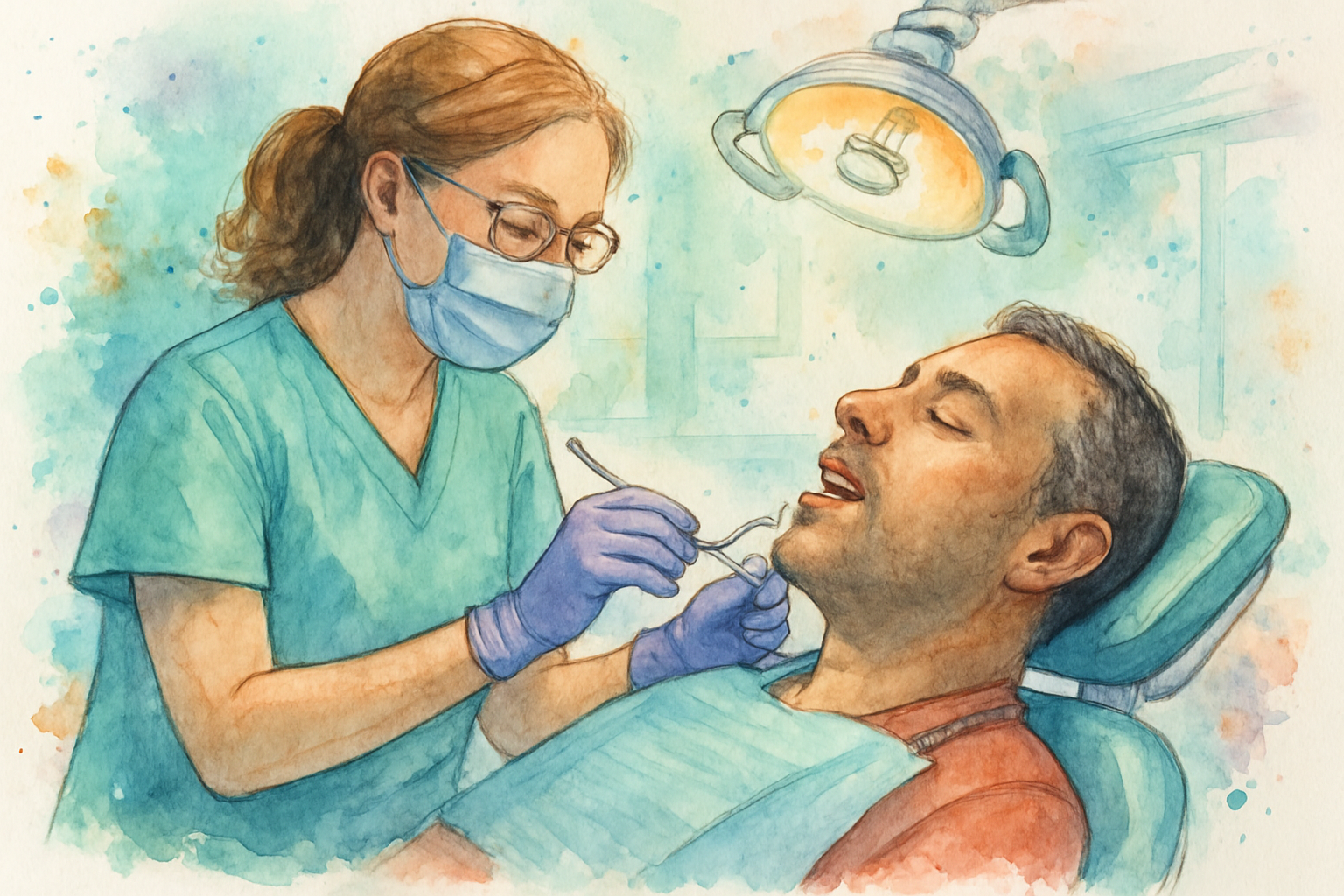
The Real Value of a Cleaning: What the Exam Finds
The cleaning itself is only part of what happens at a twice-yearly appointment. What matters just as much is the exam and X-rays that come with it — because that’s where problems get caught early, when they’re still small and cheap to fix.
Dr. Kalvin checks for things that have no symptoms yet. Cavities between teeth don’t hurt until they’re deep. Gum disease doesn’t hurt at all in its early stages — most people who have it don’t know. A cracked tooth can look fine until it splits under pressure.
Here’s what a routine exam typically screens for:
- Early-stage cavities — caught here, a filling costs around $150–$300; missed until later, a root canal and crown can run $2,000–$3,500 in Orange County
- Gingivitis and early gum disease — reversible when caught early; much harder and more expensive to treat once bone loss starts
- Bite and wear patterns — grinding, clenching, and misalignment show up in the enamel before you feel it
- Changes in existing restorations — old fillings crack, crowns loosen, and early failure is fixable; late failure often means replacement
Skipping a cleaning doesn’t just mean skipping a polish. It means going 12 to 24 months without anyone looking at what’s actually happening in your mouth — and a lot can change in that time.
For families with kids in Huntington Beach’s schools, back-to-school season is actually one of the best times to schedule everyone’s exams before fall sports start and schedules get tight. Staying consistent with dental cleanings and exams is one of the most cost-effective things a family can do for long-term oral health.
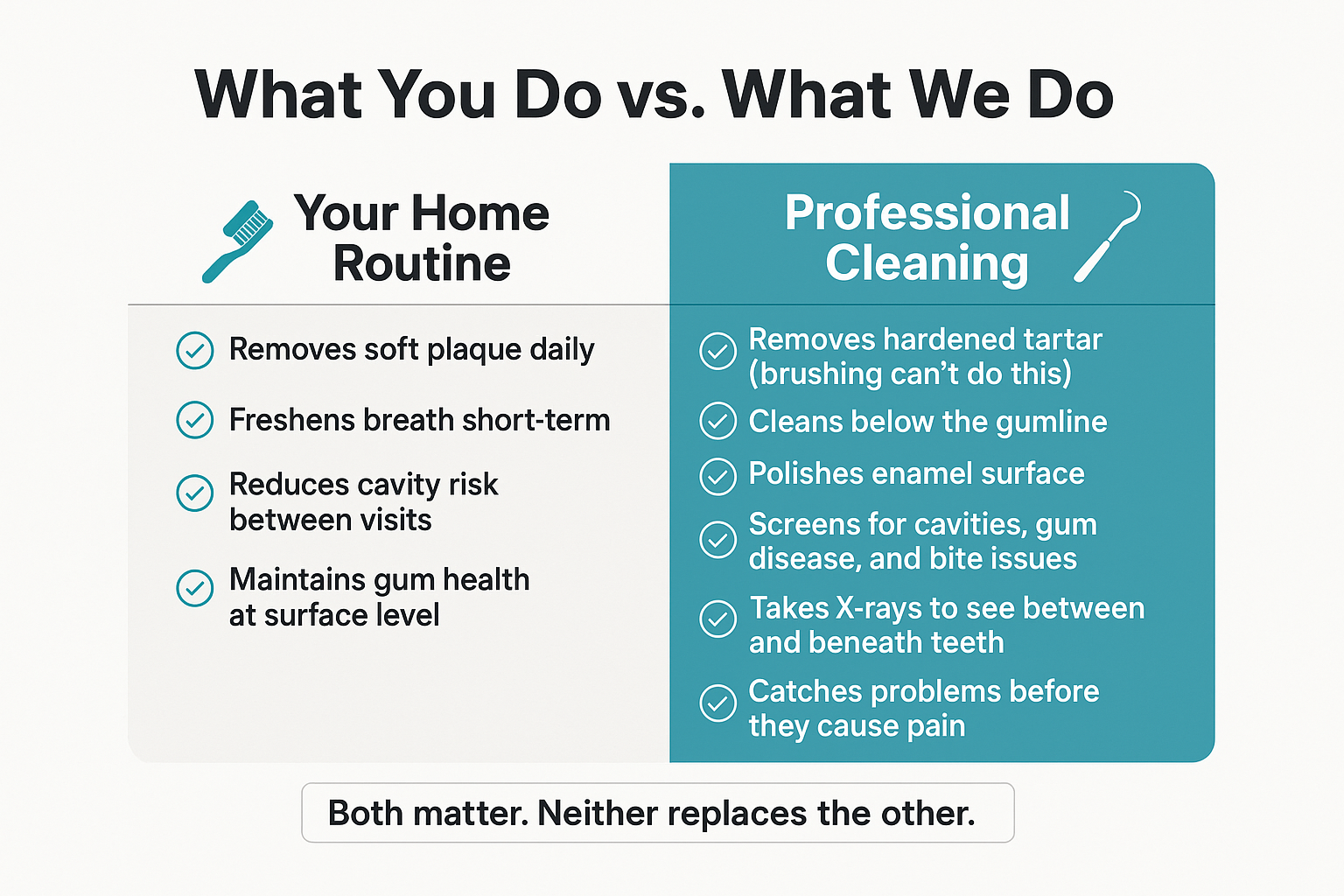
What Happens at a Professional Cleaning vs. What Brushing Covers
This infographic breaks down the difference between what your home routine handles and what a professional cleaning addresses — side by side.
What About Patients Without Insurance? Here’s What Cleanings Actually Cost
One of the most common reasons patients in Huntington Beach skip cleanings is cost — especially adults without dental insurance. And that’s a real concern worth addressing honestly.
A routine cleaning and exam in the Huntington Beach and Fountain Valley area typically runs $150–$250 out of pocket at an independent practice. At corporate dental chains, the base price might look lower, but add-on charges often push the total higher once X-rays and exams are included.
For patients without insurance, understanding what’s included in a cleaning visit — and what the real cost of skipping looks like — changes the math completely.
Our in-house savings plan at Kali Dental is built specifically for uninsured patients. For a flat annual fee, it covers preventive care — including cleanings and X-rays — and reduces the cost of any additional treatment needed. For a family of four in Oak View or Bolsa Chica-Heil, that kind of predictable cost structure makes it much easier to stay consistent.
The math is pretty simple:
- 2 cleanings per year at ~$200 each = $400
- One untreated cavity that becomes a root canal = $1,500–$3,500
- Early gum disease treatment (scaling and root planing) = $800–$1,600 per quadrant
Prevention is not the cheaper option just because it sounds like good advice. The numbers actually back it up. Patients who skip cleanings for cost reasons often end up spending significantly more within two to three years.
Cost Comparison: Preventive Care vs. Treating What Gets Missed
These are typical price ranges for Orange County patients. Catching problems early almost always means simpler, less expensive treatment.
| Situation | Caught Early | Treated Late |
|---|---|---|
| Small cavity between teeth | $150–$300 filling | $1,500–$3,500 root canal + crown |
| Early gingivitis | $0 — addressed at cleaning | $800–$1,600 per quadrant (deep cleaning) |
| Cracked tooth (minor) | $300–$600 bonding or crown | $2,000+ extraction + implant or bridge |
| Gum recession (early) | Monitored, no treatment yet | $1,000–$3,000 grafting procedure |
| Routine cleaning (preventive) | $150–$250 per visit | N/A — this is the prevention |
Frequently Asked Questions About Dental Cleanings
How often do I actually need a cleaning if my teeth feel fine?
Twice a year is the standard recommendation for most adults, and it holds up even when your teeth feel great. The whole point is that most dental problems — early cavities, gum disease, cracked teeth — don’t cause symptoms until they’re already significant. Feeling fine is not the same as being fine. Some patients with a history of gum disease may need cleanings every three to four months instead of every six.
My gums bleed when the hygienist cleans them. Is that normal?
Bleeding during a cleaning usually means there’s some inflammation in the gum tissue — most commonly early gingivitis. It’s common, and it’s not a reason to avoid cleanings. In fact, consistent cleanings are usually what resolves it. If your gums bleed regularly when you brush at home too, mention it at your next visit so we can take a closer look.
I haven’t been to the dentist in a few years. Is a regular cleaning enough, or do I need something different?
If it’s been more than two or three years, you may need a deep cleaning (scaling and root planing) rather than a standard prophylaxis cleaning — especially if there’s significant tartar buildup below the gumline. Dr. Kalvin will check for gum pocket depth during your exam and let you know what’s actually needed. No one will pressure you — it’s just about doing what the situation actually calls for.
Do kids need professional cleanings too, or is brushing enough for them?
Kids need cleanings just as much as adults — and in some ways more, because their brushing technique is still developing. Baby teeth can get cavities quickly, and catching early decay before it reaches the permanent teeth underneath matters a lot. For most kids, cleanings every six months starting around age one is the recommendation. Pediatric dental visits also build the habit and comfort level that carries into adulthood.
What if I don’t have insurance — can I still afford to come in regularly?
Yes. Our in-house savings plan covers preventive care for an annual flat fee, which makes cleanings and X-rays predictable and affordable without needing insurance. It’s designed specifically for uninsured patients who want consistent care without surprise bills. Call us at (657) 800-5254 and we can explain exactly what’s included before you commit to anything.
Ready to Get Back on Track with Your Preventive Care?
Whether you’re a Huntington Beach local who’s been meaning to come in for a while, or a Fountain Valley family looking for a practice that won’t make you feel judged for the gap — we’re here without the lecture. Kali Dental’s team makes routine cleanings genuinely comfortable, from the neck pillows to the in-room TVs to Dr. Kalvin’s no-pressure approach. Call us at (657) 800-5254 or book your appointment online at kalidental.com — and let’s take care of what brushing alone can’t.