
Direct Answer: A child’s first dental visit should happen by age 1, or within six months of the first tooth. It’s a short, gentle exam of the gums and teeth, plus fluoride and parent questions.
Most parents I meet in Huntington Beach bring their child in for the first time somewhere around age 3 or 4. Usually it’s because a preschool form asked for it, or they spotted a dark spot on a molar and got worried.
By then, a lot of first-visit anxiety has already built up. The child has heard the word “dentist” in the same sentence as “be brave,” and now the whole thing feels like a test they might fail.
I want to walk you through what a first visit at ages 1 to 3 actually looks like, why the timing matters more than people think, and what you can say at home in the days before. One parent left us a review after bringing her 3-year-old in for his very first appointment and wrote that he “had the best time and left excited about coming back.” That’s the goal, and it’s very doable.
When Should a Child Have Their First Dental Visit?
The recommendation is earlier than most families expect. The American Academy of Pediatric Dentistry advises a first visit by age 1, or within six months of the first tooth breaking through.
That’s often a 12-month-old with four front teeth. And no, we are not doing much dentistry on that child. We’re looking, teaching, and building a habit.
Here’s what an early first visit is really buying you:
- A baseline record of how the teeth and bite are coming in
- Early catch of baby bottle tooth decay, which shows up as chalky white or brown lines near the gumline on the top front teeth
- Real answers on pacifiers, thumb-sucking, teething, and juice cups
- A child who thinks a dental office is a normal, boring place
That last one is the sleeper benefit. A kid from Oak View or Central Huntington Beach who has been in the chair four times by age 3 doesn’t need to be talked into it at age 7. We’re a family practice that sees every age under one roof, and the kids who started early are almost always the easiest teenagers to treat later.
What Actually Happens at a Toddler’s First Appointment
Parents picture drills, needles, and a lecture. None of that is on the table for a healthy 2-year-old.
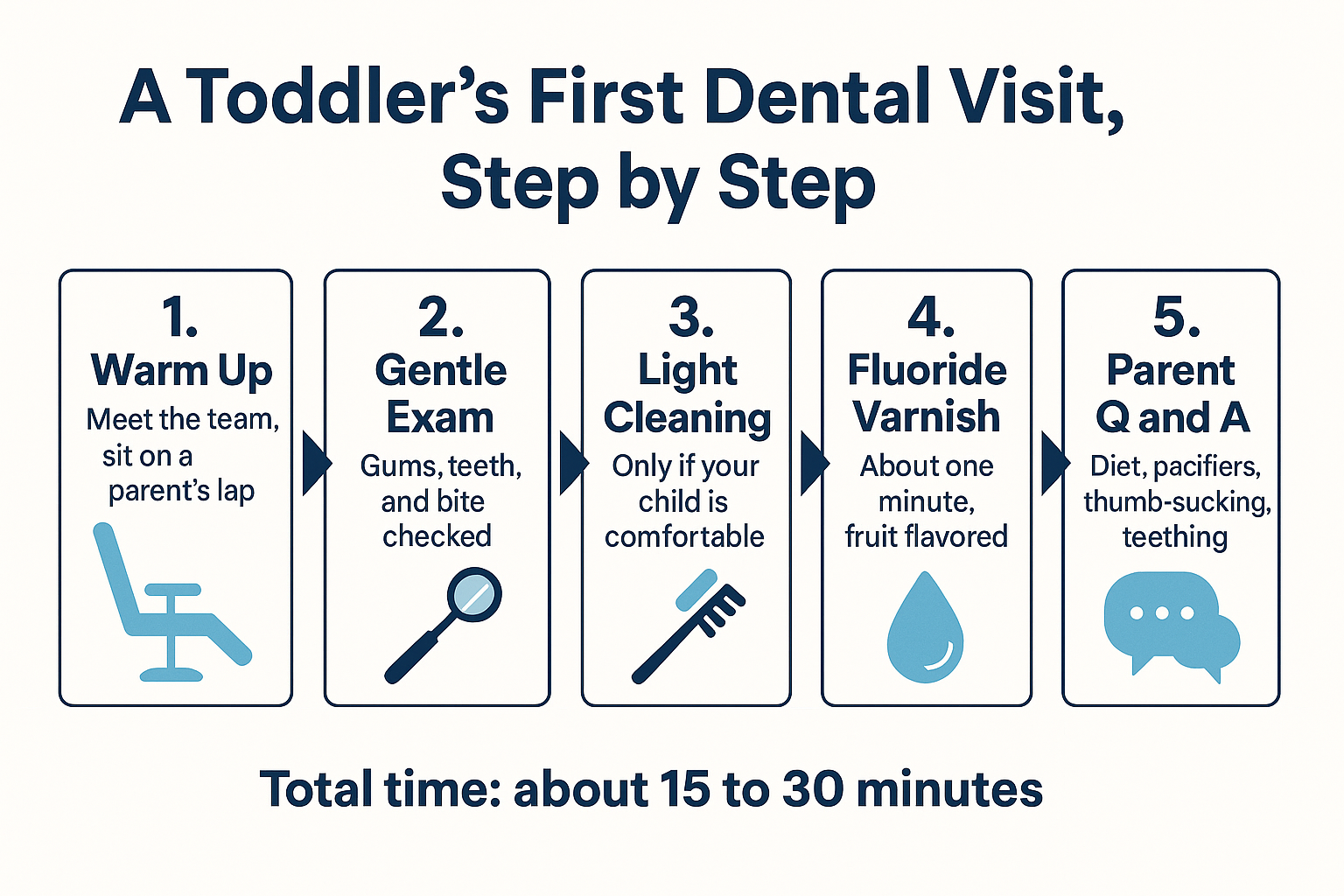
A typical first visit runs 15 to 30 minutes and looks like this:
- A quick chat while your child gets used to the room and the chair
- A gentle look at the gums, the teeth that have come in, and how the bite lines up
- A soft polish or wipe-down if your child is cooperating that day
- A fluoride varnish painted on, which takes about a minute and tastes like fruit
- Ten minutes of your questions, answered plainly
X-rays usually are not part of a first toddler visit. We take them when there’s a reason, like teeth touching tightly enough that we can’t see between them.
Your child can sit on your lap the whole time. That’s not a special accommodation, it’s how a lot of these visits go. Blankets, neck pillows, and a TV on the ceiling exist for exactly this reason, and they work just as well on a 3-year-old as they do on an adult with dental anxiety.
What the Visit Looks Like at Each Age
The same appointment changes shape a lot between the first birthday and the third. Here’s roughly how it shifts.
| Age | What we’re mainly doing | What parents usually ask |
|---|---|---|
| 12-18 months | Quick lap exam, gum and tooth check, fluoride varnish, brushing demo | Teething pain, night bottles, when to stop the pacifier |
| 18-24 months | Full look at erupting molars, early decay check, fluoride | How much toothpaste, thumb-sucking, first snacks and juice |
| 2-3 years | Exam plus a gentle cleaning if the child allows it, fluoride, sealant discussion later on | Grinding at night, spacing and gaps, what a cavity would mean at this age |
The First Visit, Step by Step
A simple look at how a toddler appointment moves from the waiting room to the door.
How You Talk About It at Home Changes the Whole Visit
This is the part I wish more parents knew. The words you use in the two days before the appointment matter more than anything we do in the room.
Two well-meaning phrases backfire almost every time:
- “It won’t hurt.” Your child had not considered hurt until you said it.
- “Be brave.” Bravery is for scary things, so now this is a scary thing.
What works better is boring, factual framing:
- “The dentist is going to count your teeth and make sure they’re all healthy.”
- “They’ll take a picture of your smile and give your teeth a shiny coat.”
- “You can sit on my lap the whole time.”
A library book about a dentist visit helps. So does bringing a stuffed animal or a blanket from home, which nobody on our team will think twice about.
One more thing: if you have your own dental fear, try not to narrate it. Kids read tone before they read words.
Baby Teeth Are Not Just Placeholders
I hear a version of this every month. “They’re going to fall out anyway, so does a cavity really matter?”
It does, and the reason is structural. Baby teeth hold the space for the permanent teeth forming in the jaw underneath them.
When a baby molar gets infected or comes out years too early, the neighboring teeth drift into the gap. The permanent tooth then has nowhere clean to come in, so it erupts crooked or gets blocked.
That’s the crowding that turns into an orthodontic conversation at age 11. Protecting a baby tooth is really protecting the adult tooth sitting under it.
Decay in very young kids also moves faster than it does in adults, because the enamel on baby teeth is thinner. A spot that looks minor in March can reach the nerve by summer. That’s a big part of why preventive care costs so much less than the alternative.
The Best Time of Year to Get on the Schedule
Timing is practical, not urgent. Two windows work best for Huntington Beach families.
June and July are the easiest. School routines are loose, there’s no 2:30 pickup at Eader or Peterson to plan around, and morning slots are wide open before the beach afternoon.
August is the other smart window. A visit before the first day of school means your child starts the year with a clean bill of dental health, and any follow-up is handled before homework and soccer eat your evenings. We wrote more about why summer works so well for kids’ exams if you want the longer version.
We’re on Brookhurst near the Fountain Valley line, closed Thursdays, with Saturday morning slots from 8am to 2pm by appointment. Families from Bolsa Chica-Heil, Huntington Harbour, and Goldenwest tend to grab those Saturday times first, so the fall rush fills them fast.
Frequently Asked Questions About a Child’s First Dental Visit
What if my toddler cries the entire time?
Then they cry, and we still get useful information. A crying child has an open mouth, which honestly makes the exam easier. We don’t force anything, and a short partial visit that ends on a good note is worth far more than a long one that ends badly.
How much does a first visit for a child cost?
It depends on what the visit includes and whether X-rays are needed, so the honest answer is to call for an exact number. Our new patient exam and X-rays are listed at $150, and for families without insurance we run an in-house savings plan instead of pushing you toward coverage you don’t have. Here’s more on staying ahead of dental problems without insurance.
Do you take X-rays on a 2-year-old?
Usually not at a first visit. We take them when there’s a specific reason, like teeth sitting tightly together where decay can hide, or a visible problem we need to see under. If we recommend one, we’ll tell you exactly why before we do it.
Can I stay in the room with my child?
Yes. For toddlers we often prefer it, and lap exams are completely normal at this age.
How often should they come back after the first visit?
Every six months for most kids, same as adults. If we see early decay risk or a habit worth watching, we may suggest a three or four month check for a while, then space it back out.
Thinking About Your Child’s First Visit?
If your little one has teeth and hasn’t been seen yet, there’s no wrong time to start. Our team sees toddlers from all over Huntington Beach, Fountain Valley, and Orange County, and we keep first visits short, calm, and free of pressure. You can reach us at (657) 800-5254 or book online at kalidental.com whenever you’re ready.