
Quick Answer
Cross bite correction treats teeth that close in the wrong position, so the upper and lower teeth fit together more normally. In children, early treatment often uses expansion or braces while the jaw is still developing. In adults, treatment may involve braces or clear aligners, and long-term success depends heavily on wearing retainers as directed.
If you’re looking at your child’s bite and something seems “off,” or you’ve noticed your own teeth hitting unevenly, you’re not overreacting. Cross bite correction can protect chewing, comfort, and long-term tooth wear, and the first step is identifying what kind of bite problem is present.
Parents and adult patients often worry that treatment will be complicated or intimidating. In most cases, it starts with a careful exam, clear images, and a straightforward conversation about what’s going on.
What Is a Crossbite Understanding Causes and Risks
A crossbite means some upper teeth sit inside the lower teeth when the mouth closes. Normally, the upper teeth should rest slightly outside the lower teeth. When that relationship flips, the bite can work against itself.
Imagine a lid that doesn’t sit properly on a box. It may still close, but the edges don’t line up the way they should, so pressure lands in the wrong places.

The two main types
Posterior crossbite affects the back teeth, with the upper molars or premolars biting too far inside the lower back teeth.
Anterior crossbite affects the front teeth. In that situation, one or more upper front teeth sit behind the lower front teeth when biting down.
Some people have one tooth involved. Others have a wider pattern that reflects a jaw-width issue, tooth-position issue, or both.
Why a crossbite happens
Crossbites can develop for different reasons. Sometimes the upper jaw is too narrow. Sometimes individual teeth erupt in the wrong position. Family traits can play a role, and childhood growth patterns matter too.
That’s why treatment isn’t one-size-fits-all. Two people can both have a crossbite but need very different solutions.
A crossbite is a position problem, but the real question is whether it’s coming from the teeth, the jaw, or both.
Why dentists take it seriously
A crossbite isn’t always obvious to a patient because people adapt. They chew a certain way, shift the jaw a little, or avoid biting with certain teeth. The problem is that adaptation can create extra strain over time.
Potential concerns can include:
- Uneven tooth wear: Teeth can rub in ways they weren’t designed to.
- Chewing discomfort: Some patients notice one side does most of the work.
- Jaw tension: A bite that forces the jaw into an awkward path can contribute to soreness.
- Gum stress: Teeth in poor alignment may be harder to keep clean and can receive pressure unevenly.
- Facial growth concerns in children: When a child repeatedly shifts the jaw to close, growth can be affected over time.
Adult treatment paths look different
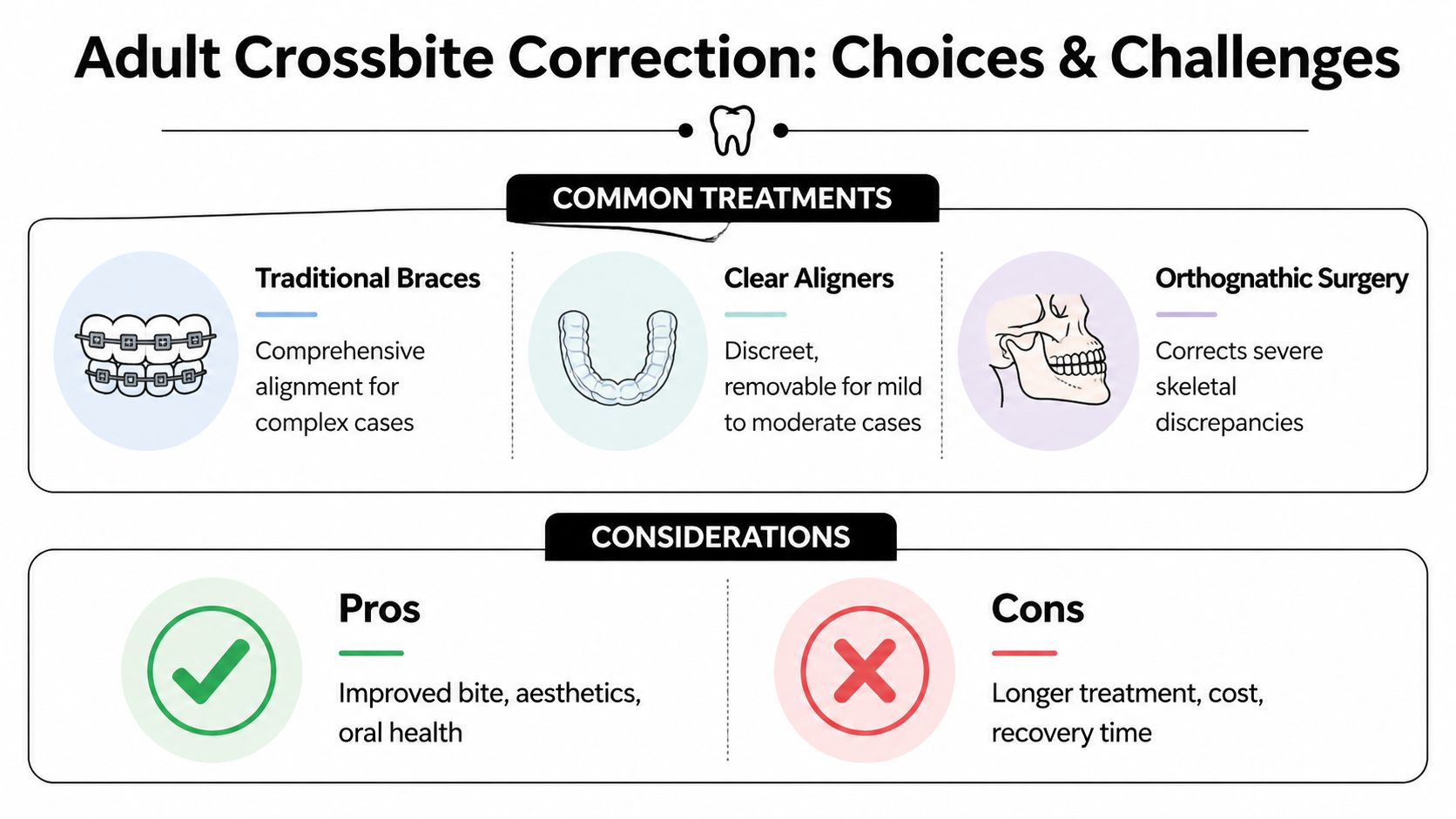
Adults often ask whether clear aligners can fix a crossbite. Sometimes yes, especially when the issue is mild to moderate and mostly dental. Braces may be a better fit for more complex tooth movement, and severe skeletal problems may require evaluation beyond non-surgical care.
It’s important to be realistic about stability. According to Invisalign information on crossbite treatment, non-surgical adult crossbite correction can relapse in up to 30% to 50% of cases if retention protocols aren’t followed. That doesn’t mean treatment isn’t worthwhile. It means the retainer phase matters just as much as the movement phase.
How We Diagnose a Crossbite at Kali Dental
A crossbite visit is often expected to be complicated. It usually isn’t. A good diagnosis starts with listening, then confirming what we see with clear records.
At a first visit, Dr. Kalvin checks how the teeth fit together, whether the jaw shifts when closing, and whether the bite problem seems limited to a few teeth or reflects a broader arch issue. He’ll also ask what you’ve noticed at home, such as uneven chewing, crowding, clenching, or jaw soreness.
What the appointment usually includes
Diagnosis may involve:
- A visual bite exam: We look at tooth contact, midlines, arch width, and wear patterns.
- Digital imaging: X-rays help us see roots, tooth position, and supporting bone.
- CBCT when needed: This gives a more complete three-dimensional view in selected cases.
- A conversation about goals: Cosmetic concerns matter, but function comes first.
If you’d like a look at the digital tools used in a modern office, this overview of digital X-rays and one-day crown technology at Kali Dental gives a helpful picture of how technology supports accurate planning.
Why diagnosis matters before talking treatment
Cross bite correction only works well when the plan matches the cause. A narrow upper jaw in a child is different from a single front tooth in crossbite. An adult with tooth tipping is different from an adult with a jaw-width mismatch.
This is also where aftercare enters the conversation. Patients often want to focus on how to move the teeth, but long-term success depends on how we hold the result afterward. Retainers are not an optional extra. They’re part of treatment.
Practical rule: If a bite was difficult to correct, it’s usually important to protect that correction carefully afterward.
Cross Bite Correction Options for Children
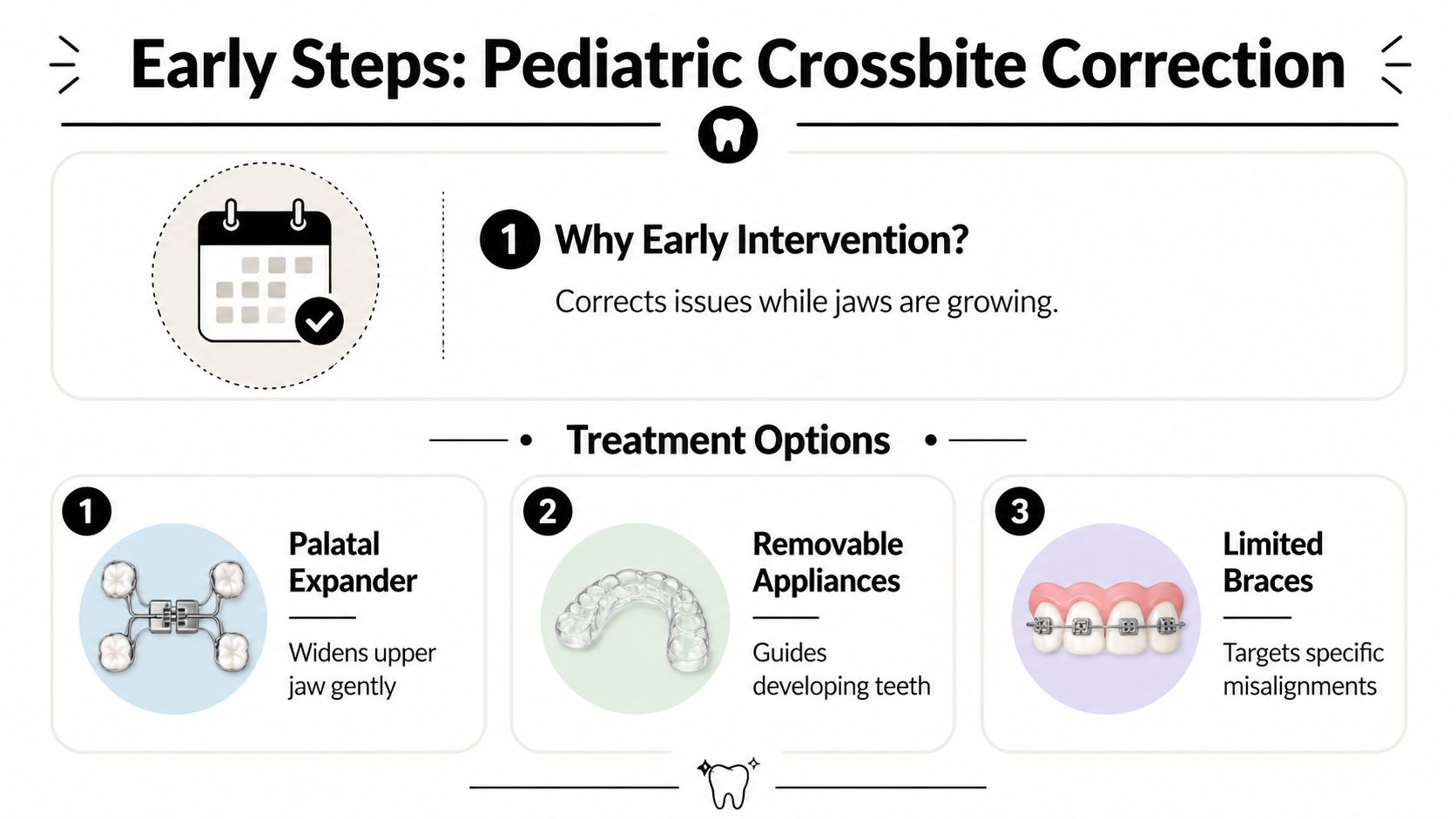
Children usually have the most flexible treatment window because their jaws are still growing. That gives us a chance to guide development rather than only react to a finished problem later.
When parents ask whether it’s worth checking early, the answer is usually yes. Even if treatment doesn’t start right away, an exam can tell you whether the bite should be monitored or addressed sooner.
Why early treatment can help
A child with a posterior crossbite may shift the jaw to one side to get the teeth to fit. Over time, that repeated shift can become a pattern. Correcting the bite early can help the mouth close in a more balanced way.
For some children, the issue is a narrow upper arch. In those cases, widening the arch can create the space needed for a healthier bite relationship.
Common options for kids
Treatment depends on the child’s age, the teeth involved, and whether the problem is skeletal or dental.
| Option | What it does | When it may help |
|---|---|---|
| Palatal expansion | Widens the upper arch | Narrow upper jaw or posterior crossbite |
| Limited braces | Moves selected teeth into better position | Single-tooth or localized bite issues |
| Monitoring | Watches growth and eruption carefully | Mild cases or timing-sensitive situations |
Some children do very well with fixed appliances because they don’t depend as much on day-to-day cooperation. That matters more than many parents expect.
What the evidence shows about fixed appliances
A strong example is the quad-helix, a fixed appliance used for certain pediatric posterior crossbites. In a review summarized in this pediatric orthodontic evidence article, the quad-helix achieved 984 per 1000 crossbite corrections compared with 763 per 1000 for observation alone, with a mean increase in final intermolar distance of 4.71 mm.
That doesn’t mean every child needs a quad-helix. It does show that fixed treatment can be very effective when expansion is the right choice.
What parents usually want to know right away
Some children adjust to an appliance quickly. Speech may sound a little different at first, and the teeth or palate can feel pressure, but kids usually adapt faster than parents expect.
A few practical points help:
- Soft foods first: Yogurt, pasta, eggs, and smoothies can make the first days easier.
- Extra brushing attention: Appliances create more places for food to hide.
- Clear instructions matter: Parents do best when they know exactly what to watch for.
- Follow-up visits protect progress: Small checks help us catch irritation or fit issues early.
Families who want ongoing care in one place often appreciate a family dentistry approach in Huntington Beach where children and adults can both be seen with the same comfort-first mindset.
Modern Cross Bite Correction for Adults
Adults often come in with a simple question: “Can this still be fixed?” In many cases, yes. The main difference is that adult treatment works with a fully developed jaw, so movement tends to be more about tooth position unless the case is severe.
That’s why adult cross bite correction starts with a careful distinction between a dental crossbite and a skeletal crossbite. If the problem is mostly how the teeth are tilted or positioned, braces or clear aligners may work well. If the upper and lower jaws themselves are mismatched, treatment planning becomes more complex.
Braces and clear aligners
Traditional braces give very precise control over tooth movement. They’re often useful when the bite is more involved or several teeth need to move in coordinated ways.
Clear aligners appeal to adults who want something less visible and removable for meals and brushing. They can be a very good option for mild to moderate cases when the bite issue is appropriate for that approach.
If you’re comparing both paths, this guide on Invisalign vs. traditional braces in Huntington Beach can help you think through the tradeoffs.
When surgery enters the conversation
Most adults hope to avoid surgery, and many can. Still, surgery may be discussed when the bite problem reflects a significant jaw discrepancy rather than only tooth alignment.
That doesn’t mean surgery is the likely answer for every adult with a crossbite. It means the diagnosis should be honest. A treatment plan should match what the teeth and jaws can do.
Five common adult questions
Will treatment hurt?
Most patients describe pressure and soreness, especially after adjustments or when changing aligners. That’s different from sharp pain. A well-managed plan should feel active, not alarming.
Do I have to wear a retainer after treatment?
Yes. This is one of the most important parts of adult cross bite correction. Teeth can drift, and adult cases are not naturally “locked in” just because treatment ended.
Are aligners enough for every adult crossbite?
No. Aligners are useful in the right case, but not every crossbite is a good aligner case. The decision depends on whether the problem is dental, skeletal, mild, moderate, or more involved.
Can I wait if it isn’t bothering me much?
Sometimes people live with a crossbite for years. That doesn’t mean it’s harmless. If the bite is causing wear, shifting the jaw, or stressing certain teeth, delay can make later treatment harder.
How often will I need visits?
That depends on the appliance and complexity. Adults with busy schedules usually want predictability, so we try to map out the visit pattern clearly at the start.
Retainers protect the result you worked for. Without them, even a well-finished case can drift.
Treatment Timelines Recovery and Long-Term Success
The question I hear most is, “How long will this take?” The honest answer is that treatment time depends on age, severity, and the method used. A single tooth in crossbite moves differently from an arch-width problem, and a child’s growing mouth behaves differently from an adult’s.
Some appliances work fairly quickly once the right diagnosis is made. For example, a Cochrane review discussed in Kevin O'Brien's summary of posterior crossbite treatment evidence found that quad-helix treatment averaged 3.15 months shorter than removable plates, with a 1.48 mm greater intermolar distance gain, and fixed appliances were more effective for correction.
What recovery feels like day to day
Recovery usually means adjustment, not downtime. Patients may notice pressure, mild tenderness when chewing, and a short learning period for brushing around an appliance or handling aligners correctly.
Adults often do best when they plan ahead for the first few days after a new appliance or aligner change. Kids usually do well with softer meals and a little reassurance.

Why long-term success depends on retention
Finishing treatment is not the same as finishing stabilization. Bone and soft tissue need time to adapt to the new tooth positions, and that’s where retainers do their job.
A 2022 meta-analysis on long-term stability of posterior crossbite correction found that approximately 19.5% of posterior crossbite corrections in growing children relapse long term. In plain language, that means nearly 1 in 5 corrected cases can show relapse over time.
That’s the reason dentists take retainers seriously. Not because we want to add one more step, but because we want the correction to last.
What helps keep the result stable
- Wear retainers exactly as prescribed: Don’t guess your own schedule.
- Keep follow-up visits: Small bite changes are easier to address early.
- Report breakage right away: A cracked or lost retainer leaves teeth unprotected.
- Stay consistent: Skipping nights repeatedly can undo progress slowly.
Patients comparing timelines often find this resource on how long Invisalign takes useful because it helps frame expectations around movement, compliance, and follow-up.
Understanding the Costs of Crossbite Treatment
Cost is one of the first questions people have, and it should be. Cross bite correction can vary widely because treatment isn’t the same from one patient to the next.
The final fee is usually shaped by the complexity of the bite, the kind of appliance used, how long treatment is expected to last, and whether care involves only tooth movement or a broader functional problem. Records and imaging also matter because accurate planning is part of good treatment.
According to the American Association of Orthodontists overview of crossbite treatment, national costs can range from $3,000 to over $10,000, and insurance may cover up to 50% in some cases. That range is exactly why an in-person consultation matters. It’s the only reliable way to understand what applies to your situation.
If you’re trying to think through insurance, financing, and how to compare treatment value, this article on comparing dental costs without insurance is a practical place to start.
Ask for a clear breakdown of what the treatment includes, what insurance may help with, and what follow-up care is part of the plan.
Frequently Asked Questions About Cross Bite Correction
How do I know if my child might have a crossbite?
You may notice upper teeth sitting inside lower teeth, a jaw shift when closing, uneven chewing, or crowding. Sometimes parents don’t spot it at all and it’s found during a routine exam. If something looks uneven, it’s worth having it checked.
Is cross bite correction painful?
Most treatment feels like pressure or soreness, not severe pain. Children and adults usually adjust within a short time after a new appliance or adjustment. Comfort improves when patients follow food and hygiene instructions closely.
Can a crossbite fix itself?
Some very minor bite issues may appear to improve as teeth erupt, but you shouldn’t assume that a true crossbite will self-correct. A dental exam helps determine whether the bite needs treatment, monitoring, or simple timing.
Will I need teeth pulled for cross bite correction?
Not always. Some crossbites are treated with expansion, braces, or aligners without extractions. The need for removal depends on space, crowding, tooth position, and the overall bite plan.
Can adults still get cross bite correction?
Yes. Adults can often improve a crossbite with braces or clear aligners, depending on the cause and severity. The key is a realistic diagnosis and strong retainer use after treatment.
How long do appointments usually take?
That depends on whether the visit is for records, appliance placement, adjustment, or a routine check. Most patients want a predictable schedule, so we try to explain the visit pattern early and keep it manageable for work and school routines.
Your Next Step to a Healthier Bite in Huntington Beach
A lot of parents and adult patients come in after staring at photos online and wondering, “Is this serious, or am I overreacting?” That uncertainty is common. Crossbite correction gets much less intimidating once someone you trust looks at your bite in person, explains what is happening, and shows you the options in plain language.
At Kali Dental, I want this to feel like a neighborhood conversation, not a rushed sales pitch. Some people need treatment soon. Some only need to watch growth or tooth eruption for a while. The goal is a clear answer that fits your life, your comfort level, and your budget. If cost is part of your decision, our guide to how to compare dental costs without insurance can help you ask better questions before you commit.
Good information helps people feel calmer. That is true in dentistry and in other areas of health care too, which is why articles about optimizing healthcare websites matter. Clear health content helps patients sort through fear, avoid guesswork, and come to appointments ready to have a real conversation.
If you live in Huntington Beach or nearby Orange County and want a local, compassionate opinion about your child’s bite or your own, we’re here to help.
If you’d like to talk through cross bite correction with Dr. Kalvin at Kali Dental, call (657) 800-5254 or visit 19201 Brookhurst Street, Suite 103, Huntington Beach, CA. Office hours are Monday to Friday 9:00 AM to 6:00 PM and Saturday 8:00 AM to 2:00 PM. You can also learn more or request a visit at kalidental.com.