
Direct Answer: Senate Bill 1311 took effect September 21, 2026. Unlicensed dental assistants can now meet California’s infection control requirement by DANB exam, a six hour virtual course, or an in-person board approved course.
If you have called around Huntington Beach looking for a cleaning and heard “our next opening is five weeks out,” staffing was probably part of the reason. Dental offices across Orange County have spent the past two years short on unlicensed dental assistants, the team members who set up your room, take your X-rays with the dentist, and keep instruments sterile.
That changed on September 21, when Governor Gavin Newsom signed Senate Bill 1311. It took effect the same day as an urgency measure, not on January 1 like most new laws.
I want to walk through what the law actually says, who it covers, and the part patients care about most: whether a virtual training option means anything different about the safety of your appointment. Short answer on that last one is no, and I will explain why.
What the California dental assistant infection control law 2026 actually changed
Before this, the rule came from SB 1453, which took effect in January 2025. It required an unlicensed dental assistant to complete an approved in-person eight hour infection control course before working around blood and saliva.
That sounds reasonable on paper. In practice, in-person seat time was hard to find, and a new hire in Fountain Valley or Central Huntington Beach could sit for weeks waiting for a class date.
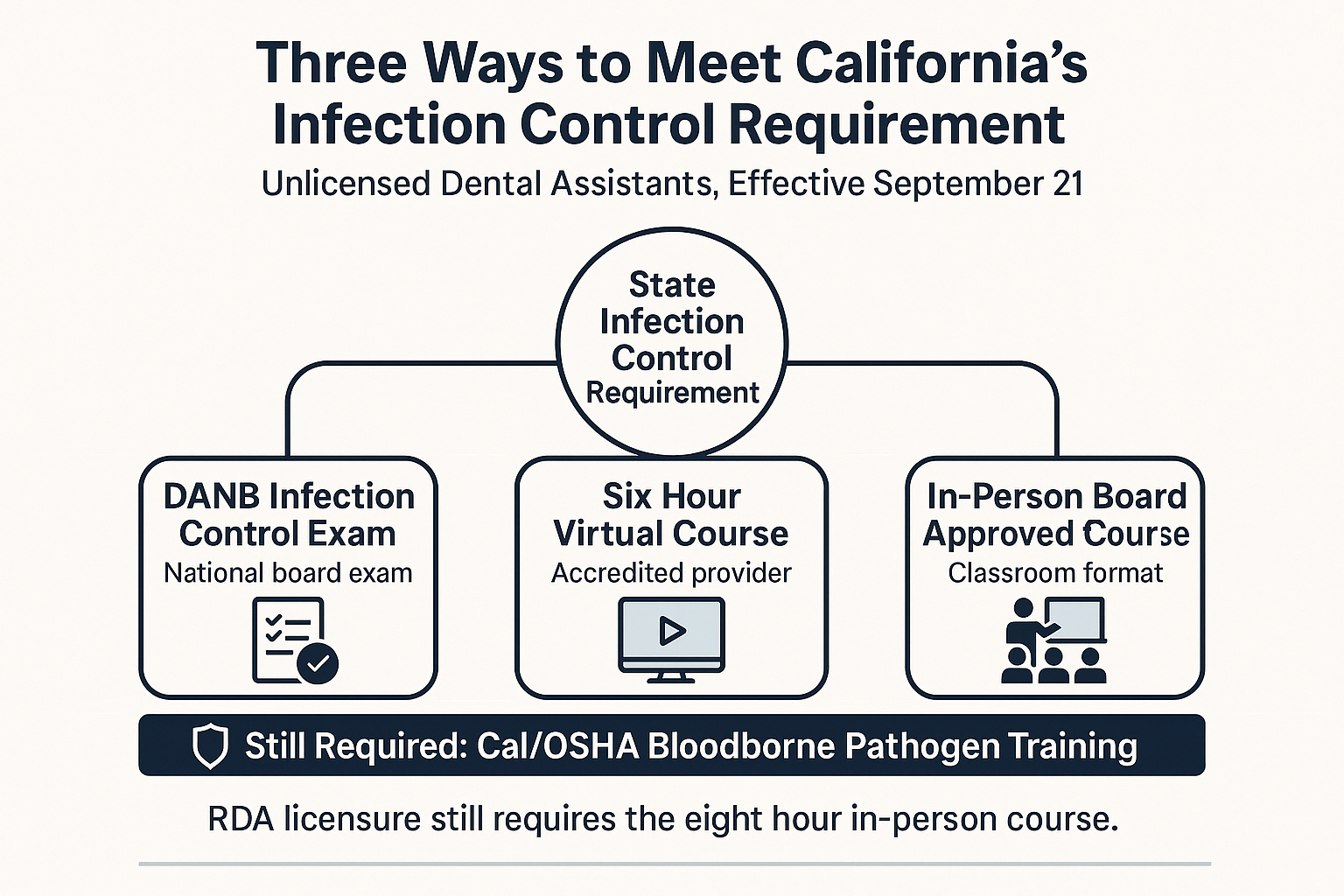
SB 1311, authored by Sen. Aisha Wahab (D-Hayward), gives three ways to meet the requirement instead of one:
- The Dental Assisting National Board infection control exam
- A six hour virtual course from an accredited provider
- An in-person board approved course
One piece did not change. The eight hour in-person course is still required for registered dental assistant (RDA) licensure. So the flexibility applies to unlicensed assistants, not to the licensing path.
You can read the California Dental Association’s summary of the signed bill if you want the legislative detail straight from the source.
Who this covers, and who it does not
This is the part that gets mixed up most often, so let me be plain about it.
The law applies to unlicensed dental assistants who are not enrolled in a board-approved registered dental assisting program or an alternative dental assisting program. That is the person who seats you, suctions, and preps the room.
It does not change training rules for:
- Dentists, who hold a separate state license with their own continuing education requirements
- Registered dental hygienists, who are licensed separately and do your scaling and polishing
- Registered dental assistants, who still need the eight hour in-person course to get licensed
And it does not touch Cal/OSHA bloodborne pathogen training, which is a workplace safety requirement every dental employee in California has to complete and repeat. Infection control certification and Cal/OSHA training are two separate boxes. Both still get checked.
So if you are sitting in a chair on Brookhurst Street, the mix of licenses in the room is the same as it was in August. What changed is how fast an office can get a new assistant trained and onto the floor.
Before September 21 vs. after: a side by side
Here is the short version of what moved and what stayed put.
| Requirement | Before Sept 21 | On and after Sept 21 |
|---|---|---|
| Unlicensed dental assistant, infection control | Approved in-person eight hour course (SB 1453, effective January 2025) | DANB infection control exam, a six hour virtual course from an accredited provider, or an in-person board approved course |
| Virtual training allowed | No | Yes, six hour accredited course |
| Registered dental assistant licensure | Eight hour in-person course | Eight hour in-person course, unchanged |
| Cal/OSHA bloodborne pathogen training | Required for dental employees | Required for dental employees, unchanged |
| Effective date | January 2025 | September 21, took effect immediately |
The three approved pathways at a glance
Three routes now satisfy the same state requirement for unlicensed dental assistants.
What this means for getting an appointment in Huntington Beach
Staffing is the hidden reason behind a lot of scheduling pain. An office can have open chairs and still not be able to run them without enough trained assistants.
When a practice can bring an assistant up to speed in days instead of waiting on a classroom date, a few things usually follow:
- Shorter waits for routine cleanings and exams, which matters most in the August back-to-school rush and the December benefits crunch
- More room for same-day problems, like a crown that popped off or a tooth that cracked on a Saturday morning after club soccer
- Better odds that Saturday slots stay open, which is the only window a lot of working parents in Oak View and Bolsa Chica-Heil actually have
One of our reviewers put it simply after a crown came loose: “They got me in an hour, glued it back in and listened to and honored my dentist fears with kindness.” That kind of turnaround takes a full team in the building, not just a dentist.
If weekends are your only option, this piece on what a single Saturday dental visit can realistically cover is worth a read before you book.
Does a virtual course mean less safety in the room?
This is the question I would ask too, so I will answer it directly. The state did not lower the standard. It added formats for meeting the same one.
Think about what infection control training is actually teaching: how pathogens spread, how to handle sharps, how to process instruments, how to set and break down barriers, when to change gloves. That content works fine on a screen. The hands-on part has always happened in the office anyway, under the supervision of the dentist and the senior team.
On top of the state requirement, every dental employee in California still has Cal/OSHA bloodborne pathogen training, which covers exposure control plans, sharps handling, and post-exposure procedures.
In our operatories, the things you can actually see have not changed:
- Instruments come out of a sealed sterilization pouch at the chair, not from an open drawer
- Surfaces get barriers or wipe-down between every patient
- Gloves and masks change for each person, every time
- The autoclave gets spore tested on a regular schedule, not just visually checked
If you are anxious about dental visits, you are allowed to ask how any of this works. Patients do, and we would rather answer than have you sit there wondering. Our guide on what to tell your dentist before you sit down covers how to start that conversation.
Does this change what you pay?
Not directly. SB 1311 is a workforce and training law. It does not set fees, insurance rules, or what shows up on your treatment plan.
The one indirect effect worth mentioning is staffing cost. Training that used to require eight hours of in-person seat time plus travel is cheaper to deliver virtually, and labor costs feed into fee schedules over time. I would not promise anyone a lower bill because of it.
What actually protects you from a surprise is asking for a written estimate before treatment starts, every time, at any office. One patient wrote that we “showed me exactly how it was broken up,” and that is the standard you should hold any practice to. Our walkthrough on what to ask before treatment starts lists the exact questions.
For context on our own posted pricing, a new patient exam with X-rays is listed at $150, and we keep an in-house savings plan for patients without insurance. Costs for anything beyond that depend on what the exam finds, so call for a real number rather than guessing from a blog post.
Frequently Asked Questions About the 2026 Infection Control Law
When exactly did this take effect?
September 21, the day it was signed. SB 1311 passed as an urgency measure, so it did not wait for the usual January 1 start date.
Does my dental assistant have less training now?
No. The requirement is the same, the formats are just broader. An unlicensed assistant has to pass the DANB infection control exam, finish a six hour virtual course from an accredited provider, or complete an in-person board approved course, and they still need Cal/OSHA bloodborne pathogen training on top of that.
Does this apply to hygienists and dentists too?
It does not. Dentists and registered dental hygienists hold separate state licenses with their own requirements. This law is about unlicensed dental assistants who are not enrolled in a board-approved RDA program or an alternative dental assisting program.
Can I ask who is working on my teeth and what training they have?
Yes, and you should feel fine doing it. Any office worth going to will tell you who is licensed, who is assisting, and what the dentist is doing personally. If a question like that gets brushed off, that tells you something.
Will this actually shorten my wait for an appointment?
It helps, but it is not magic. Offices still have to recruit, hire, and train people. What it removes is the weeks of dead time waiting for a classroom seat, which was a real bottleneck for practices across Orange County through 2025 and most of 2026.
Does the eight hour in-person course still exist?
Yes. It is still required for registered dental assistant licensure. The new flexibility is for the unlicensed assistant role, not for the RDA license path.
Questions about your next visit?
Rule changes like this one rarely make it to patients in plain language, so if something about your care in Huntington Beach, Fountain Valley, or anywhere in Orange County is unclear, ask. Our team on Brookhurst Street is happy to explain who does what in the room and what a visit would involve. You can reach us at (657) 800-5254 or book online at kalidental.com.
