
Direct Answer: Before picking a 2027 dental plan, confirm your dentist is in that exact network, check whether it is a DHMO or PPO, and read the annual maximum, deductible, waiting periods and frequency limits.
Most people in Huntington Beach pick a dental plan in about four minutes. They scan the monthly premium column, click the cheapest one, and move on with their day.
Then January hits. They call the office they have gone to for years, read their new plan off the card, and get told the office is not in that network. I hear some version of that call constantly, and the frustrating part is that it is almost never about money. It is about a plan type they did not know they were choosing.
This article walks through five things worth checking before your enrollment window closes. Spend ten minutes on these and you avoid spending all of 2027 driving to an office you did not pick.
1. Confirm Your Dentist Is In the New Network Before the Window Closes
Plan lineups change year to year, and the network behind a plan name can change even when the name stays the same. Checking takes a phone call. Not checking can cost you twelve months of inconvenience.
The timing is real. California’s state employee dental enrollment window ran September 14 through October 9, 2026, for coverage that starts January 1, 2027, and the 2027 lineup moves to eight options across Delta Dental and MetLife: six PPO plans and two prepaid DHMO plans, according to CalHR’s dental benefits page.
Here is the part that catches people. Anyone who did not actively choose by the deadline got moved automatically, and DHMO enrollees were auto enrolled into a MetLife DHMO plan.
Most private employers around Orange County run their own windows in October and November on the same calendar year cycle. If you work in Fountain Valley or Central Huntington Beach and your HR email is still sitting unopened, that is the one to open.
A plan you never actively picked can still be the plan you are stuck with for all of 2027.
2. Know Whether You Are Picking a DHMO or a PPO
This single line on the enrollment form decides more about your year than the premium does.
- DHMO or prepaid plan. Lower monthly cost, but you are usually assigned to one contracted office. Care outside that assigned office generally is not covered.
- PPO. Higher monthly cost, but a wider list of contracted offices and partial coverage if you go out of network.
- Discount or savings plan. Not insurance at all. It is a membership that gives you a reduced fee schedule.
One of the most common questions we get from prospective patients is a short one: do you accept Delta Dental PPO? That question is smart, and it is also the reason the distinction matters. Two plans from the exact same carrier, one PPO and one HMO, can land in completely different places.
If you want the longer breakdown, we wrote one here: DHMO, PPO, or Discount Plan? How to Tell What Your Dental Card Covers.
The plan you choose in October decides which offices you can walk into in January.
DHMO vs PPO: What Actually Changes for You
This is the comparison I wish more people ran before they clicked submit on the enrollment portal.
| What to check | DHMO / Prepaid | PPO |
|---|---|---|
| Monthly premium | Usually the lowest option | Higher, often noticeably |
| Choice of office | Typically assigned to one contracted office | Choose from a contracted list |
| Out of network care | Generally not covered | Partially covered in most plans |
| Annual maximum | Often none, with set copays instead | Commonly in the $1,000 to $2,000 range |
| Best fit for | Predictable preventive care, tight budget | Patients who want to keep a specific dentist |
| Biggest risk | Your current dentist is not the assigned office | Paying for flexibility you never use |

3. Read Four Numbers, Not Just the Monthly Premium
Premium is the number the enrollment portal puts in the biggest font. It is also the least useful number for predicting what you will actually spend.
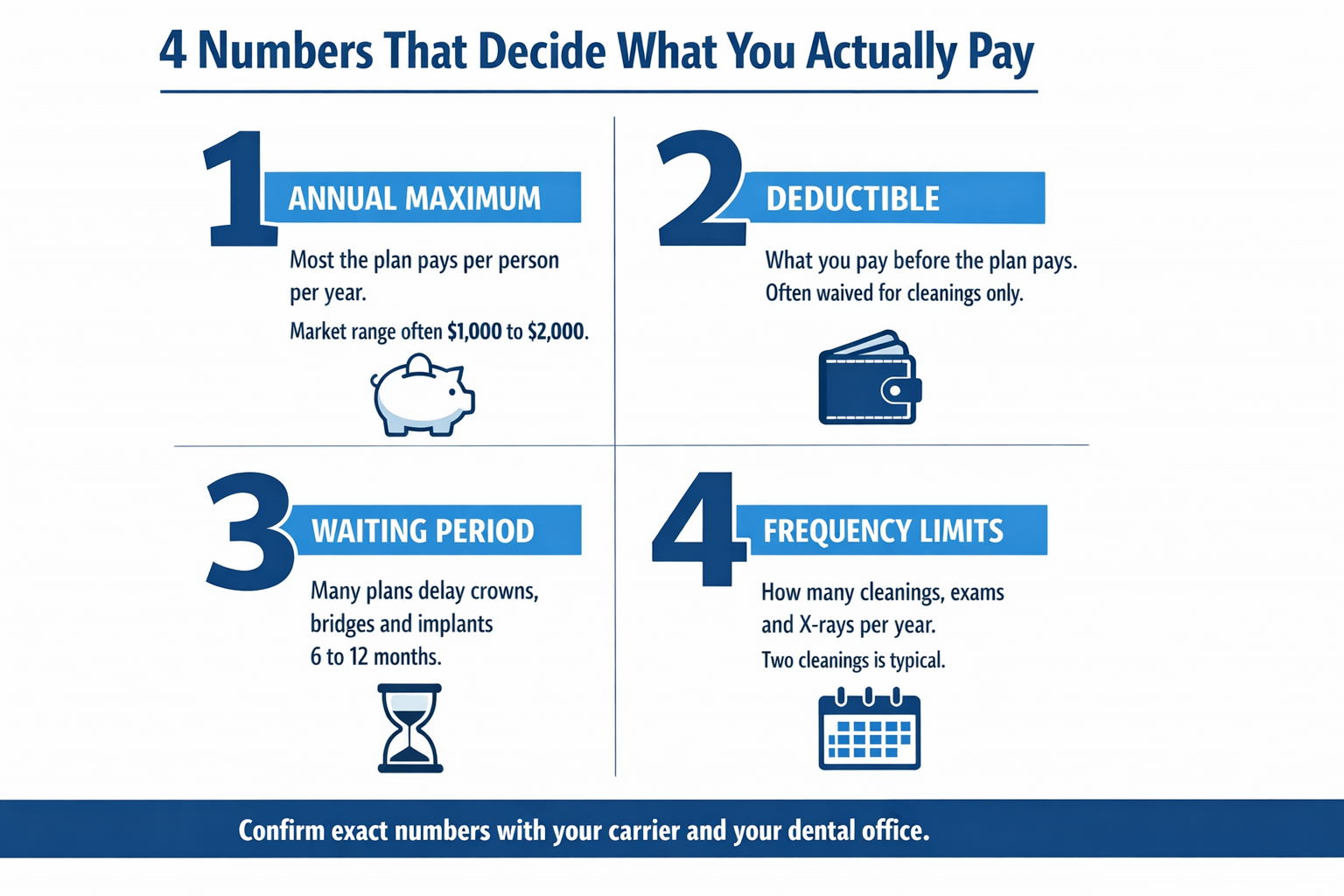
Four other numbers do that work:
- Annual maximum. The most the plan pays per person per calendar year. Across the market, PPO maximums still tend to land somewhere around $1,000 to $2,000, and the American Dental Association has publicly criticized the fact that these caps have barely moved in decades while treatment costs climbed.
- Deductible. What you pay before the plan pays anything. Often waived for cleanings, often not for anything else.
- Waiting periods. Many plans make you wait 6 to 12 months before covering crowns, bridges, implants or dentures.
- Frequency limits. How many cleanings, exams and X-rays per year. Two cleanings is typical. Some plans count by calendar year, others by rolling months.
Run the plain math. A single crown can eat a $1,000 annual maximum by itself. If you already know a crown, a bridge or an implant is likely in 2027, the maximum matters far more than a few dollars a month in premium.
That hits home here. Huntington Beach skews toward employer PPO coverage, median household income sits near $121,000, and the largest age group in town is 45 to 64, which is exactly the group most likely to need major restorative work in a given year.
These are general market ranges, not anyone’s quoted numbers. Confirm your exact figures with your carrier and with your dental office.
The Four Numbers to Pull Off Any Plan Summary
Before you compare two plans, find these four numbers on each summary of benefits and write them side by side.
4. Call the Dental Office Directly, Not the Online Directory
Carrier directories go stale. Contracts end, networks get renamed, and the listing sits there looking current for months. The only verification I trust is a live call to the office with your plan details in front of you.
Have these ready before you dial:
- The carrier name on the card, such as Delta Dental, MetLife, Cigna or Humana
- The network name printed on the card, which is the part people skip
- Your group number and member ID
- Whether the plan is a PPO or a prepaid DHMO
Then ask one specific question: are you contracted for this exact network, not just this carrier? I have seen a Delta Dental PPO verify as in network at our office while a county Medi-Cal managed plan from the same conversation could not be used at all. Carrier name alone tells you very little.
One more thing, and it saves people the most grief. Ask the office to hold a tentative time while coverage is confirmed. Callers who hang up planning to sort it out on their own tend to end up in callback limbo and never get back on a schedule.
We covered the full script here: Not Sure Your Dental Plan Is Accepted? How to Find Out Before You Book.
5. Run the Math on Skipping Insurance Altogether
For some people, especially the self employed and part time workers staring down a 12 month waiting period on major work, no plan is the honest answer. That is a legitimate choice as long as preventive visits still happen.
The comparison is simple. Add up twelve months of premium plus the deductible, then compare that to the cash cost of two cleanings and an exam for the year. If no major work is likely in 2027, paying as you go can come out ahead. If a crown or implant is coming, insurance usually wins even with a modest annual maximum.
For the uninsured path, two things are worth asking about at any office:
- In-house savings or membership plans, which set a flat annual fee and a reduced fee schedule
- Third party financing, which spreads larger treatment over monthly payments
Not every office takes every financing product. CareCredit comes up a lot in Orange County and plenty of practices do not accept it, ours included, so ask before you assume. We broke the alternatives down in CareCredit Not Accepted? Here’s What Dental Financing Options Exist.
Our published new patient exam and X-ray fee has been $150, though fees change, so confirm the current number when you call.
What Good Looks Like After You Pick
Choosing a plan is step one. The step that actually protects your wallet is having coverage verified and explained before treatment starts, not after the statement shows up.
That means a breakdown of what the plan pays, what it does not, and what your share looks like, in plain numbers, before anyone picks up a handpiece. One patient put it this way in a Google review: “Tom called me before my appointment to verify insurance and provide cost estimates so I wouldn’t have any surprise costs.”
If you are also weighing whether to use what is left of your 2026 benefits before they reset, that is a separate but related question: Is It Worth Using Your Dental Benefits Before They Expire?
Frequently Asked Questions About Choosing a Dental Plan
My employer’s enrollment window already closed. Am I stuck for all of 2027?
Usually yes, unless you have a qualifying life event like a marriage, a birth, or a job change. That is why the ten minutes of checking before the deadline matters so much. If you are already locked in, call your preferred office and ask what out of network reimbursement would look like before you assume you have to switch dentists.
The directory says my dentist is in network. Why should I call anyway?
Because directories lag behind reality by months. Contracts change and listings do not always get updated. A thirty second phone call with your network name and group number is the only verification that holds up.
Is a cheaper DHMO plan a bad idea?
Not at all, as long as the assigned office is one you are happy going to. DHMO plans often have no annual maximum and set copays, which works well for families doing mostly cleanings, sealants and fluoride. The problem is only when someone picks it on price and discovers in January that they cannot keep their dentist.
I have no insurance and no plan to get it. What should I budget for?
Two cleanings and an exam per year is the baseline. Ask any office about an in-house savings plan, since those are built for exactly this situation and usually cost less than a year of premiums. Costs vary by practice, so get the actual numbers rather than guessing from online averages.
Can I use one plan for my kids and a different one for myself?
Sometimes, depending on how your employer structures the options. It is worth asking HR, especially if your kids only need preventive care and you are the one facing a crown or an implant this year.
Want a Second Set of Eyes on Your Plan Options?
If you are comparing plans for 2027 and want to know whether a specific network works at our Brookhurst Street office in Huntington Beach, our team is glad to look it up over the phone at (657) 800-5254. We serve patients across Huntington Beach, Fountain Valley and the wider Orange County area, and checking coverage before anything gets scheduled is just how Kali Dental does it. Appointments can also be booked at kalidental.com whenever you are ready.
