
Direct Answer: If it’s been years since your last cleaning, expect X-rays, a quick exam, and then the cleaning itself, the dentist shares findings at the end. No lectures.
The most common reason adults in Huntington Beach put off a dental cleaning isn’t money, and it isn’t scheduling. It’s not knowing what they’re walking into, and quietly dreading that someone in a white coat is going to make them feel bad about it. We hear this on almost every first call we get, and we want to say it plainly: no-judgment care is the baseline here, not a selling point.
If you haven’t been in for two years, five years, or longer, you are not alone. A lot of people across Oak View, Goldenwest, and Central Huntington Beach are in exactly the same spot. Life gets busy, insurance lapses, anxiety creeps in, and suddenly a year becomes three.
This article walks you through exactly what happens at a first cleaning visit, step by step, so you know what to expect before you even sit down. When you understand the sequence ahead of time, the whole thing feels a lot less like stepping into the unknown.
What Actually Happens at a Teeth Cleaning Visit in Huntington Beach
Most dental offices don’t explain the sequence, and that silence is where anxiety grows. Here’s how a routine new patient visit actually unfolds, in order.
Step 1, Digital X-rays first. Before anything touches your teeth, we take a full set of digital X-rays. This gives Dr. Kalvin a complete picture of what’s happening between and below the teeth, things no mirror can show. Modern digital X-rays use a fraction of the radiation of older film-based systems, and they’re done in minutes.
Step 2, The clinical exam. Dr. Kalvin reviews the X-rays and does a hands-on exam, checking each tooth, your gums, your bite, and your jaw. He takes measurements of the gum pockets around each tooth using a small probe. Those numbers matter more than you might think, and we’ll get to that in a minute.
Step 3, The cleaning itself. Once the exam is done, a hygienist removes plaque and tartar buildup using hand instruments and an ultrasonic scaler. Teeth are polished at the end. If it’s been a while, there may be more hardened tartar to work through, and the appointment may run longer, but that’s normal.
Step 4, Dr. Kalvin reviews findings with you. This is where we tell you what we found and what, if anything, we’d recommend next. No pressure, no upsell, just a clear explanation of what the numbers and images showed. As one patient put it after their visit: what actually happens during a professional dental cleaning is often less dramatic than people fear.
The Difference Between a Routine Cleaning and a Deep Cleaning
This is one of the most common concerns we hear from patients who’ve been away for a while. Many callers worry they’ll sit down for a regular cleaning and walk out with a recommendation for a much more expensive deep cleaning. It’s worth explaining exactly how that decision gets made.
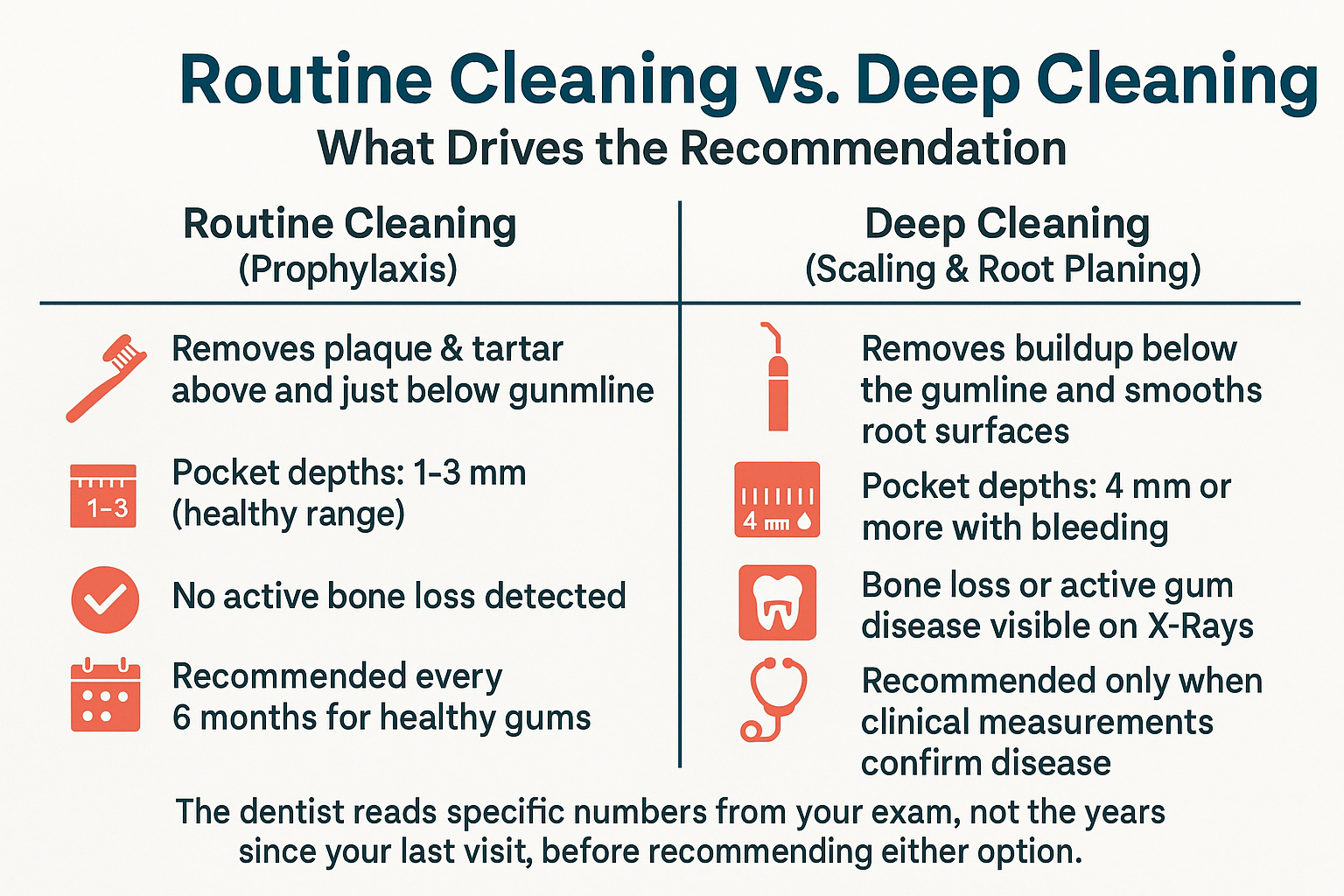
A routine cleaning (called a prophylaxis) removes plaque and tartar above the gumline and just slightly below it. It’s appropriate when your gum tissue is healthy and those pocket depth measurements Dr. Kalvin takes are in a normal range, generally 1-3 millimeters.
A deep cleaning, the clinical term is scaling and root planing, goes further. It removes buildup from below the gumline and smooths the root surfaces where bacteria anchor. It’s only recommended when there are measurable signs of active gum disease, including pocket depths of 4 millimeters or more with bleeding and bone loss visible on X-rays.
The key word is measurable. Dr. Kalvin looks at specific clinical numbers before recommending anything, and he explains what those numbers mean before suggesting a treatment path. If you want to understand more about why consistent cleanings protect you from ever needing the more involved option, preventive dental care costs less than you think breaks that down well.
A long gap between visits does not automatically mean you need a deep cleaning. The exam tells that story, not the calendar.
Routine Cleaning vs. Deep Cleaning, How the Decision Gets Made
This breakdown shows the clinical difference between the two types of cleaning and what measurements actually drive the recommendation.
What a Longer Gap Actually Means for Your Visit
If you’ve been avoiding the chair because you’re convinced it’s going to be terrible news, here’s an honest answer: it might not be. And even if there is something to address, finding out sooner is always better than finding out later.
Hardened tartar, what forms when plaque is left untouched for months or years, takes longer to remove than fresh buildup. The cleaning appointment may run longer, and you may feel more sensitivity during it. That’s real. But it doesn’t mean you’re in for a painful experience or a huge treatment plan.
As the American Dental Association notes, regular professional cleaning removes deposits that brushing and flossing simply can’t reach, and the longer those deposits sit, the more work it takes to clear them. Coming in after a long break is still far better than continuing to wait.
What patients usually find after that first visit back is that things weren’t nearly as bad as they imagined. There may be a cavity or two to fill, or some gum inflammation to address, but the exam tells that story clearly, without drama. We’d rather you come in and find out together than stay away and wonder. If you’re also uninsured and nervous about cost, no insurance doesn’t have to mean falling behind on dental health, there are real options.
What a New Patient Cleaning Visit Typically Includes, and What Affects Cost
Cost is a real question for a lot of Huntington Beach patients, especially those without insurance. Here’s what typically goes into the total and what can shift the number.
| Part of the Visit | What It Covers | What Affects the Cost |
|---|---|---|
| Digital X-rays | Full mouth or bitewing series, reveals what the mirror can’t show | Number of images taken; full-mouth vs. bitewing series |
| Clinical Exam | Tooth-by-tooth check, gum pocket measurements, bite evaluation | Whether additional diagnostic imaging is needed |
| Routine Cleaning | Plaque and tartar removal, polishing | Amount of buildup; may take longer after a long gap |
| Fluoride Treatment | Applied after cleaning to strengthen enamel | Often an add-on; ask if included in the visit fee |
| In-House Savings Plan | Flat-rate access for uninsured patients | Replaces insurance; makes total cost predictable |
What a New Patient Visit Costs, and How the In-House Plan Helps
Cost comes up on almost every first call we receive. We’d rather answer it directly than dance around it.
In the Huntington Beach market, a new patient visit that includes X-rays, an exam, and a cleaning can vary quite a bit depending on the practice, the number of X-rays taken, and whether fluoride is included. When you price-shop, make sure you’re comparing the same set of services, some offices quote a cleaning fee alone, and the total with X-rays and the exam looks very different.
For patients without insurance, we offer a new patient special that bundles the exam, X-rays, and cleaning into a predictable flat rate. This is the question that comes up most on first calls, and we’d rather you have a clear number going in than be surprised at checkout. Our in-house savings plan is a separate option for ongoing care, it’s designed specifically for patients who don’t carry dental insurance and want a consistent, affordable way to stay current.
If you’re coming in through insurance, it’s worth knowing that out-of-network situations aren’t necessarily a dealbreaker either. Understanding what out-of-network actually means can save you from walking away from a practice that’s actually a good fit.
What If You Have Dental Anxiety?
Dental anxiety is genuinely common, not a personality flaw, not something to be embarrassed about. A lot of the patients we see across Huntington Beach and Fountain Valley describe themselves as nervous going in, even for a basic cleaning.
Sam N., one of our patients, put it simply in their review: “I was nervous going into my appointment, but that feeling disappeared as soon as I met the team.”
We take that seriously. A comfort-first approach means we adjust the pace of the appointment to the patient, not the other way around. That looks like:
- Neck pillows and blankets in the chair so you’re physically comfortable
- In-room TVs to give you something to focus on during the cleaning
- Clear communication before each step so nothing happens without warning
- No rushing, if you need a moment, we pause
Reviewer Yasmeen A. said it plainly after her visit: “If you have a fear of the dentist or dental work come here! I have the worst anxiety and the doctor was so great and comforting.” We hear this often, and we don’t take it lightly. You brush every day, here’s why professional cleanings still matter even when anxiety makes it hard to get there.
Frequently Asked Questions About Teeth Cleanings in Huntington Beach
I haven’t been to the dentist in five or more years. Will I get lectured?
No. We hear this concern from new patients regularly, and the honest answer is that judgment has no place in a dental exam. The visit is about figuring out where things stand and what, if anything, needs attention, not about how long it’s been. Dr. Kalvin explains findings clearly and moves forward without making you feel bad about the gap.
How long will the appointment take if it’s been a while?
For a new patient visit, plan for 60 to 90 minutes on average. If there’s significant tartar buildup from a long gap, the cleaning portion may run longer. We’d rather take the time to do it properly than rush through it.
Will I automatically need a deep cleaning if I haven’t been in years?
Not automatically. The recommendation depends on your clinical measurements, specifically the gum pocket depths Dr. Kalvin records during the exam, not the calendar. Some patients who’ve skipped several years still have healthy enough gums for a routine cleaning. Others who’ve been going regularly need a deep cleaning because of active gum disease. The numbers drive the decision, and Dr. Kalvin explains exactly what they mean before recommending anything.
What’s the difference between the new patient special and the in-house savings plan?
The new patient special is a flat-rate bundled fee for your first visit, it typically includes the exam, X-rays, and cleaning so you know the total before you come in. The in-house savings plan is an ongoing membership option for patients without insurance, designed to make routine and restorative care more predictable throughout the year. They serve different purposes, and our front desk can walk you through both on your first call.
Is it okay to bring my kids to the same appointment?
Yes, we see patients of all ages, including young children coming in for their first visits. If you’re trying to coordinate a family appointment in Huntington Beach, call ahead so we can block the right amount of time for everyone.
What if I don’t have insurance?
A lot of our patients don’t, and it’s one of the most common topics on first calls. Our in-house savings plan is built specifically for that situation, it gives uninsured patients access to care at a predictable cost without having to navigate a third-party plan. Ask about it when you call, and our team will explain exactly what’s included.
Ready to Find Out Where Things Actually Stand?
If you’ve been putting off a cleaning because you weren’t sure what you’d be walking into, now you know the sequence, and you know we’re not going to make you feel bad about the gap. We’re welcoming new patients at our Huntington Beach office at 19201 Brookhurst Street, and our team is ready to answer your questions before you even come in. Call us at (657) 800-5254 or book online at kalidental.com, and come find out together.