
Direct Answer: Out of network means your dentist hasn’t signed a contract with your insurer — but most PPO plans still reimburse a portion of the cost. You may pay less than you think.
We hear this every week at our office on Brookhurst Street: someone calls, asks if we take their insurance, hears ‘we’re out of network,’ and hangs up. No follow-up questions. No conversation about what that actually means for their bill. Just a dial tone.
I get it — that phrase sounds like a door slamming shut. But in most cases, it isn’t. Out of network does not mean your insurance won’t help you. It means the practice hasn’t signed a discounted-rate contract with your carrier — and that’s a much smaller distinction than most people realize.
This article walks through exactly what out-of-network coverage means, how to figure out what your specific plan actually covers, and what your options are if your plan won’t cover anything at all. The goal is that you finish reading this knowing exactly what question to ask before you ever hang up the phone again.
What ‘Out of Network’ Actually Means — and What It Doesn’t
When a dental office is in-network, it means they’ve signed a contract with your insurance company agreeing to charge a pre-negotiated, discounted rate. In exchange, the insurer sends patients their way. It’s a volume-for-discount arrangement.
When an office is out of network, that contract doesn’t exist. The practice charges its own fees. Your insurance hasn’t pre-approved those rates.
But here’s what most patients don’t know: your PPO plan may still pay a portion of the bill. PPO stands for Preferred Provider Organization, and the key word is preferred — not exclusive. Most PPO plans are designed to cover a percentage of an out-of-network visit, based on what the insurer calls their Usual, Customary, and Reasonable (UCR) fee schedule. That UCR rate is the insurer’s own benchmark for what a procedure should cost in your area — and your reimbursement is calculated from that number, not from what the dentist actually charged.
So your out-of-pocket cost depends on three things:
– What the dentist charges for the procedure
– What your insurer’s UCR rate is for that same procedure in Huntington Beach
– What percentage your plan covers for out-of-network services
That math is completely doable before your appointment — but most patients never try because they assume ‘out of network’ is already the answer.

HMO vs. PPO: This Distinction Matters More Than Anything Else
Not all dental insurance works the same way, and this is where a lot of confusion comes from — even among patients who’ve had coverage for years.
HMO plans (Delta Dental HMO is one of the most common in Orange County) are built around a closed network. You’re assigned to a specific dentist or group, and care outside that network typically isn’t covered at all. If you have an HMO and your dentist isn’t in the plan, you’ll usually be paying the full bill out of pocket. That’s not a policy technicality — it’s how HMO plans are fundamentally designed.
PPO plans work differently. You have a preferred network with better rates, but you’re generally free to go outside it. The plan pays less for out-of-network care, but it pays something. Humana Dental PPO, MetLife PPO, Cigna PPO — these all typically include some level of out-of-network reimbursement.
So the first question isn’t ‘are you in my network?’ It’s ‘do I have an HMO or a PPO?’ Here’s how to find out fast:
– Look at your insurance card — it usually says PPO, HMO, or DHMO right on the front
– Log into your carrier’s member portal and look under ‘Plan Type’
– Call the member services number on the back of your card and ask directly
If you have a PPO, the next conversation — about what they’ll actually reimburse — is worth having before you assume you can’t be seen.
How to Calculate Your Out-of-Pocket Cost Before You Book
This step-by-step breakdown shows exactly how to figure out your real cost at an out-of-network dental office — before you ever sit in the chair.
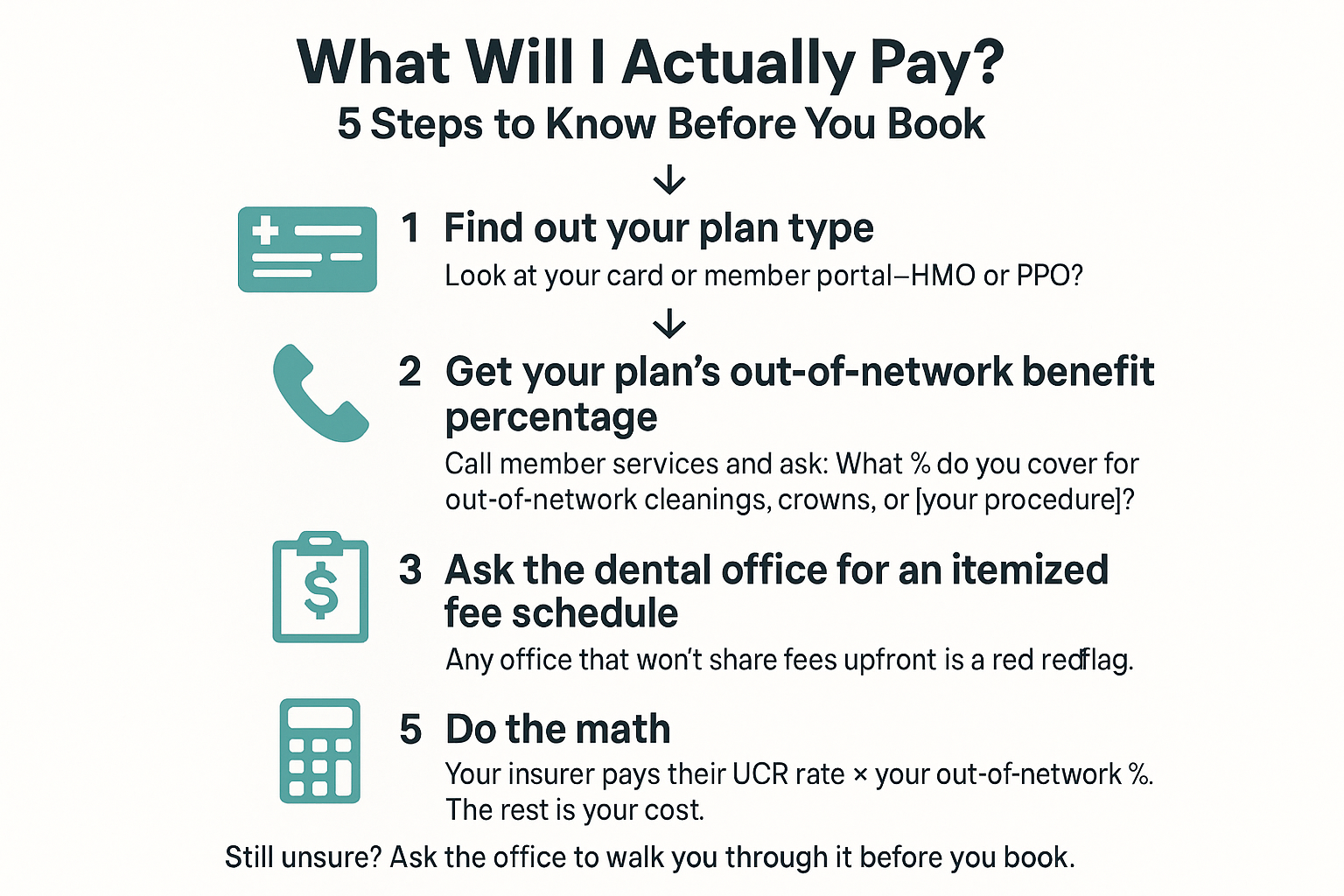
Ask for a Fee Schedule Before You Book — and Pay Attention to Whether They Share It
One of the most useful things I can tell you about finding a dental office — whether it’s ours or anyone else’s — is this: ask for an itemized fee schedule before your appointment. Not after. Before.
A transparent practice will give you one without hesitation. They’ll tell you what a new patient exam costs, what X-rays run, what a cleaning is, what a crown is if you happen to need one. That information lets you do the actual math with your insurance’s out-of-network coverage — and it tells you something about how the practice operates in general.
Offices that are evasive about fees before a visit tend to be evasive about them after. Surprise charges after a procedure are one of the most common complaints in dentistry, and they almost always trace back to an office that never gave the patient a clear number upfront.
When callers ask us about a procedure — a cracked crown, a cleaning they’ve put off for two years, a same-day crown situation — we walk them through the cost before they book. Not because it’s a sales tactic, but because people deserve to make an informed decision. One caller recently came in for a crown after we walked her through what her out-of-network Humana coverage would likely reimburse. She had assumed she couldn’t afford it. The actual math told a different story.
For context, a standard dental cleaning in the Huntington Beach area often falls somewhere in the $100–$200 range depending on the office and whether X-rays are included, though your exact cost will depend on your specific plan’s reimbursement rate and the office’s fees — always confirm directly. Crowns, implants, and restorative work vary more widely, which is exactly why getting a fee schedule and running it against your plan’s UCR rate is worth the ten-minute phone call.
PPO vs. HMO: What Out-of-Network Coverage Usually Looks Like
This is a general comparison — individual plans vary, so always verify your specific benefits with your carrier.
| Plan Type | Out-of-Network Coverage | What to Do First |
|---|---|---|
| Delta Dental PPO | Typically covers a percentage based on UCR rates | Call member services, ask for your out-of-network benefit % and UCR rate for your procedure |
| Delta Dental HMO (DHMO) | Usually no out-of-network coverage | Confirm with your carrier — if HMO, you may need to use an in-network provider or pay full price |
| Humana Dental PPO | Generally includes out-of-network reimbursement | Ask for the out-of-network fee schedule and compare it to the office’s fees |
| MetLife Dental PPO | Typically covers out-of-network at a lower percentage | Get the office’s procedure codes (CDT codes) and call MetLife to price each one |
| Cigna Dental PPO | Out-of-network reimbursement usually available | Verify your annual maximum and whether it applies to out-of-network claims |
| CalOptima / Medi-Cal Dental | Generally requires in-network providers | Check our article on Medi-Cal dental changes for more context on current coverage |
If Your Plan Won’t Cover Out-of-Network — or You Don’t Have Insurance at All
Sometimes the math doesn’t work out. Your plan is an HMO with no out-of-network benefit, or your annual maximum is already used up, or you’re one of the many Huntington Beach families — in Oak View, Goldenwest, Bolsa Chica-Heil, and elsewhere — who simply don’t have dental coverage at all.
That’s where in-house membership plans come in. These are flat-rate annual memberships that a dental practice offers directly to patients, completely outside the insurance system. There are no claims, no deductibles, no pre-authorization forms, and no annual maximums in the traditional sense.
Here’s what a typical in-house plan covers:
– Two preventive visits per year (cleanings and exams)
– X-rays at scheduled intervals
– A percentage discount on other services — fillings, extractions, crowns, and so on
They’re not insurance. They don’t protect against a major unexpected cost the way a PPO can. But for patients who skip the dentist entirely because they can’t afford to walk in the door, a membership plan turns two visits a year into a fixed, predictable cost.
We have our own in-house savings plan for exactly this reason. If you want to understand more about how to stay on top of dental health without traditional coverage, this guide on staying ahead of dental problems without insurance covers it in depth.
What the People Who Called and Hung Up Actually Left Behind
In a single month of tracked calls, several patients called our office, heard ‘we’re out of network,’ and ended the call before we could explain further. Every one of them had expressed a real need — a cavity, a crown issue, a cleaning that was long overdue.
Many of them could have been seen. Some had PPO plans that would have reimbursed a meaningful portion. A few might have qualified for our in-house plan. But the conversation never got that far.
I’m not telling you this to sell you on us specifically. I’m telling you because it happens at every dental office, and the people who lose in that situation are the patients — not the practice. The practice moves on. The patient goes another few months without care, and whatever was minor in January becomes a root canal by July. We wrote about exactly that pattern in our piece on why preventive care costs less than you think.
The one question worth asking before you hang up: ‘Can you walk me through what my actual cost would be?’ If the answer is yes and they’re willing to do it — that’s the office worth booking.
Frequently Asked Questions About Out-of-Network Dental Coverage
Can I still submit an insurance claim if my dentist is out of network?
Yes — if you have a PPO plan, you can typically submit a claim for out-of-network services and receive partial reimbursement based on your plan’s UCR rate. Some offices will submit the claim on your behalf; others ask you to submit it yourself. Ask before your appointment which process they follow. If you have an HMO plan, out-of-network claims are usually not reimbursed at all.
What is a UCR rate and why does it matter?
UCR stands for Usual, Customary, and Reasonable — it’s the fee your insurance company has decided is ‘standard’ for a given procedure in your area. When you go out of network, your insurer reimburses a percentage of their UCR rate, not the actual amount the dentist charges. If the dentist charges more than the UCR rate, the difference comes out of your pocket. This is why asking your insurer for the UCR rate on your specific procedure — before the appointment — is so useful.
How do I find out what my out-of-network benefits actually are?
Call the member services number on the back of your insurance card and ask two specific questions: ‘What is my out-of-network reimbursement percentage for [procedure]?’ and ‘What is your UCR rate for that procedure in zip code 92646 or 92648?’ Write those numbers down. Then ask the dental office for their fee on the same procedure. The gap between those two numbers is roughly what you’ll owe.
If I don’t have insurance, is there any affordable option for dental care in Huntington Beach?
In-house membership plans are worth looking into. These are annual plans offered directly by the dental practice — no insurance company involved. They typically include two cleanings and exams per year plus X-rays, and offer discounts on other services. They’re not a replacement for insurance if you need major work, but they make routine preventive care affordable and predictable. We offer one at our office for exactly this reason.
Is it a red flag if a dental office won’t give me a fee schedule upfront?
In my experience, yes. Any office that’s reluctant to share what a cleaning, exam, or crown costs before you book is giving you information about how they operate. Transparent pricing isn’t a favor — it’s what allows you to plan. Offices that are comfortable with that conversation tend to be the same ones that won’t surprise you with unexpected charges after the fact.
What if my plan has already hit its annual maximum?
Most PPO dental plans have an annual maximum — commonly somewhere around $1,000–$2,000 — and once that’s used up, the insurer stops paying until your plan year resets. At that point, you’re essentially a self-pay patient for the remainder of the year. That’s a good time to ask the office about an in-house membership plan or whether they offer a self-pay discount. It’s also worth timing any non-urgent work to fall at the start of a new plan year when your maximum resets.
Have Questions About What Your Insurance Would Actually Cover Here?
We’re happy to walk through it with you before you book — no pressure, just real numbers. Kali Dental serves patients across Huntington Beach and Orange County, including many who come in as out-of-network patients and pay far less than they expected. Give us a call at (657) 800-5254 or book online at kalidental.com and we’ll help you figure out what your visit would actually cost.