
Direct Answer: Wisdom tooth removal in Huntington Beach typically costs less for a fully erupted tooth and significantly more for an impacted one requiring surgery. The exact price depends on tooth position, anesthesia, and your insurance classification.
We get this question constantly — sometimes as a quick form submission, sometimes from someone who’s already been told by another office that their wisdom tooth needs to come out and they’re trying to figure out what it’s actually going to cost. One person who reached out to us put it simply: ‘What is the cost of removing wisdom teeth for one tooth?’ A completely fair question. But the honest answer is that there’s no single number, and anyone who gives you one without examining your X-rays is guessing.
The cost of wisdom tooth removal in Huntington Beach can vary by several hundred dollars — sometimes more — depending entirely on how that tooth is sitting in your jaw. A tooth that has fully broken through the gum line is a very different procedure from one that’s buried in bone and angled sideways. We want to explain that difference clearly, because it’s the single biggest factor that determines what you’ll pay.
We’ll also cover how insurance actually works for this procedure (it’s more complicated than most people expect), what to know about sedation options, and what the first few days of recovery genuinely look like. By the end of this, you’ll have a real picture of what you’re dealing with — not a number pulled from a dental cost calculator.
The Two Very Different Procedures Both Called ‘Wisdom Tooth Removal’
When a friend tells you their wisdom tooth removal was quick and affordable, and another tells you theirs was expensive and took weeks to recover from, they probably had two completely different procedures — even though they both used the same phrase.
Simple extraction applies when a wisdom tooth has fully erupted and sits upright in a normal position. The dentist numbs the area, loosens the tooth, and removes it. It’s often over in under 15 minutes. These cases tend to fall at the lower end of the cost range.
Surgical extraction is a different story. When a tooth is impacted — meaning it’s partially or fully buried in the jawbone, or it’s angled toward the neighboring molar — the dentist has to cut through gum tissue, sometimes remove a small amount of bone, extract the tooth (often in sections), and then suture the site closed. More steps, more time, more complexity, and a longer healing window. These cases carry a noticeably higher cost.
The position of the tooth drives everything:
- Fully erupted, upright — simplest case, lowest cost
- Soft tissue impaction — tooth has emerged through bone but is still covered by gum tissue
- Partial bony impaction — tooth is partially embedded in the jawbone
- Full bony impaction — tooth is completely enclosed in bone, often the most complex and costly scenario
When we take a CBCT digital X-ray at our office, we can show you exactly where your tooth sits and give you an honest cost estimate before any decision is made. No surprises.

The Cost Factor Most People Forget to Ask About: Anesthesia
We had a patient submit a form asking about wisdom tooth costs — and in the same message, they asked whether we use nitrous oxide. That combination of questions tells you something real: the fear of the experience is running right alongside the fear of the bill.
Anesthesia choices affect both how you feel during the procedure and what you pay. The three most common options are:
- Local anesthetic only — numbs the area, you’re awake, this is the standard and the lowest-cost option
- Nitrous oxide (laughing gas) — added on top of local anesthetic; it takes the edge off anxiety without putting you to sleep, and the additional cost is usually modest
- IV sedation — for patients with significant anxiety or complex surgical cases; you’re in a deeper sedated state, and this adds a meaningful amount to the total
For most straightforward wisdom tooth cases, local anesthetic alone does the job. But if the thought of being awake during the procedure causes real anxiety, nitrous is worth asking about — it’s something our team offers and it changes the experience significantly for patients who need it.
The key is knowing upfront what’s included in the quoted price. Some offices quote the extraction fee and list sedation separately. Ask before you assume.
If dental anxiety is part of what’s been keeping you from moving forward, you’re not alone. Many of our patients — including people who haven’t been to a dentist in years — describe that same hesitation. We’ve found that talking through what the procedure actually involves, step by step, removes most of the fear before the appointment even starts.
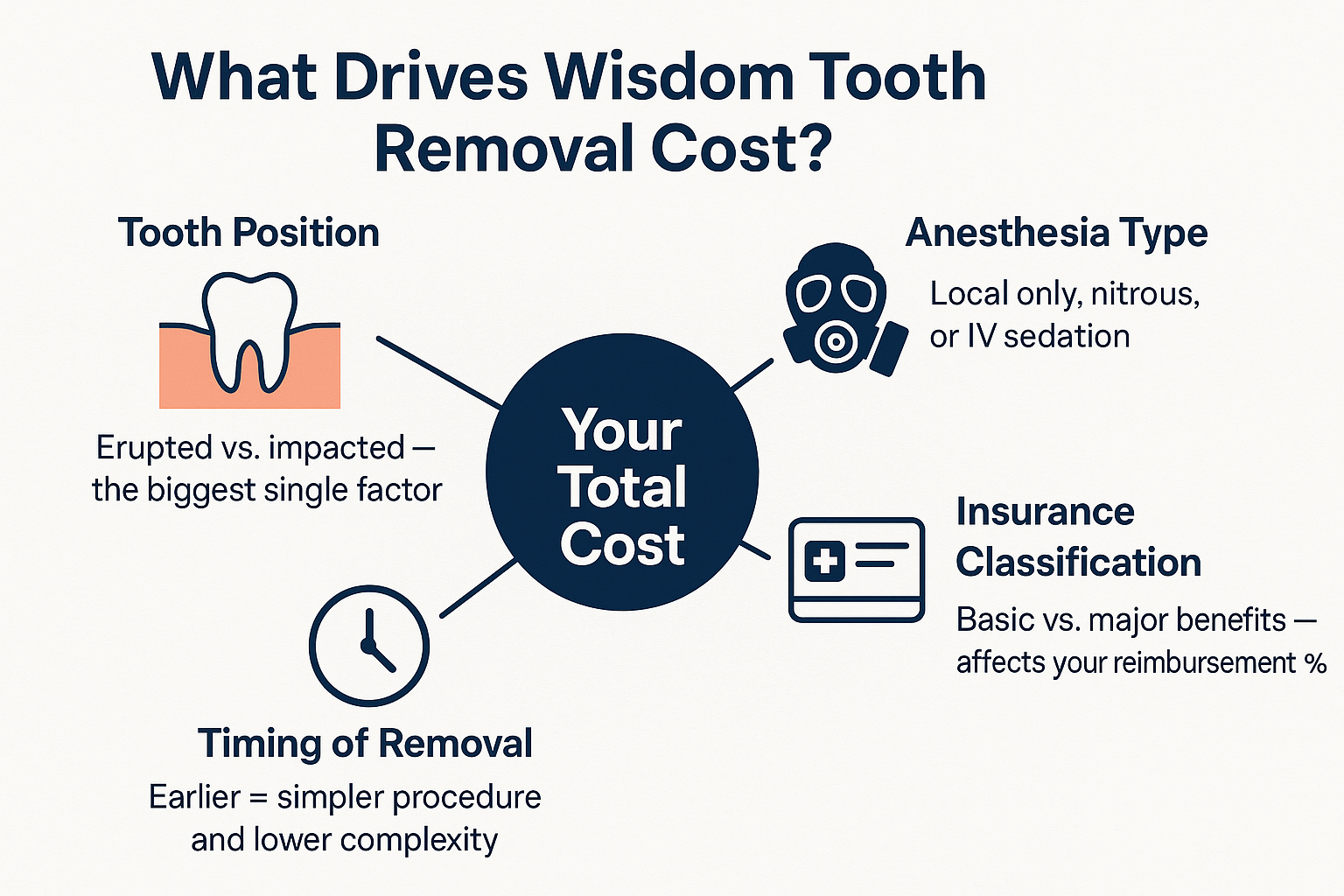
What Actually Drives the Cost of Wisdom Tooth Removal
This breakdown shows the four main variables that determine what you’ll pay — from tooth position to insurance classification.
How Insurance Actually Covers This — and Where the Surprises Come From
Most dental insurance plans do cover wisdom tooth removal, but the coverage percentage depends on how the procedure is classified — and that classification isn’t always what patients expect.
Dental insurance typically divides procedures into three tiers:
- Preventive — usually covered at 100% (cleanings, exams)
- Basic — commonly covered at 70-80% (fillings, simple extractions)
- Major — often covered at 50% (surgical extractions, crowns, bridges)
Here’s where wisdom teeth get complicated. A simple extraction may fall under basic benefits. A surgical removal of an impacted tooth usually lands in the major benefits category — which means you might be responsible for 50% of the cost after your deductible, not 20%. That gap surprises a lot of people who assumed they were mostly covered.
There’s also a less-obvious wrinkle: some wisdom tooth procedures, especially when tied to infection or jaw damage, may cross into medical insurance territory. If your medical plan has dental-adjacent benefits, it’s worth checking — though navigating that requires a direct conversation with both your dental and medical carrier.
Before your appointment, here’s what’s worth verifying with your insurance:
- What tier does surgical extraction fall under in my plan?
- Have I met my annual deductible yet?
- Does my plan have an annual maximum, and how close am I to it?
- Is this provider in-network?
We can help walk through the insurance piece when you come in. We’ve had patients come in assuming they owed very little and others who came in braced for a large bill — and the reality was different in both directions. Knowing your numbers ahead of time prevents that shock. For patients without insurance, we also offer an in-house savings plan that makes this kind of care accessible without having to navigate a carrier at all.
Wisdom Tooth Removal: Cost Drivers at a Glance
These aren’t fixed prices — actual costs vary by case and insurance. This table shows the factors that push the total up or down, so you know what to ask about before your appointment.
| Factor | Lower Cost End | Higher Cost End |
|---|---|---|
| Tooth position | Fully erupted, upright | Full bony impaction |
| Anesthesia | Local anesthetic only | IV sedation |
| Insurance tier | Basic benefits (70-80% covered) | Major benefits (50% covered) |
| Number of teeth | Single tooth | All four at once |
| Timing | Early removal, no infection | Infected or bone-damaged tooth |
Why Waiting Makes It More Expensive — and Harder
We’ve seen patients come in after getting a recommendation from another office to remove a symptomatic wisdom tooth — and then waiting months before following through. By the time they come to us, the situation has gotten more complex.
Waiting doesn’t make wisdom tooth problems go away. It usually makes the procedure harder and recovery longer. Here’s why:
Infection changes everything. An infected tooth means inflamed tissue, which makes anesthesia less effective and increases the risk of post-procedure complications. You may need antibiotics before the extraction can even happen, which adds time and cost.
Bone damage raises the surgical stakes. A tooth that’s been pressing against the adjacent molar for an extended period can cause bone loss around that neighboring tooth. Now you’re dealing with two problems instead of one.
Timing affects your insurance too. If your deductible resets in January and you wait until December, you may have already met your deductible and be in a better position to act. Or you may be close to your annual maximum and want to schedule before year-end. These aren’t abstract points — they affect what you pay out of pocket.
I’ve noticed that patients who are ‘on the fence’ about timing often aren’t avoiding the procedure because they don’t think it’s necessary — they usually know it is. They’re waiting because they’re not sure what it will cost, or they’re anxious about what it will feel like. Both of those are real concerns worth talking through before they lead to a more difficult procedure down the road.
For more on what happens when dental pain spreads beyond the tooth, when a toothache spreads to your neck is worth reading — it explains how untreated dental problems can create symptoms well beyond the mouth.
Recovery: What the First 72 Hours Actually Look Like
Recovery from wisdom tooth removal tends to get exaggerated in both directions online — some sources make it sound trivial, others make it sound like a week in bed. The honest picture is somewhere in between, and it depends heavily on whether you had a simple or surgical extraction.
After a simple extraction, most patients feel back to normal within 2-3 days. Soreness is normal the first day. Swelling is minimal. Soft foods for a day or two, no straws (suction can disrupt the healing clot), and you’re generally back to regular activity quickly.
After surgical removal of an impacted tooth, the healing window is longer — typically 5-7 days before most patients feel fully functional, with some residual soreness for a week or two after that. The first 48 hours involve:
- Swelling that peaks around day 2-3 — ice packs in 20-minute intervals help
- Soft food diet — think eggs, yogurt, soup, smoothies (no straws)
- Avoiding smoking or vaping — this significantly increases dry socket risk
- Keeping the site clean without directly disturbing it
The complication patients most commonly call about is dry socket — when the protective blood clot is dislodged before the site heals, exposing the bone. It’s distinctly painful, usually starting 3-4 days after extraction. If you feel increasing pain after the first couple of days rather than decreasing pain, that warrants a call.
For a deeper look at what normal healing looks like versus what doesn’t, what recovery from a tooth extraction actually looks like walks through the full timeline. And if you’re wondering about pain that’s lasting longer than expected, is it normal for your mouth to still hurt days after a tooth removal covers exactly that.
Frequently Asked Questions About Wisdom Tooth Removal Cost in Huntington Beach
Can you give me a price over the phone before I come in?
We can give you a general range based on what you describe, but an accurate quote requires seeing your X-rays. The difference between a simple and surgical extraction can be significant, and we can’t know which applies until we see how your tooth is positioned. What we can do is give you a clear breakdown before any treatment starts — no surprises.
Does dental insurance cover wisdom tooth removal?
Most plans cover it when the tooth is symptomatic or impacted, which qualifies as medically necessary. But the coverage percentage depends on how your plan classifies the procedure. Simple extractions often fall under basic benefits (typically 70-80% covered). Surgical removal of an impacted tooth usually lands under major benefits, which many plans cover at only 50%. Verify your tier, deductible status, and annual maximum before your appointment — those three numbers tell you your real out-of-pocket cost.
What if I don’t have dental insurance?
We offer an in-house savings plan specifically for patients without insurance. It’s designed to make procedures like this accessible without requiring you to navigate a carrier or pay full out-of-pocket rates. Ask us about it when you call or come in.
Is nitrous oxide available, and does it cost extra?
Yes, we offer nitrous oxide. It’s added on top of local anesthetic and helps significantly with anxiety during the procedure. There is an additional fee, but it’s generally modest compared to IV sedation. If the thought of being awake during a dental procedure makes you anxious, it’s absolutely worth asking about — it changes the experience for a lot of our patients.
My wisdom tooth doesn’t hurt right now. Do I still need to remove it?
Not necessarily — but it depends on the position. Some wisdom teeth erupt cleanly and cause no issues. Others are angled or impacted in a way that will eventually create problems, even if they’re currently quiet. The risk of waiting is that the procedure becomes more complex if infection or bone damage develops. A current X-ray gives you the real answer for your specific situation.
How long does the procedure take?
A simple extraction can take as little as 10-20 minutes. A surgical extraction of an impacted tooth typically runs 45-60 minutes, sometimes longer if multiple teeth are being removed in the same visit. We’ll give you a realistic time estimate when we review your X-rays.
Ready to Get a Clear Answer on Your Wisdom Tooth?
If you’re in Huntington Beach — whether you’re near Goldenwest, Bolsa Chica-Heil, or coming in from Fountain Valley — and you’ve been sitting on a wisdom tooth question, the clearest next step is a set of X-rays and an honest conversation. Kali Dental’s team can show you exactly where your tooth sits, explain what removal would involve, and give you a real cost breakdown before anything is scheduled. Call us at (657) 800-5254 or book directly at kalidental.com.