
Direct Answer: Brushing removes soft plaque, but hardened tartar can only be removed by a dental professional. Cleanings also catch early problems before they become expensive ones.
You brush in the morning. You brush before bed. Maybe you even floss most nights. So when your dentist tells you there’s buildup on your teeth, it’s easy to feel confused — or even a little defensive.
Here in Huntington Beach, we hear this a lot. Patients from Oak View to Huntington Harbour come in thinking that good home habits should be enough. And honestly, good home habits are important. But they only do part of the job.
This article breaks down the two things your toothbrush genuinely cannot do — and why skipping your twice-yearly cleaning can quietly set you up for much bigger problems down the road.
What Your Toothbrush Actually Removes — And What It Leaves Behind
Your toothbrush is good at one specific thing: disrupting soft plaque before it hardens. Plaque is that thin, sticky film that forms on your teeth throughout the day. Brush it away within about 24 to 48 hours, and it’s gone.
But here’s what most people don’t realize. Plaque that sits too long — in the spots your brush misses — mineralizes into tartar, also called calculus. And once tartar forms, no amount of brushing will touch it. It bonds to the tooth surface the way mineral deposits bond to the inside of a pipe.
Those hard-to-reach spots include:
- The back sides of your lower front teeth
- Along the gumline, especially where the gum meets the tooth
- Between teeth in areas your brush bristles can’t reach at an angle
- Around older dental work like crowns or bridges
Tartar is porous, which means it traps bacteria. That bacteria releases acids that irritate your gums and attack enamel — even on teeth you’re brushing faithfully every single day. A professional cleaning uses specialized instruments to scrape tartar away without damaging the tooth. Why your gums might bleed during that process is a separate question worth understanding before your next visit.
The Second Reason Cleanings Matter Has Nothing to Do With Cleaning
The professional cleaning itself is only half the appointment. The other half — the part that prevents the expensive stuff — is the exam and X-rays that happen at the same visit.
Dr. Kalvin uses digital X-rays and CBCT imaging to see what’s happening underneath the surface. Decay that starts between teeth is completely invisible to the naked eye and shows zero symptoms until it reaches the nerve. By then, what could have been a $150–$200 filling is now a root canal and a crown — easily $1,500 or more out of pocket.
The same logic applies to gum disease. Early-stage gum disease (called gingivitis) has no pain. No obvious swelling you’d notice at home. But during a cleaning appointment, the hygienist measures the space between your gum and tooth at six points per tooth. A healthy pocket is 1–3 millimeters. Anything deeper signals the start of a problem — and catching it at that stage means a routine cleaning can still reverse it.
For Huntington Beach families managing busy schedules between Bolsa Chica-Heil and the Central area, the math on prevention versus treatment is straightforward. Two cleanings a year at $100–$150 each (or covered by most insurance plans entirely) protect against repair costs that can run into thousands. If you’re uninsured, our in-house savings plan makes routine care genuinely affordable without cutting corners.
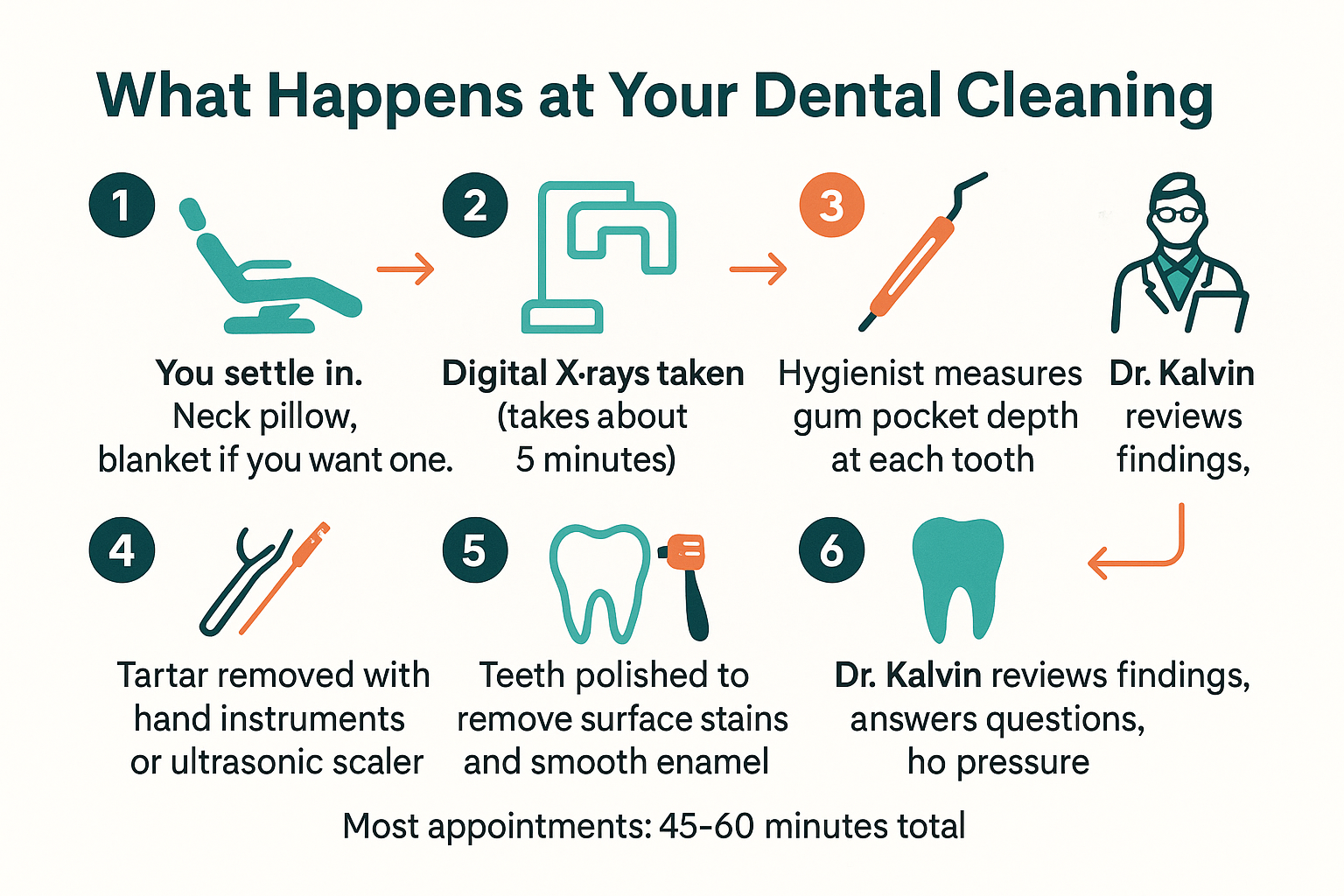
What Happens at a Professional Cleaning — Step by Step
This infographic walks through exactly what a standard cleaning appointment involves, from the moment you sit down to when you leave.
Brushing vs. Professional Cleaning: What Each One Actually Does
A lot of confusion comes from not knowing where home care ends and professional care begins. This table makes that line clear.
| Task | Daily Brushing & Flossing | Professional Cleaning |
|---|---|---|
| Removes soft plaque | Yes — if done within 24–48 hours | Yes |
| Removes hardened tartar | No | Yes — only way to remove it |
| Cleans between teeth | Partially with floss | More thoroughly with instruments |
| Checks for early decay | No | Yes — X-rays and visual exam |
| Measures gum pocket depth | No | Yes — at every appointment |
| Catches problems before symptoms | No | Yes — that’s the whole point |
| Cost | $0 (just your time) | $100–$150 / visit, or covered by insurance |
How Often Do You Actually Need a Cleaning?
The standard recommendation is every six months, and for most healthy adults, that holds. But it’s not a universal rule.
Some patients — particularly those with a history of gum disease, higher tartar buildup rates, or certain health conditions like diabetes — benefit from cleanings every three to four months. Others with excellent oral health and minimal buildup may hear from Dr. Kalvin that once a year is fine for them specifically.
The point is that the frequency should be based on your mouth, not a generic schedule. That’s a conversation worth having at your next visit.
For kids in Huntington Beach, the six-month schedule lines up nicely with school breaks — summer and winter — which makes it easy for parents in Goldenwest and the Oak View neighborhoods to keep both adults and children on track without pulling anyone out of class. Family dental practices that see all ages can manage that scheduling in one place, which saves a lot of coordination.
And if it’s been more than a year since your last cleaning, don’t let embarrassment stop you from coming in. We see this regularly, and there’s no judgment here — just a plan to get things back on track.
Frequently Asked Questions About Dental Cleanings
Does a cleaning hurt? I’ve avoided going because I’m nervous about the scraping.
For most people with healthy gums, a cleaning is uncomfortable at most — not painful. The scraping sensation is just the tartar being broken up. If your gums are inflamed from buildup, they can be more sensitive, but that improves quickly once the irritants are removed. If you’re anxious, just tell us before we start. Our team works at your pace, and Dr. Kalvin is genuinely patient with nervous patients — it’s part of how we practice.
I don’t have dental insurance. Can I still afford regular cleanings?
Yes. We run an in-house savings plan specifically for uninsured patients that makes cleanings, exams, and X-rays affordable without requiring a third-party insurance policy. A lot of our patients from the Fountain Valley and Huntington Beach area use it. Learn more about what value actually looks like in dental care before you decide what fits your budget.
My teeth look fine and I have no pain. Do I really still need to come in?
This is the most common reason people skip appointments — and it’s exactly backwards. Dental decay and early gum disease almost never cause pain until they’ve progressed significantly. By the time something hurts, the damage is already done. The whole point of a cleaning appointment is to catch problems at the stage where they’re still small and cheap to fix.
How long does a cleaning actually take?
Most routine cleaning appointments run 45 to 60 minutes from start to finish, including X-rays and the exam with Dr. Kalvin. If it’s your first visit or you haven’t been in a few years, plan for closer to 75 minutes.
My gums bled last time I had a cleaning. Is that normal?
Bleeding during a cleaning is usually a sign of gum inflammation — not that the hygienist hurt you. Inflamed gum tissue has more blood flow and is more reactive. It’s one of the early signs of gingivitis, and it often resolves after the cleaning removes the tartar that was causing the irritation. We wrote a full explanation of this if you want the full picture.
Ready to Get Back on Track?
If it’s been a while since your last cleaning — or you’ve never had one with a dentist who actually takes time to explain what they’re finding — we’d be glad to see you at our Huntington Beach office on Brookhurst Street. Kali Dental is open to patients of all ages across Orange County, including families from Fountain Valley, Goldenwest, and beyond. Call us at (657) 800-5254 or book your appointment online at kalidental.com.