
Direct Answer: There is no age cutoff for dental implants. Candidacy depends on jawbone volume, gum health, blood sugar control, smoking, and certain medications, not on how old you are.
Almost every week, someone in their late sixties or seventies sits down in my chair, points at a gap in their smile, and says some version of the same thing: “I’m probably too old for implants, right?”
I hear it so often here because Huntington Beach skews older than most of Orange County. Roughly one in five residents is 65 or older, and the 45 to 64 group is the single largest slice of the city. So this is not a hypothetical question in Oak View or Huntington Harbour. It comes up daily.
Here is the short version: there is no age cutoff for dental implants. Not at 65, not at 80. What matters is your bone, your gums, and your health history. Let me walk you through what we actually look at, what the money conversation really looks like for retirees, and how long the whole thing takes.
Why Age Alone Never Decides Implant Candidacy
I have placed implants for patients decades apart in age and had nearly identical conversations, because the birthday on the chart is not one of the inputs.
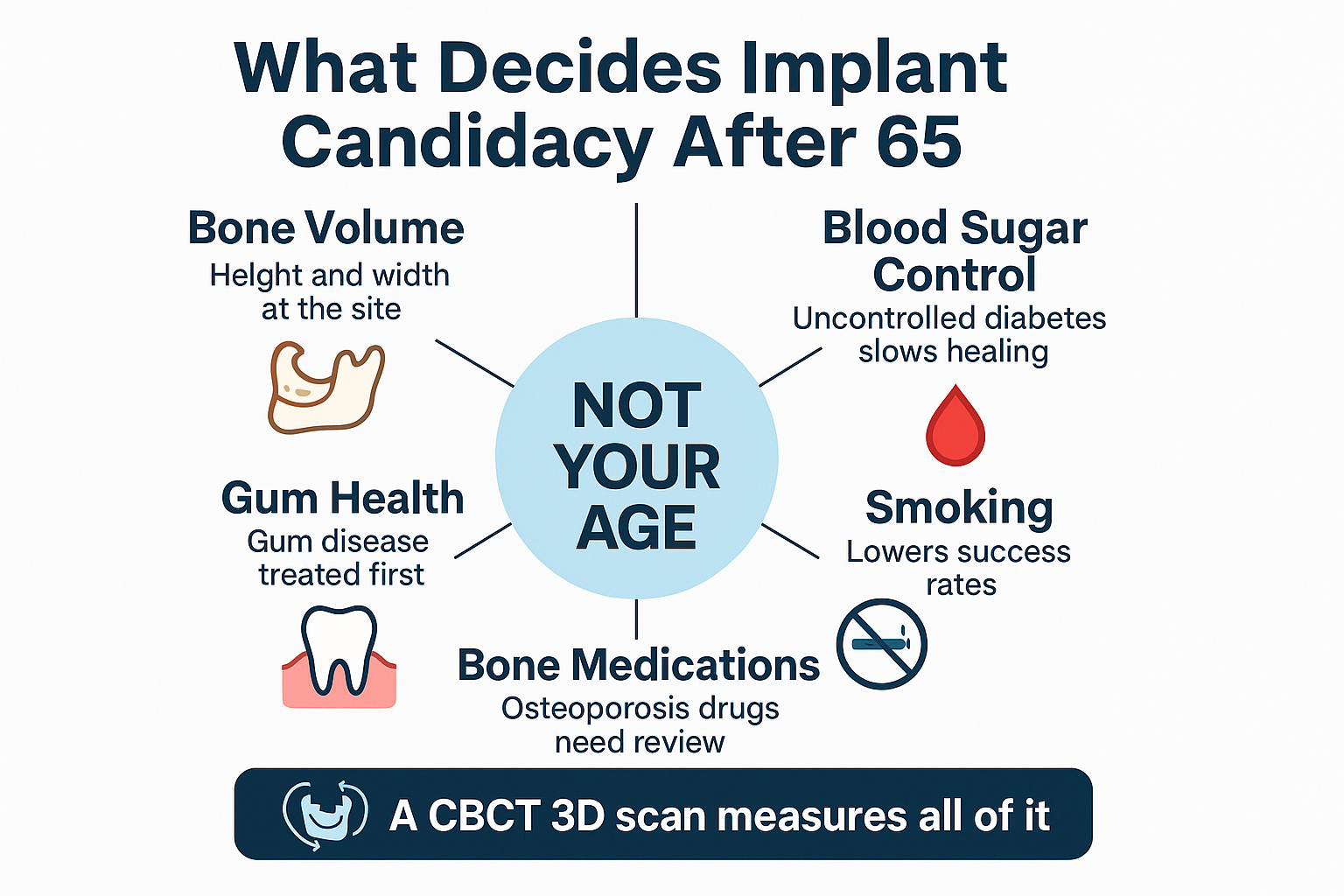
What I am really evaluating is a short list of things that affect whether a titanium post will fuse to your jaw and stay there:
- Bone volume and density at the exact site of the missing tooth
- Gum health, since active gum disease has to be treated first
- Uncontrolled diabetes, which slows healing and raises infection risk
- Smoking, which meaningfully lowers success rates
- Certain bone-strengthening medications taken for osteoporosis, which need a conversation with your physician before surgery
Notice that four of those five are things you can change or manage. A patient with well-controlled blood sugar at 74 is often a better candidate than a heavy smoker at 45.
The one that catches people off guard is bone. When a tooth comes out, the jawbone that held it starts shrinking within months. If a molar has been missing since the 1990s, there may be less bone left than expected, and that is a solvable problem more often than people assume.
The CBCT Scan Is What Turns a Guess Into a Measurement
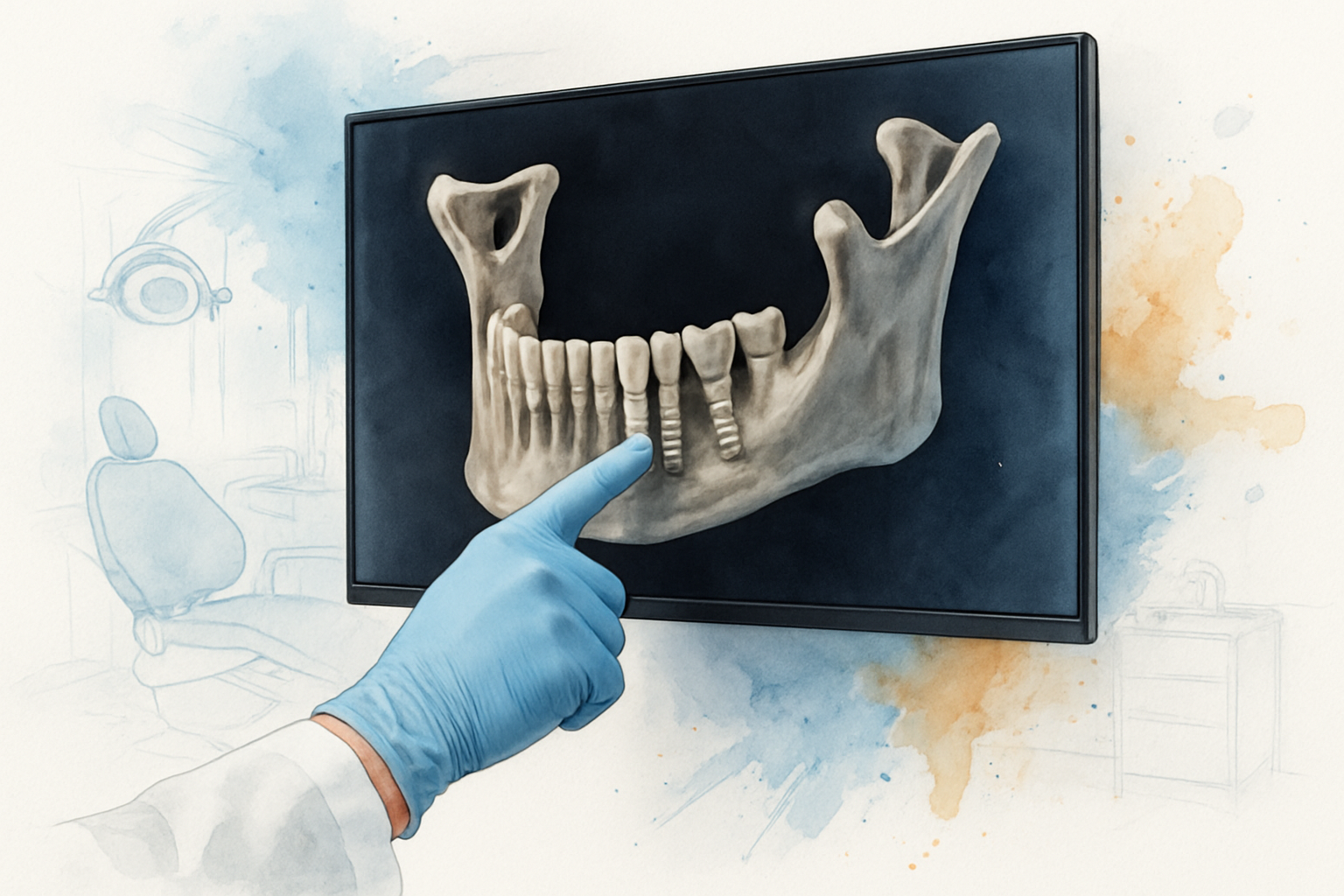
If someone tells you whether you are a candidate for implants without taking a 3D scan, that opinion is not worth much. A flat X-ray shows you a shadow. It cannot tell you how thick your bone is front to back.
A CBCT scan is a 3D image of your jaw that takes under a minute and lets me rotate your anatomy on screen and measure it. Here is what I am reading on it:
- Bone height above the nerve canal in the lower jaw, so the implant stays safely clear of it
- Bone width at the ridge, which decides whether the post fits or whether grafting comes first
- Sinus position in the upper jaw, since upper back molars sit close to the sinus floor
- Bone quality, meaning how dense and solid it looks versus soft and porous
- Hidden infection at old root tips or under existing crowns
This is also the scan that produces the honest answer nobody wants but everyone deserves. Sometimes it shows there is not enough bone yet, and the real plan starts with a graft or with ridge preservation at the time of extraction. Sometimes it shows plenty of bone and the case is simpler than expected.
Either way, you get a measurement instead of a shrug.
If You Have Worn Dentures for Years, Read This Part
A big share of the people asking me about dental implants for seniors are long-time denture wearers. The complaint is almost always the same. The lower denture rocks, adhesive stops holding by lunch, and steak is off the menu.
That is not your fault and it is not a bad denture. It is bone loss. Without tooth roots in the jaw, the ridge keeps flattening year after year, so a denture that fit beautifully in 2018 floats in 2026.
Implant-retained dentures solve that differently. Two or more posts are placed in the jaw, and the denture snaps onto them. It stays put without adhesive, and the posts stimulate the bone so the shrinking slows way down.
I want to be straight with you though. A well-made conventional denture costs less up front, requires no surgery, and is still the right call for plenty of people, especially someone managing several health conditions or who simply does not want a procedure. Both are legitimate choices, and I would rather you pick the one that fits your life than the one that sounds more advanced.
Conventional Denture vs Implant-Retained Denture
This is the comparison I sketch out on paper for patients almost every week. Neither column is the “right” answer for everyone.
| Factor | Conventional Denture | Implant-Retained Denture |
|---|---|---|
| Up-front cost | Lower | Higher, since it includes surgical placement |
| How it stays in | Suction and adhesive | Snaps onto implant posts |
| Bone loss over time | Continues, so refits are needed | Slows considerably at the implant sites |
| Chewing power | Limited with tougher foods | Much closer to natural teeth |
| Surgery required | None | Yes, with healing time between phases |
| Typical timeline | Weeks | Several months from start to finish |
What We Check Before Saying Yes to an Implant
Five factors carry far more weight than your age when we plan an implant case.
The Money Conversation Retirees Actually Need to Have
This is where most people get stuck, and I would rather explain it plainly than let you find out the hard way at the front desk.
First, coverage. Traditional Medicare does not include routine dental care, which surprises a lot of new retirees. You can read the specifics straight from Medicare’s own dental coverage page. Medicare Advantage plans often add a dental rider, but the riders vary widely and the annual maximums rarely stretch across a full implant case.
So most retirees I work with are planning around some mix of savings, a plan maximum, and financing. We use Cherry for financing, and we have an in-house savings plan for patients with no insurance at all.
Second, and this is the part almost nobody knows: an implant quote is built from separate pieces.
- The surgical placement of the post
- The abutment, the connector piece
- The crown that sits on top
- Sometimes extraction, grafting, or a CBCT scan on top of that
Costs vary quite a bit across Orange County depending on which of those pieces a case needs. That is exactly why two quotes can look nothing alike until you ask each office for the line-by-line breakdown. If you are comparing numbers, ask what is included before you assume one is higher. I wrote more about that in our breakdown of what dental implants actually cost in Orange County, and if financing is the sticking point, here are the options that exist beyond CareCredit.
How Long It Takes, Planned Around Real Life
Implants are not slow because we are dragging our feet. They are slow because bone needs time to fuse to titanium, and that biology does not negotiate.
A general shape of the timeline looks like this:
- Extraction and healing, if the tooth is still there, roughly a few weeks to a couple of months
- Implant placement, a single appointment
- Integration, commonly a few months while bone grows around the post
- Crown placement, which we can mill in office once you are ready
And nobody walks around with a visible gap in the meantime. There are interim options that keep your smile looking normal while the bone does its work.
This matters more for our patients than you would think. Between snowbird schedules, grandkids visiting over summer, and travel plans, timing is a real factor. A case started in the fall is usually finishing well after the holidays. If you have a wedding or a trip on the calendar, tell me at the consult and we plan backward from it. Our full walkthrough of the implant process timeline covers the phases in more detail.
About the Part You Are Really Nervous About
Many of the older patients I meet have years of avoidance behind them. Something hurt once, life got busy, and ten years went by. The number one worry they bring in is not the drill. It is being lectured about it.
That is not how we work. I would rather spend the visit figuring out where you are now than reviewing decisions you cannot undo.
The comfort setup exists for exactly this reason: blankets, neck pillows, and a TV in the room. Small things, but they change how a long appointment feels. One patient’s family put it this way in a review: “He made sure we were all comfortable with all our options before we committed to one.”
And if you are an adult child reading this for a parent, you are in good company. A lot of first calls about implants come from a son or daughter. If nerves are the main barrier, this piece on what to tell your dentist before you sit down is worth passing along.
One last practical note. Having the CBCT planning, any needed extraction, the implant, and the milled crown handled in one office on Brookhurst Street means fewer separate drives across Orange County, one set of records, and one team answering the phone when something feels off at 8pm.
Frequently Asked Questions About Dental Implants After 65
Is 80 too old for a dental implant?
No. There is no upper age limit. I evaluate bone, gums, and overall health, and plenty of patients in their eighties heal beautifully. Age by itself has never been the deciding factor.
I take medication for osteoporosis. Can I still get implants?
Possibly, but it needs a real conversation first. Some bone-strengthening medications, especially IV forms, affect how the jaw heals after surgery. Bring the exact drug name and how long you have taken it, and we may coordinate with your physician before making a plan.
Does Medicare pay for dental implants?
Traditional Medicare does not cover routine dental work, including implants. Some Medicare Advantage plans include a dental rider, but the annual cap usually covers only part of a case. Most retirees end up combining a plan maximum with savings or financing.
What if the scan shows I do not have enough bone?
That is common when a tooth has been missing for years, and it is usually not the end of the conversation. Bone grafting or ridge preservation can rebuild the site, which adds months to the timeline but often makes an implant possible.
Can I just get a consult to find out where I stand?
Yes, and I would rather you do that than guess. A visit with a 3D scan gives you an actual measurement and a written breakdown of what a case would involve. Our new patient exam with X-rays is $150, and we have a savings plan for patients without insurance.
Want to Know Where You Actually Stand?
If you have been assuming your age took implants off the table, a 3D scan will give you a real answer instead of a guess. Our team sees patients from Huntington Beach, Fountain Valley, and across Orange County, including Saturday mornings by appointment. You can reach us at (657) 800-5254 or book online at kalidental.com whenever you are ready to talk it through.